
Grant stood in the doorway.
Behind him stood Diane.
Neither of them looked surprised to find me holding the envelope.
That was the first thing I noticed.
The second was the expression on my husband's face.
He wasn't confused.
He wasn't embarrassed.
He was angry.
"Louisa," he said quietly. "What are you doing in here?"
I looked down at the envelope in my hand.
My mother's name was written across the back.
Carmen Ortega.
For several seconds, nobody moved.
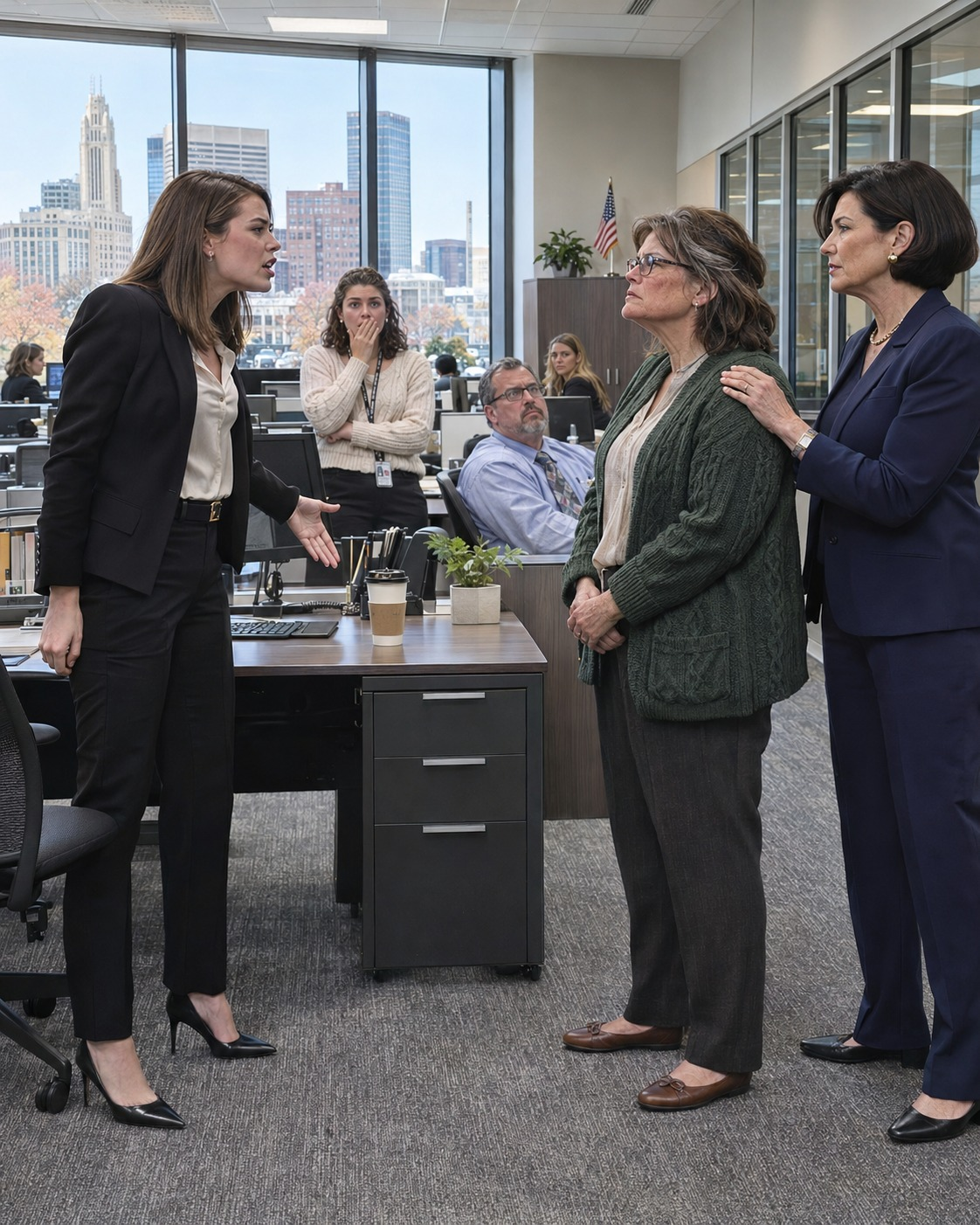
Then Diane stepped into the office and closed the door behind her.
"Put that down, Louise."
I hated when she called me that.
But I hated the way she looked at the envelope even more.
"Why does my mother's name appear on a letter addressed to you?"
Diane glanced at Grant.
It was quick.
Almost invisible.
But I saw it.
"That's an old family matter."
"How old?"
"Before you came into our lives."
I looked at my husband.
"Grant?"
He walked toward the desk.
"Give me the envelope."
"Why?"
"Because it's private."
I almost laughed.
"My mother's name is on it."
"That doesn't mean you have the right to open it."
I stared at him.
The words were so different from the man I thought I had married that I briefly wondered whether I had misunderstood him.
I had spent three years believing we could discuss anything.
Now he was standing between me and a letter that might explain something about my own childhood.
"Did you know my mother?"
Grant looked at Diane again.
She answered before he could.
"Your mother was involved in an unfortunate situation many years ago."
"What situation?"
"Nothing that concerns you."
I tightened my grip on the envelope.
"Then why keep a letter from her?"
Diane's expression hardened.
"Because some correspondence should be preserved."
"Why?"
"Because it contains information that could be damaging if taken out of context."
The room became very quiet.
I looked at the envelope again.
There was no return address.
No postage stamp.
Only a handwritten date from twenty-six years earlier.
I had been five years old.
"Was this written before she disappeared from my life?"
Neither of them answered.
I looked at Grant.
"Please tell me what this is."
He reached toward the envelope.
I stepped backward.
"Don't."
His hand stopped.
For the first time since we had married, I saw something unfamiliar in his expression.
Not anger exactly.
Fear.
He glanced toward Diane.
She gave him a small nod.
"Your wife is tired," she said. "She's been working too much. This isn't the time."
I turned toward her.
"Stop talking about me as if I'm not standing here."
Diane raised her eyebrows.
Grant immediately stepped between us.
"Mom, please."
It was the first time he had asked her to stop that evening.
But he still wasn't standing beside me.
He was standing between us.
And somehow, that felt worse.
I placed the envelope on the desk.
"Fine. I won't open it."
Grant exhaled.
"But I want an answer."
He looked at the floor.
Diane picked up the envelope and slipped it into her handbag.
"You don't need to concern yourself with this."
Then she walked out.
Grant remained in the doorway.
I waited.
I wanted him to explain.
I wanted him to tell me that the letter meant nothing, that Diane had exaggerated something, and that my mother had nothing to do with the Halloway family.
Instead, he said, "Please don't make assumptions."
"What assumptions?"
"That there's something going on."
I stared at him.
"Then tell me what happened."
He rubbed his forehead.
"I can't explain everything right now."
"Why not?"
"Because it's complicated."
I had heard that word too many times.
Complicated.
Private.
Family business.
Every time I asked a reasonable question, another word appeared to prevent an answer.
I walked past him.
"Good night, Grant."
He followed me into the hallway.
"Lou, wait."
I kept walking.
He reached for my hand.
I stopped.
"Do you know my mother?"
His fingers loosened.
"I know who she is."
That answer stayed with me.
Because there was a difference between knowing someone's name and knowing them.
And Grant had chosen his words carefully.
The following morning, Diane called before I finished breakfast.
I almost let it go to voicemail.
Then I remembered the envelope.
I answered.
"Hello?"
"Louise, darling."
Her voice sounded unusually pleasant.
"Good morning."
"I wanted to apologize for yesterday."
I sat down at the kitchen counter.
That was unexpected.
Diane rarely apologized.
"I shouldn't have spoken so sharply."
"Thank you."
There was a pause.
Then she continued.
"I understand that seeing your mother's name must have been upsetting."
I didn't respond.
"However, I want you to understand something. There are people who leave complicated histories behind them. Sometimes the kindest thing we can do is refuse to reopen old wounds."
I looked out the kitchen window.
"Did my mother contact you?"
Silence.
Only for a second.
But enough.
"I don't know what you mean."
"There's a letter with her name on it."
"Louise, I have explained that this is an old matter."
"Did she write to you?"
Diane sighed.
"Your husband has enough responsibilities without being dragged into something that happened before he even knew you."
I gripped the phone.
"My mother is not something."
"I didn't say she was."
"You keep talking about her like she's a problem."
Diane's voice cooled.
"Be careful, Louise. Curiosity can be expensive."
Then she ended the call.
I stared at my phone.
I had spent years trying to understand why my mother had disappeared.
I had wondered whether she had been sick, frightened, struggling with money, or simply unwilling to raise a child.
My aunt never gave me a complete answer.
Whenever I asked, she became quiet.
Eventually, I stopped asking because I thought the truth would hurt more than the uncertainty.
Now I was beginning to suspect that the uncertainty had been protecting someone else.
I called my aunt.
She answered on the third ring.
"Sweetheart?"
"Can I ask you something?"
"Of course."
"Did you ever hear of Diane Halloway?"
There was a pause.
I heard something being placed on a table.
"Why are you asking?"
"Because I found a letter with my mother's name on it in Diane's house."
My aunt didn't speak.
I closed my eyes.
"Please don't tell me you don't know anything."
"Where did you find it?"
"In Grant's office."
Another silence.
Then she said something I hadn't expected.
"You need to be careful about what you ask that woman."
My stomach tightened.
"You know her."
"I knew of her."
"That's not the same thing."
"No."
I waited.
My aunt took a slow breath.
"Louisa, there are things about your mother's past that I didn't want you carrying around."
"Why?"
"Because you were a little girl."
"I'm thirty-one now."
"I know."
"Then tell me."
She was quiet for so long that I thought the call had disconnected.
Finally, she said, "I need to find something first."
"What?"
"Some old papers."
"About Mom?"
"Yes."
My heart began beating faster.
"Why didn't you tell me before?"
"Because I promised someone I wouldn't."
"Who?"
My aunt didn't answer.
Instead, she said, "Don't confront Diane alone."
Then she ended the call.
That afternoon, I returned to the hospital.
I worked a twelve-hour shift.
I checked on patients, assisted with deliveries, reviewed medical charts, and comforted a young mother who was frightened about her newborn's breathing.
The work helped me focus.
But every time I had a quiet moment, I remembered the envelope.
Carmen Ortega.
Diane Halloway.
Twenty-six years.
I kept returning to the same question.
What could possibly connect them?
During my lunch break, I searched my mother's name online.
There were very few results.
An old business directory listed a Carmen Ortega associated with an automotive repair shop in Georgia.
A public record showed an address in the northern Atlanta area.
There was also an outdated newspaper reference to a court proceeding.
I recognized the wording.
It was the same kind of record Diane had read aloud during my engagement dinner.
I closed the browser.
I wasn't ready to turn my mother's entire life into an investigation.
I wanted to hear the truth from her.
Not from Diane.
Not from a folder.
Not from a stranger's interpretation of something that happened decades earlier.
That evening, Grant sent me a message.
Mom says you're upset.
I stared at the screen.
Then another message appeared.
Can we please have a normal evening?
I typed several responses.
Deleted them.
Finally, I wrote:
I want to know why my mother's letter was in your office.
He replied almost immediately.
There are things you don't understand.
I put the phone down.
That sentence was becoming the foundation of our marriage.
Grant came home after eight.
He brought takeout from my favorite restaurant and kissed my forehead.
For a few minutes, he acted as though nothing had happened.
He asked about work.
He asked whether I had eaten.
He told me Brooke was planning a family gathering.
I listened.
Then I asked him about the letter.
His smile disappeared.
"Lou."
"Just answer me."
He placed the food containers on the counter.
"Mom has some old documents from years ago."
"Why does one have Carmen's name?"
"Because they knew each other."
The room seemed to tilt slightly.
"What?"
He looked uncomfortable.
"I didn't want you to find out this way."
I stared at him.
"How long have you known?"
"Not long."
"Since before our wedding?"
He hesitated.
That hesitation answered more than his words could have.
I moved away from the counter.
"You knew my mother was connected to your family when you married me?"
"It's not like that."
"Then what is it like?"
He lowered his voice.
"Mom knew her years ago. There was an incident involving some paperwork and a business arrangement."
"What paperwork?"
"I don't know all the details."
"Grant."
"I'm telling you the truth."
"Then why did you let Diane read my mother's court record at our engagement dinner?"
His expression changed.
"I didn't know she was going to do that."
"But you knew there was history."
He looked away.
I felt something cold settle in my stomach.
"Did you ever think to tell me?"
"I didn't think it was relevant."
"She's my mother."
"I know."
"Do you?"
He stepped toward me.
"Lou, please. I love you."
I wanted those words to comfort me.
They didn't.
"Then why do I keep finding out that the people closest to you know things about my life that I don't?"
Grant ran a hand through his hair.
"Because Mom thinks she's protecting the family."
"What family?"
He didn't answer.
I looked at him carefully.
"Are you protecting her?"
"No."
"Then tell me what happened."
He opened his mouth.
His phone rang.
Diane.
He glanced at the screen.
I watched him.
He answered.
"Mom?"
I could hear her voice from across the kitchen.
She was speaking quickly.
Grant's expression tightened.
"Wait. What?"
He turned away from me.
"Did you check the date?"
Another pause.
Then he looked directly at me.
His face had gone pale.
"I understand."
He ended the call.
"What happened?" I asked.
"Nothing."
"Grant."
He put the phone into his pocket.
"Mom needs me at the estate."
"Why?"
"There's a problem with some old records."
I almost laughed.
"Of course there is."
He picked up his keys.
I moved toward the doorway.
"Are you going to tell me what is happening?"
He stopped.
For a moment, I thought he might finally answer.
Instead, he said, "Please trust me."
Then he left.
I didn't sleep much that night.
At two in the morning, I went downstairs and opened my laptop.
I searched for the Halloway family trust.
I found several public references to businesses associated with Grant's late father, but nothing that explained the documents.
I remembered Bill Cranston.
The banker Diane had mentioned when we announced the pregnancy.
I searched his name alongside the family trust.
An old professional directory appeared.
I didn't contact him.
I wasn't ready to involve a stranger.
But I began to understand why Diane had been so interested in our daughter's birth.
The trust had existed long before I met Grant.
And the arrival of a grandchild apparently changed something.
I opened a blank document and wrote down the questions I needed answered.
Why had Carmen written to Diane?
What had happened twenty-six years earlier?
Why had Diane kept the letter?
What did the family trust have to do with my daughter?
And why did Grant seem more frightened of his mother than he was concerned about the truth?
I stared at the list.
Then I remembered something.
The envelope hadn't been the only document in the drawer.
There had been another one.
The cream-colored envelope addressed to Grant.
The one from Bill Cranston.
I returned to the office the following morning while Grant was at work.
The drawer was locked.
I tried the handle twice.
Then I noticed a small brass key inside the decorative bowl beside the desk.
It fit.
Inside were several folders, bank statements, and old correspondence.
I didn't want to search through everything.
I was looking for one thing.
The envelope from Bill Cranston.
I found it beneath a stack of papers.
My name appeared on the first page.
Louisa Ortega Halloway.
I read the heading twice.
It was a formal letter concerning the Halloway family trust and the future addition of a beneficiary.
Our daughter.
But beneath the administrative language was a paragraph that made my hands go cold.
It referred to an unresolved historical matter involving a previous communication from Carmen Ortega.
I read it again.
Then I noticed a handwritten note attached to the final page.
The handwriting was Diane's.
Do not disclose the previous agreement to Louisa before the child's registration.
I felt my throat tighten.
Previous agreement?
What agreement?
I turned the page.
There was a reference number.
A date.
And another name.
Carmen Ortega.
I reached for my phone and photographed the document.
Then I heard a car door outside.
Grant was home.
I quickly returned the papers to their original positions and locked the drawer.
Footsteps approached the office.
I stepped away from the desk.
Grant entered.
He looked at me.
Then at the drawer.
"Have you been going through my things?"
I didn't answer immediately.
Instead, I asked the question that had been burning inside me.
"What agreement did your mother make with mine?"
His face changed.
Not gradually.
Immediately.
He closed the office door.
"Louisa, listen to me."
I held up my phone.
"I read the letter."
He looked at the screen.
Then he whispered, "You weren't supposed to see that."
"Why?"
He stepped closer.
"Because Mom said she'd explain everything after the baby was born."
"Explain what?"
He swallowed.
For the first time, my husband looked like a man who had just realized he could no longer keep a secret.
Then he said something that made my blood run cold.
"Your mother didn't disappear from your life because she wanted to."
I couldn't breathe.
"What does that mean?"
Grant glanced toward the closed office door.
And before he could say another word, Diane's voice came from the hallway.
"Grant, don't you dare tell her what happened to that money."





Comments 0