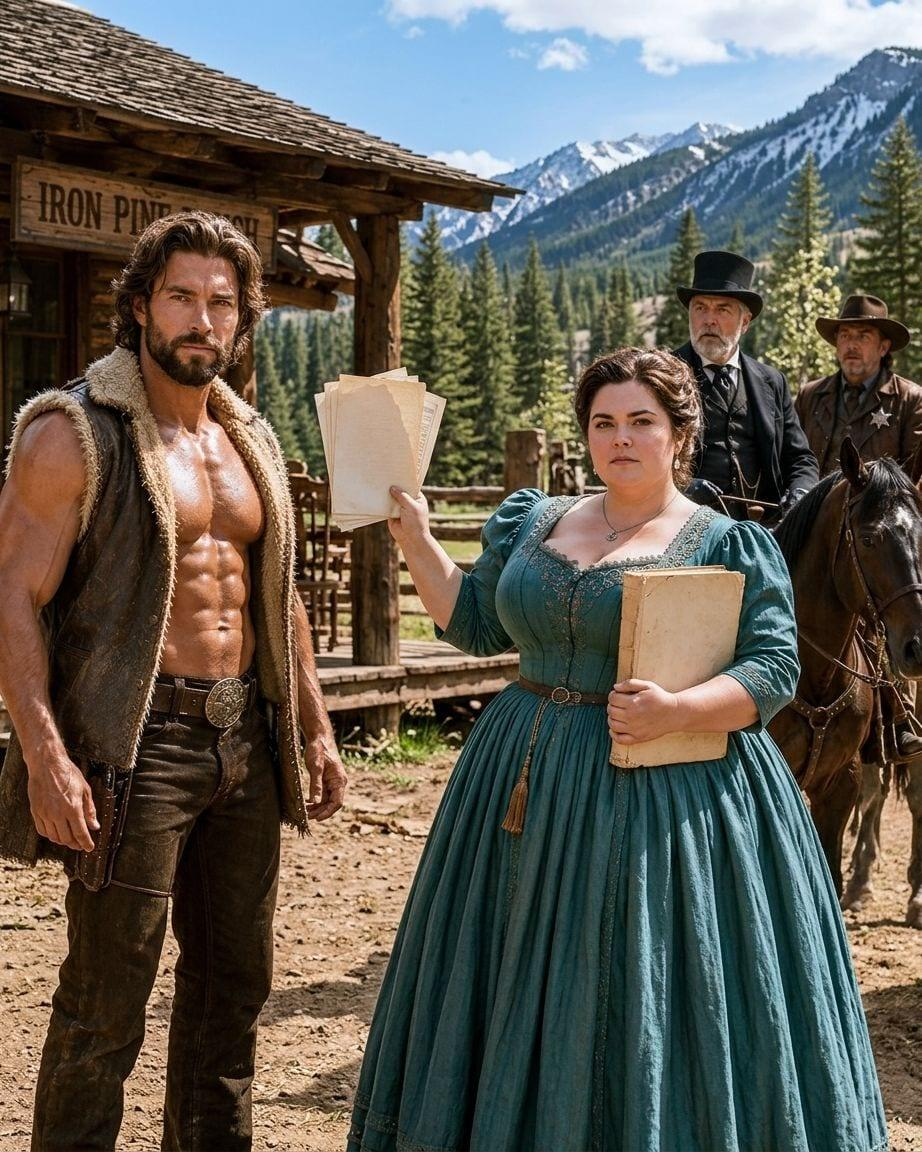
"Tell me why that man knows my name!"
Matilda Higgins stood beside the cabin door, her hands trembling despite her effort to remain calm.
Outside, a horse stamped against the frozen ground.
Ethan Boone held his Winchester rifle across his chest.
"Get away from the door, Matilda."
"But he called me—"
"I heard him."
The stranger laughed again.
"Come on, Boone! Don't tell me your new bride never mentioned Mr. Arthur Whitcomb!"
Matilda went pale.
Arthur Whitcomb.
For ten years, that name had followed her through the corridors of the Chicago textile mill like a bad smell.
He had been the mill's chief financial officer.
A man who wore expensive waistcoats, spoke politely to wealthy investors, and treated ordinary employees as though they were furniture.
He had also been the man who signed her dismissal papers.
Ethan noticed her expression.
"You know him?"
Matilda swallowed.
"Yes."
"Who is he?"
"My former employer."
Outside, the stranger gave another ugly laugh.
"That's right! Seems the lady's got quite a history!"
Ethan stepped toward the door.
"State your business, Wyatt."
The laughter stopped.
"You recognize my voice?"
"I'd recognize a rattlesnake if it learned to talk."
Wyatt chuckled.
"Always had a way with words, Boone."
Ethan raised the rifle slightly.
"You've delivered your paper. Now get off my property."
"Mr. Caldwell thought you might appreciate knowing what kind of woman you've brought into your house."
Matilda felt her stomach tighten.
She had endured insults about her weight since childhood.
She could survive another.
But the mention of Whitcomb frightened her in a different way.
There were things about her final weeks at the textile mill she had never fully understood.
And now a stranger in Montana knew about them.
"What does Caldwell want?" Ethan demanded.
"Same thing he's always wanted. Your land. Your water. Your signature."
"He's not getting any of them."
"Then the bank will take them."
Wyatt's horse shifted.
Leather creaked.
"Thirty days, Boone. That's what the paper says."
Ethan glanced at the foreclosure notice lying on the table.
"Tell Caldwell I'll see him in hell."
Wyatt laughed.
"Probably sooner than you think."
The hoofbeats began moving away.
Then Wyatt called one final time.
"And tell Miss Higgins that Mr. Whitcomb sends his regards!"
The horses disappeared into the darkness.
For several seconds, neither Ethan nor Matilda moved.
The fire crackled.
Wind pressed against the cabin walls.
Finally, Ethan lowered his rifle.
"Who is Whitcomb?"
Matilda looked toward the floor.
"A man I hoped never to hear about again."
"That doesn't answer my question."
"He managed the finances at the mill where I worked."
"And?"
"And he dismissed me."
Ethan studied her.
"Why?"
Matilda's face tightened.
"Officially, because the company was reducing expenses."
"Unofficially?"
She hesitated.
"I questioned some entries in the payroll accounts."
Ethan waited.
"Several workers had deductions taken from their wages that didn't appear in the company records. When I asked about them, Mr. Whitcomb told me I was exceeding my authority."
"What happened?"
"I asked again."
Despite everything, Ethan almost smiled.
"That sounds familiar."
Matilda looked at him.
"He dismissed me the following morning."
Ethan's expression hardened.
"And now Caldwell's foreman knows his name."
"Yes."
"That means somebody's been asking questions about you."
Matilda wrapped her arms around herself.
The cabin suddenly felt colder.
"Why would anyone care about a dismissed bookkeeper?"
Ethan looked at the foreclosure notice.
"Because Caldwell doesn't leave anything to chance."
He placed the rifle beside the door.
Then he took the paper from the table and examined it beneath the lantern.
Thirty days.
That was all the time he had left.
Thirty days to produce more money than the ranch could possibly earn before spring.
Thirty days before the bank could seize his cattle, buildings, grazing land, and the water rights that made Iron Pine valuable.
He had spent two years trying to outlast Josiah Caldwell.
Now the end had a date.
Matilda watched him.
"How much do you owe?"
Ethan folded the notice.
"More than I can pay."
"How much?"
"Miss Higgins—"
"Matilda."
He looked up.
"My name is Matilda."
He sighed.
"Four thousand eight hundred dollars."
She stared.
"That is a considerable sum."
"Thank you. I hadn't noticed."
She ignored his sarcasm.
"Is that the original loan?"
"No."
"What was the original amount?"
"Three thousand."
Matilda frowned.
"And the additional eighteen hundred?"
"Interest. Fees. Penalties. Whatever else the bank decided I owed."
"Over what period?"
"Two years."
Her eyes narrowed.
"That seems excessive."
Ethan gave a bitter laugh.
"Tell that to the bank."
"I would like to see the agreement."
He looked at her as though she had suggested taking a stroll through a blizzard.
"Why?"
"Because I understand financial agreements."
"And I understand cattle. Neither of us can change the weather."
"Weather doesn't write contracts, Mr. Boone."
He opened his mouth.
Then closed it.
Matilda held out her hand.
"May I see the notice?"
For a moment, Ethan considered refusing.
He had spent years protecting his pride.
He had hidden his financial troubles from neighbors, suppliers, and even the few friends who still visited.
Now a woman who had arrived only hours earlier wanted to inspect the evidence of his failure.
But she was looking at the paper, not at him.
There was no pity in her expression.
Only concentration.
He handed it over.
Matilda carried the notice to the desk.
She adjusted the lantern, unfolded the paper, and began reading.
Ethan watched her eyes move down the page.
Something about her changed.
The nervous woman from the railway station seemed to disappear.
Her shoulders straightened.
Her breathing steadied.
Her fingers moved carefully along the printed lines.
She was no longer an unwanted bride trying to survive an awkward evening.
She was a professional examining a problem.
"Who is Samuel Pritchard?" she asked.
"The bank manager."
"Has he always managed your account?"
"No. He arrived last spring."
"And before that?"
"Mr. Bellamy. Decent man. Retired after his wife died."
Matilda nodded.
"Did the loan terms change when Mr. Pritchard took over?"
Ethan frowned.
"I don't know."
"You didn't receive a revised agreement?"
"I received plenty of letters."
"Did you sign anything?"
"Not that I remember."
She looked up.
"That's important."
"Why?"
"Because the bank cannot simply invent new terms whenever it pleases."
Ethan shook his head.
"You don't understand how things work out here."
"Then explain them."
He stared at her.
She waited.
Finally, he pulled out a chair.
"All right."
He sat opposite her.
"Caldwell owns more cattle than anyone in this part of the territory. He controls shipping contracts, feed suppliers, and half the men who sit on local business boards."
"Does he own the bank?"
"Not officially."
"But he influences it."
Ethan nodded.
"He wants my water rights."
"Why?"
"Because the lower creek runs through my property. Without it, his eastern grazing lands are worthless during dry summers."
Matilda considered this.
"So your land is more valuable to him than to you."
"That's one way of putting it."
"And if the bank forecloses?"
"They'll auction the ranch."
"Caldwell will buy it."
"Probably for pennies on the dollar."
Matilda looked down at the document.
"Then this isn't simply about collecting a debt."
Ethan leaned back.
"No, ma'am. It never was."
For the first time that evening, he saw genuine anger cross her face.
Not the embarrassed hurt he had witnessed at the station.
Something sharper.
Something colder.
She had seen powerful men use paperwork to destroy vulnerable people before.
In Chicago, it had been mill workers.
Here, it was a rancher.
Different buildings.
Different clothes.
The same cruelty.
"How much money did you send the marriage agency?" she asked suddenly.
Ethan blinked.
"What?"
"The agency. What did you pay?"
"Fifty dollars."
Matilda lowered her gaze.
Fifty dollars.
She knew exactly what that amount represented.
At the textile mill, she had earned eleven dollars a week during her best years.
Fifty dollars had been more than a month's wages.
For a struggling rancher, it might have meant winter feed or repairs to a leaking roof.
Yet Ethan had spent it seeking a wife.
Not romance.
Help.
Hope.
And someone had turned that hope into a weapon.
"Why did you request a bride?" she asked quietly.
Ethan looked toward the fireplace.
"My father built this ranch."
Matilda waited.
"He came west with two horses, a rifle, and enough money to buy a broken wagon. Worked this land until his hands couldn't close around a hammer."
"What happened to him?"
"Died six winters ago."
"I'm sorry."
Ethan shrugged.
"He knew it was coming."
"And your mother?"
"Buried beside him."
Matilda looked toward the window.
Somewhere beyond the darkness lay two graves belonging to people who had once believed in this place.
"I promised him I'd keep the ranch," Ethan said.
His voice had changed.
It was quieter now.
Less defensive.
"When the cattle market fell, I borrowed money. When the first winter killed part of the herd, I borrowed more. Then Caldwell started buying the surrounding land."
He rubbed his hands together.
"Every year I worked harder. Every year I fell further behind."
Matilda said nothing.
"I figured a wife who knew ranch work might give me a fighting chance."
He looked at her.
"And then you stepped off that train."
The words hurt.
Ethan saw it immediately.
"Matilda, I didn't mean—"
"Yes, you did."
He fell silent.
She folded the foreclosure notice carefully.
"But I understand why."
Ethan watched her return the paper.
He had expected tears.
Perhaps anger.
Instead, she looked tired.
More tired than a woman should look on the first night of what was supposed to be her new life.
"Did you know what the agency promised me?" she asked.
He shook his head.
"A respectable rancher seeking a wife of good character. A man who valued loyalty, intelligence, and companionship."
Ethan looked away.
"Sounds like somebody wrote a fine advertisement."
"They also said you had a prosperous property and sufficient means to support a household."
He gave a humorless laugh.
"Prosperous."
Matilda nodded.
"I see now that both of us were deceived."
The realization settled between them.
Two strangers.
Two different hopes.
One carefully arranged betrayal.
Ethan stood.
"There's something I need to show you."
He crossed to a small shelf and retrieved the original advertisement he had sent to the agency.
The paper was worn along its folds.
Matilda read it.
A hardworking rancher seeking a strong, experienced farm woman capable of assisting with livestock, household duties, and difficult frontier conditions.
She read the description twice.
Then handed it back.
"I see."
Ethan noticed her expression.
"You have every right to be angry."
"At you?"
"Yes."
Matilda shook her head.
"Not for asking for what you needed."
She paused.
"But someone deliberately made certain you wouldn't receive it."
Ethan looked toward the door.
"Caldwell."
"Perhaps."
"There's no perhaps about it."
Matilda picked up the agency confirmation.
"Then why would he leave his seal on the letter?"
Ethan frowned.
"What?"
"If he intended to conceal his involvement, why mark the document?"
Ethan had no answer.
She examined the embossed corner.
"It could have been carelessness. Or arrogance."
"Knowing Caldwell, I'd wager on arrogance."
"Or he wanted you to know."
Ethan's expression changed.
Matilda continued.
"He wanted you to recognize his involvement. To feel humiliated. To believe he could control even your private decisions."
Ethan slowly sat down again.
He had spent two years imagining Caldwell as a man who wanted land.
Matilda was describing a man who wanted surrender.
And suddenly, that seemed far closer to the truth.
"How did you learn to think like that?" he asked.
Matilda gave a small smile.
"Ten years of balancing accounts for men who believed women couldn't count."
For the first time, Ethan laughed.
It was brief.
Rough.
Almost surprised.
But it was real.
Matilda smiled in return.
Then the moment passed.
Ethan rose and began preparing their supper.
There was little to offer.
A pot of beans, salted pork, and a hard piece of bread.
He looked embarrassed as he placed the food on the table.
"It's not much."
"I've eaten worse."
"At the mill?"
"At the boardinghouse."
He gave her the larger portion.
She noticed.
So did he.
Neither mentioned it.
They ate quietly.
Outside, the wind scraped branches against the roof.
Inside, the lantern burned low.
After supper, Ethan showed Matilda where to find extra blankets, water, and the small supply of firewood stacked beside the hearth.
He apologized for the cold.
She thanked him for the bed.
Then he settled onto his bedroll.
Within minutes, exhaustion overcame him.
Matilda remained awake.
She sat on the edge of the narrow mattress, listening to the fire.
Her thoughts returned to Arthur Whitcomb.
The payroll discrepancies.
The sudden dismissal.
The agency advertisement.
Caldwell's seal.
And Wyatt's deliberate mention of a man who should have had no connection to Montana.
She rose quietly.
Her trunk stood beside the bed.
She opened it and removed a small packet wrapped in faded blue cloth.
Inside were the final pages she had copied from the mill's accounts before leaving Chicago.
She had kept them because something about the figures had troubled her.
She had never imagined they might matter again.
Matilda unfolded the first sheet.
Several company names appeared in neat columns.
Railroad suppliers.
Cotton merchants.
Shipping contractors.
One name caught her attention.
Caldwell Western Holdings.
She stopped breathing for a moment.
Then she unfolded the second page.
A payment had been recorded six months earlier.
Five hundred dollars.
The recipient was listed only as Western Matrimonial Services.
Matilda stared at the entry.
The amount was ten times what Ethan had paid for his bride.
She turned to the final page.
There was another payment.
This one had been approved by Arthur Whitcomb himself.
The description consisted of four words.
Special placement. Montana account.
Matilda slowly looked toward Ethan.
He was asleep beside the fire.
She glanced back at the document.
Her own departure from Chicago had not been a fortunate accident.
Someone had arranged it.
Someone had paid for it.
And whoever had done so had been willing to spend a considerable sum.
Her fingers trembled as she examined the final line.
There was a reference number beside the payment.
She had seen that number before.
But where?
Matilda searched through the papers, her heart beating faster.
She found the agency confirmation and held it beside the copied account.
The numbers matched.
Exactly.
She pressed one hand against her mouth.
The agency had not simply selected her from a list.
Someone had requested her personally.
But why?
She looked at the account again.
Then she noticed something she had missed.
Beneath the payment reference was a handwritten instruction.
Recipient must not be informed of sponsor.
Matilda stared at the words.
She thought of Whitcomb's cold smile on the morning he dismissed her.
She remembered how quickly the matrimonial agency had responded to her application.
She remembered the unusually generous offer of assistance with her railway ticket.
And she remembered the agent insisting that she leave Chicago before the end of the month.
A terrible suspicion began forming.
Perhaps Caldwell had not merely chosen a woman he believed incapable of surviving ranch life.
Perhaps he had chosen Matilda because someone in Chicago had told him exactly how to find her.
She turned the paper over.
A faint impression showed through from the other side.
She held it closer to the lantern.
There was another handwritten note, almost completely hidden beneath an old fold.
Matilda carefully flattened the page.
The first words became visible.
Regarding Miss Higgins and the missing—
A sharp knock sounded at the cabin door.
Matilda froze.
Ethan stirred beside the fireplace.
Another knock followed.
Three slow blows against the wood.
Ethan opened his eyes.
"Who's there?"
No answer.
He reached for his rifle.
Matilda stood motionless, the paper still in her hand.
Then a woman's voice came from outside.
"Matilda Higgins?"
Matilda felt the blood drain from her face.
The voice was familiar.
Impossible.
She had heard it every morning for ten years in Chicago.
Ethan moved toward the door.
"Who are you?"
The woman outside spoke again.
"Matilda, don't let him open that door."
Ethan stopped.
The latch began to turn.
And from the other side, someone whispered, "Arthur Whitcomb sent me."






Comments 0