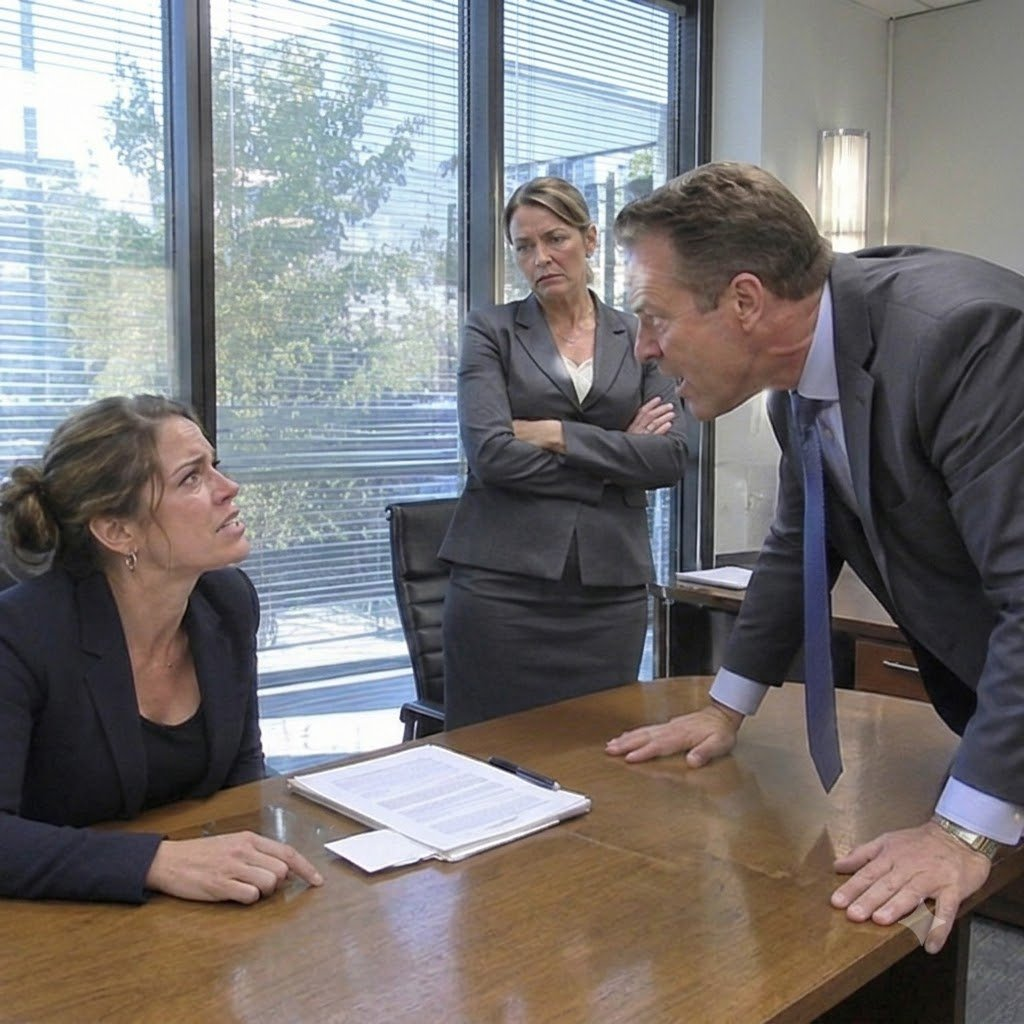
The woman standing outside the conference room was Rebecca Shaw.
Derek looked as though someone had just pulled the floor out from beneath him.
She wore a dark blue pantsuit, carried a leather portfolio, and had the expression of someone who had already heard enough excuses.
Behind her stood a tall man in a gray suit holding a sealed envelope.
I didn't recognize him.
Margaret did.
"Mr. Bennett," she whispered.
The man acknowledged her with a brief nod.
"Good morning."
Nobody returned the greeting.
Rebecca stepped inside and disconnected her phone from the live call.
"Sarah, please remain seated."
Derek immediately moved toward the door.
"I have another meeting."
"It has been canceled," Rebecca replied.
"By whom?"
"The board."
He stopped walking.
For the first time since entering that conference room, I felt that somebody understood the seriousness of what was happening.
Rebecca placed her portfolio on the table.
The man beside her introduced himself as Thomas Bennett, outside legal counsel representing the board of directors.
He looked at the unsigned confession.
Then he looked at Margaret.
"Who prepared this document?"
Margaret hesitated.
"Our department worked with executive management."
"Which executives?"
She glanced at Derek.
He looked away.
Thomas pulled out a chair.
"I think we should begin with the five disputed transactions."
Those words took me back four days.
Back to the moment when my entire life began falling apart.
It had started with an ordinary Thursday morning.
I arrived at Westbridge Equipment at seven fifteen, carrying a cup of coffee and a blueberry muffin I intended to eat before my first customer call.
Our company supplied heavy industrial equipment to construction firms, manufacturing plants, and infrastructure contractors across the country.
We sold machines that cost more than most houses.
Some cost more than entire apartment buildings.
Every transaction involved contracts, financing arrangements, inspections, delivery schedules, and customer acceptance documents.
Nothing happened quickly.
That was why I immediately noticed something unusual when I opened the quarterly sales dashboard.
Five orders had been marked as completed overnight.
Together, they represented $11.8 million.
I recognized every customer.
Three belonged to my regional accounts.
Two belonged to colleagues I had trained.
None of those orders should have been completed.
I clicked on the first transaction.
A manufacturing company in Oklahoma had purchased an industrial processing system worth $2.4 million.
The customer was still waiting for an electrical inspection at its new facility.
The second order involved specialized construction equipment destined for Louisiana.
Delivery had been postponed because the customer's financing approval was incomplete.
The remaining three orders had similar problems.
Yet every transaction displayed the same status.
Delivered. Accepted. Revenue recognized.
I opened the supporting documents.
There were no signed customer acceptance forms.
No delivery confirmations.
No completed inspection reports.
Someone had overridden the normal requirements.
I called Miguel Alvarez, our warehouse operations supervisor.
"Miguel, did those five machines ship last night?"
He laughed.
"Sarah, those things aren't bicycles. We'd need half the loading crew and several specialized trucks."
"So they're still there?"
"Every one of them."
"Are you certain?"
"Come downstairs. I'll show you."
I grabbed my employee badge and headed toward the warehouse.
The building smelled of machine oil, metal, and cardboard packaging.
Forklifts moved between enormous storage areas while workers prepared equipment for scheduled shipments.
Miguel stood beside a yellow safety barrier holding a clipboard.
He was fifty-six, had worked at Westbridge for nineteen years, and knew the warehouse better than anyone.
He pointed toward the first machine.
"There's your Oklahoma order."
We walked farther down the aisle.
"And there's Louisiana."
One by one, he showed me all five machines.
They were exactly where they had been the previous afternoon.
Two were still partially wrapped in protective packaging.
Another had a maintenance technician inspecting its control panel.
I photographed the equipment identification labels using my company-issued phone.
Then Miguel showed me the warehouse inventory records.
Every serial number matched.
Every machine was physically present.
None had been released for shipment.
"This makes no sense," I said.
Miguel lowered his clipboard.
"What doesn't?"
"Someone marked these orders as delivered."
His expression changed.
"That's impossible."
"I thought so, too."
He glanced toward the warehouse office.
Then he spoke more quietly.
"Someone called me yesterday asking whether I could prepare delivery confirmations before the trucks arrived."
I turned toward him.
"Who?"
He hesitated.
"Derek Sloan."
My stomach tightened.
"What did you tell him?"
"That I don't sign documents for shipments that haven't happened."
"How did he react?"
Miguel gave a humorless smile.
"He told me I wasn't being a team player."
I knew that phrase.
Derek used it whenever someone refused to do something questionable.
During his first six weeks, he had introduced aggressive sales targets, shortened reporting deadlines, and repeatedly criticized employees who insisted on following established procedures.
He called it eliminating unnecessary bureaucracy.
I called it dangerous.
"Did you document that conversation?" I asked.
Miguel shook his head.
"It was a phone call."
"Write down everything you remember. Include the date and approximate time."
He studied my face.
"Are we in trouble?"
"I don't know."
That was the truth.
At that point, I still believed the situation could be corrected before it became something worse.
I returned upstairs and emailed Derek.
I explained that five transactions appeared to have been prematurely recognized as revenue.
I included the order numbers, warehouse confirmation, and missing customer acceptance documents.
I expected him to investigate.
Instead, he appeared beside my desk eleven minutes later.
"Conference room. Now."
He didn't wait for an answer.
Several coworkers looked up as I followed him.
Inside the smaller meeting room, Derek closed the door.
"What exactly are you doing?"
"Reviewing the quarterly dashboard."
"Those transactions have been approved."
"By whom?"
"Executive management."
"The equipment hasn't shipped."
"That's a logistical detail."
"It's an accounting requirement."
He stared at me.
"You're in sales, Sarah. Not accounting."
"And I'm responsible for certifying my regional transactions."
He walked toward the window.
"The customers have committed to purchasing the equipment."
"Two haven't secured financing."
"They will."
"That doesn't make the revenue recognizable today."
He turned around.
"Do you understand how important this quarter is?"
I understood perfectly.
Westbridge was negotiating an expansion of its credit facilities with several major lenders.
The board had also been discussing a possible acquisition.
Strong quarterly results could significantly influence the company's valuation.
But that made accurate reporting more important, not less.
Derek placed a printed certification form in front of me.
"I need your approval before ten thirty."
I read the document.
It required me to confirm that all transactions met the company's revenue recognition requirements.
"I can't sign this."
His expression hardened.
"You're refusing a direct instruction?"
"I'm refusing to certify inaccurate information."
He stepped closer.
"Do you know how many people would love to have your position?"
"Probably quite a few."
"Then don't make me reconsider whether you deserve it."
For a moment, I wondered whether I had misunderstood him.
Eight years at Westbridge.
Six consecutive years of record-breaking performance.
Hundreds of successful customer relationships.
And this man was threatening my position because I wouldn't lie.
I pushed the certification form back toward him.
"Correct the transactions, and I'll approve the report."
He stared at the paper.
Then he opened the door.
"Get out."
I returned to my desk with trembling hands.
My coffee had gone cold.
The blueberry muffin remained untouched.
I opened the company's compliance portal and submitted a formal report.
I attached the relevant order numbers, photographs, inventory records, and my earlier email to Derek.
The system generated a confirmation number.
WB-40719.
I wrote it down in my notebook.
Something told me I might need it.
At eleven forty-three, my computer screen froze.
I tried reopening the sales dashboard.
Access denied.
I attempted to log into my email.
Account disabled.
My desk phone rang.
It was someone from information technology.
"Sarah, we've been instructed to suspend your system privileges pending an administrative review."
"Who authorized that?"
"I'm not permitted to disclose that information."
"Can you confirm the exact time my access was disabled?"
He paused.
"Eleven forty-two."
I wrote that down, too.
At noon, Derek sent a message to the sales department instructing everyone to redirect my customer inquiries to him.
Nobody knew what had happened.
By one o'clock, people had stopped approaching my desk.
Some avoided looking at me.
Others whispered behind closed doors.
Eight years of professional credibility seemed to evaporate in a single afternoon.
My closest colleague, Natalie Brooks, finally approached me near the break room.
"Sarah, what's going on?"
"I reported some inaccurate transactions."
Her eyes widened.
"Those five orders?"
I looked at her.
"You knew?"
She immediately glanced around.
"Not here."
We stepped into an empty stairwell.
Natalie lowered her voice.
"Derek told us this morning that the quarter was already finalized. He said you were creating problems because you didn't agree with the new commission structure."
"What commission structure?"
She shook her head.
"I don't know. That's what he said."
I felt sick.
He wasn't merely trying to force me to approve the transactions.
He was already creating an explanation for my objections.
One that made me appear selfish.
Uncooperative.
Dishonest.
"Be careful," Natalie whispered.
"Why?"
"He's been meeting with Evelyn almost every evening this week."
Evelyn Price.
Our chief financial officer.
The woman who had promoted me twice.
The woman who had sent flowers when my father died.
I couldn't imagine her approving false revenue.
Perhaps Derek was misleading her, too.
At least, that was what I wanted to believe.
That evening, I called Rebecca Shaw from my car.
She listened without interrupting.
When I finished, she asked for the compliance report confirmation number.
I gave it to her.
There was a long silence.
"Sarah, are you certain that's the number?"
"Absolutely."
"Do you have a copy of the submission confirmation?"
"I wrote it down."
"Keep that notebook somewhere safe."
Her tone frightened me.
"Rebecca, what's happening?"
"I need to verify something before I answer that."
She instructed me not to access company systems without authorization and not to remove confidential records from the premises.
Then she asked me to notify her immediately if management scheduled a disciplinary meeting.
On Monday morning, I did exactly that.
Now Rebecca was sitting across from Derek in the conference room.
Thomas Bennett opened his leather briefcase.
I finished explaining what I had discovered in the warehouse.
Margaret looked increasingly uncomfortable.
Derek remained standing.
"That's her version of events," he said.
Rebecca nodded.
"Fortunately, we have more than her version."
She removed several documents from her portfolio.
The first contained warehouse inventory records.
The second contained the original transaction histories.
The third was a report from the company's information security department.
Derek folded his arms.
"Those records will confirm that Sarah approved the entries."
Rebecca looked directly at him.
"They confirm something considerably more interesting."
Thomas slid the report toward me.
I recognized my employee identification number immediately.
Beside it were five transaction approvals.
All five had supposedly been authorized by my account.
For one terrible moment, I understood why someone unfamiliar with the situation might believe I was guilty.
Then I noticed the timestamp.
Thursday.
12:17 p.m.
Thirty-five minutes after my account had been disabled.
I looked at Rebecca.
"That's impossible."
"Exactly," she replied.
Derek stepped forward.
"There must have been a system delay."
Rebecca ignored him.
She turned to the final page.
"Our investigators recovered the original authentication records. We know which device submitted those approvals."
Margaret slowly removed her glasses.
Thomas opened the sealed envelope.
Inside was another document.
Rebecca placed her finger beneath a single line.
Derek suddenly reached across the table.
"Don't show her that."
Thomas moved the document out of his reach.
I leaned forward.
There was my name.
There was my employee number.
And directly beneath them was the identity of the person who had been using both.
Rebecca turned the page toward me.
"Sarah, you're about to discover who stole your identity."






Comments 0