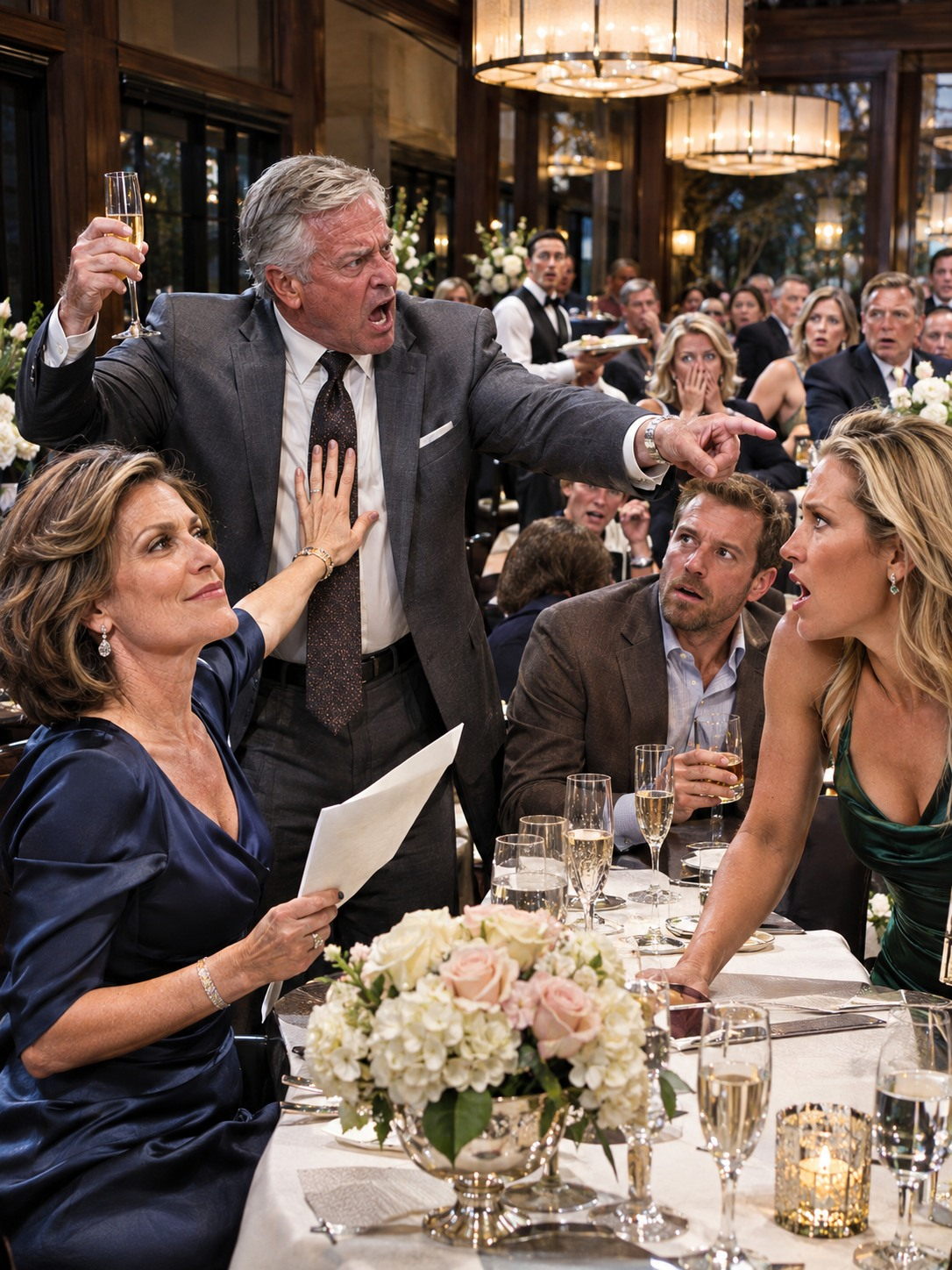
Caroline turned the final page toward the room.
The name written beneath my signature belonged to Daniel Price.
For several seconds, nobody moved.
Daniel stood near the doorway, his face pale. He had attended our wedding forty years earlier. He had celebrated Jason's graduation, joined us for Christmas dinners, and once spent an entire weekend helping Robert repair the deck behind our house.
He had been one of the people I trusted most.
And he had witnessed a document claiming I had authorized a financial transaction involving property I had never agreed to share.
Robert stared at him.
"Daniel, what are you doing here?"
Daniel didn't answer immediately.
Caroline placed another document beside the authorization.
"This is a copy of the original witness statement provided by Mr. Price. He has agreed to cooperate with the investigation and explain how this document was presented to him."
Richard Vance stepped forward.
"This gathering is completely inappropriate. These allegations belong in court."
Caroline looked at him.
"Agreed. And the relevant evidence has already been submitted to the appropriate authorities."
Robert turned toward Daniel.
"You told me you would keep this private."
Daniel finally spoke.
"I kept it private for four years, Robert. That was my mistake."
Robert's jaw tightened.
"You signed the document."
"I signed as a witness to a conversation, not to Julia's consent. You told me she had authorized the arrangement. I believed you."
"Then you have nothing to worry about."
Daniel shook his head.
"I also have the emails you sent me afterward."
Robert went completely silent.
Caroline explained that Daniel had preserved the original correspondence, including messages in which Robert instructed him to confirm an agreement that had never been signed or witnessed by me.
The evidence also included the original account-book entries, the recording Thomas Bell had preserved, the disputed declaration, and the financial transfers involving Morgan Property Consulting.
For the first time that evening, Robert appeared to understand that his carefully constructed story was falling apart in front of the very people he had invited to witness my humiliation.
Amber quietly picked up her handbag.
Robert noticed.
"Where are you going?"
She looked at him.
"I'm leaving."
"Amber, sit down."
"No, Robert."
Her voice trembled.
"You told me the property arrangement was legitimate. You told me Julia had agreed to everything."
Robert reached for her arm.
She stepped away.
"I didn't know you had used her signature."
Then she walked toward the door.
Nobody stopped her.
Jason remained standing beside the table.
He looked at me, tears gathering in his eyes.
"Mom, I'm sorry."
I couldn't answer immediately.
I had imagined hearing those words for years.
But now that they had finally arrived, they didn't erase anything.
They didn't return the years of trust I had lost.
They didn't undo his participation in the scheme.
I simply nodded.
"Not tonight, Jason."
He lowered his head.
And for the first time in forty years, I walked away from Robert without asking him to follow me.
The legal consequences unfolded over the following months.
Caroline worked with the Texas attorney, Mr. Hayes, to challenge the disputed property documents.
The original deed established that my grandfather had transferred the three thousand acres to me before my marriage.
The separate checking account statements established that I had paid the property taxes using funds that had never passed through our joint accounts.
The original account book helped reconstruct the attempted transactions.
Thomas Bell authenticated his recording and provided the correspondence he had preserved.
Daniel supplied the financial records connected to the first proposed acquisition.
The security footage documented Jason's unauthorized entry into my home office.
Most importantly, the disputed signature was examined by an independent forensic document specialist.
The conclusion was clear.
I had not signed the financial authorization.
The document could not establish my consent.
The property declaration was formally challenged, and the attempted financing arrangement was halted.
Robert's attorneys eventually withdrew several of the claims they had previously advanced.
Richard Vance was required to respond to questions concerning his involvement in the preparation and submission of the disputed documents. His role became the subject of a separate professional investigation.
The financial records also exposed the transfers made through Jason's consulting company.
Daniel cooperated fully with the investigation, acknowledging his involvement in the original negotiations and providing evidence that helped establish the sequence of events.
Robert could no longer pretend that everything had been a misunderstanding.
His own emails, recorded conversations, and financial transactions contradicted him.
The divorce proceeded under the supervision of the court.
Caroline refused to let me sign the original settlement agreement.
Instead, she prepared a complete accounting of the marital estate.
The house, retirement accounts, investments, savings, and pension were examined.
Robert had spent months insisting that I was entitled to almost nothing.
But the financial records told a different story.
I had contributed forty years of work to our marriage.
I had managed our household, supported his career, raised our son, and helped maintain the financial foundation that allowed him to accumulate his assets.
The final settlement reflected those contributions and the applicable law.
I received my fair share of the marital estate, including an equitable portion of the retirement assets and the proceeds associated with our jointly accumulated property.
Robert retained his separate assets and the financial obligations assigned to him.
Most importantly, my grandfather's Texas property remained mine.
The forty-five-million-dollar acquisition was completed after the title issues were resolved and the transaction was independently reviewed.
The money was transferred directly into the separate trust Caroline had helped establish.
Not one dollar entered our former joint accounts.
When Caroline called to confirm the closing, I was sitting beside the kitchen window.
"Julia, it's complete."
I held the telephone against my ear.
"The transfer?"
"Yes. The funds have cleared. The trust is fully funded."
I looked outside.
The garden was quiet.
For years, that land had been nothing more than an annual tax bill and a collection of old family papers.
Now it represented something I had almost lost.
Not simply money.
My grandfather's final gift.
My independence.
My ability to choose what happened next.
"Thank you, Caroline."
She smiled through the telephone.
"You did the difficult part. You refused to sign something you didn't understand."
After we ended the call, I sat quietly for a long time.
Then I opened the drawer where I kept my grandfather's letter.
I read his final sentence again.
The land is yours.
I finally understood how much those words meant.
Jason's consequences were more complicated.
His brewery could not survive the financial obligations that had accumulated during the investigation.
Several vendors pursued unpaid debts.
The business eventually closed.
He had to sell equipment, negotiate outstanding obligations, and accept responsibility for the decisions he had made.
I did not rescue him.
That was perhaps the hardest decision of my life.
He called several times during those first months.
Sometimes he apologized.
Sometimes he explained.
Sometimes he simply asked whether I was angry.
I never pretended that everything was forgiven.
One afternoon, he arrived at my new apartment carrying a small cardboard box.
I opened the door.
He looked thinner.
His expensive clothes had been replaced by an ordinary blue sweater and jeans.
"Hi, Mom."
"Hello, Jason."
He held out the box.
"I found these while cleaning out the brewery office."
I opened it.
Inside were photographs.
Jason as a little boy.
Jason wearing his first hockey uniform.
Jason standing beside me at his college graduation.
And one photograph of my grandfather holding him in the backyard.
I touched the photograph.
"Your grandfather loved you very much."
Jason nodded.
"I know."
He looked down.
"I've been thinking about what happened. I kept telling myself I was helping Dad save the family. But I wasn't helping anyone. I was protecting my own business."
I remained silent.
"I knew some of the documents weren't right. I knew you hadn't agreed to everything. I just kept telling myself that we'd fix it later."
His eyes filled.
"I'm sorry, Mom."
I looked at my son.
I still loved him.
That love had never disappeared.
But I had finally learned that loving someone did not require giving them unlimited opportunities to hurt me.
"Jason, I can't pretend those things didn't happen."
"I understand."
"You will have to rebuild your life without expecting me to pay for every mistake."
He nodded.
"I understand."
I placed the photographs back into the box.
"But if you genuinely want to change, you can start by telling the truth, even when it costs you something."
Jason wiped his eyes.
"I want to."
I opened the door a little wider.
"Would you like some coffee?"
He looked at me, surprised.
"Yes, Mom."
We sat together for nearly an hour.
We didn't discuss money.
We didn't discuss the land.
We talked about my grandfather, childhood memories, and the things we should have appreciated before everything became complicated.
It wasn't forgiveness in a single afternoon.
It was a beginning.
And this time, I wasn't going to confuse being a mother with being someone else's financial safety net.
Robert eventually moved out of the house.
The property was sold as part of the divorce settlement, and neither of us returned to live there.
I heard through mutual acquaintances that his relationship with Amber ended shortly after the anniversary dinner.
She had her own financial and professional difficulties to address, and the corporate arrangements that once connected her to Robert were no longer viable.
Robert's professional reputation suffered.
Several former associates distanced themselves from him.
The investigation into the attempted property transactions continued, and he had to answer for his involvement in the disputed documents and financial arrangements.
He eventually accepted responsibility for his role in the misconduct through the legal process.
He was no longer the confident man who had stood before fifty guests holding champagne and announcing that he was leaving his wife for someone younger.
But I no longer needed to watch him suffer.
His consequences belonged to him.
My future belonged to me.
Six months after the anniversary dinner, I returned to Reeves County.
Mr. Hayes had arranged for me to visit the property before the final development work began.
The three thousand acres stretched beneath a wide Texas sky.
The land was dry and open.
Wind moved through the scrub brush.
There were no elaborate buildings or beautiful gardens.
Just the property my grandfather had left me.
I stepped out of the vehicle and walked several yards away from the road.
For a moment, I imagined him standing beside me.
I remembered his rough hands, his quiet voice, and the way he used to tell me that the most valuable things in life were often the ones other people overlooked.
The energy company had agreed to preserve several areas of the property during development.
The project would bring investment and employment to the region while allowing the transaction to proceed under the protections established in the final agreement.
I had also created a charitable fund through my trust.
Its first purpose was to provide scholarships for students from rural Texas communities who wanted to become teachers.
It was something I had wanted to do since retiring from school administration.
I didn't want to spend the rest of my life simply watching a bank balance grow.
I wanted to build something that would outlast the money.
Standing there, I took a photograph of the land.
Then I sent it to Caroline.
"Thank you for helping me protect Grandpa's gift," I wrote.
She replied:
"You protected it yourself, Julia. I only helped you understand how."
I smiled.
For the first time in a long while, the smile came naturally.
A year after the anniversary dinner, I hosted a small gathering in my new home.
There were twelve guests.
Margaret brought flowers.
Thomas Bell brought an old photograph of my grandfather.
Daniel came with a handwritten apology and a promise that he would spend the rest of his career being more careful about whose trust he accepted.
Caroline brought a bottle of sparkling cider.
Jason arrived last.
He had found work with a local construction company and was making regular payments toward his outstanding obligations.
He wasn't wealthy.
He wasn't successful in the way he had once imagined.
But he was finally learning to live within his means.
After dinner, he helped me carry the dishes into the kitchen.
"Mom?"
"Yes?"
"I was wondering whether you'd like to visit Grandpa's property with me sometime."
I looked at him.
"Why?"
"I want to see it. Properly. I don't think I ever understood what it meant to you."
I considered his request.
"Perhaps we can go in the spring."
He nodded.
"Thank you."
I turned toward the sink.
Jason remained beside me.
"Mom, I know things won't ever be exactly the same."
I looked at him.
"No, they won't."
He lowered his eyes.
"But they can be better," I continued. "If we're honest with each other."
He nodded.
"I'll try."
"Don't just try, Jason. Do the work."
"I will."
I handed him a dish towel.
He dried the plates while I washed them.
It was an ordinary moment.
But after everything that had happened, ordinary moments had become precious.
Later that evening, after everyone had left, I sat beside the window with my grandfather's letter in my hands.
The city lights shimmered outside.
My divorce was final.
The property was protected.
The money was secure.
The false ownership claims had been challenged and resolved through the legal process.
Robert no longer controlled my decisions.
Jason was taking responsibility for his actions, and although our relationship still needed time, we had begun rebuilding it honestly.
I had also established the scholarship fund in my grandfather's name.
The first group of students would receive their awards the following semester.
I thought about the woman who had sat in that private dining room one year earlier.
She had watched her husband introduce another woman in front of fifty guests.
She had listened to him describe their marriage as a mistake.
She had been expected to cry, apologize, and sign away her future.
But she had finally understood that keeping the peace was not worth losing herself.
I placed the letter in its protective folder.
Then I walked to the kitchen and poured myself a glass of water.
There was no champagne.
No expensive dinner.
No audience waiting to hear what happened next.
Just a quiet home that belonged to me.
And for the first time in forty years, I didn't have to organize my life around someone else's promises.
I had enough money to live comfortably.
I had people I could trust.
I had work that mattered to me.
And I had finally learned that a good ending did not require everyone to apologize, return, or understand.
Sometimes, a good ending simply meant being free to choose your own life.
I turned off the kitchen light and looked once more at my grandfather's letter.
The land was his gift.
The future was mine.






Comments 0