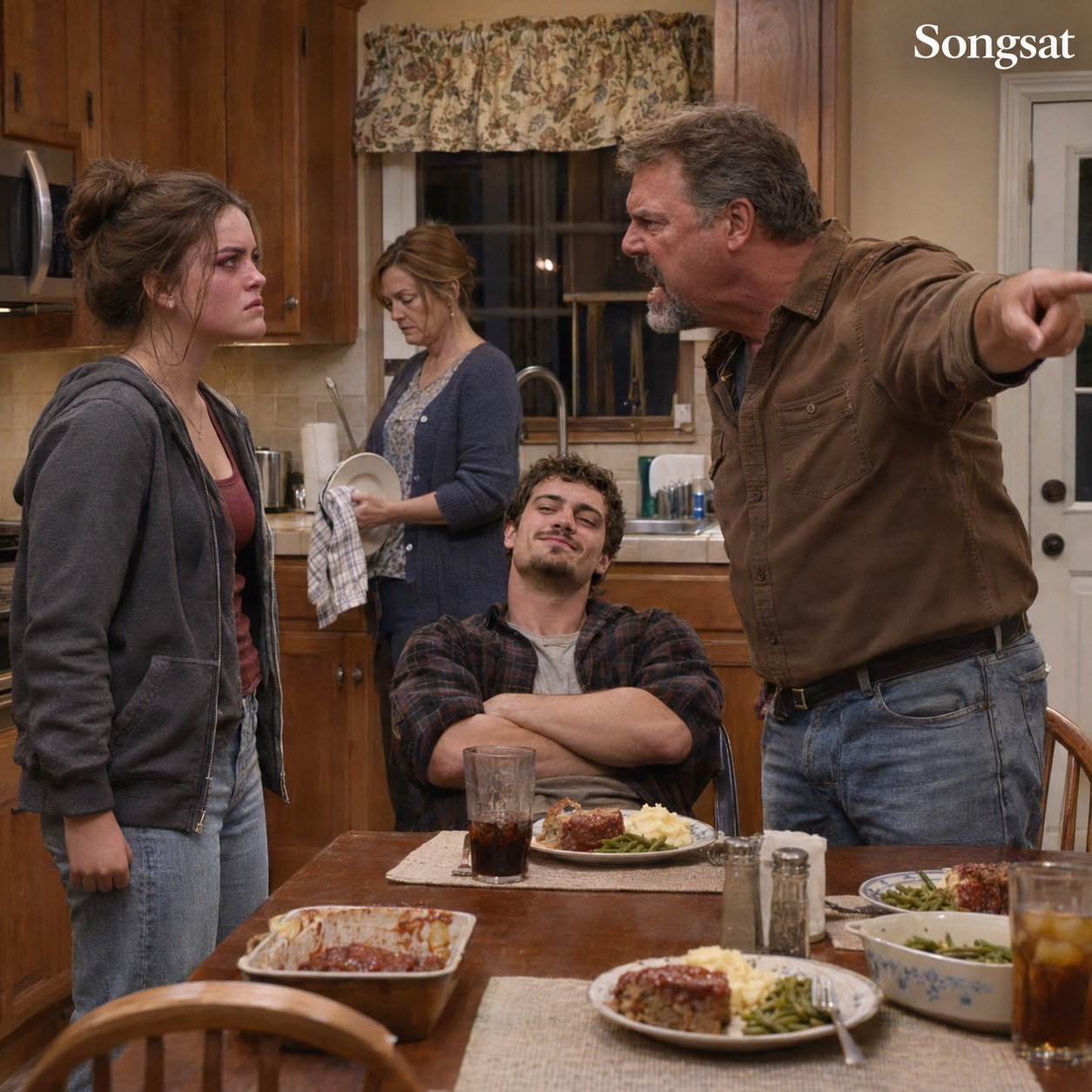
I pulled into a highway rest stop just after midnight, with $430 in my bank account and nowhere to sleep.
My phone kept lighting up.
Dad called twice.
Derek sent three messages.
Mom sent nothing.
I sat behind the steering wheel of my old blue Ford F-150, staring at Walter Briggs's message.
"Audrey, I heard what happened. Don't let anybody touch that truck. There's something your father and Derek need to understand about its title, and I think you should know before tomorrow morning..."
I read it again.
Then I called him.
He answered after the second ring.
"Audrey?"
"Yeah. It's me."
For a moment, neither of us spoke.
Then he sighed.
"Are you okay, kid?"
I looked through the windshield at the empty parking lot.
"I don't know."
"Where are you?"
"Somewhere on the highway. I left."
"I figured."
His voice sounded tired.
Not surprised.
Just tired.
I rubbed my forehead.
"Walter, what did you mean about the title?"
He paused.
"First, tell me you have the original paperwork."
"I do. It's in my bag."
"Good. Keep it somewhere safe. Don't leave it in the truck."
"Why?"
"Because your brother has been asking questions about that vehicle for weeks."
My stomach tightened.
"What kind of questions?"
"Whether the title was in your name. Whether your father could transfer ownership. Whether you needed to sign anything."
I stared at the dashboard.
"Why would Derek ask that?"
Walter gave a humorless laugh.
"Because he wants the truck."
"I already told him no."
"I know. Your father told me what happened."
I gripped the steering wheel.
"What exactly did Dad tell you?"
"That you were being unreasonable. That you refused to help your brother. That you walked out."
I closed my eyes.
Of course.
Even after telling me to leave, Dad had already found a way to make himself the victim.
"Walter, I bought that truck."
"I know you did."
"I paid every dollar."
"I know that, too."
"Then why is everybody acting like I stole something?"
Walter was quiet for a moment.
"Because some people don't understand the difference between being responsible for someone and controlling them."
I swallowed.
I wanted to believe those words.
But I was eighteen, alone on a highway, and suddenly very aware of how little money I had.
"Listen," Walter continued. "The title is in your name. Keep your documents. Don't sign anything your father or brother puts in front of you."
"I won't."
"And don't let anybody convince you that because you lived in that house, they own what you earned."
I looked at the passenger seat.
My diploma was sticking out of the duffel bag.
"I don't think I'm going back."
Walter exhaled.
"Then make sure you have somewhere safe to go."
"I'll figure it out."
"Audrey?"
"Yeah?"
"You worked hard for that truck. Don't let anybody make you feel guilty for keeping it."
I thanked him.
Before hanging up, he gave me his personal number and told me to call if I ever needed help understanding anything related to the vehicle.
I saved it.
Then I turned my phone face down.
For the next hour, I sat in the parking lot, trying to decide what to do.
North Carolina had appeared on my map because I had once heard a coworker talk about how inexpensive some towns were compared with Ohio.
I knew nobody there.
I had no job waiting.
No apartment.
No friends.
But I had a truck, a full tank of gas, and enough money to get started.
That was more than I had felt I possessed inside my father's house.
I restarted the engine.
The old Ford made a rough sound before settling into its familiar rumble.
"Come on, girl," I whispered.
Then I pulled back onto the highway.
By sunrise, the sky had turned pale orange.
My eyes burned from exhaustion.
I stopped at a small gas station, bought a coffee and a breakfast sandwich, and checked my bank balance.
Four hundred and twelve dollars.
I stared at the number.
It suddenly seemed ridiculously small.
I had spent years imagining what independence would feel like.
I had pictured getting my own place, buying groceries, decorating a bedroom, and never having to ask permission to do ordinary things.
I hadn't imagined calculating whether I could afford another tank of gas.
Still, I kept driving.
Every mile took me farther from the kitchen where my father had pointed at the door.
Every mile reminded me that nobody had followed me.
At one point, I pulled into a quiet parking area and checked my phone.
There was a new message from Mom.
"Your father is very upset. Please call him when you calm down."
I read it twice.
Not Are you safe?
Not Where are you staying?
Not Do you have enough money?
Just a request to calm down.
I typed a response.
"I am calm, Mom. I just don't understand why nobody cared that Derek wanted something I worked two years to buy."
I stared at the message before sending it.
Then I deleted it.
There was no point.
I put the phone away and continued south.
By late afternoon, I crossed into North Carolina.
I remember the exact moment I saw the welcome sign.
I didn't cheer.
I didn't cry.
I simply felt my shoulders relax.
For the first time, nobody knew whose daughter I was.
Nobody knew Derek.
Nobody knew what my father thought I owed him.
I was just Audrey.
An eighteen-year-old woman driving an old blue pickup with two duffel bags behind her seat.
I stopped in a town called Millbrook, a small place with a main street, a grocery store, a diner, and a row of modest rental properties.
I had chosen it because a motel sign advertised weekly rates.
The room was small.
The carpet had a stain near the door.
The air conditioner rattled every few minutes.
But the lock worked, the bed was clean enough, and nobody asked why I was alone.
I paid for three nights.
That left me with $287.
I put my bags inside and sat on the edge of the bed.
For several minutes, I didn't move.
Then I started looking for work.
The next morning, I walked into a diner called Millbrook Grill.
A woman behind the counter was counting receipts.
She looked up.
"Can I help you?"
"I'm looking for a job."
She studied me.
"You have experience?"
"Restaurants, retail, cleaning. I can work mornings, evenings, weekends. Whatever you need."
She looked at the clock.
"Can you start tomorrow?"
I almost laughed from relief.
"Yes."
"Kitchen or serving?"
"Either."
She handed me a short application.
Her name was Linda.
She owned the diner with her husband, and she didn't seem particularly interested in my personal history.
She wanted someone dependable.
I could be dependable.
I had been dependable for two years while working jobs in Ohio.
I completed the application, gave her my phone number, and walked back outside.
My first paycheck wouldn't arrive for another two weeks.
I knew I needed something else.
That afternoon, I found a small office-cleaning company looking for evening help.
The manager, Mr. Collins, asked whether I could clean bathrooms, empty trash cans, vacuum floors, and work without supervision.
I told him yes.
He hired me for three evenings a week.
By the end of my second day in North Carolina, I had two jobs.
I also had approximately two hundred dollars left.
It wasn't the beginning I had imagined.
But it was a beginning.
The first week was brutal.
I woke up before sunrise, worked breakfast shifts at the diner, returned to my motel room for a few hours, and then cleaned offices until late evening.
My hands smelled like dish soap and disinfectant.
My feet hurt.
Sometimes I ate leftover toast from the diner because I didn't want to spend money on another meal.
But I didn't complain.
I was learning how to survive without someone else deciding what I deserved.
One evening, Linda noticed me counting coins beside the register.
"Everything okay?"
I quickly put the coins away.
"Yeah."
She looked at me for a moment.
"You're a hard worker, Audrey."
"Thank you."
"Don't let anybody take advantage of that."
The words stayed with me.
I had heard something similar from Walter.
Maybe there were adults who understood that helping someone didn't mean owning them.
I didn't know yet how important that lesson would become.
Two weeks later, my first paycheck arrived.
I paid the motel bill, filled the truck with gas, bought groceries, and started looking for a longer-term place to stay.
I found a small room in a house owned by an elderly widow named Mrs. Carter.
She had a separate entrance, a tiny bathroom, and a kitchenette with a refrigerator that hummed loudly at night.
The rent was affordable.
She didn't ask many questions.
When I handed her the deposit, she gave me a spare key.
"Welcome home, sweetheart."
I nearly cried.
Not because the room was beautiful.
Because nobody had demanded anything from me before offering kindness.
The following months passed in a blur of work.
I learned which grocery store offered the cheapest food.
I learned how to stretch a paycheck.
I learned to change the truck's oil, check its fluids, and recognize when something didn't sound right.
I kept the title documents inside a locked folder beneath my bed.
Walter's warning never left my mind.
I didn't hear from him again.
I didn't hear from Dad.
I didn't hear from Derek.
Mom sent one birthday message several months later.
"Happy birthday. Hope you're doing okay."
I replied, "Thank you."
That was the entire conversation.
I sometimes wondered whether Dad ever regretted what he had said.
I wondered whether Derek had finally found another vehicle.
I wondered whether Mom still stood at the kitchen sink pretending not to hear arguments.
But wondering didn't pay rent.
And I had a life to build.
By the time I turned nineteen, I had saved enough money to move into a small apartment.
It wasn't much.
One bedroom.
One bathroom.
A kitchen barely large enough for two people.
But the lease had my name on it.
The electricity bill had my name on it.
The mailbox had my name on it.
I put a photograph of my blue Ford on the refrigerator.
Underneath it, I taped a handwritten note.
"$5,800. Two jobs. Mine."
Every time I saw it, I remembered the night I had driven away.
I also remembered Derek laughing.
For a long time, I wanted him to be wrong more than I wanted anything else.
I wanted to prove I could survive.
I wanted my father to hear that I had made it.
But eventually, something changed.
I stopped imagining their reactions.
I started making plans that had nothing to do with them.
I considered going back to school.
I researched better-paying careers.
I began thinking about what I wanted my life to look like at twenty-five.
And then, in the spring of 2018, I walked into an Army recruiting office.
I had spent months researching my options.
I wanted stability.
I wanted training.
I wanted a career that would allow me to build something lasting.
Most importantly, I wanted to depend on myself.
The recruiter asked me why I was interested in joining.
I thought about my father.
I thought about Derek.
I thought about the blue Ford.
Then I answered honestly.
"Because I want to build a future nobody can take away from me."
He nodded and slid the paperwork across the desk.
I signed my name.
It was one of the biggest decisions I had ever made.
Before leaving, I stopped beside the truck and looked at the faded blue paint.
The old Ford had carried me out of Ohio.
It had carried my belongings, my fears, and every dollar I had left.
It was still running.
So was I.
I placed my hand on the hood.
"Still here," I whispered.
Then I climbed inside and drove toward the next chapter of my life.
I had no idea that almost ten years later, the same family that had watched me leave with four hundred and thirty dollars would suddenly need something from me.
And when the phone finally rang, it wouldn't be Derek asking for a ride.
It would be my father.
As I sat in my apartment one September morning in 2026, my phone displayed a number I hadn't seen in years.
I almost ignored it.
Then I saw the caller identification.
DAD.
I answered.
"Hello?"
His voice came through, older and strained.
"Audrey, it's your father."
I sat up slowly.
"What happened?"
He didn't ask how I was.
He didn't ask whether I was happy.
He didn't ask whether I still drove the truck.
He simply took a breath and said:
"We've got a situation here. And you're the only person who can help us."






Comments 0