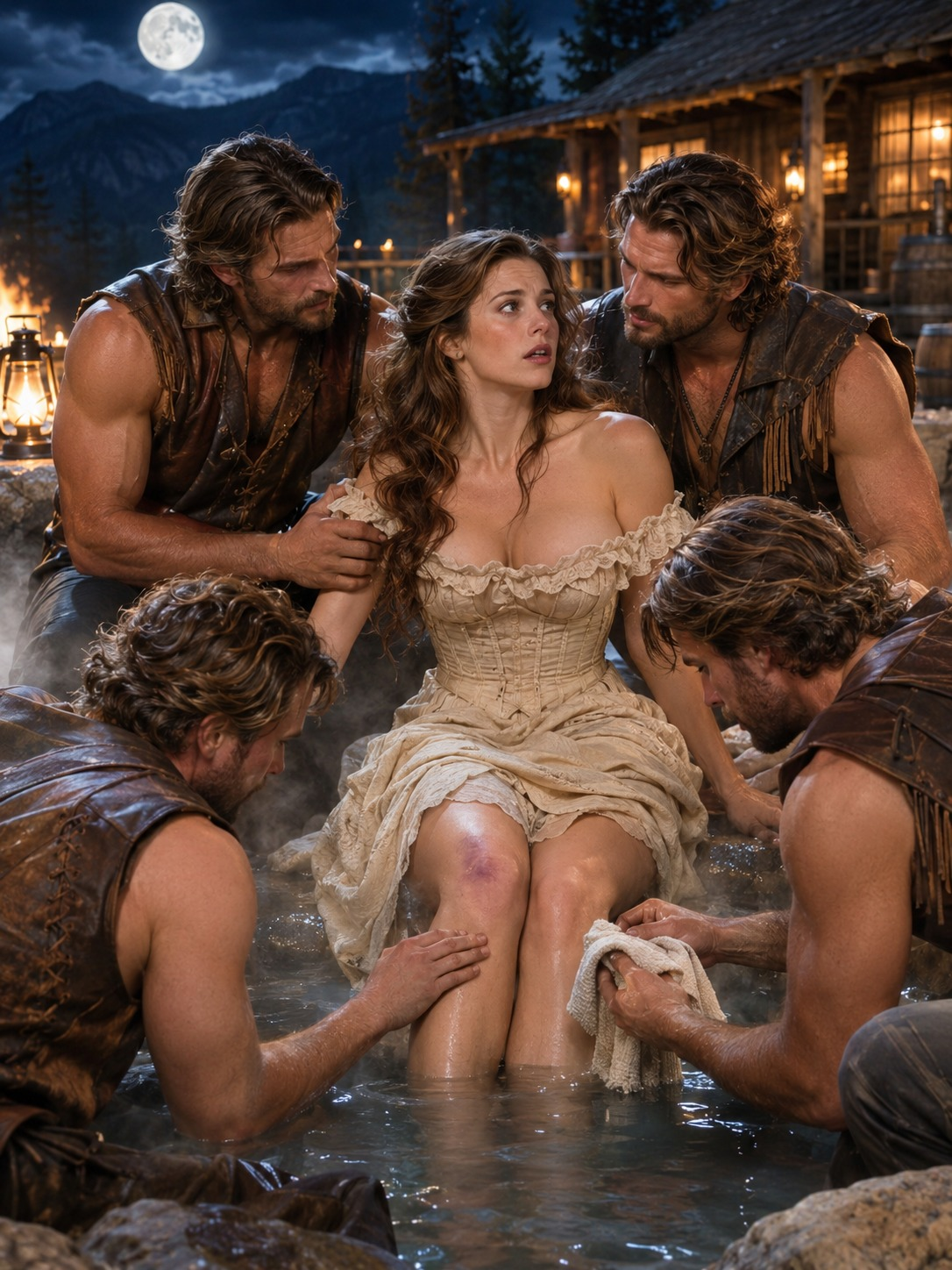
"Don't touch my trunk!" I shouted as four strangers surrounded my luggage on the railroad platform.
The tallest man stepped forward with a folded marriage contract in his hand.
Four signatures appeared beneath the agreement.
My name was written above them.
I hadn't been promised to one husband.
I had been promised to four.
For several seconds, I couldn't make myself speak.
The train behind me hissed and groaned, releasing a cloud of steam that drifted across the platform. Somewhere near the freight office, a porter shouted about missing baggage. A woman carrying a sleeping baby hurried toward the station entrance.
The world continued moving as though nothing extraordinary had happened.
But my entire future had just changed.
My name was Maeve Calloway.
I was twenty years old, alone in Montana Territory, and carrying everything I owned in one battered trunk and a faded carpetbag.
I had traveled more than a thousand miles from Chicago because a man named Callahan had promised me marriage, a respectable home, and a chance to begin again.
His letters had been brief but decent.
He owned a cattle ranch.
He needed a wife.
He believed a marriage should be built on honesty, hard work, and mutual respect.
I had read those words so many times during the journey that I could practically recite them.
Now I wondered which part of his definition of honesty included three additional husbands.
The tallest stranger stood directly in front of me.
He was broad-shouldered, with a weathered face and a pale scar crossing his left eye. His gray gaze was steady enough to make most people uncomfortable.
I refused to look away.
"You're Callahan?" I asked.
"That's right."
"And those men?"
He glanced behind him.
The largest of the three shifted awkwardly. He had kind brown eyes and hands so enormous they looked capable of lifting a wagon.
Another man stood near the railing, silent and watchful, with dark hair brushing his collar.
The fourth leaned against a wooden post. Burn scars climbed the side of his neck, and his expression suggested he had already decided I was going to be a considerable inconvenience.
"They're my partners," Callahan said.
"Business partners?"
"Ranch partners."
I waited.
He didn't elaborate.
"Then why are their names on my marriage agreement?"
The enormous man lowered his eyes.
The scarred one looked away.
Callahan drew a slow breath.
"Because the arrangement was made on behalf of all four of us."
I stared at him.
Then I laughed.
It wasn't a pleasant laugh.
It was the sound a woman made when she realized she had traveled halfway across a continent to become the punch line of somebody else's cruel joke.
"You're telling me," I said carefully, "that four grown men purchased my passage because you expected me to marry all of you?"
"Yes."
The word landed between us like a stone.
I looked at the contract again.
Four signatures.
Four men.
One woman.
Me.
"Well," I said, folding the paper, "that certainly explains why the letters never mentioned a wedding date."
The scarred man made a short sound through his nose.
I turned toward him.
"Something amusing?"
"Nothing, ma'am."
"Then I suggest you keep it that way."
His eyebrows rose.
The enormous man almost smiled.
Callahan didn't.
"Miss Calloway," he began, "I understand this is unexpected."
"Unexpected?"
My voice rose before I could stop it.
"Finding a mouse in my carpetbag would be unexpected. Discovering that four men believe they've purchased the right to call themselves my husbands is something considerably worse."
Several people on the platform turned to stare.
I didn't care.
For two years, I had been running from a man who believed money gave him ownership over another human being.
I had not crossed the country to meet four more.
"I am not a piece of property you can share."
Callahan's expression tightened.
Not with anger.
With something that looked remarkably like shame.
"You're right."
That stopped me.
I had expected excuses.
Arguments.
Perhaps a reminder that they had paid for my train fare.
Instead, the man admitted I was right.
"We should have told you," he continued.
"Yes. You should have."
"We believed you might refuse."
"Then your judgment was excellent."
The enormous man looked down at his boots.
The quiet man watched me with an expression I couldn't read.
The scarred one folded his arms.
Callahan took the contract from my hand, but only after I released it.
"You don't owe us a marriage," he said.
"How generous."
"I'm serious."
"So am I."
He glanced toward the station office.
"If you want to return east, we'll purchase your ticket. The next train leaves Thursday."
Thursday.
Three days.
The word struck a place inside me I had spent the entire journey trying to keep locked.
Because returning east was not an option.
Not really.
Back in Chicago, Jeremiah Flint was waiting.
Or perhaps he was already searching.
Flint owned the mill where my father had died.
He owned the men who had accused my father of negligence.
He owned the lawyer who had presented me with a debt large enough to swallow everything my family had ever possessed.
And when I refused to accept that debt, Flint had made it very clear that he considered me responsible anyway.
I could still hear his voice.
"Your father cost me money, Miss Calloway. One way or another, his daughter will repay it."
I had been seventeen when my father died.
By twenty, I had learned that a wealthy man did not need to be right to ruin a poor woman's life.
He only needed enough people willing to obey him.
Inside my left boot, pressed against my ankle, was a folded piece of paper I had taken from the mill office before leaving Chicago.
It was the only thing I possessed that Flint truly feared.
And it was the reason I could never go back.
"Thursday," I repeated.
Callahan nodded.
"We'll see you safely onto the train."
I studied him.
He was not smiling.
He was not threatening me.
He looked like a man who had made a foolish decision and knew it.
"Where is your ranch?"
"About four hours west."
"Is there a room where I can sleep alone?"
"Yes."
"With a door that closes?"
"Yes."
"Will anyone attempt to enter it without my permission?"
"No."
I looked at the other three.
"Does that answer apply to all of you?"
The enormous man nodded immediately.
"Of course, ma'am."
The quiet man gave a small nod.
The scarred man looked irritated.
"Nobody's planning to bother you."
"Good. Then we understand each other."
Callahan waited.
I looked down the tracks.
The train that had brought me west was preparing to depart.
I could climb back aboard and return to the city where every boardinghouse seemed to have eyes and every unfamiliar footstep made my stomach tighten.
Or I could spend three days with four strangers in the Montana wilderness.
Neither choice was particularly appealing.
But one offered the possibility of freedom.
"I'll stay until Thursday," I said.
The enormous man looked relieved.
Callahan nodded once.
"Fair enough."
"That isn't all."
He waited.
"If I stay beyond Thursday, it will be because I choose to. Not because you paid for my passage. Not because of anything written on that contract. And certainly not because four men believe they can make decisions about my life without consulting me."
"Understood."
"And I expect to be treated with respect."
"You will be."
I turned toward the scarred man.
"Even by you."
His mouth tightened.
"We'll see."
"Oh, we certainly will."
For the first time, the quiet man looked as though he might laugh.
Callahan introduced them as we walked toward the waiting wagon.
The enormous man was Harlan.
The quiet one was Roan.
The scarred man was Garrick.
Four men who had pooled their money to bring a wife to a dying ranch.
I wondered what kind of desperation made men believe such an arrangement could work.
I would soon discover the answer.
The wagon was old but well maintained.
Two horses stood patiently in the traces, their coats brushed and their harnesses repaired with careful stitching.
Harlan lifted my trunk as though it weighed no more than a basket of laundry.
"Where would you like it, Miss Calloway?"
"Somewhere it won't fall."
He grinned.
"Reckon I can manage that."
Garrick climbed into the back.
Roan mounted a dark horse tied beside the wagon.
Callahan offered me his hand.
I looked at it.
Then climbed onto the wagon without assistance.
He lowered his hand without comment.
That earned him one small measure of respect.
We left Red Sand behind beneath the afternoon sun.
The settlement disappeared quickly, swallowed by rolling grassland and distant red hills.
I had never seen so much open country.
In Chicago, buildings crowded the streets and smoke crowded the sky.
Here, the horizon seemed impossibly far away.
It should have made me feel free.
Instead, I kept thinking about how far I was from anyone who might help me.
For the first hour, nobody spoke much.
Harlan finally broke the silence.
"You hungry, Miss Calloway?"
"A little."
He reached beneath the wagon seat and produced a cloth bundle.
Inside were two biscuits and a piece of cheese.
"I brought these in case the train was late."
I looked at him.
"Thank you."
His face brightened.
"You're welcome."
I ate slowly.
The biscuits were dry, but they were the first food I'd tasted since morning.
"Who made these?"
"Harlan," Callahan answered.
I glanced at the enormous man.
"You cook?"
"When somebody has to."
"Are you good at it?"
Garrick spoke from behind us.
"If you enjoy chewing leather."
Harlan frowned.
"They're biscuits, not cake."
I took another bite.
"I've eaten worse."
"That's not much of a compliment," Garrick muttered.
"It wasn't intended as an insult."
Roan rode alongside the wagon, listening without speaking.
After a while, I noticed him watching the hills.
Not casually.
Carefully.
His gaze moved from one ridge to another, pausing whenever the trail passed between narrow walls of stone.
"Expecting trouble?" I asked.
He looked at me.
"Not expecting it."
"Then why keep looking?"
"Because trouble doesn't always announce itself."
I considered that.
"That's something we agree on."
His eyes rested on me for another moment.
Then he turned back toward the hills.
By late afternoon, the landscape had changed.
The grass grew thinner.
The ground became red and sandy.
Rock formations rose around us like enormous broken walls.
The heat seemed to collect between them.
I could smell dust, sun-baked earth, and something faintly bitter carried on the wind.
The ranch appeared at the bottom of a broad canyon.
My first impression was disappointment.
My second was concern.
The timber house was modest, with a wide porch and a roof that needed repair.
A leaning water tower stood near the barn.
The fences were straight, but the fields beyond them were dry and cracked.
Several cattle moved slowly across the pasture, their ribs showing beneath their hides.
A creek wound along the canyon floor.
Or rather, what remained of a creek.
It was little more than a thin ribbon of water.
Harlan stopped the wagon.
"Well," he said, "this is home."
I climbed down.
The ground felt hard beneath my boots.
I looked toward the fields.
Then toward the water tower.
Then at the cattle.
"How long has it been since you had proper rain?"
Callahan glanced at me.
"Too long."
"How long?"
"Nearly two months."
I looked at the creek again.
"That's a problem."
Garrick jumped down from the wagon.
"You're a sharp one."
I ignored him.
Beside the house stood a small vegetable garden.
The plants were struggling, but someone had carefully watered them.
A row of beans climbed a wooden frame.
Several tomato plants leaned toward the sun.
There were herbs growing in clay pots near the porch.
I walked toward them.
"Who planted this?"
Harlan raised his hand.
"I did."
"Why?"
He looked confused.
"Because we need vegetables."
"During a drought?"
"Well, I planted them before it got this bad."
I touched one of the leaves.
The soil was dry on top but still damp beneath.
Someone had been giving these plants water they could scarcely afford.
"You're either very stubborn," I told him, "or very hopeful."
He smiled.
"Maybe both."
I looked around the ranch again.
There was poverty here.
But not neglect.
The fences had been repaired.
The horses were groomed.
The tools hanging outside the barn had been cleaned and arranged carefully.
These men were struggling.
They were not lazy.
That mattered.
Callahan carried my trunk into the house.
My room was small.
A narrow bed stood against one wall.
A handmade quilt covered the mattress.
A wooden washstand sat beneath the window.
Someone had placed a jar of dried wildflowers on the dresser.
I stopped in the doorway.
"Who did that?"
Harlan looked embarrassed.
"The flowers?"
"Yes."
"Me."
I touched one of the brittle petals.
Nobody had put flowers in a room for me since my mother died.
"Thank you," I said quietly.
Harlan nodded.
Then stepped away.
Callahan set my trunk beside the bed.
"The room is yours. There's a lock on the inside."
I tested it.
The bolt slid into place.
A simple thing.
A small piece of iron.
But it made breathing easier.
Callahan seemed to understand.
"We'll be outside if you need anything."
He turned to leave.
"Mr. Callahan?"
He stopped.
"Why four?"
He looked back.
"Why did four men decide they needed one wife?"
For a long moment, he said nothing.
Then he glanced toward the window.
"Because this ranch is dying, Miss Calloway."
I waited.
"And we thought a family might give us a reason to keep fighting for it."
He left before I could answer.
I stood alone in the room.
A dying ranch.
Four desperate men.
A marriage arrangement built on a lie.
I should have been furious.
I was furious.
But beneath the anger, something else had begun to stir.
Curiosity.
That evening, I joined them for supper.
The meal consisted of beans, bread, and a little salted beef.
Garrick watched me from across the table.
"Can you cook?"
"Yes."
"Know anything about cattle?"
"Not yet."
"Ever worked a ranch?"
"No."
He leaned back.
"Then what exactly can you do?"
I set down my spoon.
"Read. Write. Sew. Repair simple machinery. Keep accounts. Cook for thirty people. Work twelve-hour shifts without complaining. And recognize a man who enjoys asking foolish questions."
Harlan choked on his water.
Roan lowered his head.
Callahan looked at his plate.
Garrick's face darkened.
"Everybody works here."
"Good," I replied. "I've been working since I was eleven."
"You won't last a week."
I met his gaze.
"Then I suppose you'll enjoy being proven right."
Nobody spoke for several seconds.
Then Callahan reached for the bread.
"Pass that down, Garrick."
The conversation ended.
But the challenge did not.
After supper, I helped Harlan wash the dishes.
He tried to stop me.
"You're a guest."
"Am I?"
He hesitated.
"Well, yes."
"Then let me be a useful one."
He handed me a towel.
We worked quietly.
Outside, the last light disappeared behind the canyon walls.
The ranch settled into nighttime sounds.
Horses shifting in their stalls.
A loose shutter tapping against the house.
The distant call of an owl.
For the first time since leaving Chicago, I felt tired enough to sleep.
I returned to my room.
Locked the door.
Removed my boots.
And took the folded paper from the lining of the left one.
It was worn along the creases.
The ink had faded slightly.
But the signatures were still visible.
My father's name.
Jeremiah Flint's name.
And the figures that proved the debt Flint claimed I owed had never existed.
I had risked everything to take that paper.
I had crossed a thousand miles to keep it hidden.
And I intended to make sure it stayed that way.
I folded it again and tucked it beneath the mattress.
Then I heard footsteps outside my window.
I froze.
The footsteps stopped.
A shadow moved across the curtain.
I reached for the lamp.
Before I could turn the wick, someone whispered from the darkness.
"Miss Calloway?"
It was Roan.
I approached the window carefully.
"What is it?"
"Don't light that lamp."
My hand stopped.
"Why?"
He didn't answer immediately.
Then I heard something beyond the house.
A horse.
Not one of the animals in the barn.
This one was moving slowly along the canyon trail.
Roan's voice dropped even lower.
"Did anyone follow you from Chicago?"
My blood turned cold.
I looked toward the mattress.
Toward the paper hidden beneath it.
Then back at the window.
"Why are you asking?"
Roan stepped closer.
"Because somebody just rode into the canyon."
I swallowed.
"Who?"
His answer came barely above a whisper.
"That's what I'm about to find out."
He disappeared into the darkness.
I remained beside the window, listening.
A minute passed.
Then another.
Somewhere beyond the barn, a horse snorted.
Boots scraped against gravel.
And a man's unfamiliar voice called out from the darkness.
"I've come looking for a woman named Maeve Calloway."






Comments 0