The sound came from upstairs.
A violent crack.
Then something heavy struck the floor.
Margaret grabbed my arm.
"Kimberly, don't go back inside!"
But my son was already running toward the staircase.
"Sarah!" David shouted. "What are you doing?"
I stood on the front porch, frozen.
I knew that sound.
I'd heard something similar twenty years earlier when Robert accidentally broke a doorframe while moving a dresser.
Someone was forcing open a door.
My bedroom door.
The one I'd locked to protect the room where my husband and I had spent twenty years of our marriage.
"David!" I called.
He didn't stop.
Another crash echoed through the house.
Margaret pulled out her phone.
"Kim, I'm calling for help."
I looked at her.
"Wait."
She stared at me.
"Your daughter-in-law is breaking into your bedroom!"
"I know."
"Then let me call."
I swallowed.
"Call the nonemergency number. Tell them there's property damage and that we need assistance. If anyone is in danger, tell them that too."
Margaret nodded and stepped away to make the call.
I turned toward the house.
My knees felt weak, but I refused to let fear keep me standing outside while someone destroyed my property.
I walked through the front door.
Upstairs, David was shouting.
"Sarah, stop!"
I climbed the stairs as quickly as I could.
At the top, I saw them.
Sarah stood outside my bedroom.
A metal pry bar lay on the carpet.
The wooden trim around the door had splintered.
The lock plate hung crookedly from the frame.
And my bedroom door was open.
David stood between Sarah and the doorway.
His face was red.
"What is wrong with you?" he demanded.
Sarah pointed toward the room.
"I told you I wasn't going to keep living out of a suitcase!"
I stopped three feet away.
For a moment, I couldn't speak.
I stared at the broken wood.
At the damaged lock.
At the door Robert had painted himself.
Then I looked at Sarah.
"Did you do this?"
She lifted her chin.
"The door wouldn't open."
"Because I locked it."
"Exactly."
I felt something cold move through my chest.
"So you broke it?"
She shrugged.
"I needed access."
I stared at her.
"Access to my bedroom?"
She crossed her arms.
"We're supposed to be living here."
I looked at David.
He seemed almost as shocked as I was.
"Mom, I didn't know she was doing this."
I believed him.
This time, there was no hesitation in his voice.
No attempt to explain away her behavior.
He looked genuinely horrified.
Sarah rolled her eyes.
"Can everyone stop acting like I burned the house down?"
I looked at the splintered doorframe.
Then at Robert's chair inside the room.
Thankfully, it was untouched.
But the sight of that damaged doorway made my throat tighten.
My husband had spent an entire Saturday repairing that frame after the house settled one winter.
He'd sanded the wood until it was smooth.
Then he'd painted it white.
He'd been so proud of the finished result that he'd called me upstairs to admire it.
Now pieces of that same wood lay scattered across the carpet.
I bent down and picked up a splinter.
Sarah sighed.
"Oh, Kimberly, please don't start crying over a door."
I straightened.
My voice was quiet.
"Sarah, step away from my bedroom."
She stared at me.
"What?"
"Step away."
She looked toward David.
He didn't move.
"David, tell her."
My son looked at the damaged frame.
Then at his wife.
"Sarah, go downstairs."
Her mouth fell open.
"Excuse me?"
"Please."
She laughed sharply.
"You're taking her side again?"
He looked exhausted.
"I'm asking you to stop making things worse."
Sarah's face reddened.
"You promised me this room!"
David closed his eyes.
"I know."
"You promised!"
He opened his eyes.
"And I was wrong."
The words seemed to strike her.
For a moment, she looked genuinely stunned.
Then her expression hardened.
"Fine."
She stepped backward.
"But don't expect me to pretend this is acceptable."
She marched toward the staircase.
I watched her disappear.
Then I looked at David.
He stood beside the broken doorway, staring at the floor.
"Mom," he whispered, "I'm so sorry."
I nodded.
I couldn't answer.
Not yet.
I walked into my bedroom.
The room smelled faintly of fresh wood.
A small piece of trim had landed beside the dresser.
My quilt was undisturbed.
Robert's photograph still stood on the dresser.
And his chair remained beside the window.
I crossed the room and touched the chair.
It was solid.
Safe.
I closed my eyes.
For a moment, I imagined Robert standing beside me.
Not speaking.
Just placing one hand on my shoulder.
I wished he were there.
I wished he could tell me what to do.
But I knew the answer.
I had to protect the home we'd built.
Even if protecting it meant confronting our son.
I turned toward David.
"Did you give Sarah permission to break this door?"
He looked horrified.
"No."
"Did you know she had a pry bar?"
"No."
"Did you know she planned to come upstairs while I was leaving?"
He hesitated.
"She said she wanted to get some things."
I stared at him.
"What things?"
He swallowed.
"I thought she meant clothes."
I looked toward the hallway.
The guest room door stood open.
Their clothes were still inside.
I took a breath.
"David, I need you to understand how serious this is."
He nodded.
"I do."
"Do you?"
His eyes filled.
"Mom, I know."
I looked at the damaged frame.
"Your father built this home into something we could be proud of."
David wiped his face.
"I remember."
"He taught you how to repair things."
He nodded.
"Yes."
"Then look at what happened because you couldn't tell your wife no."
He lowered his head.
The words hurt him.
I could see that.
But they needed to be said.
I wasn't blaming him for every decision Sarah made.
She was responsible for her own actions.
But David had encouraged her belief that my home was theirs to claim.
And now that belief had become something physical.
Broken wood.
A damaged lock.
A bedroom door hanging crookedly from its frame.
I walked toward the hallway.
"Come downstairs."
David followed.
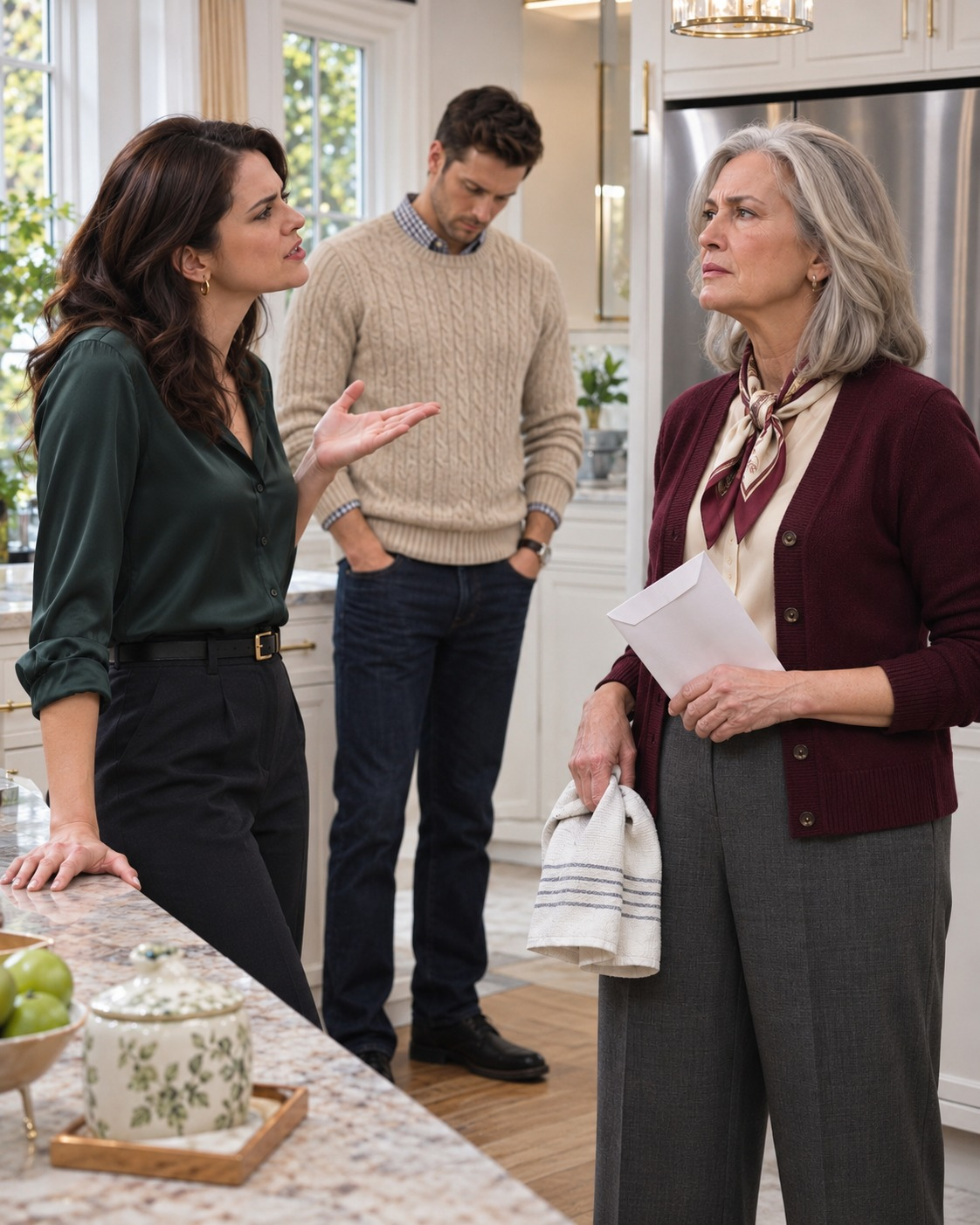
When we reached the kitchen, Sarah was sitting at the island with her phone in her hand.
She looked up.
"Are we finished with the drama?"
I stopped.
"Sarah, Margaret has contacted the police about the damage."
Her expression changed.
"What?"
"Someone needs to document what happened."
She stood.
"You're calling the police on your own family?"
I looked at her.
"You already called them on me."
"That was different."
"How?"
She opened her mouth.
Then closed it.
I continued.
"You asked them to make me surrender my bedroom. I'm asking for help documenting damage to my property."
Sarah laughed bitterly.
"This is unbelievable."
I didn't respond.
David stepped beside me.
"Sarah, you shouldn't have broken the door."
She turned toward him.
"Are you serious?"
"Yes."
She stared at him.
"You're actually blaming me?"
He took a breath.
"You broke it."
She looked from him to me.
Then she grabbed her handbag.
"I'm not staying here to be attacked."
I stepped aside.
"You're free to step outside."
She stared at me.
Then marched toward the front door.
It slammed behind her.
David sat down heavily.
I remained standing.
My hands were trembling.
I looked at the clock.
1:06.
I was supposed to be at Thomas Bennett's office.
Instead, I was waiting for the police to return to my house.
Margaret came inside a moment later.
She looked at David.
Then at me.
"Kim, are you all right?"
I nodded.
"Physically."
She glanced toward the staircase.
"How bad is it?"
"The doorframe is damaged."
Margaret closed her eyes.
"Oh, Kimberly."
I looked at her.
"She used a pry bar."
Margaret's expression hardened.
"That's unacceptable."
David stared at the table.
I could see the shame on his face.
Margaret looked toward him.
"David, what happened?"
He swallowed.
"Sarah wanted the master bedroom."
Margaret stared at him.
"Your mother's bedroom?"
He nodded.
"Yes."
"And you thought that was reasonable?"
He looked down.
"I did."
Margaret shook her head.
"David, I've known you since you were a teenager."
He said nothing.
"Your father would have been heartbroken to see this."
David covered his face.
I touched Margaret's arm.
"Please."
She looked at me.
I shook my head.
He already knew.
There was no need to keep pressing the wound.
Margaret softened.
"I'm sorry."
David looked up.
"No. You're right."
His voice cracked.
"I don't know what I've been thinking."
I sat across from him.
For a moment, nobody spoke.
Then David whispered, "Mom, I thought I had some rights here."
I looked at him.
"What rights?"
He hesitated.
"Because it's our family home."
I felt my stomach tighten.
"David, being raised here doesn't make you the owner."
He nodded.
"I know that now."
"But you didn't know it this morning?"
He looked miserable.
"Sarah kept saying I had an interest in the property."
I stared at him.
"An interest?"
He nodded.
"She said because Dad intended to leave me something, I had a right to be involved in decisions about the house."
I felt cold.
"David, your father left everything to me."
He looked up sharply.
"What?"
I stared at him.
"Didn't you know?"
He hesitated.
"I knew you handled the estate."
"Your father and I discussed our wills carefully. We wanted the surviving spouse to be secure."
David looked confused.
"But Sarah said—"
I raised one hand.
"Sarah wasn't part of those discussions."
He fell silent.
I stood.
"Come with me."
He looked up.
"Where?"
"To the filing cabinet."
Margaret followed us into the living room.
Against the far wall stood a tall oak cabinet Robert had bought at an estate sale.
He'd refinished it himself.
The brass handles were worn smooth.
Inside were years of carefully organized documents.
Tax records.
Insurance policies.
Mortgage statements.
Estate papers.
I unlocked the bottom drawer.
David watched silently.
I pulled out a thick folder labeled:
ROBERT PORTER — ESTATE.
Then I placed it on the desk.
"Your father wanted everything clear," I said.
David stepped closer.
I opened the folder.
Inside were copies of the will, probate documents, and records showing how ownership of the house had been handled after Robert's death.
I pointed to the relevant pages.
"These documents explain what happened to the property."
David leaned forward.
He read slowly.
Then looked at me.
"Mom, I didn't know."
I nodded.
"That's why you should have asked."
He swallowed.
"Sarah said Dad had promised me the house."
I stared at him.
"Your father never made that promise."
David looked shaken.
"She said he told her."
I felt my chest tighten.
"When?"
He hesitated.
"Before he died."
I looked at him.
"David, your father was very clear about his wishes."
He looked down at the paperwork.
"I know."
I took a breath.
"Your father loved you. But he also wanted me to be safe."
David nodded.
I turned another page.
"This is the record showing that the house is mine."
He read it.
Then sat down.
For several seconds, he didn't speak.
Finally, he whispered, "Sarah told me I had a legal claim."
I looked at him.
"Based on what?"
He shook his head.
"I don't know."
I felt a wave of sadness.
My son had believed something because it was easier than asking whether it was true.
And now we were standing beside a filing cabinet, trying to untangle months of assumptions.
Margaret stepped closer.
"David, did Sarah ever show you a document supporting that claim?"
He hesitated.
"She showed me some paperwork."
I looked at him.
"The documents from the envelope?"
He shook his head.
"Something older."
My pulse quickened.
"Older?"
He nodded.
"She said it came from Dad's estate."
I stared at him.
"Where did she get it?"
He looked confused.
"I thought you gave it to her."
I felt the room tilt.
"David, I never gave Sarah any estate documents."
He looked at me.
"Then how did she get them?"
I didn't answer.
Because suddenly, I remembered something.
Three months earlier, Sarah had visited me while David was working.
She'd brought pastries from a bakery downtown.
We'd sat in the kitchen and talked about family.
At one point, she'd asked whether she could use my printer.
I'd told her it was in the living room.
She'd disappeared for nearly twenty minutes.
When she returned, she'd said the printer was having trouble connecting.
I'd thought nothing of it.
Now I wondered whether she'd been looking through the filing cabinet.
I looked at the lock.
It was old.
Robert had always joked that a determined child could probably open it with a paperclip.
I felt a chill.
"David," I said slowly, "did Sarah ever mention coming here alone to look at paperwork?"
He looked away.
My heart sank.
"David."
He swallowed.
"She said she wanted to understand the estate."
I stared at him.
"When?"
He hesitated.
"A few months ago."
I felt my chest tighten.
"And you didn't tell me?"
He shook his head.
"I thought it was harmless."
I closed my eyes.
There it was again.
I thought.
I assumed.
I didn't know.
Every excuse led back to the same problem.
My son had allowed someone else to make decisions about my life without asking me.
I looked down at the folder.
Then I noticed something strange.
A document was missing.
I knew exactly where it belonged.
Robert's original handwritten letter of instructions had always been tucked behind the estate summary.
I'd seen it there after his death.
I'd read it more than once.
But now the plastic sleeve was empty.
I frowned.
"That's odd."
Margaret leaned closer.
"What is it?"
"There's a letter missing."
David looked up.
"What letter?"
"Something your father wrote."
He stared at me.
"What did it say?"
I hesitated.
"Mostly personal instructions. Things he wanted me to remember."
I looked through the folder again.
Nothing.
The letter was gone.
I felt my pulse quicken.
Margaret touched my arm.
"Kim, perhaps you moved it."
"Maybe."
But I didn't think so.
I was careful with those documents.
Especially anything Robert had written.
I checked the next folder.
Then the one beneath it.
Still nothing.
David watched me.
His expression had changed.
"Mom?"
I looked up.
"What?"
He hesitated.
"Sarah showed me a letter once."
My heart began pounding.
"What letter?"
He swallowed.
"She said Dad wrote it."
I stared at him.
"When?"
"A few months ago."
I felt cold.
"What did it say?"
He looked toward the front door.
Then whispered, "It said Dad wanted me to have the house."
For a moment, I couldn't breathe.
I stared at my son.
"David, your father never told me that."
He nodded.
"I know what you're saying."
"No. Listen to me."
My voice trembled.
"Your father and I planned our estate together. We wanted the surviving spouse to have security. He would never have secretly promised away our home without discussing it with me."
David looked miserable.
"I understand."
"Then why did you believe it?"
He stared at the floor.
"Because I wanted to."
The honesty hurt.
But it was the first completely honest answer he'd given me all day.
I sat down.
Margaret stood beside me.
David remained near the desk.
For several seconds, nobody spoke.
Then Margaret said quietly, "Kim, we need Thomas to examine everything."
I nodded.
"Yes."
She glanced at her phone.
"I'll call his office and explain why we're delayed."
"Thank you."
She stepped into the hallway.
I looked at David.
"Do you still have the letter Sarah showed you?"
He hesitated.
"She took it back."
I felt my stomach tighten.
"Did you photograph it?"
He thought for a moment.
"Maybe."
I leaned forward.
"David, please check."
He pulled out his phone.
His hands trembled as he scrolled through old messages.
I watched his face.
Confusion.
Then recognition.
Then fear.
"Mom," he whispered.
I stood.
"What?"
He turned the phone toward me.
There was a photograph of a handwritten letter.
The paper looked old.
The ink was blue.
And the handwriting resembled Robert's.
I felt tears gather in my eyes.
But something was wrong.
The opening line looked familiar.
The closing signature looked familiar.
Yet the middle paragraphs contained words Robert would never have used.
I leaned closer.
David watched me.
"Mom, is it real?"
I swallowed.
"I don't know."
Then I noticed the date.
The letter was supposedly written two weeks before Robert died.
I remembered those final weeks.
Robert had been weak.
His hands trembled.
He could barely hold a pen.
Yet the writing in the photograph was steady.
Almost perfect.
I felt a chill.
"David," I whispered, "your father couldn't have written this the way it appears."
He stared at the screen.
"What?"
I pointed toward the signature.
"Look at the last letter of his name."
David leaned closer.
I continued.
"Your father always made the final stroke of his signature upward."
David stared at the photograph.
The signature ended with a heavy downward line.
Exactly like the imitation of my signature on the moving-company form.
My son went pale.
"Mom..."
I looked at him.
"Someone copied your father's handwriting."
He swallowed.
Then whispered, "Sarah told me she found this in your filing cabinet."
I stared at him.
The room seemed suddenly silent.
Margaret returned from the hallway.
"Kim, Thomas can see us as soon as we arrive."
I barely heard her.
I was staring at David's phone.
At the letter.
At the signature.
At the words claiming Robert wanted his son to take ownership of the house.
Then David's phone buzzed.
A new message appeared.
From Sarah.
He looked down.
His expression changed.
I saw the color drain from his face.
"What is it?" I asked.
He didn't answer.
"David?"
He slowly turned the screen toward me.
The message contained a photograph.
It showed the inside of a storage unit.
Several cardboard boxes.
A wooden dresser.
And a familiar blue metal lockbox.
My heart stopped.
I recognized it immediately.
Robert's lockbox.
The one he'd kept beneath his desk for years.
The one that had disappeared shortly after his funeral.
I stared at the photograph.
Then read Sarah's message.
Tell your mother to stop digging through the estate papers. If she wants the original documents, she can come get them herself.
I felt my knees weaken.
Margaret caught my arm.
"Kimberly?"
I couldn't answer.
Because beneath the photograph was a second message.
This one contained an address.
And a warning.
Come alone.
I stared at the screen.
Then David whispered something that made my blood run cold.
"Mom, I know that storage unit."
I turned toward him.
"How?"
His eyes filled with fear.
He swallowed.
Then said, "Because Sarah made me rent it under your name."
I stared at him.
Before I could speak, Margaret's phone rang.
She answered.
Listened.
Then slowly turned toward me.
Her face had gone white.
"Kimberly," she whispered, "that was Thomas Bennett."
I gripped the edge of the desk.
"What did he say?"
Margaret swallowed.
"He checked the county property records."
I felt my heart pounding.
"And?"
She looked at David.
Then back at me.
"Someone filed a document concerning your house this morning."
I stared at her.
"What document?"
Margaret opened her mouth.
Then stopped.
Because her phone buzzed again.
A new message from Thomas appeared on the screen.
She looked down.
Read it.
And when she lifted her eyes, she was trembling.
"Kimberly," she whispered, "the document claims you transferred ownership of your house to—"






Comments 0