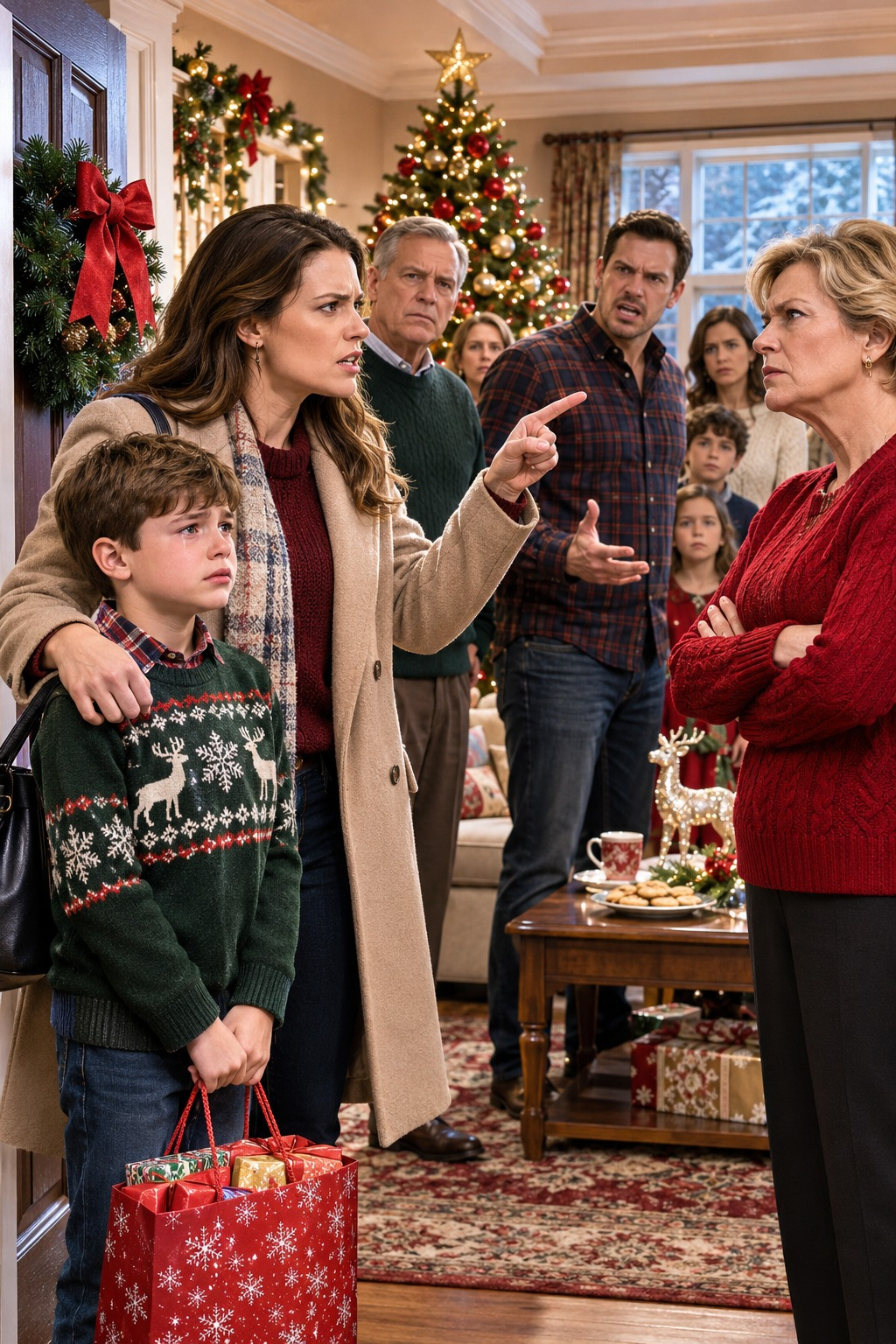
My ten-year-old son dropped a red Christmas gift bag beside my hospital bed and whispered, "Grandma said we're not family."
I reached for the bag and found six unopened presents.
One small white tag had my mother's name written in Tyler's crooked handwriting.
That was when I realized my mother hadn't just rejected a visitor.
She had rejected my child.
For several seconds, I couldn't move.
The hospital room was warm, but something cold seemed to settle beneath my skin. An IV pump clicked beside me. A Christmas movie played silently on the television mounted above the door. Someone in the hallway was laughing about a holiday dinner.
And my little boy stood in front of me, trying desperately not to cry.
"Tyler," I whispered. "Come here, sweetheart."
He took one step toward me, then stopped.
His sandy-blond hair was flattened on one side from his winter hat. His burgundy Christmas sweater had a tiny golden star near the collar, and the sleeves were slightly too long because he'd insisted on buying a size he could wear next year.
His cheeks were bright red.
But it was his eyes that frightened me.
My son had always been an expressive child. When he was excited, his whole face lit up. When he was upset, he talked about it. He asked questions. Sometimes too many questions.
Now he looked as though he had decided that speaking might make something worse.
"Did Grandma say something else?" I asked.
He shook his head.
Then he nodded.
I glanced toward the doorway.
Our nanny, Rachel, stood there holding Tyler's winter coat. She was thirty-two, dependable, and one of the kindest people I'd ever employed. She had been helping me care for Tyler since he was six.
I'd never seen her look so uncomfortable.
"Rachel?"
She swallowed.
"I think you should hear what happened."
I looked back at my son.
"Sweetheart, why don't you sit beside me?"
He climbed into the chair next to my bed without saying a word.
The red gift bag remained on the floor.
Six presents.
Six people.
Six names written carefully by a child who believed Christmas was about making other people happy.
I had helped him choose every gift.
And suddenly I couldn't stop remembering the night we'd wrapped them.
Three weeks earlier, Tyler had spread red wrapping paper across our kitchen table.
He'd saved nearly every dollar of his allowance since September.
Sometimes he earned extra money by watering our neighbor's plants or helping Rachel organize the garage. I always offered to contribute, but he was determined to buy the presents himself.
"Because then they'll know I thought about them," he'd explained.
He had selected a lavender-scented candle for my mother.
A small metal keychain shaped like a fishing boat for my father.
A leather cardholder for my younger brother, Nick.
A set of measuring spoons for Nick's wife, Amanda.
And small gifts for their two children, Mason and Lily.
Nothing expensive.
But each present had a reason.
Grandma loved lavender.
Grandpa talked about fishing.
Uncle Nick always misplaced his cards.
Aunt Amanda liked baking.
Mason loved puzzles.
Lily collected miniature animal figurines.
Tyler remembered all of it.
He'd wrapped the gifts himself, occasionally using so much tape that I wondered whether anyone would be able to open them.
Then he'd written the tags.
His handwriting was uneven, but he was proud of it.
"Do you think Grandma will like hers?" he'd asked.
"Of course," I'd told him.
I had believed that.
That was the part I couldn't forgive myself for.
"Mom?"
Tyler's voice pulled me back into the hospital room.
"Are you mad?"
I looked at him.
"Not at you."
He stared at the bag.
"I didn't mean to make trouble."
My throat tightened.
"Tyler, look at me."
He hesitated.
"Please."
He raised his eyes.
"You did absolutely nothing wrong."
His lower lip trembled.
"But Grandma said—"
"I know what Grandma said."
I reached for his hand.
"And she was wrong."
He looked confused.
"Can grown-ups be wrong about family?"
I nearly broke.
Instead, I squeezed his fingers.
"Yes, sweetheart. Sometimes very wrong."
Rachel quietly closed the hospital door.
Then she told me everything.
Three days earlier, I'd been rushed to the emergency department after a severe allergic reaction.
It had started with an uncomfortable tingling around my lips.
Within minutes, my face had swollen, my throat felt tight, and breathing had become difficult.
I remembered calling for help.
I remembered the ambulance.
I remembered a doctor telling me to keep my eyes open.
After emergency treatment, my condition stabilized, but the medical team wanted to monitor me because my symptoms had been severe.
Christmas was only two days away.
My first thought had been Tyler.
His father had been out of our lives for years. I was the person who made his breakfast, checked his homework, attended his school concerts, and listened when he couldn't sleep.
Missing Christmas morning felt unbearable.
But Rachel had promised to make it special.
She would help Tyler open his presents, prepare his favorite cinnamon pancakes, and take him to my parents' house.
My parents lived only a few blocks from us.
They knew I was hospitalized.
They knew Tyler was frightened.
They knew he had been looking forward to Christmas with them.
Or at least, I thought they knew.
Rachel stood near the foot of my bed.
"This morning, after breakfast, Tyler asked whether we could take his presents to your parents' house."
I nodded.
"That was the plan."
"I know."
She glanced at Tyler.
"He was so excited. He kept checking the gift tags in the car."
Tyler looked down.
Rachel continued.
"When we arrived, there were several cars in the driveway. Your brother's SUV was there. Your father's pickup. Amanda's parents' car."
I felt something tighten in my chest.
"So everyone was there."
"Yes."
"Did you go inside with him?"
Rachel shook her head.
"I parked near the curb. Tyler said he wanted to surprise Grandma with the presents. I could see the front door clearly from the car."
She paused.
"He walked up the steps and rang the bell."
Tyler was staring at his shoes.
"Your mother answered."
I waited.
"Tyler wished her Merry Christmas. He lifted the bag and told her he'd brought presents for everyone."
Rachel's voice became quieter.
"Your mother looked at the bag. Then she looked toward the driveway."
"And?"
"She told him Christmas was just for family this year."
I stared at her.
"What?"
"Those were her words."
I looked at Tyler.
"Sweetheart, is that what Grandma said?"
He nodded.
Then he whispered, "She said they weren't expecting us."
I closed my eyes.
Not expecting us.
My mother had known for days that I was in the hospital.
She'd known Tyler wouldn't be spending Christmas morning with me.
She'd known Rachel was caring for him.
And she had known, because I had personally mentioned it, that Tyler wanted to bring his presents over.
"What happened next?" I asked.
Rachel hesitated.
"She closed the door."
The words hung between us.
I stared at her.
"She closed the door while he was standing there?"
"Yes."
"Did she say she'd call later?"
"No."
"Did she ask how I was doing?"
Rachel's expression answered before her mouth did.
"No."
I looked at Tyler.
"Did Grandpa come outside?"
He shook his head.
"Uncle Nick?"
Another shake.
"Did anybody take your presents?"
"No, Mom."
His voice cracked.
"I waited for a little while."
"Why, baby?"
He rubbed his thumb against the seam of his sweater.
"Because I thought maybe Grandma forgot something."
I felt tears burning behind my eyes.
He continued.
"Sometimes grown-ups close the door when they go get something."
I couldn't speak.
"So I waited."
"How long?"
He shrugged.
"I don't know."
Rachel answered gently.
"About two minutes. Maybe three."
Three minutes.
My ten-year-old son had stood outside his grandparents' house on Christmas morning, holding six presents, waiting for someone to remember that he mattered.
And nobody came back.
I pulled Tyler toward me as carefully as I could.
He climbed halfway onto the bed, avoiding the IV line.
For a moment, he held himself stiffly.
Then his arms went around my neck.
And he began to cry.
Not loudly.
Not dramatically.
Just the small, exhausted sobs of a child who had been trying to stay brave for too long.
"I'm sorry," he whispered.
I held him tighter.
"For what?"
"For making Christmas bad."
That sentence did something to me.
I had spent years convincing myself that my mother's behavior was harmless.
That her comments were merely old-fashioned.
That her favoritism toward Nick was something I should accept.
That maintaining peace mattered more than confronting uncomfortable truths.
But now my son was apologizing for being rejected.
And I finally understood what my silence had been teaching him.
"Tyler," I said, pulling back enough to see his face. "You did not ruin Christmas."
He wiped his eyes.
"Grandma was mad."
"Grandma made a choice."
"Because I came over?"
"No."
"Because you were sick?"
"No, sweetheart."
"Then why?"
I had no answer that a ten-year-old should have to hear.
Because your grandmother thinks love is something people earn by being useful.
Because your uncle has always been treated like the center of our family.
Because I have spent most of my adult life paying bills, solving emergencies, and pretending that being needed meant being loved.
Because your grandmother never learned the difference between family and obligation.
Instead, I brushed the hair away from his forehead.
"Sometimes people behave badly because of problems inside themselves. It doesn't mean there's anything wrong with you."
He studied my face.
"Do you still love Grandma?"
The question surprised me.
I thought about it.
"Yes," I said finally. "But loving someone doesn't mean letting them hurt you."
He was quiet for a moment.
"Or letting them hurt your kid?"
I kissed his forehead.
"Especially not that."
After Rachel took Tyler to wash his face, I sat alone with the red gift bag.
I reached inside.
The candle was wrapped in bright paper with tiny white snowflakes.
A tag hung from the ribbon.
To Grandma. Merry Christmas. Love, Tyler.
I turned it over.
On the back, in smaller letters, he'd written:
I hope this makes your house smell happy.
I pressed the tag between my fingers.
And suddenly I remembered a phone call from November.
My mother had been crying.
Not softly.
Not discreetly.
She had been crying with the urgency she reserved for situations she expected me to fix.
"Your brother is going to lose his house," she'd said.
I had been sitting at my office desk, reviewing a contract for a client.
"What happened?"
"He's behind on rent."
"How far behind?"
"Two months."
I closed my laptop.
"Mom, Nick is thirty-seven."
"Don't start."
"He has a job."
"He's having a difficult year."
"He's been having a difficult year for a decade."
My mother made a wounded sound.
"I cannot believe you're talking about your own brother that way."
I stared out the office window.
"How much does he owe?"
There was a pause.
Then she gave me the number.
It was substantial.
Enough to cover several months of Tyler's extracurricular activities.
Enough to replenish part of the emergency savings I'd used during a slower business quarter.
Enough that I should have said no.
Instead, I asked for Nick's landlord's contact information.
My mother began crying again.
This time with relief.
"Oh, sweetheart. I knew you'd understand. Family takes care of family."
That sentence had followed me my entire life.
Family takes care of family.
When Nick needed money for a car repair.
When Nick's credit card was maxed out.
When Nick and Amanda couldn't cover groceries.
When their electricity bill was overdue.
When their children needed school supplies.
Somehow, family always meant me.
And taking care always meant paying.
I had covered the overdue rent.
Then, against my better judgment, I'd arranged monthly payments directly to Nick's landlord.
I told myself it was temporary.
I told myself Mason and Lily shouldn't suffer because their father couldn't manage money.
I told myself helping my brother was the right thing to do.
My mother thanked me.
Nick sent a short text.
Appreciate it.
That was all.
No discussion about repayment.
No plan for financial independence.
No acknowledgment that I was raising a child alone while running my own business.
Just an expectation that the money would continue arriving.
And now, one month later, my mother had looked my son in the eyes and told him he wasn't family.
I placed the candle back into the bag.
Then I picked up my phone.
Our family group chat was called The Whole Crew.
My mother had created it years earlier.
The group included my parents, Nick, Amanda, and me.
Most messages were photographs of Nick's children.
Their birthdays.
Their school achievements.
Their vacations.
Their Christmas decorations.
Occasionally, my mother posted reminders about family dinners.
She rarely asked about Tyler.
When he won a school reading award, I'd shared a picture.
My mother responded with a thumbs-up.
Two hours later, she posted fourteen photographs of Mason's soccer game.
I had noticed.
Of course I had noticed.
But I had convinced myself it wasn't worth a fight.
I opened the chat.
The most recent message was from Amanda.
A photograph of Mason and Lily sitting in front of my parents' Christmas tree.
They were wearing matching pajamas.
Behind them were dozens of wrapped presents.
The caption read:
Best Christmas morning ever! So grateful for family.
I stared at those words.
Best Christmas morning ever.
While Tyler stood outside the front door.
So grateful for family.
While my son waited for someone to let him inside.
I scrolled upward.
There was a photograph of my father carving a holiday roast.
A picture of Nick holding a drink.
A selfie of my mother smiling beside the Christmas tree.
Everyone looked happy.
Nobody looked concerned.
Nobody had mentioned Tyler.
Nobody had asked whether I was recovering.
And nobody had bothered to explain why a ten-year-old boy had been sent away.
My phone felt heavy in my hand.
For years, I had responded to this kind of treatment by trying harder.
More gifts.
More visits.
More patience.
More financial help.
As though generosity could purchase the affection my mother handed Nick for free.
I was finished negotiating for basic kindness.
I opened the message field.
Typed one sentence.
Read it twice.
Then pressed SEND.
I won't be covering Nick's rent anymore.
No explanation.
No apology.
No argument.
Just a decision.
I placed the phone on the bedside table.
And waited.
The first call came less than three minutes later.
MOM.
I watched the screen light up.
I didn't answer.
The call ended.
Immediately, another began.
MOM.
Then a message appeared.
What is this supposed to mean?
Another.
Call me immediately.
Then my father called.
I let it ring.
A text followed.
Your mother is very upset. We need to discuss this.
I almost laughed.
My mother was upset.
How unfortunate.
Had anyone considered whether Tyler was upset?
Had anyone wondered how a little boy felt after being told he didn't belong?
Another call.
NICK.
Then another.
NICK.
Then a message.
Are you serious right now?
I set the phone facedown.
For the first time in years, I felt no urge to defend myself.
No need to explain.
No instinct to make everyone comfortable.
I simply sat there, listening to the IV pump click.
A few minutes later, Rachel returned with Tyler.
His face was clean, although his eyes were still red.
"Mom, can I use your tablet?"
"Of course."
He climbed into the chair beside me.
Rachel glanced at my phone, which was vibrating against the bedside table.
"Everything okay?"
I looked at her.
"No."
She nodded slowly.
"Do you want me to take Tyler home?"
I watched my son open a game.
His small shoulders were hunched.
He was pretending not to listen.
"No," I said. "Not yet."
Rachel hesitated.
"Are you sure?"
I reached for the nurse's call button.
"I'm going to ask the doctor whether I can go home."
The nurse arrived several minutes later.
Her name was Denise.
She was patient, practical, and had been checking on me throughout my hospital stay.
When I asked about discharge, she looked surprised.
"Your doctor wanted another day of observation."
"I understand."
"Your reaction was severe."
"I know."
She studied my face.
"Is something wrong at home?"
I glanced at Tyler.
"Something happened to my son."
Denise's expression softened.
She didn't press.
Instead, she explained that the doctor would need to review my condition before making any discharge decision.
I agreed.
I wasn't going to risk another medical emergency.
Tyler needed me healthy.
But he also needed to know that I would stand beside him when people treated him cruelly.
While we waited, Rachel brought me water.
Tyler continued playing his game.
My phone kept vibrating.
I finally switched it to Do Not Disturb.
Then I noticed something.
Not one missed call had come before my message about Nick's rent.
Not one.
My parents knew I'd nearly stopped breathing three days earlier.
They knew I was still hospitalized.
They knew their grandson was spending Christmas without his mother.
But none of that had inspired an urgent phone call.
The possibility of losing financial support had.
I stared at the screen.
And a memory surfaced.
I was sixteen.
Nick was fourteen.
I'd saved money from a summer job to buy a used laptop.
Nick wanted a new gaming console.
My mother told me that my brother had been having a difficult time at school.
She asked whether I could contribute some of my savings.
When I refused, she barely spoke to me for a week.
Eventually, I gave her the money.
Nick got his console.
I waited another year for my laptop.
At the time, I thought I was being a good sister.
Now I wondered whether that was the moment my family learned they could make me feel guilty enough to surrender almost anything.
Another memory followed.
My college graduation.
Nick had gotten into trouble with his car.
My father spent most of the ceremony on the phone helping him arrange a tow.
My mother left before the photographs because Nick needed a ride.
I stood outside the auditorium holding my diploma while other families celebrated.
I told everyone my parents had an emergency.
Technically, that was true.
Nick was always the emergency.
I was always expected to understand.
Then there was Tyler's seventh birthday.
My mother had promised to attend.
She canceled that morning because Mason had a soccer tournament.
Tyler waited by the window for an hour.
I told him Grandma had been busy.
He accepted it.
Children often accept explanations adults should be ashamed to give.
And I kept giving them.
Until Christmas morning.
Until six unopened presents.
Until my son asked whether grown-ups could be wrong about family.
The doctor arrived later that morning.
He examined me, reviewed my vital signs, and asked several questions about my symptoms.
After a final assessment, he agreed that I could be discharged with medication, emergency precautions, and strict instructions to seek immediate care if symptoms returned.
I listened carefully.
Rachel offered to stay with us overnight.
I accepted.
Then I changed into the clothes she'd brought.
A navy wool coat.
An ivory sweater.
Dark trousers.
Black ankle boots.
Ordinary clothes for an extraordinary Christmas.
When I emerged from the bathroom, Tyler looked up.
"Are we going home?"
I smiled gently.
"Eventually."
He tilted his head.
"Where are we going first?"
I glanced at the red gift bag.
"There's something I need to take care of."
His expression changed.
"Are we going to Grandma's?"
I knelt in front of him.
"Only if you're comfortable."
He looked at the bag.
"Will she be mad?"
"Maybe."
"Will Uncle Nick yell?"
"I won't let anyone frighten you."
He thought for a moment.
Then he whispered, "I want to know why."
I nodded.
"So do I."
Rachel offered to drive us, but I felt well enough after discharge to drive the short distance, and she agreed to follow in her car.
Before leaving, I checked my phone one more time.
Seventeen missed calls.
Nine messages.
The latest was from Nick.
You better fix this before you ruin Christmas for my kids.
I stared at it.
Then I looked at Tyler.
He was carefully straightening the handles of his red gift bag.
My brother was worried about Christmas being ruined for his children.
Mine had already been ruined.
And he hadn't even noticed.
Twenty minutes later, I turned onto my parents' street.
Their house stood near the end of the block.
The driveway was crowded.
Nick's SUV.
My father's pickup.
Amanda's parents' car.
Through the front windows, I could see the Christmas tree glowing.
People moved around the living room.
Someone laughed.
A child ran past the window carrying a brightly wrapped box.
There was no shortage of warmth inside.
No shortage of presents.
No shortage of family.
I parked near the curb.
Tyler looked toward the house.
"Mom?"
"Yes?"
"Do you think Grandma will open the door this time?"
I looked at him.
His expression was so hopeful that it hurt.
"I think she will."
He nodded.
Then he picked up the gift bag.
"Should I still give them the presents?"
I hesitated.
"That's your decision, sweetheart."
He looked down at the packages.
"I picked them for them."
"I know."
"I don't want them to think I was being mean."
I closed my eyes for one second.
Even now, after everything, my son was worried about hurting the feelings of people who had hurt him.
I reached across the seat and took his hand.
"Tyler, being kind doesn't mean you have to keep giving people chances to be cruel."
He considered that.
Then he said something I would remember for the rest of my life.
"But I still want Grandma to know I remembered what she likes."
I nodded slowly.
"Then you can carry the bag."
We stepped out of the car.
The winter air was sharp.
Tyler walked beside me.
I kept one hand around his shoulders.
As we approached the porch, I could hear Christmas music playing inside.
The same kind of music my mother used to play when Nick and I were children.
Back then, I believed Christmas brought families together.
I hadn't understood that sometimes a holiday simply revealed who people had been all along.
We reached the front door.
A large wreath hung at eye level.
Its red ribbon fluttered slightly.
Tyler stopped.
His fingers tightened around the bag handles.
I looked down.
"You ready?"
He nodded.
I raised my hand.
And knocked.
Inside, footsteps approached.
The music continued.
Someone called out, "Who is it?"
Then the lock turned.
The door opened.
My mother stood there in her emerald-green Christmas sweater.
Her smile vanished when she saw us.
But before I could speak, I noticed something behind her.
On the living room wall, beside the Christmas tree, hung a large framed family photograph taken earlier that morning.
My parents.
Nick.
Amanda.
Mason.
Lily.
Amanda's mother.
Everyone smiling beneath a wooden sign that read:
FAMILY IS EVERYTHING.
There was no Tyler.
There was no me.
And beneath the photograph, on the console table, lay a folded piece of paper with my name written across the front.
My mother saw me looking at it.
Her face changed.
She stepped sideways, blocking my view.
"You're not supposed to see that," she said.
Then she reached behind her and grabbed the paper.
But Tyler had already noticed it.
He looked up at me.
"Mom," he whispered, "why does Grandma have a letter with your name on it?"
My mother tightened her grip.
And from behind her, Nick suddenly shouted:
"Mom, don't let her read that!"






Comments 0