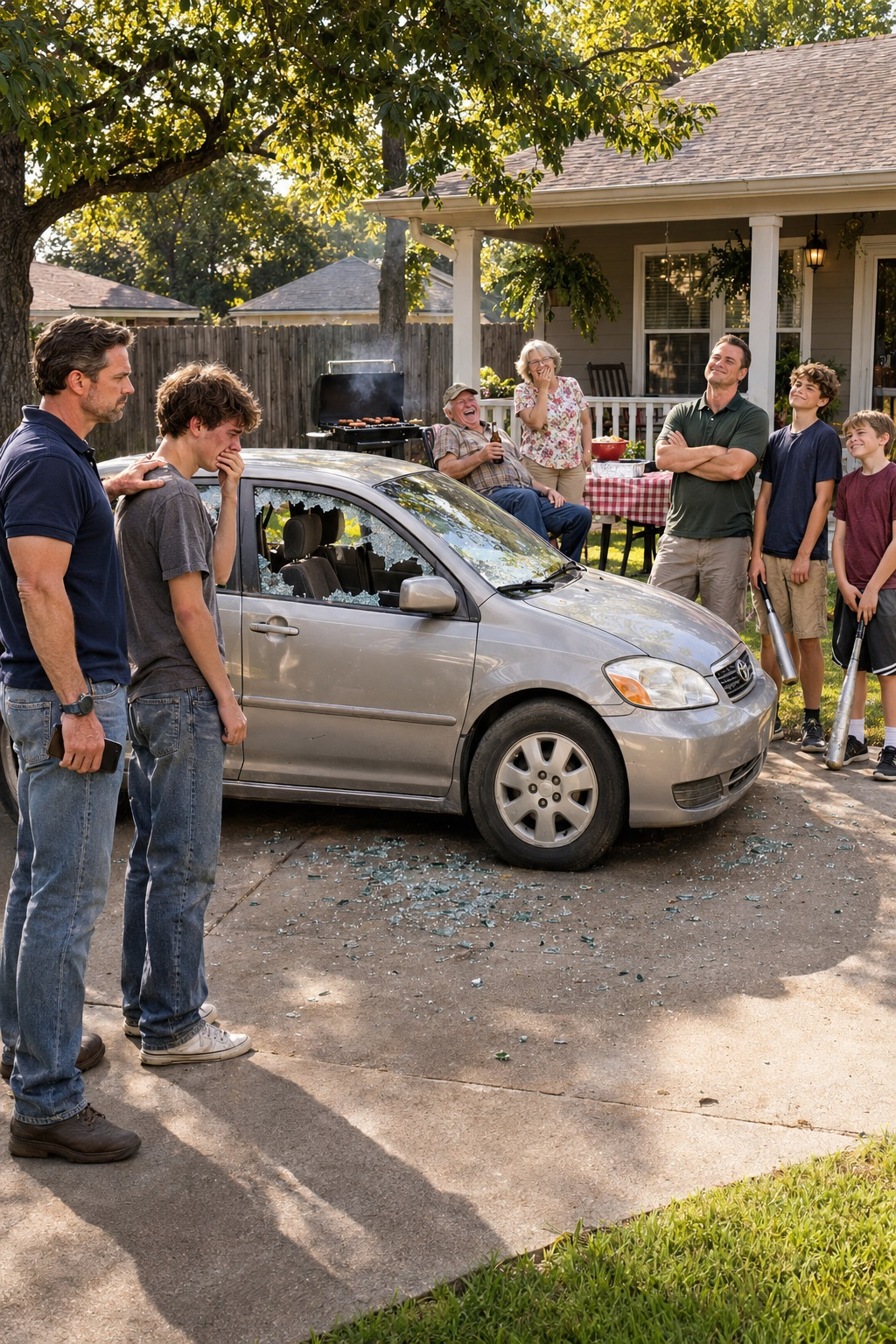
A thirteen-year-old boy raised an aluminum baseball bat over his shoulder.
"Watch this!"
When I turned toward my son's silver Toyota Corolla, the passenger window was already exploding.
Sixteen seconds later, four windows were gone.
And my family was laughing.
I stood on my parents' porch with a plate of brisket in my left hand. For a moment, I couldn't understand what I was seeing. My brain seemed determined to turn the scene into something harmless.
Maybe the boys were playing around.
Maybe the first window had been an accident.
Maybe Lennox was about to tell them to stop.
Then my younger nephew lifted his bat.
He looked directly at his father.
Lennox nodded.
The boy swung.
Another window shattered.
That was when I understood.
This wasn't an accident.
My brother was allowing it.
Worse, he was enjoying it.
The afternoon had started like every other family barbecue at my parents' house in Tulsa. Dad had been working the grill since noon, and Mom had arranged food across a folding table near the back porch. There were paper plates, plastic cups, potato salad, baked beans, cornbread, and enough brisket to feed twice as many people as we had invited.
I had brought Kit with me because my parents had asked us to come.
He was seventeen, and lately, getting him to spend an entire afternoon with the family had become harder than convincing Dad to replace his ancient television.
Not because Kit disliked his grandparents.
He simply had other things to do.
School, friends, his part-time responsibilities, and the excitement of finally having a car had made him increasingly independent.
I understood.
I'd wanted the same freedom at his age.
The difference was that Kit had earned something I never had.
His first car.
A silver 2007 Toyota Corolla.
Nothing luxurious.
No leather seats, no impressive sound system, no shiny new paint.
It had 112,000 miles on it and a few scratches near the rear bumper. The air conditioning worked, the engine sounded healthy, and the tires still had plenty of life.
It was exactly what I wanted for him.
I had spent twelve months saving for that car.
Six hundred and twenty-five dollars whenever I could manage it.
Some months, I had saved more. Other months, I had barely reached my target.
There had been evenings when I wanted to order dinner after working all day, but instead I went home, cooked whatever was left in the refrigerator, and transferred the money into my savings account.
There had been weekends when my friends invited me out, and I declined because I wanted the account balance to keep growing.
It wasn't that I couldn't afford a better car.
It was that I wanted Kit to understand what it meant to work toward something.
When his birthday finally arrived, I gave him the keys in the driveway outside our house.
He had stared at them for several seconds.
Then he looked at me.
"Seriously, Dad? It's mine?"
I nodded.
He didn't jump around.
He didn't scream.
He just held the key in his palm and looked at the little silver car.
I remembered that expression more clearly than I remembered anything else about the purchase.
He had been careful with it from the beginning.
He checked the mirrors before backing out. He parked between the lines, even when there was nobody else in the parking lot. He cleaned the dashboard with a soft cloth and never slammed the doors.
He had driven it four times.
Four.
And now my nephew was destroying it.
The older boy moved toward the driver's side.
He gripped his aluminum bat with both hands.
I finally lowered my plate.
"Hey!"
My voice came out louder than I expected.
But nobody listened.
The boy swung.
CRASH.
Glass scattered across the driveway.
My younger nephew was already moving toward the rear window.
Lennox stood nearby with his arms folded.
He was forty-one, tall, broad-shouldered, and always seemed to occupy more space than necessary. He managed sales at a Kia dealership and carried himself like every conversation was a negotiation he had already won.
He wore that familiar expression now.
The one that said he knew something I didn't.
"Maybe this will teach him he's not special," he called.
I stared at him.
I wanted to ask what he meant.
I wanted to demand that he explain why his sons were holding baseball bats and why he was allowing them to destroy their cousin's car.
But before I could speak, the younger boy struck the rear window.
CRASH.
Four windows.
Four blows.
Sixteen seconds.
The boys lowered their bats.
For a moment, nobody moved.
The Corolla looked as if someone had taken a hammer to every piece of glass around its cabin.
Shattered fragments covered the seats. Some had fallen onto the pavement. Others glittered inside the vehicle beneath the afternoon sunlight.
I looked toward the porch.
Dad was sitting near the grill with a beer in his hand.
He was laughing.
Mom had one hand over her mouth. Her shoulders were moving, and she was trying very hard not to make a sound.
I couldn't believe it.
These were my parents.
These were the people who had taught me that family meant protecting one another.
And they were watching my son's car being destroyed like it was a comedy show.
I looked back at Lennox.
He met my eyes.
There wasn't even a hint of regret on his face.
He knew exactly whose car it was.
He knew how long I had worked to buy it.
He knew Kit loved it.
He also knew how much that purchase had cost me.
But Lennox had always struggled with the idea that somebody else might accomplish something without his approval.
For years, he had made jokes about my pest-control business.
"Bug man money," he called it.
He said it whenever I mentioned a new contract or a successful month.
I had started that business with one borrowed truck and a handful of customers. Eleven years later, I had three company vehicles and two technicians working alongside me.
It wasn't a massive operation.
But it was mine.
I had built it without asking anyone for permission.
Apparently, that bothered him.
What bothered me more was that my parents had accepted my help for years while allowing him to treat me like I was beneath him.
Every year, I paid $2,800 toward Dad's property taxes.
I also covered $340 every month for an insurance arrangement that helped Lennox at the dealership.
Nobody laughed when those payments arrived.
Nobody called my income embarrassing then.
I looked at the broken Corolla again.
Then I placed my plate on the porch railing.
My hand was steady.
Lennox noticed.
He tilted his head slightly, waiting for what he expected to happen next.
He knew the routine.
He would provoke me.
I would get angry.
He would make another comment.
Then Mom would tell me I was being too sensitive, and Dad would say that everybody needed to calm down.
By the end of the afternoon, I would somehow be the problem.
But I wasn't interested in playing that game.
Not today.
I heard the back door open.
Kit stepped through the gate carrying a paper plate with a piece of cornbread on it.
He was wearing a faded gray T-shirt and dark jeans. His sandy hair was slightly messy, and he had the relaxed expression of somebody who had just come back from a normal trip inside the house.
He took two steps.
Then stopped.
His eyes moved toward the Corolla.
The plate tilted.
The cornbread fell onto the driveway.
He stared at the shattered windows.
For several seconds, he didn't say anything.
Then he slowly raised both hands toward his head.
"Dad."
I walked toward him.
"Dad, my car."
His voice was small.
That hurt more than the glass.
I placed my hand on his shoulder.
"I know, buddy. I saw it."
He looked from the car to his cousins.
The two boys were standing beside Lennox with their bats lowered.
Kit looked at his uncle.
Then he looked at his grandparents.
"Why did they do this?"
Nobody answered.
He looked at me again.
His voice cracked.
"Why?"
I swallowed.
"Your uncle thinks teaching is the same as breaking," I said quietly. "It isn't."
Kit looked down at the ground.
He seemed to be trying to understand how something so simple could happen in front of so many adults.
I wanted to tell him that we could replace the windows.
That the engine was probably fine.
That the car was still his.
But those weren't the things he needed to hear.
He was waiting for his grandparents to say something.
Anything.
An apology.
An explanation.
A single sentence acknowledging that what had happened was wrong.
Dad stayed in his chair.
Mom kept her hand over her mouth.
Neither of them moved.
I watched my son wait for people who had already decided not to speak.
That was the moment something changed inside me.
I took out my phone.
Across the driveway, Lennox smiled.
He thought I was calling a glass repair shop.
I opened the dashcam application.
Years earlier, a customer had accused one of my technicians of damaging a fence. The accusation was false, but proving it had cost me days of work and several uncomfortable conversations.
After that incident, my business partner, Odell, insisted that every company vehicle have a dashboard camera.
I eventually installed cameras in our family cars too.
I wanted records.
Nothing more.
Kit's Corolla had one.
The camera had been installed discreetly behind the rearview mirror. It recorded the road, the driveway, and the voices of people standing near the open windows.
The driver's window had been left open a couple of inches because of the June heat.
That small gap mattered.
I tapped the recording.
The application loaded.
A thumbnail appeared.
I selected the video.
Lennox was there.
So were both boys.
The recording began before the first window broke.
I turned up the volume.
At first, I heard ordinary outdoor sounds.
Birds.
The grill.
A few distant voices.
Then Lennox stepped toward the Corolla.
I watched him approach the car with both boys.
He said something.
The older boy laughed.
I dragged the recording backward.
Played it again.
Then I looked at Lennox.
He was still smiling.
I turned up the volume one more time.
The recording continued.
And then I heard my brother's voice.
Clear.
Unmistakable.
My thumb stopped moving.
I looked at the screen.
Then I looked up at him.
Lennox was no longer smiling.
He had recognized his own voice.
And he knew I had heard something he never intended me to hear.
I replayed the last few seconds.
The boys hadn't acted on their own.
Lennox had planned this.
But the words that came next were even worse.
I lifted my eyes from the phone.
Across the driveway, my brother took one step toward me.
"Turn that off," he said.
For the first time that afternoon, Lennox sounded afraid.
And I hadn't even reached the most important part of the recording.






Comments 0