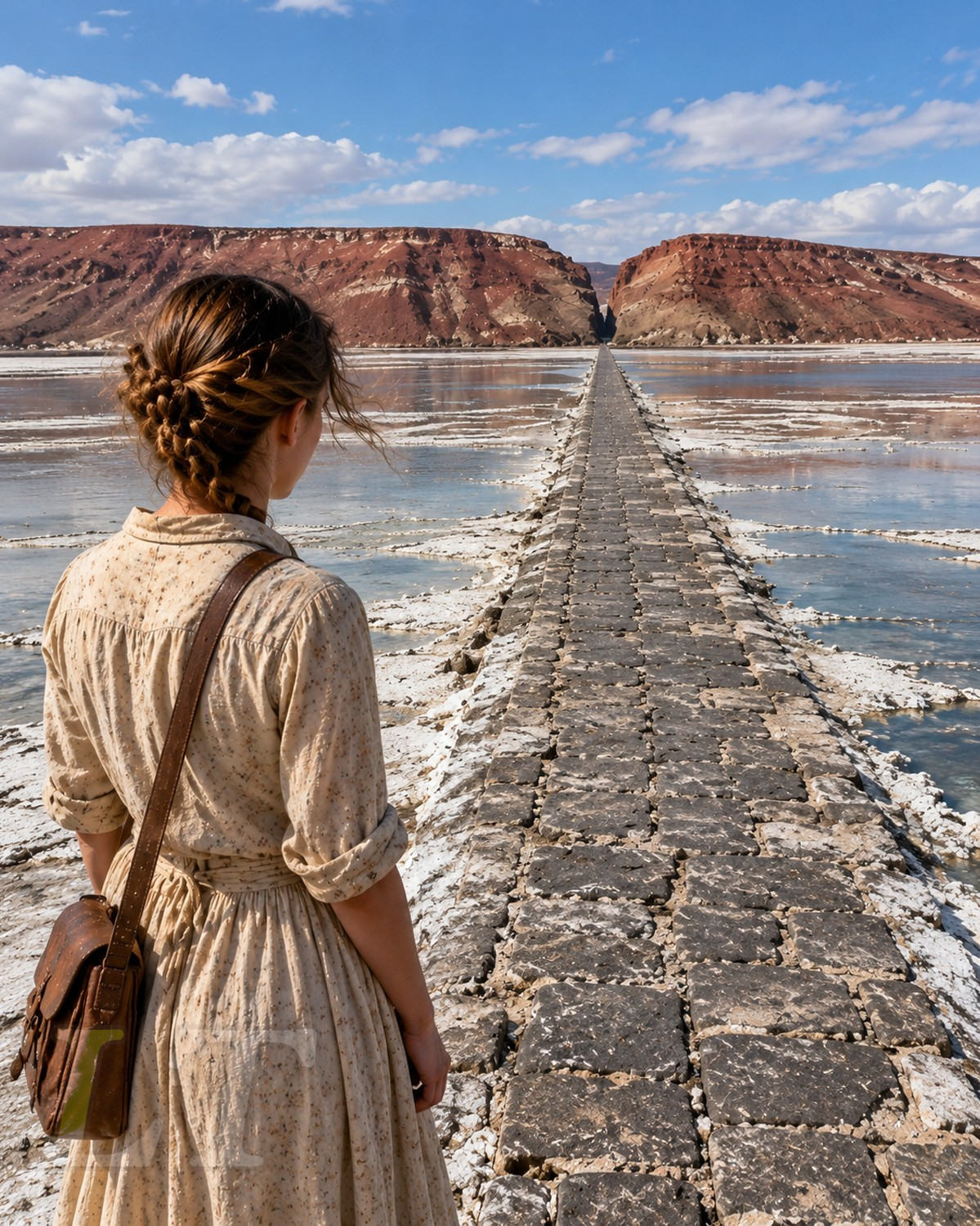
"Wait! You can't leave me here!" Grace Hayes screamed, running after the departing wagon.
Merritt Boone, the wealthiest businessman in Salt Wash, had personally signed her transportation contract.
Grace still carried the folded paper in her leather satchel.
On its back were three words written in unfamiliar handwriting:
"She knows nothing."
The wagons were not leaving her behind by accident.
They were following orders.
Grace Hayes was twenty-seven years old when she discovered that a human life could be purchased for less than the price of a good horse.
She learned this on a lonely freight trail, hundreds of miles from anyone who knew her name.
The first wagon was already moving when she realized something was wrong.
"Mr. Cutter!"
The driver did not turn.
"Mr. Cutter, wait!"
She stumbled forward, clutching her half-empty canteen. The wheels rattled over the hard ground, throwing pale dust into the air.
The second wagon followed the first.
Neither slowed.
Grace ran harder.
Her dusty sage-green dress tangled around her knees. Her leather boots struck loose stones. The small burgundy satchel bounced against her hip.
"Please!"
The word tore from her throat.
"I paid you!"
A man riding beside the second wagon glanced back.
His name was Silas Vane.
He was a thin, narrow-faced teamster with a crooked nose and a habit of chewing tobacco even while speaking.
For the past four days, he had barely looked at Grace.
Now he looked directly at her.
And smiled.
Grace stopped running.
There was something terribly deliberate about that smile.
"Silas!"
He raised one hand.
For a moment, she thought he intended to signal the driver to stop.
Instead, he touched two fingers to the brim of his hat.
A farewell.
Then the wagon disappeared into a rising curtain of dust.
Grace stood alone.
The silence afterward was so complete that she could hear her own breathing.
She waited.
Surely they would realize their mistake.
Surely Mr. Cutter would turn around.
Perhaps Silas had misunderstood something.
Perhaps the wagons were only moving farther down the trail to find better ground.
She counted to sixty.
Then another sixty.
The dust settled.
The road remained empty.
Grace slowly turned toward the battered wooden trunk sitting beside her.
It contained everything she owned.
A secondhand wool dress.
A small Bible that had belonged to her mother.
A tin cup.
A bone-handled knife.
A pouch of dried apples.
Two pieces of canvas.
And a folded letter from her father, written shortly before his death.
She had carried the trunk outside the wagon because Cutter claimed one of the axles needed inspecting.
"Just stand over there a moment, Miss Hayes," he had said. "Ten paces ought to do."
Ten paces.
She looked down at the marks her boots had left in the dust.
Ten paces had been enough to separate her from the only transportation crossing this part of the territory.
Ten paces had been enough to turn a paid passenger into a woman abandoned in the wilderness.
And somewhere behind those departing wagons was a man who had wanted exactly that.
Merritt Boone.
Three weeks earlier, Grace had still believed she could leave Salt Wash with her dignity intact.
She had lost nearly everything else.
Her mother, Eleanor Hayes, had died the previous winter after a long illness.
Her father, Samuel, had followed in the spring.
He had been a quiet man with weathered hands and a stubborn belief that honest work eventually received an honest reward.
For twenty-nine years, he had maintained wells, repaired irrigation channels, and helped neighboring ranchers find water during the driest seasons.
He had never become wealthy.
But he had kept food on the table.
And he had kept their small clapboard house.
Until he died.
Three days after the funeral, Merritt Boone arrived carrying a black leather document case.
He wore an expensive charcoal coat, polished boots, and a silver watch chain that flashed whenever he moved.
Two men stood behind him.
Grace remembered how carefully Boone had removed his hat before entering.
"Miss Hayes," he said. "I'm terribly sorry about your father."
"Thank you."
"Samuel was a good man."
Grace said nothing.
Boone glanced around the room.
His eyes moved over the furniture, the kitchen shelves, the little stove, and the framed photograph of Grace's parents.
Then he opened his document case.
"I'm afraid there's a matter we need to settle."
He placed a folded paper on the table.
Grace read the first line.
A debt.
A substantial one.
Her father had supposedly borrowed money against the house and land.
The document bore his signature.
Grace stared at it.
"My father never mentioned this."
"Men sometimes protect their daughters from financial concerns."
"He told me everything."
Boone gave a sympathetic smile.
"Then perhaps he was embarrassed."
Grace examined the signature.
It looked like her father's handwriting.
Almost.
The first letter of his surname had a strange downward stroke.
Her father had never written it that way.
"Where did you get this?"
"From my records."
"Who witnessed it?"
Boone pointed to two names near the bottom.
Both belonged to men employed by his freight company.
Grace looked up.
"Your own workers?"
"Respectable men."
"Then why wasn't the debt recorded at the county office?"
For the first time, Boone's smile weakened.
"Miss Hayes, I understand this is difficult."
"That wasn't my question."
He closed the document case.
"Your father owed money. The debt is now due. I can offer you a fair settlement, or we can let the court decide."
Grace had known enough about Salt Wash to understand what that meant.
Boone supplied freight transportation.
Boone extended credit to merchants.
Boone financed ranchers during dry seasons.
And Boone had helped pay for the courthouse.
People who challenged him usually discovered that their friends had suddenly become very busy.
Two weeks later, the house was sold.
The buyer was Merritt Boone.
Grace received almost nothing after the supposed debt was settled.
She had stood on the porch while Boone's men carried out the furniture.
One of them dropped her mother's rocking chair.
A wooden spindle broke.
Grace bent to retrieve it.
Boone watched from the yard.
"You know," he said pleasantly, "you might find life easier somewhere else."
Grace straightened.
"That's exactly what I intend to do."
He smiled.
"East?"
"My mother's sister lives in Missouri."
"Then perhaps I can help."
She should have refused.
Later, she would remember that moment more clearly than almost any other.
The open document case.
The silver watch chain.
The sunlight on Boone's polished boots.
And his expression when she mentioned leaving.
Not surprise.
Not concern.
Relief.
Grace returned to the abandoned freight trail and forced herself to examine what remained.
The sun was still high.
She had no idea how far the wagons had carried her from the nearest settlement.
Cutter had said they were taking a southern route to avoid damaged roads.
She had believed him.
Now she understood why he had refused to tell her the names of the places they passed.
Grace opened her canteen.
She tilted it gently.
Less than half remained.
Her first instinct was to drink.
Her second was to cry.
She did neither.
Instead, she screwed the cap back into place.
"Panic won't help," she whispered.
It was something her father used to say when a well collapsed or a storm destroyed a fence.
"First find what you have. Then find what you need."
Grace opened her trunk.
She laid everything out on the ground.
The dried apples might last several days if she rationed them carefully.
The canvas could provide shade.
The knife might help her cut brush or defend herself from an animal.
The wool dress could keep her warm after sunset.
But nothing could replace water.
She looked toward the western horizon.
The wagon tracks were still visible.
Following them seemed the obvious choice.
Yet she knew the teamsters had traveled much faster than she could walk.
They had horses, food, and barrels of water.
She had splitting boots and a canteen that would soon be empty.
If the men had intended to kill her, they might have chosen this location precisely because no one could survive the journey back.
Grace turned slowly toward the distant red mountains.
She remembered hearing Cutter mention a spring somewhere near the northern ridges.
Silas had laughed.
"Not much water up there unless you know where to look."
At the time, the comment had meant nothing.
Now she searched the horizon.
The mountains were far away.
Their red and brown cliffs rose above the pale desert like the broken walls of an enormous fortress.
Grace had no reason to believe water existed there.
But she had even less reason to believe she could catch the wagons.
She repacked the trunk.
Then she tried to lift it.
It was too heavy to carry any great distance.
She stood with both hands gripping the wooden handles.
Her mother's Bible was inside.
Her father's letter.
The last clothing her mother had sewn.
Everything that remained of her former life.
Grace swallowed.
Then she opened the trunk again.
She removed the Bible, the letter, the knife, the apples, and the canvas.
She placed them inside her satchel.
The wool dress stayed behind.
So did the tin cup, after she reluctantly decided that carrying the canteen mattered more.
She closed the trunk.
For several moments, she stood looking at it.
"I'm sorry, Mama."
Then she turned away.
She walked toward the mountains.
By sunset, Grace understood how quickly the desert could punish a mistake.
The ground seemed level from a distance, but every step revealed another hidden obstacle.
Loose stones rolled beneath her boots.
Dry gullies forced her to change direction.
The heat pressed against her shoulders until her dress felt heavy with sweat.
She tried to remember everything her father had taught her.
Travel early.
Rest during the hottest hours.
Look for shade.
Never trust a dry streambed during a storm.
Watch where animals travel.
Water leaves evidence.
She had listened to those lessons as a child without imagining she would someday need them to survive.
Now she repeated them silently.
When the sun began to sink, she found a shallow depression beside a low rock shelf.
She spread one piece of canvas over the ground and wrapped the other around her shoulders.
The temperature dropped quickly.
Grace ate two pieces of dried apple.
She allowed herself a small mouthful of water.
Then she removed her father's letter.
The paper had been folded so many times that the edges had begun to soften.
She knew most of it by heart.
My dear Grace,
If there is one thing I hope you remember, it is that a person can lose land without losing the truth of what belongs to them.
People will tell you that ownership is whatever a man can prove with a document.
But documents can lie.
The earth cannot.
Grace stared at those words.
Her father had written them shortly before his death.
At the time, she thought he was speaking about the little house.
Now she wondered.
Why had he mentioned documents?
Why had he sounded almost angry?
She continued reading.
Your mother and I have tried to give you a good life. There are things I wanted to explain, but I have not yet found the proper moment.
If I fail to tell you myself, remember what I always said about water.
It remembers where it came from.
The letter ended with his signature.
Samuel Hayes.
Grace touched the name.
A strange uneasiness moved through her.
Her father had been worried about something.
Something he had never explained.
She folded the letter and returned it to her satchel.
Then she looked toward the distant mountains.
For the first time, she wondered whether Boone had taken more from her family than their house.
The second day brought thirst.
The third brought fear.
By the fourth, Grace had learned that the worst part of being alone was not the silence.
It was having no one to confirm that she was still making sensible decisions.
Every direction looked possible.
Every direction might be fatal.
She found animal tracks in a dry wash and followed them for several hours.
They ended near a shallow basin of hardened mud.
There was no water.
She searched beneath stones.
Nothing.
She dug into damp-looking earth with her knife.
The soil was dry beneath the surface.
By late afternoon, she could barely swallow.
She sat beneath a rock ledge and stared at her canteen.
Her hands trembled as she opened it.
She took one careful sip.
Then another.
She stopped herself.
"Enough."
Her voice sounded unfamiliar.
She had not spoken to another human being in four days.
That night, she dreamed of her mother's kitchen.
A kettle whistled on the stove.
Rain tapped against the window.
Her father sat at the table, repairing a leather strap.
Grace walked toward him.
"Papa?"
He looked up.
"Don't follow the road."
She stopped.
"What?"
"The road belongs to Boone."
Then the kitchen disappeared.
Grace woke with a gasp.
Cold darkness surrounded her.
Her heart hammered.
It had only been a dream.
Yet the words remained.
The road belongs to Boone.
She lay awake until dawn.
On the fifth morning, Grace found a dead mule.
Its bones lay beside an old freight trail, half buried beneath drifting sand.
A rusted iron ring remained attached to a leather harness.
The sight made her stomach tighten.
Someone had traveled this way before.
Someone had lost an animal.
Perhaps the driver had survived.
Perhaps not.
Grace searched the surrounding ground.
She found a broken wagon spoke.
An empty tobacco tin.
A strip of faded blue cloth.
And a small wooden sign that had fallen face down into the dirt.
She turned it over.
Most of the lettering had disappeared.
Only three words remained.
NORTH PASS ROAD.
Grace stared toward the distant mountains.
North.
The same direction she had been traveling.
She looked back at the old trail.
It was barely visible, but it continued between two low ridges.
Perhaps it led to a settlement.
Perhaps it led to water.
She considered following it.
Then she noticed something unusual.
A shallow groove had been carved into the wooden sign.
Not lettering.
A spiral.
Grace frowned.
She touched the marking.
It was too deliberate to be damage.
Someone had carved it after the sign was made.
She remembered an old prospector who had once rented a room above the boardinghouse in Salt Wash.
His name was Elias Rourke.
He had smelled of tobacco and dust and had spent most evenings talking about places no one believed existed.
One night, Grace had overheard him speaking to another traveler.
"Everybody thinks the desert's empty," Elias said.
"Because it is," the other man replied.
"That's what fools say when they can't read the stones."
"What stones?"
"The old markers. Some have spirals on them."
The other man laughed.
Elias had not.
"Follow them north, and you'll find water that hasn't seen daylight in a hundred years."
Grace had dismissed the conversation as another frontier legend.
Now she stood beside a fallen road sign, looking at the same symbol.
A spiral.
She searched the ground around the sign.
Nothing.
She looked toward the ridge.
There, half hidden beneath loose gravel, stood a narrow dark stone.
It was different from the surrounding rock.
Grace approached it.
A faint carving marked its surface.
Another spiral.
Her pulse quickened.
Two markings.
Both pointing toward the mountains.
She remembered one more thing Elias had said that night.
Something that had made the other traveler stop laughing.
"Men have killed to keep that water hidden."
Grace slowly turned.
The empty desert stretched behind her.
No wagon.
No rider.
No movement.
Yet she suddenly felt watched.
By the seventh day, she had stopped measuring distance.
She measured progress by shadows.
By the number of times she rested.
By the small changes in the mountains ahead.
Her food was almost gone.
Her feet hurt constantly.
A blister had opened beneath her right heel.
She wrapped it with a strip torn from the hem of her dress.
Her canteen felt frighteningly light.
Still, she continued north.
The spiral markers appeared irregularly.
Sometimes she walked for hours without seeing one.
Then a dark stone would rise from the pale ground, its worn carving barely visible.
Each discovery gave her a reason to continue.
On the eighth evening, she found a narrow crevice between two rocks.
The air inside felt cooler.
She crawled into the shade and rested.
Her breathing gradually slowed.
For the first time since the wagons abandoned her, she allowed herself to think seriously about Merritt Boone.
Why would he arrange her transportation only to have her abandoned?
He already owned the house.
He had taken the land.
She had no money.
No influence.
No one powerful enough to defend her.
What could he possibly gain from her death?
Grace removed the transportation contract from her satchel.
She unfolded it carefully.
Boone's signature appeared at the bottom.
So did the payment amount.
Every coin she had given him.
She turned the paper over.
Three words had been written on the back.
She knows nothing.
Grace had noticed them before boarding the wagon but assumed they were an unrelated note.
Now they seemed sinister.
Who had written them?
Who was the message intended for?
She examined the handwriting.
The letters were narrow and sharply angled.
The ink was dark.
Below the words was a faint impression, as though another sheet had once rested on top of the contract.
Grace tilted the paper toward the fading light.
She could barely make out a few letters.
Something beginning with an H.
Then a number.
She squinted.
The paper trembled in her hands.
There was a second message hidden in the impression.
But the light was disappearing.
She placed the contract inside her Bible.
She would examine it again in the morning.
On the ninth day, Grace reached the first large stone marker.
It stood nearly as high as her waist.
Its dark surface had been polished by generations of wind.
The spiral carved into its face was deeper than the others.
Below it were three short lines.
Grace knelt.
She brushed away the dust.
The lines were arranged in a pattern.
One long.
Two short.
Then another spiral.
She did not understand the meaning.
But she knew the markings were intentional.
Someone had created a system.
Someone had left instructions.
She stood and looked toward the mountains.
A narrow gap divided two enormous sandstone cliffs.
From this distance, it appeared as a dark crack in the red rock.
The ancient markers seemed to lead directly toward it.
Grace felt a small, dangerous flicker of hope.
Perhaps Elias Rourke had been telling the truth.
Perhaps there really was water beyond those cliffs.
She tightened her satchel strap.
Then she began walking again.
That evening, Grace found something that changed her understanding of the journey.
It was a horseshoe.
Freshly discarded.
The metal had not yet developed the deep rust she expected from an old object.
She crouched beside it.
Nearby were hoofprints.
Not ancient tracks.
Recent ones.
Someone had ridden through this area.
She followed the prints for several yards.
They crossed the old stone-marker route.
Then turned south.
Grace's heart began beating faster.
A rider had passed here.
Possibly within days.
She looked toward the horizon.
There was no one in sight.
She considered shouting.
But the wind was rising, and she knew her voice would not carry far.
She returned to the horseshoe.
A small stamped mark appeared near its edge.
Two letters.
MB.
Grace went cold.
Merritt Boone owned a large stable in Salt Wash.
His horses were often fitted with shoes bearing the initials of his freight company.
She had seen those letters before.
On wagons.
On harness buckles.
On the iron gates outside his warehouse.
MB.
She sat back on her heels.
Had Boone sent someone into the desert after her?
Or had his men traveled this route before?
She looked toward the mountains.
The hoofprints continued away from the ancient markers.
As though the rider had approached the route, examined something, and then turned back.
Grace suddenly remembered Boone's expression when she told him she was leaving Salt Wash.
Relief.
Not because she was leaving.
Because he had already decided where she would end up.
She slipped the horseshoe into her satchel despite its weight.
It was the first physical evidence connecting Boone to this wilderness.
If she survived, she intended to keep it.
The tenth morning arrived with a bitter wind.
Grace woke beneath her canvas shelter, stiff and aching.
Her throat hurt.
Her lips had begun to crack.
She ate the last small piece of dried apple.
Then she opened the Bible.
The transportation contract lay between two pages.
She took it out.
In the stronger morning light, the impressed letters became clearer.
She held the paper at an angle.
H.
A.
Y.
Grace stopped breathing.
Hayes.
Her own surname.
Below it appeared a number.
Eleven.
And beneath that, something that looked like a rough sketch of a spiral.
Grace stared.
Her father's name had somehow been connected to the same symbol she had followed through the desert.
She turned the paper over.
Boone's signature remained at the bottom.
She looked back at the faint impression.
HAYES.
11.
A spiral.
The connection was too strange to dismiss.
Grace carefully folded the contract.
Then she remembered a conversation with Ada Winslow, the elderly woman who helped care for the little white church in Salt Wash.
It had happened two days before Grace left town.
Ada had seen her carrying the trunk toward the freight office.
"Leaving us, child?"
"Missouri."
Ada's expression had changed.
"Boone arranged it?"
Grace nodded.
The old woman had looked toward the freight office.
Then she had stepped closer.
"Your father knew things about this country."
"He knew how to find water."
"More than that."
Grace had waited.
Ada had touched her wrist.
"The stones remember what the deed forgets."
Grace had smiled politely.
"I don't understand."
"You may someday."
Then Ada had looked over her shoulder.
As though afraid someone might be listening.
"Be careful who tells you which road to take."
Grace had not understood the warning.
Now, ten days into a journey that might kill her, she finally did.
Ada had known something.
So had her father.
And Boone had wanted Grace gone before she learned it.
That afternoon, the mountains appeared closer than ever.
The gap between the cliffs was clearly visible.
The stone markers continued toward it.
Grace moved slowly.
Her body had begun conserving strength without conscious effort.
She no longer wasted movement.
She no longer spoke unless necessary.
She stopped beneath a shallow overhang and took out her canteen.
One small mouthful remained.
Perhaps two.
She stared at it.
Then she closed it again.
Not yet.
She could survive another few hours without drinking.
Perhaps she would find shade.
Perhaps the stones would lead her to a spring.
Perhaps the old prospector had told the truth.
She stood.
Her legs trembled.
She waited for the dizziness to pass.
Then she took another step.
And another.
The desert stretched endlessly around her.
There were no trees.
No buildings.
No smoke from a distant chimney.
Only the ancient path, the red mountains, and the strange spiral symbols that seemed to know exactly where they were going.
Grace reached the crest of a low rise.
From there, she could see the next marker.
It stood near a cluster of pale stones.
Something dark lay beside it.
At first, she thought it was another rock.
Then the wind lifted one corner.
Cloth.
Grace hurried forward.
She stumbled once, caught herself, and continued.
The object was a leather pouch.
Weathered.
Cracked.
Partly buried beneath the sand.
Someone had tied it shut with a thin cord.
Grace knelt and lifted it.
The leather was stiff.
She loosened the knot.
Inside were three objects.
A small brass compass.
A folded piece of paper.
And a silver button.
Grace recognized the button immediately.
It belonged to her father's old traveling coat.
She had sewn it back onto that coat herself when she was sixteen.
The distinctive flower engraved on its surface had been her mother's favorite.
Grace's hands began trembling.
Her father had been here.
Not merely somewhere in the desert.
Here.
Beside the ancient stone markers.
She unfolded the paper.
The writing was faded, but she recognized the familiar slant of Samuel Hayes's handwriting.
Only a few lines remained legible.
If the northern markers are still standing, the passage can be found.
Do not trust Boone.
The eleventh opening holds—
The final words had been torn away.
Grace stared at the ragged edge.
Her father had left a message in the desert.
A warning.
And someone had removed the most important part.
She turned the paper over.
There was another line.
Written in darker ink.
Not her father's handwriting.
Five words.
He should have stayed silent.
Grace felt the blood drain from her face.
She looked toward the distant sandstone cliffs.
Then she heard something behind her.
A metallic click.
Small.
Sharp.
Unmistakable.
Grace slowly turned her head.
A horse stood on the ridge she had crossed moments earlier.
A man sat in the saddle.
His face was hidden beneath the brim of a dark hat.
He held a rifle across his knees.
Grace recognized the silver insignia on his coat.
Merritt Boone's freight company.
The rider looked down at the pouch in her hands.
Then he slowly raised the rifle.
"Miss Hayes," he called.
His voice was almost friendly.
"Mr. Boone said you might find that."
Grace did not move.
The man pulled back the hammer.
And said—
"Now put down your father's letter."






Comments 0