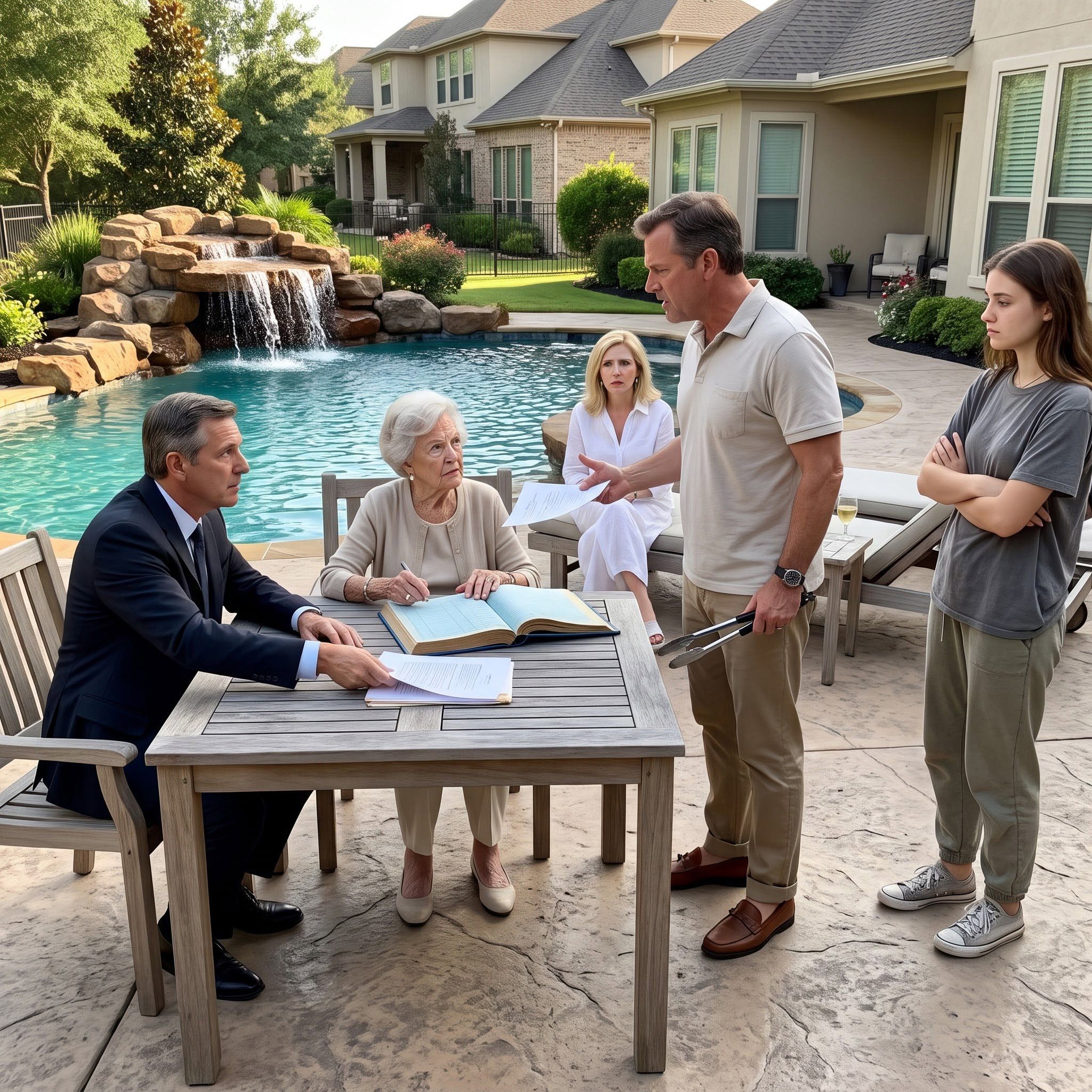
"YOU'D HAVE WASTED THE MONEY ANYWAY!"
My father slammed his barbecue tongs onto the patio table.
Grandma Evelyn opened a blue leather ledger.
One entry was underlined twice.
OLIVIA — COLLEGE DEBT — $64,720 — THROUGH DANIEL.
My father's smile disappeared.
He had just realized I hadn't come to beg.
Three hours earlier, I had been scraping cold scrambled eggs off a stranger's plate when my grandmother walked into Miller's Diner.
I almost didn't recognize her.
Not because she looked different.
Because she wasn't supposed to be there.
Grandma Evelyn Whitmore had never eaten at Miller's. She preferred quiet restaurants with cloth napkins, real silverware, and waiters who remembered how she liked her tea.
Miller's had cracked red booths, sticky menus, and a coffee machine that sounded like it was dying every time someone pressed the button.
It was where I worked on weekends.
And until that Sunday, it was the one place I had successfully kept hidden from my family.
"Olivia?"
I froze with a tray in my hands.
Grandma stood beside booth seven, staring at my stained apron.
"Grandma?"
She looked from my face to the dirty dishes.
Then down at my shoes.
The right one had started splitting near the toe three weeks earlier. I'd been holding it together with glue because replacing it would cost sixty dollars I didn't have.
Her expression changed.
"What are you doing here?"
I forced a smile.
"Working."
"I can see that."
She stepped closer.
"Your father told me you worked in finance."
"I do."
"Then why are you carrying dirty dishes?"
I glanced toward the kitchen.
"Because people don't usually carry them back themselves."
She didn't laugh.
"Olivia."
Something about the way she said my name made my stomach tighten.
I lowered the tray.
"I work in payroll during the week. This is just extra income."
"Extra income for what?"
"Life."
"Be specific."
I sighed.
"Rent. Groceries. Insurance. Student loans."
She went completely still.
"Student loans?"
"Yes."
"How much?"
"Grandma—"
"How much, sweetheart?"
"Four hundred twelve dollars a month."
Her hand moved to the edge of the booth.
I thought she was going to sit down.
Instead, she whispered, "That's impossible."
I tried to smile again.
"Trust me, it's very possible. They take it out of my account every month."
"No."
Her voice was barely audible.
"Your grandfather paid those loans off."
For a moment, I thought I'd misheard her.
"What?"
"Arthur paid them in 2019."
I stared at her.
Then I shook my head.
"No, he didn't."
"Olivia—"
"Grandma, I've been paying those loans for seven years."
Her face lost its color.
"Seven years?"
"Yes."
"Every month?"
"Every single month."
She reached for my wrist.
Her fingers were cold.
"How much do you still owe?"
"A little over forty-two thousand."
She closed her eyes.
I had never seen my grandmother look so old.
"Grandma?"
She opened her eyes again.
"Sit down."
"I can't. I'm working."
"Sit down, Olivia."
I obeyed.
She slid into the booth across from me and took out her phone.
Her hands were trembling.
She found a contact and pressed the call button.
"Martin?"
I watched her face.
"It's Evelyn."
A pause.
"I need you to bring Arthur's blue ledger."
Another pause.
"The original."
She looked directly at me.
"And bring the college payoff documents from August 2019."
My mouth went dry.
"Grandma, what documents?"
She held up one finger.
"Martin, please come to my house immediately."
She ended the call.
For several seconds, neither of us spoke.
Then I asked the question that would change everything.
"What did Grandpa do?"
Grandma looked at me.
And for the first time in my life, she seemed afraid to answer.
"He gave your father sixty-four thousand seven hundred twenty dollars."
I stared at her.
"For what?"
"To pay off your college loans."
I felt the blood drain from my face.
"No."
"He told Arthur the payment had been made."
"No, Grandma."
"He even showed us the confirmation."
I shook my head harder.
"That never happened."
She reached across the table.
"Olivia, your grandfather believed you graduated without debt."
I looked down at my hands.
They were red from hot water and cleaning chemicals.
There was a small burn near my thumb from the coffee machine.
My fingernails were cut short because long nails made it harder to carry trays.
For seven years, I had worked weekends.
Seven years.
And now my grandmother was telling me the money had existed all along.
"Where did it go?" I whispered.
She didn't answer.
Because neither of us knew.
Not yet.
My name is Olivia Whitmore.
I was twenty-nine years old, had a degree in business administration, and worked two jobs because my life had become a collection of bills that never stopped arriving.
Monday through Friday, I worked at Westbridge Payroll Services.
My official title was senior payroll specialist.
It sounded impressive.
I processed wages for employees across eleven locations, corrected payroll discrepancies, reviewed deductions, and spent most of my days making sure other people received their money on time.
On Saturdays and Sundays, I worked at Miller's Diner.
Sometimes I picked up evening shifts, too.
Between the two jobs, I usually worked sixty to seventy hours a week.
During busy periods, it was more.
My father called that poor planning.
"You need to learn how to manage money, Olivia."
He said it at Christmas.
He said it on my birthday.
He said it whenever I mentioned being tired.
He said it the afternoon my car broke down and I asked whether he knew a trustworthy mechanic.
"Maybe stop spending money on things you don't need."
I remembered looking at my phone afterward, wondering what he thought I was buying.
I didn't own designer handbags.
I didn't take vacations.
I hadn't bought a new winter coat in four years.
My apartment had secondhand furniture, a microwave with a broken handle, and a refrigerator that made a loud clicking noise every night.
I bought groceries according to what was on sale.
I kept emergency cash in an envelope behind the cereal boxes.
And every month, I watched four hundred twelve dollars disappear from my checking account.
Sometimes I paid more when I could.
Usually I couldn't.
My father lived in a gated neighborhood fifteen minutes away.
His house had five bedrooms, a three-car garage, an outdoor kitchen, and a swimming pool with a custom rock waterfall.
The pool alone had cost more than I earned in a year.
He loved showing it off.
He posted pictures of himself sitting beside the water with a drink in his hand.
He hosted barbecues.
He invited business associates over.
He talked about hard work and smart investments.
Once, when I arrived at a family gathering wearing shoes with worn soles, he glanced down and laughed.
"Still haven't figured out how to get ahead?"
I smiled because arguing with him never accomplished anything.
He interpreted silence as agreement.
He always had.
What I didn't know was that his comfortable life had been financed, at least in part, by money that was supposed to have freed me from debt.
My grandfather, Arthur Whitmore, was the opposite of my father.
Grandpa didn't care about appearances.
He wore the same brown jacket for fifteen years.
He drove an old sedan long after he could have afforded something better.
He kept receipts.
Every receipt.
Grocery receipts.
Gas receipts.
Property tax statements.
Birthday checks.
He wrote everything down in a blue leather ledger.
When I was little, I used to sit beside him at the kitchen table while he balanced his accounts.
"Money tells a story, Livvy," he would say.
I would roll my eyes.
"Grandpa, money doesn't talk."
He would smile.
"No. But it leaves evidence."
I hadn't thought about those words in years.
Not until Grandma called Martin Bell.
Grandpa had always believed education mattered.
When I graduated from college, he hugged me so tightly I could barely breathe.
"I'm proud of you," he whispered.
I remember laughing.
"You already said that."
"Then I'll say it again."
He kissed the top of my head.
"You worked hard. Now go build yourself a good life."
Three months later, he died.
And everything changed.
After the funeral, my father told me Grandpa's estate was complicated.
"There isn't anything available for grandchildren," he explained.
We were standing in his kitchen.
He was pouring whiskey into a glass.
I hadn't asked for money.
I had only asked whether there was anything I needed to sign.
Dad looked at me with that familiar expression.
The one that made me feel twelve years old again.
"Your grandfather wanted you to be independent."
I nodded.
"Of course."
"Good. Because I won't be supporting you forever."
He said it as though he had been supporting me.
He hadn't paid my rent.
He hadn't paid my tuition.
He hadn't even helped with textbooks.
But I was grieving, exhausted, and too young to understand that sometimes the people who talk most about responsibility are the ones avoiding it.
So I believed him.
I believed Grandpa had left me nothing.
I believed my father knew best.
And I spent the next seven years paying for that belief.
My manager, Rita, found me sitting in booth seven with my grandmother.
"Olivia?"
I looked up.
"You okay?"
I opened my mouth.
Nothing came out.
Rita glanced at Grandma.
"Is everything all right?"
Grandma answered before I could.
"There's been a family emergency."
Rita looked at me again.
"Go home."
"I can't. I need the hours."
She shook her head.
"I'll cover your shift."
"Rita—"
"Olivia, you've covered enough shifts for everybody in this place. Go."
I almost cried.
Not because of what Grandma had told me.
Because Rita had said something kind without expecting anything in return.
I took off my apron and folded it.
Then I followed Grandma outside.
Her car smelled faintly of lavender.
She drove without speaking for the first few minutes.
I watched familiar buildings pass through the window.
Finally, I asked, "Did Grandpa really give Dad that much money?"
"Yes."
"Are you sure?"
"Arthur told me himself."
I swallowed.
"Then why didn't he tell me?"
Grandma tightened her grip on the steering wheel.
"Daniel said you knew."
I turned toward her.
"What?"
"He said you were embarrassed about accepting help."
My chest tightened.
"He said that?"
"He told us you wanted to stand on your own."
I stared at her.
"He told me Grandpa left nothing."
Grandma's eyes filled with tears.
"Oh, Olivia."
"He told me there wasn't any money for grandchildren."
She shook her head.
"Arthur wanted to make sure you started your adult life without that burden."
I looked out the window.
For years, I had felt guilty whenever I thought about Grandpa.
I had wondered whether I had disappointed him.
Whether he had expected me to become more successful.
Whether he would have been ashamed to see me waiting tables at twenty-nine.
Now I learned he had tried to help me.
And someone had stood between us.
Someone with my last name.
Martin Bell arrived at Grandma's house shortly after noon.
He was a tall man in his early sixties with neatly combed gray hair and rectangular glasses.
He had been my grandparents' attorney for more than twenty years.
I remembered him from Grandpa's funeral.
He had stood quietly beside the church entrance, holding Grandma's coat.
Now he walked into her kitchen carrying a dark leather portfolio and an old blue ledger.
"Olivia," he said.
"Mr. Bell."
"Martin is fine."
He placed the ledger on the table.
Grandma sat beside me.
Nobody offered coffee.
Nobody made small talk.
Martin opened the book.
The pages were filled with Grandpa's handwriting.
Neat columns.
Dates.
Amounts.
Short explanations.
Everything organized.
Everything accounted for.
Martin turned to August 2019.
Then he placed his finger beneath one entry.
"Read that."
I leaned forward.
OLIVIA — COLLEGE DEBT — $64,720 — THROUGH DANIEL.
I stared at the words.
My name.
My debt.
My father's name.
And an amount large enough to have changed my entire life.
"That's Grandpa's handwriting," I whispered.
Grandma nodded.
Martin opened his portfolio.
He removed a printed email and placed it beside the ledger.
The sender was my father.
The recipient was Grandpa.
The date was August 14, 2019.
The message read:
Funds received. I will remit the full amount to her loan servicer as instructed.
I read it twice.
Then a third time.
"That means Dad got the money."
"Yes," Martin said.
"Did he send it?"
Martin didn't answer immediately.
Instead, he removed another sheet of paper.
It was a loan payoff confirmation.
My name appeared at the top.
The logo of my loan servicer was printed in the corner.
The document stated that my outstanding balance had been paid in full.
For one wonderful second, I felt relief.
Maybe the payments I'd been making were a mistake.
Maybe the servicer had mishandled something.
Maybe all I needed was to show them the confirmation.
Then I looked at the account number.
And my stomach dropped.
"That's wrong."
Martin leaned closer.
"What is?"
"The account number."
I pointed at the document.
"That's not mine."
Grandma frowned.
"Are you certain?"
I almost laughed.
"Grandma, I've been paying that loan for seven years. I know the account number."
I took out my phone.
Opened the loan servicer's app.
Pulled up my most recent statement.
Then I placed the phone beside the document.
The numbers didn't match.
Not even close.
Martin adjusted his glasses.
He compared them carefully.
Then he looked at Grandma.
"Evelyn, we have a serious problem."
She sat very still.
"What kind of problem?"
Martin tapped the confirmation.
"This document may not be genuine."
I stared at him.
"What does that mean?"
"It means we need to verify whether the payment was ever made and determine where the money went."
I looked at the paper again.
My name.
A fake confirmation.
A false account number.
And my father's email.
Suddenly, I remembered something.
A photograph.
A Facebook post.
My father standing beside a brand-new swimming pool.
Celia holding a glass of champagne.
The waterfall cascading behind them.
The caption read:
Hard work pays off.
I remembered being happy for him.
I remembered liking the photograph.
I remembered sitting in my apartment that same evening, eating instant noodles because I couldn't afford groceries until payday.
And I remembered the date.
September 2019.
Three weeks after Grandpa's transfer.
"Oh my God," I whispered.
Grandma touched my arm.
"What?"
I looked at Martin.
"My father's swimming pool."
He waited.
"He built it right after Grandpa sent him the money."
Martin's expression sharpened.
"Do you have photographs?"
I opened Facebook.
Scrolled through years of posts.
Found the picture.
There was Dad.
Smiling beside the turquoise water.
The rock waterfall.
The expensive landscaping.
The custom patio.
The outdoor kitchen.
And a brass plaque mounted beside the grill.
THE GOOD LIFE — EST. 2019.
I turned the screen toward Martin.
He studied the date.
Then he looked at Grandma.
"Did Daniel ever explain how he paid for the renovation?"
Grandma frowned.
"He said his business had done well."
I shook my head.
"Dad told me he got a big contract."
Martin wrote something down.
"Do you know approximately how much the pool cost?"
"No."
I hesitated.
"But Dad said the whole backyard project was over a hundred thousand dollars."
Grandma covered her mouth.
Martin didn't speak for several seconds.
Then he said, "I think we need to follow the money."
At work, I reconciled payroll discrepancies across eleven locations.
I knew how financial records worked.
I knew that every transaction had a date.
Every payment had a destination.
Every missing dollar left a question someone eventually had to answer.
So I opened my laptop.
I downloaded seven years of student loan statements.
Every payment.
Every interest charge.
Every automatic withdrawal.
Every extra amount I'd managed to send when I had a good month.
I entered the numbers into a spreadsheet.
Martin watched quietly.
Grandma sat near the window.
When I finished, I stared at the total.
Thirty-four thousand six hundred eight dollars.
That was how much I'd paid since 2019.
And I still owed more than forty-two thousand.
I stared at the screen.
Then at Grandpa's ledger.
The money had existed.
Grandpa had sent it.
Dad had received it.
But my loans had never been paid.
I thought about every Saturday morning I'd dragged myself out of bed.
Every birthday I'd missed because I needed another shift.
Every time I'd declined an invitation because I couldn't afford dinner.
Every time Dad had laughed at me for struggling.
My throat tightened.
But I didn't cry.
Not yet.
I was too angry.
"Olivia?"
Grandma's voice brought me back.
I looked at her.
She was crying.
"I'm sorry," she whispered.
I shook my head.
"You didn't know."
"I should have."
"Grandma—"
"Your father told me you wanted to be independent. Whenever I suggested visiting, he said you were busy."
I looked down.
"I was busy."
"Because you were working two jobs."
I nodded.
She wiped her cheeks.
"All this time, I thought I was respecting your wishes."
I reached for her hand.
"You were trusting your son."
She looked at Grandpa's ledger.
"Yes."
Her expression hardened.
"And he knew exactly how to use that trust."
At 1:16 p.m., my phone vibrated.
A message from Dad.
Heard you ran into your grandmother. Don't bother her with your financial drama.
I stared at the screen.
Then another message arrived.
She's too old to deal with your problems.
I turned the phone toward Grandma.
She read both messages.
Her expression changed.
Not dramatically.
She didn't gasp.
She didn't raise her voice.
She simply became very still.
"Martin," she said.
He looked up.
"Yes?"
"I want to know exactly what Daniel did with Arthur's money."
Martin nodded.
"We'll need to obtain the relevant records."
"Then obtain them."
"And if the documents confirm what we suspect, we can discuss recovery options and possible legal action."
Grandma folded her hands.
"Do whatever is necessary."
I looked at her.
"Grandma, I don't want you fighting with Dad because of me."
She turned toward me.
"Olivia, this isn't because of you."
Her voice was firm.
"This is because my son may have stolen money his father entrusted to him."
I had never heard her speak about Dad that way.
Not once.
She stood and walked toward the kitchen window.
For a moment, she looked much older than seventy-nine.
Then she straightened her shoulders.
"Arthur believed Daniel would do the right thing."
She turned around.
"If Daniel betrayed that trust, he will answer for it."
Martin closed his portfolio.
"I'll make some calls."
For the next forty minutes, Martin worked from Grandma's dining room.
He contacted the financial institution that had handled Grandpa's transfer.
He requested records from the trust administrator.
He spoke with a forensic accountant he knew.
He explained that obtaining complete banking records could take time and might require formal legal procedures.
I sat at the kitchen table, staring at my spreadsheet.
Every number seemed to mock me.
Four hundred twelve dollars.
Month after month.
Seven years.
I remembered the winter my apartment heater broke.
I had slept in two sweaters because the repair bill would have meant missing my loan payment.
I remembered turning down a better-paying job in another city because I couldn't afford to relocate.
I remembered crying in my car after a twelve-hour shift because my checking account had fallen below twenty dollars.
And I remembered my father telling me that struggling built character.
My phone vibrated again.
Dad.
You need to stop filling your grandmother's head with nonsense.
I didn't answer.
Another message.
Whatever she thinks she owes you, she doesn't.
I read it twice.
Then I showed Martin.
He studied the messages.
"Don't delete these."
"I won't."
"Save screenshots."
I did.
Then I asked, "Does he know?"
Martin looked at me.
"Know what?"
"That we found the ledger."
"I can't say."
I stared at Dad's message.
He had always been confident.
Always dismissive.
Always certain that everyone else would eventually do what he wanted.
But this message felt different.
It felt like a warning.
I wondered whether he was afraid.
And if he was, what exactly he was afraid we would discover.
At 1:43 p.m., Martin's phone rang.
He answered immediately.
"Bell speaking."
I watched him listen.
His expression grew serious.
"Are you certain?"
A pause.
"And the transfer date?"
He reached for his pen.
"August fourteenth?"
He wrote something down.
"Please send me what you're authorized to provide."
He ended the call.
Grandma looked up.
"What happened?"
Martin sat down.
"We've confirmed that the original transfer was completed."
I felt my heartbeat quicken.
"To Dad?"
"To an account controlled by Daniel, yes."
Grandma closed her eyes.
"And the college payment?"
"There's no evidence in the materials we've reviewed that the money reached Olivia's loan servicer."
I stared at him.
"So he took it."
Martin held my gaze.
"We have evidence that he received the money and did not make the payment he promised. We still need the complete account records to establish where the funds went."
I nodded.
I understood the difference.
At work, I couldn't accuse someone of stealing because a number looked wrong.
I had to prove it.
And Martin was going to prove it.
He opened his laptop.
A new email appeared.
He clicked it.
Then stopped.
His eyes moved across the screen.
Slowly.
He scrolled down.
Then back up.
"Martin?" Grandma asked.
He didn't answer.
He opened the attachment.
It was a scanned document.
A formal acknowledgment of payment.
My name appeared near the bottom.
Below it was a signature.
I leaned closer.
At first, I couldn't understand what I was seeing.
Then my stomach turned.
Because the signature was supposed to be mine.
And I had never signed it.
"That's not my handwriting."
Martin looked at me.
"Are you absolutely certain?"
"Yes."
I pointed at the screen.
"I don't sign my name like that."
Grandma leaned forward.
Her face drained of color.
"What is that document?"
Martin read the heading.
Then he looked at me.
"It's an acknowledgment stating that you received the benefit of the college payoff."
I shook my head.
"I never received anything."
"According to this document, you did."
"But I didn't sign it."
Martin enlarged the image.
The signature filled the screen.
My name.
My supposed acknowledgment.
A transaction I knew nothing about.
I stared at the date.
August 16, 2019.
Two days after Grandpa sent the money.
I thought about where I had been that week.
I had been moving into my first apartment after graduation.
I had spent most of the day carrying boxes up three flights of stairs.
Dad hadn't helped.
He had told me he was too busy.
I looked at Martin.
"Someone forged my signature."
He didn't answer immediately.
He was studying something near the bottom of the document.
A small line of text.
A certification field.
He leaned closer.
Then adjusted his glasses.
"What?" I asked.
He enlarged the bottom section.
A second signature appeared.
Beneath it was a printed name.
DANIEL WHITMORE.
My father.
Martin went completely still.
Grandma rose from her chair.
"Martin?"
He looked at her.
Then at me.
And his voice became very quiet.
"Olivia, this document doesn't just claim you received the money."
He pointed to the line beneath my father's name.
"It identifies the person who certified your signature."
I leaned toward the screen.
There was a date.
A certification statement.
And one final line I hadn't noticed.
Martin moved his finger toward it.
"Look at who supposedly witnessed you signing this."
I followed his finger.
The name began to come into focus.
And when I recognized it, my heart nearly stopped.






Comments 0