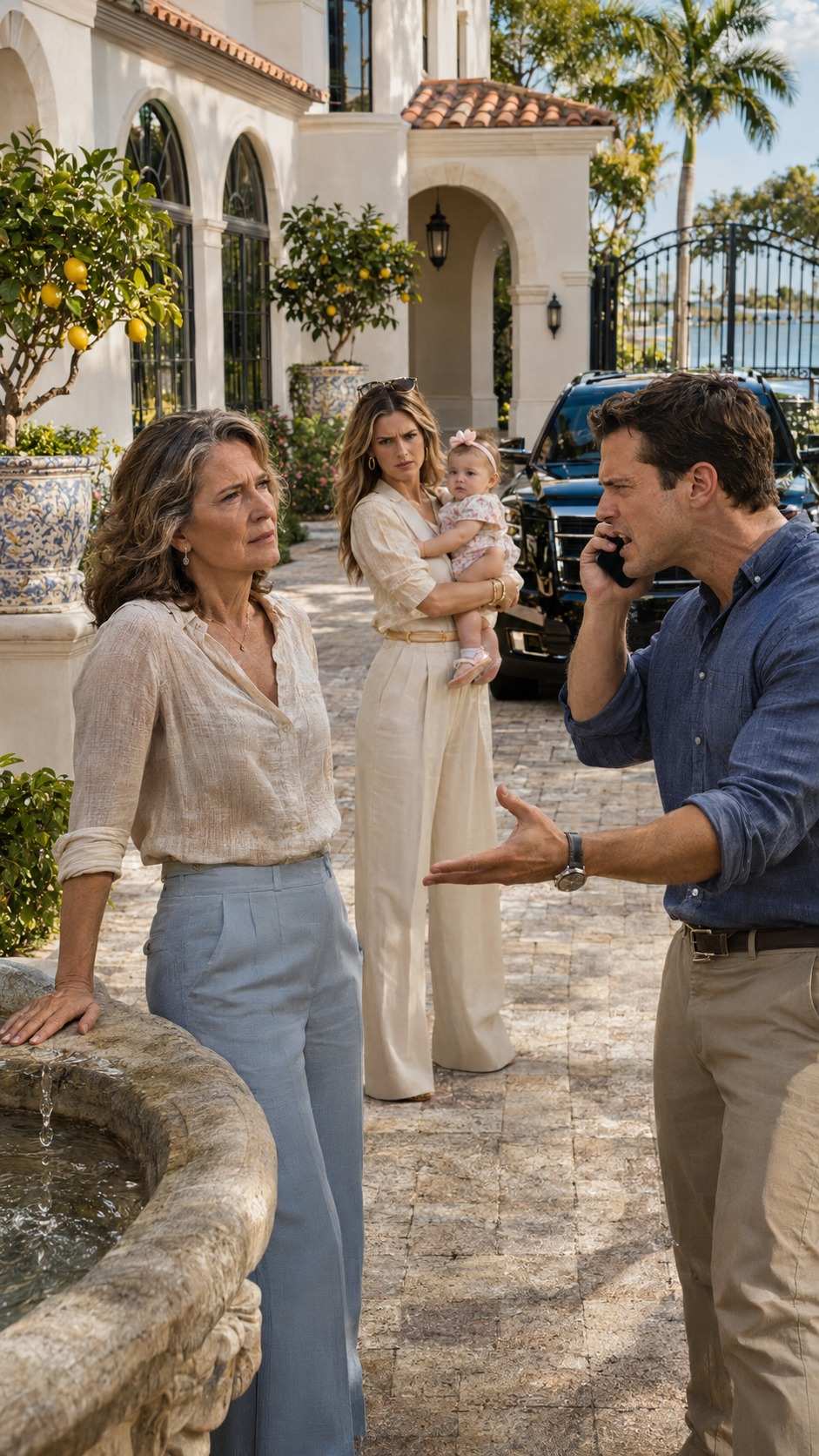
"Send an officer! My mother is trying to throw my wife and baby out of our home!"
My forty-year-old son, Preston, shouted those words into his cellphone while standing beside my courtyard fountain.
He held his phone in one hand and pointed at me with the other.
Behind him stood a black SUV, a white Mediterranean villa, and his wife holding their ten-month-old daughter.
The dispatcher asked him for the property address.
Preston gave it without hesitation.
Then he said something that made my blood run cold.
"She's sixty-one, recently divorced, and mentally unstable."
I looked toward the small security camera above my front entrance.
Preston had just made the biggest mistake of his life.
And he didn't know it yet.
My name is Eleanor Whitmore. I'm sixty-one years old, recently divorced, and the sole legal owner of a beautiful waterfront villa near Sarasota, Florida.
Six months earlier, I would never have imagined that my only child would stand on my property and tell an emergency dispatcher that I was incapable of making decisions.
I certainly never imagined he would use my granddaughter as part of his attempt to take my home.
But there he was.
My son.
The little boy who used to climb into my bed during thunderstorms.
The teenager whose first car I helped purchase.
The young man whose rent I'd covered when he lost his job.
Now he was standing in my courtyard, trying to convince the police that I was a danger to his family.
"Preston," I said quietly, "you need to tell that woman the truth."
He turned away from me.
"She's getting aggressive now," he told the dispatcher.
I almost laughed.
Not because anything was funny.
Because the accusation was so outrageous that, for one brief second, I couldn't believe I was hearing it.
I was standing beside my own fountain, wearing a silk blouse and tailored trousers, with one hand resting on the limestone rim.
I hadn't raised my voice.
I hadn't threatened anyone.
I hadn't even moved toward him.
But Preston had already decided what kind of woman I was going to be in his version of events.
An unstable elderly mother.
A confused divorcee.
Someone who needed to be controlled.
His wife, Kendra, stood near the SUV with their daughter, Lila, balanced against her hip.
Kendra was thirty-five, polished, fashionable, and exceptionally skilled at making an insult sound like concern.
She watched me with an expression I had come to recognize.
It was the look she wore whenever she believed Preston was about to get his way.
"Tell them about the baby," she called.
Preston nodded.
"There's an infant involved," he said into the phone. "My mother is threatening to make us homeless."
I closed my eyes for a moment.
Six weeks earlier, those same two people had visited the tiny apartment I was renting behind a laundromat.
They hadn't seemed particularly worried about my housing situation then.
In fact, they had found it embarrassing.
"Mom, you're sixty-one," Preston had said, looking around my cramped kitchen. "You should be thinking practically, not pretending you're going to start over."
Kendra had taken one look at the peeling cabinets and said, "Renting is fine for some people."
I remembered the way she'd emphasized those last two words.
Some people.
As though I belonged to a category of women who should accept less.
As though my life had already reached its final chapter.
They hadn't known about my investments.
They hadn't known about the commercial properties.
And they certainly hadn't known about the money.
For thirty-four years, I had been married to a man named Richard Whitmore.
To our friends, Richard was charming, successful, and generous.
He knew how to work a room, order expensive wine, and make everyone believe he was the smartest person at the table.
What most people didn't know was that I handled our finances.
I paid the bills.
I tracked our investments.
I worked with our accountant.
And when Richard wanted to make a financial decision, I was usually the person who explained whether we could afford it.
My grandmother had left me a modest inheritance when I was twenty-nine.
Rather than spend it, I invested part of it in two commercial properties.
Over the years, those investments grew.
I maintained careful records, kept the ownership documents in order, and made sure the properties remained legally mine.
Richard enjoyed telling people that he had built our comfortable life.
I rarely corrected him.
I didn't need applause.
I needed security.
When our marriage finally ended, that distinction mattered more than I could have imagined.
Richard kept the lake house.
He kept the boat.
He kept the expensive furniture he'd always loved.
He also kept most of the friends who had once gathered around our dining table.
I walked away with my sewing machine, my grandmother's china, several boxes of books, and the right to begin again.
The divorce exhausted me.
For weeks, I barely slept.
I rented a small apartment in Sarasota because I wanted time to think before making any major decisions.
The kitchen cabinets were peeling.
The bathroom fan rattled.
And every afternoon, I could hear the laundromat machines humming through the wall.
But it was mine.
For the first time in decades, nobody criticized how I spent my mornings.
Nobody questioned why I wanted to read instead of entertain guests.
Nobody complained when I stayed up late sewing.
I had peace.
And peace, I discovered, was worth more than a beautiful house filled with unhappiness.
Then my attorney called.
The sale of my second commercial property had closed.
After taxes and expenses, I had enough money to purchase a home I had once believed existed only in magazines.
I found the villa on a quiet road near the bay.
White stucco walls.
Terracotta roof tiles.
Tall arched windows.
Four bedrooms.
A marble fireplace.
A swimming pool.
A courtyard with a carved stone fountain and two lemon trees growing in enormous ceramic planters.
Behind the garden stood a detached guesthouse.
The moment I saw it, I imagined turning that little building into an art and sewing studio.
I pictured long afternoons with fabric spread across a worktable, sunlight coming through the windows, and nobody telling me I was wasting my time.
I purchased the property outright.
No mortgage.
No co-owner.
No family agreement.
Just my name on the deed.
For three wonderful weeks, I lived there quietly.
I unpacked my grandmother's china.
I arranged my books.
I bought fresh flowers for the kitchen.
I sat beside the pool in the evenings and listened to the palm trees moving in the breeze.
I hadn't told Preston.
Not because I wanted to hurt him.
Because I wanted something that belonged entirely to me before anyone else decided what I should do with it.
Then my neighbor Diane posted photographs from a small housewarming dinner.
Forty-three minutes later, my phone started ringing.
"Mom," Preston said when I answered, "what is that house?"
"My new home."
There was a pause.
"Your new what?"
"My home, sweetheart."
"How much did it cost?"
I should have recognized the warning in that question.
Instead, I told him I had purchased it using the proceeds from my investments.
He became unusually quiet.
Then he asked for the address.
By Saturday morning, his black SUV was parked outside my gate.
Kendra sat in the passenger seat.
Lila was strapped into her car seat.
I opened the gate because, despite everything, they were my family.
I wanted to believe they were coming to celebrate with me.
For the first few minutes, Preston behaved like a proud son.
He admired the courtyard.
He complimented the pool.
He asked about the kitchen appliances.
Then he began opening doors.
He inspected the bedrooms.
He walked through the guesthouse.
He studied the garage.
At one point, he asked whether the property had a security system.
I told him it did.
He nodded thoughtfully.
I assumed he was concerned about my safety.
Now I understood he had been evaluating the house for an entirely different reason.
Upstairs, Kendra stepped into a small bedroom overlooking the garden.
"This would make the cutest nursery," she said.
I smiled politely.
"I was thinking of putting bookshelves in here."
Her expression changed.
"Bookshelves?"
"Yes. I have quite a collection."
She looked toward Preston.
Something passed between them.
A glance.
A silent understanding.
I noticed it.
But I didn't yet understand what it meant.
When we returned to the courtyard, Preston stood beside the fountain and looked around.
"It's perfect," he announced.
I felt a small rush of happiness.
"Thank you, sweetheart."
Then he turned toward his wife.
"Kendra is going to love living here."
I waited for him to laugh.
He didn't.
"What did you say?"
He looked genuinely surprised by my question.
"We've been talking about this. The house is perfect for us."
"Us?"
"Me, Kendra, and Lila."
I stared at him.
He continued as though he were discussing a perfectly reasonable arrangement.
"You can take the guesthouse. It's actually ideal. Smaller, easier to maintain, and you won't have to worry about all these rooms."
I remember the sound of the fountain behind him.
I remember a bird calling from one of the lemon trees.
I remember the strange sensation of hearing my own son explain how he intended to move me out of my home.
"Preston," I said, "I'm not moving into the guesthouse."
He frowned.
"Mom, don't make this difficult."
"This is my home."
"And we're your family."
"That doesn't make it your house."
Kendra shifted Lila against her shoulder.
"Eleanor, think about how wonderful this would be for the baby."
"I love Lila," I said. "But that doesn't change my answer."
Preston sighed.
"You're one person, Mom. We're three. It doesn't make sense for you to occupy a four-bedroom house."
I looked at him for a long moment.
Then I said the word he apparently had never expected to hear.
"No."
His expression hardened.
He tried reasoning.
Then guilt.
Then frustration.
Finally, he warned me that the conversation wasn't over.
That evening, he sent a message saying they would return the following weekend to organize the move.
I replied with one sentence.
"You are not moving into my house."
I thought that would settle the matter.
It didn't.
The following Saturday, at exactly 7:43 in the morning, my security system alerted me to movement outside the gate.
Preston's SUV was in the driveway.
Behind it sat a white moving truck.
He had packed his family's belongings.
He had hired movers.
He had apparently decided that my refusal was irrelevant.
When I spoke through the gate intercom, he sounded furious.
"We already gave notice on our rental!"
"That was your decision."
"We have nowhere to go!"
"Then you need to make other arrangements."
He held up Lila's car seat.
"You're really going to do this to your granddaughter?"
My heart hurt.
But I kept the gate closed.
Eventually, the moving truck drove away.
I thought the worst was over.
Later that morning, Diane returned from the grocery store.
Preston followed her car through the gate before it closed.
By the time I reached the courtyard, he was unloading suitcases beside the guesthouse.
I gave him ten minutes to remove them.
Then I called a locksmith.
Every exterior lock was changed that afternoon.
While collecting the storage bins Preston had abandoned, I noticed something silver beside the guesthouse door.
A key.
Small.
Newly cut.
With a single black letter written on its plastic tag.
G.
I picked it up.
For several seconds, I simply stared.
Then I called Preston.
"Did you make a copy of my guesthouse key?"
He didn't answer immediately.
That silence told me more than any explanation could have.
Finally, he said, "Mom, don't start acting paranoid."
"Where did you get this key?"
"It's not a big deal."
"Preston."
His voice changed.
"You really need to stop treating everything like a personal attack."
I looked toward the guesthouse.
"How did you get access to that lock?"
Another pause.
Then he said something I would remember for a very long time.
"You should be grateful we're willing to take care of you."
I ended the call.
That evening, I placed the silver key in a small envelope.
I wrote the date on the front.
Then I put it inside the locked drawer of my desk.
I didn't know whether the key would ever matter.
But something about it frightened me.
Not the metal.
Not the letter.
The certainty with which my son had behaved as though my property belonged to him.
And now, standing beside my fountain while Preston spoke to the emergency dispatcher, I understood that the key had been only the beginning.
"Sir," the dispatcher said faintly through his phone, "are you currently residing at that address?"
Preston hesitated.
I watched him carefully.
Then he answered.
"Yes. This is our family home."
I felt something inside me go very still.
He had crossed a line.
Not by demanding my house.
Not by insulting my judgment.
But by telling a lie that could be checked.
I looked toward the front entrance.
Above the dark wooden door, the discreet security camera continued recording.
And just inside that door was the control panel connected to the system I'd installed shortly after moving in.
Preston followed my gaze.
For the first time that afternoon, he stopped talking.
His eyes narrowed.
"Mom," he said slowly, covering the phone's microphone, "what are you looking at?"
I didn't answer.
Because at that exact moment, my phone vibrated in my pocket.
A notification appeared from the security system.
FRONT ENTRANCE — SAVED EVENT AVAILABLE.
I opened the alert.
The screen displayed a recording from the morning Preston had arrived with the moving truck.
I tapped the video.
And the first voice I heard wasn't Preston's.
It was Kendra's.
She was standing beside my front door, speaking to someone just outside the camera's view.
Then she said five words that made my stomach drop.
"She doesn't know about it."
I turned up the volume.
A second voice answered.
And when I recognized who was speaking, my hand froze above the screen...






Comments 0