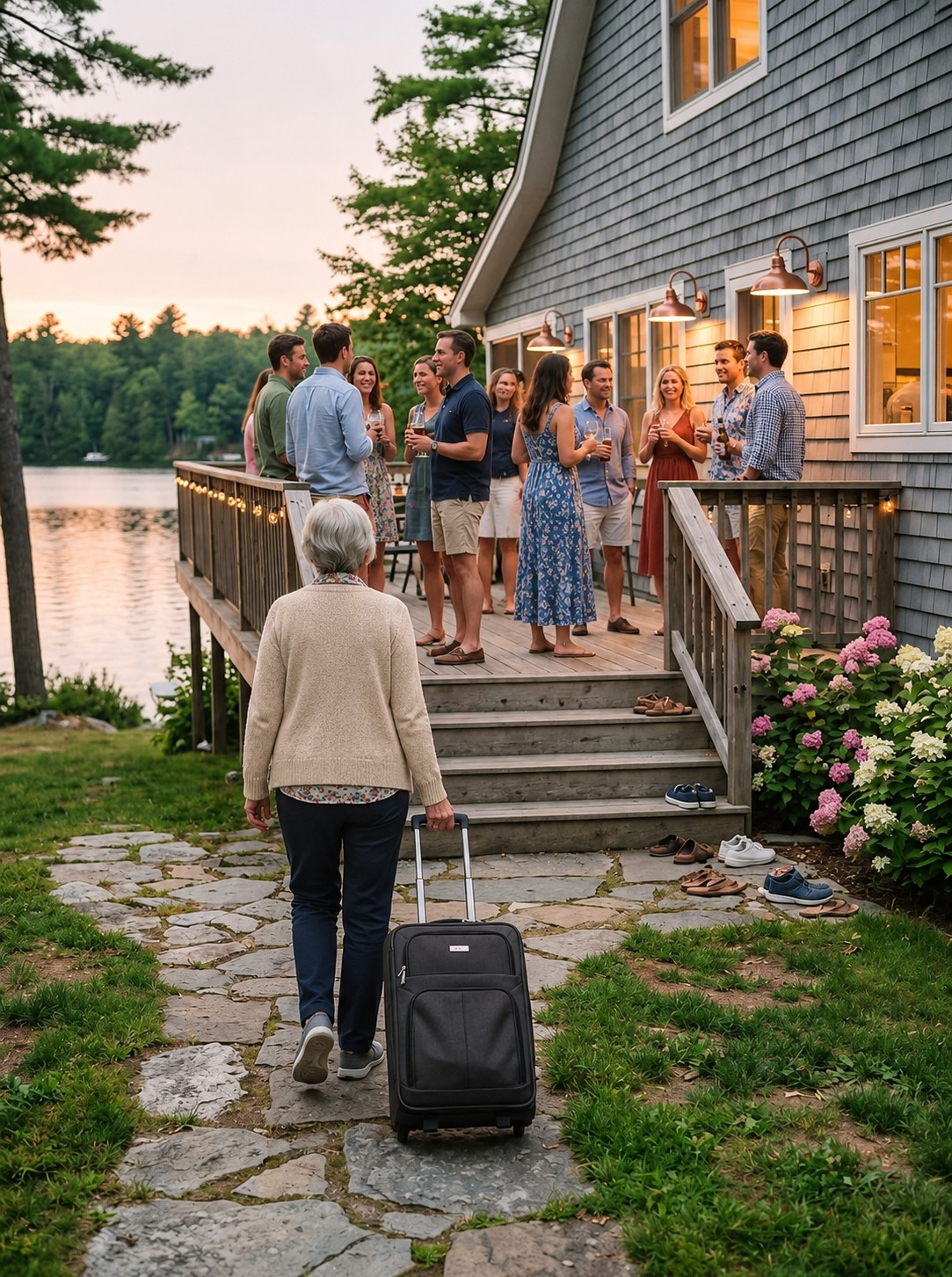
Arthur Bennett had always been careful with words.
That was one of the reasons I trusted him.
He didn't dramatize things.
He didn't rush to conclusions.
And he certainly didn't call a seventy-year-old widow on a Friday afternoon to frighten her without reason.
So when he told me there was a document bearing what appeared to be my signature, I knew I needed to listen.
I sat in the parking lot of a small grocery store, watching people push shopping carts toward their cars.
A young mother struggled to buckle a toddler into a car seat.
An older man loaded two bags of groceries into the trunk of a faded sedan.
Ordinary life continued around me.
Meanwhile, my own life seemed to have tilted slightly off its foundation.
"Arthur," I said, "tell me exactly what you found."
He paused.
"There's a document that appears to authorize temporary management of the lake property."
"Management?"
"Yes."
"By whom?"
"Robert Whitmore."
I closed my eyes.
My son.
My only child.
The boy I had raised.
The man whose first steps I still remembered.
I had spent years believing that whatever differences existed between us, one thing would never change.
He would not deliberately hurt me.
"Robert?" I whispered.
"His name appears on it."
"And you said there was someone else?"
"Yes."
I waited.
"Megan Whitmore."
I opened my eyes.
Across the parking lot, the toddler had begun crying.
His mother lifted him from the car seat and held him against her shoulder.
I watched her rock him gently.
And for one painful second, I remembered holding Robert exactly that way.
"Are you certain?" I asked.
"I'm certain of the names. I'm not yet certain the document is valid."
"What does it allow them to do?"
"That's what I need to examine more closely."
"Arthur, please."
He sighed.
"The language suggests they were seeking authority to arrange short-term occupancy and manage certain property-related transactions."
I stared at the dashboard.
"Short-term occupancy?"
"Yes."
"Do you mean renting my house?"
"Possibly."
My mouth went dry.
I thought of the coolers.
The parked cars.
The strangers.
The woman wearing my apron.
"Arthur, there are people there right now."
"I understand."
"Could they be paying to stay?"
"I don't know."
I thought back to the deck.
The guests seemed familiar with one another.
Megan had called it a family weekend.
But I hadn't recognized everyone.
And suddenly I wondered whether that was because they weren't all family.
"Where did this document come from?" I asked.
"A title company contacted my office requesting clarification about a recorded authorization."
"Why your office?"
"Because my firm handled the original purchase, and our information appeared in the associated records."
"Did they think I signed it?"
"They were asking whether I could verify it."
"And could you?"
"No."
The word came quickly.
Firmly.
"I told them I couldn't authenticate your signature without speaking to you."
I leaned back against the seat.
The car felt too warm.
"Arthur, I want to come in."
"Good. I'll wait."
I ended the call.
For a moment, I sat without moving.
Then I opened the glove compartment and took out a tissue.
I wasn't crying.
Not yet.
But my hands had begun to shake.
I pressed the tissue between my fingers until the trembling eased.
Then I started the engine.
Arthur's office was in a brick building near the courthouse.
He had been there for almost thirty years.
I knew the waiting room well.
The green upholstered chairs.
The framed photographs of the lake.
The little bowl of peppermint candies on the reception desk.
His assistant, Helen, looked up when I entered.
"Eleanor."
She stood immediately.
"Arthur's expecting you."
I tried to smile.
"Hello, Helen."
Her expression softened.
"Would you like some water?"
"Yes, please."
She brought me a glass and led me down the hallway.
Arthur was standing behind his desk when I entered.
He was in his late sixties, with thinning gray hair and reading glasses that always seemed to be slipping down his nose.
He came around the desk and took my hand.
"Eleanor."
"Arthur."
He pulled out a chair.
"Sit down."
I did.
On his desk lay a thin folder.
A yellow legal pad.
And several printed pages.
He waited until I had taken a sip of water.
Then he opened the folder.
"I want to be very clear," he said. "At this point, we have questions, not conclusions."
I nodded.
He slid a document toward me.
At the top were the words:
PROPERTY MANAGEMENT AUTHORIZATION.
Below that was the address of my lake house.
My address.
My property.
My refuge.
I read the first paragraph.
Then the second.
The language was formal, full of phrases that seemed designed to make simple things difficult to understand.
But I understood enough.
The document claimed I had authorized Robert and Megan to coordinate occupancy arrangements and certain maintenance-related services.
I looked at Arthur.
"I never agreed to this."
"I believe you."
I read farther.
Then I saw it.
My name.
Eleanor Whitmore.
Written in a flowing signature at the bottom of the page.
For a moment, I couldn't breathe.
It looked like my handwriting.
Almost.
The first letter was correct.
The long loop in the W was familiar.
But the final stroke was wrong.
I had signed my name thousands of times.
On checks.
On invoices.
On school permission slips.
On medical forms.
On the paperwork that purchased my home.
I knew my own signature.
And that wasn't it.
"Arthur," I said, pointing, "that's not mine."
He leaned forward.
"Tell me why."
"The last letter."
He looked closely.
"I always finish the e with a little upward line."
I demonstrated with my finger.
"This one curves down."
Arthur nodded.
"Anything else?"
"The spacing."
I swallowed.
"And the W is too neat."
He wrote something on his legal pad.
Then he asked, "Do you have a recent example of your signature?"
"Of course."
I opened my purse and took out my checkbook.
I wrote my name on a blank piece of paper.
Arthur placed it beside the document.
Even I could see the differences.
Small.
But real.
He studied both signatures.
"We'll preserve this comparison."
I looked at the document again.
"Who submitted it?"
"That's one of the questions we're investigating."
"Was it Robert?"
"I don't know yet."
"Was it Megan?"
"Again, I don't know."
I felt anger rise in my chest.
Then I remembered Megan standing on my deck.
The way she had smiled when I agreed to leave.
The certainty in her voice.
She had behaved like a woman who believed the house was already under her control.
"Arthur, I need to tell you something."
He looked up.
"When I arrived, Megan had a key."
"To the house?"
"Not just the house."
I explained about the brass key and the faded blue ribbon.
Arthur listened.
"Where was the cabinet?"
"In the utility room."
"What did you keep inside?"
"Important papers. Old receipts. Some insurance records."
"Anything with your signature?"
I hesitated.
Then my stomach dropped.
"Yes."
Arthur waited.
"Copies of the closing documents."
He set down his pen.
"And?"
"Some old checks. Letters. A few signed forms."
He leaned back.
"Eleanor, has anyone besides you had access to that cabinet?"
"Robert knew where it was."
"Did he have a key?"
"He used to."
"Used to?"
"Thomas gave him a spare years ago, when Robert helped us repair the kitchen."
Arthur nodded slowly.
I stared at the papers on the desk.
I didn't want to think what I was thinking.
But the thought was there.
Someone had obtained a copy of my signature.
Someone had created a document I never signed.
And someone was using that document to claim authority over my property.
I looked at Arthur.
"What do we do?"
"First, we verify the document's origin and whether anything has been recorded or acted upon."
"Then?"
"We notify the relevant parties that you dispute the authorization."
"Can we remove the people from my house?"
"We need to establish who they are and what arrangements were made. We can take appropriate legal steps, but I don't want you confronting anyone or attempting to force them out yourself."
I nodded.
He continued.
"I also want to review your title records and confirm there have been no changes."
"Changes?"
"Transfers, liens, encumbrances. Anything affecting ownership."
My heart sank.
"Arthur, could someone have taken my house?"
He met my eyes.
"Your deed still shows you as the owner based on the records I've reviewed so far."
I exhaled.
"But we need to understand what this authorization was intended to accomplish."
I looked down at my hands.
They were folded tightly in my lap.
The same hands that had sewn wedding gowns.
The same hands that had held Robert when he was sick.
The same hands that had signed the deed to my lake house.
I had always believed hard work was enough to protect the things you earned.
Now I was learning that sometimes you also needed to protect them from people you loved.
Arthur reached across the desk.
"Eleanor."
I looked up.
"You're not alone in this."
For the first time that afternoon, tears filled my eyes.
I blinked them away.
"Thank you."
He handed me a tissue.
We spent the next hour reviewing documents.
Arthur made notes.
Helen brought copies of several records.
I answered questions about when Robert had last visited the house.
Whether Megan had ever asked to use it.
Whether I had given anyone permission to rent it.
Whether I had signed any power of attorney.
I answered no.
Again and again.
No.
No.
No.
Then Arthur asked something unexpected.
"Has Robert been having financial difficulties?"
I frowned.
"Not that I know of."
"Has he mentioned debts?"
"No."
"Business problems?"
"He works in commercial sales. He's always said things were going well."
Arthur wrote something down.
"Why do you ask?" I said.
"Because sometimes unauthorized property arrangements are connected to financial pressure."
I stared at him.
"Are you saying my son might have needed money?"
"I'm saying we should not assume anything until we have evidence."
I nodded.
But the possibility had already taken root.
Robert had always been ambitious.
Even as a boy, he wanted the best bicycle.
The newest shoes.
The things other children had.
Thomas used to say ambition was good as long as it didn't make a person forget what mattered.
I wondered whether Robert had forgotten.
Or whether Megan had convinced him that wanting something was the same as deserving it.
By the time I left Arthur's office, the sun was beginning to sink behind the buildings.
He had arranged for a title review and said he would contact the relevant parties.
He also advised me to keep records of everything that had happened.
"Write down the conversation while it's fresh," he said.
"I will."
"And Eleanor?"
"Yes?"
"Don't delete any messages from Robert or Megan."
I nodded.
Outside, I sat in my car and opened my phone.
There were three missed calls from Robert.
One text from Megan.
I opened hers first.
Glad you understood. We really needed this weekend without drama.
I read it twice.
Then I took a screenshot.
A second message appeared.
Please don't make Robert feel guilty about this. He's already under enough pressure.
I stared at those words.
Under enough pressure.
What pressure?
I opened Robert's messages.
The most recent one had arrived ten minutes earlier.
Mom, Megan said you stopped by. I wish you'd called first. Can we talk tomorrow?
I felt a sharp ache behind my ribs.
He hadn't asked whether I was all right.
He hadn't apologized.
He hadn't asked why strangers were sleeping in my bedroom.
He wished I had called first.
I typed a reply.
Then deleted it.
Typed another.
Deleted that too.
Finally, I wrote:
Robert, I need to know whether you authorized Megan to occupy my house and invite other people to stay there.
I sent it.
The reply came almost immediately.
It's complicated.
I looked at the screen.
Complicated.
That was the word people used when they didn't want to tell the truth.
I typed:
Then explain it.
Three dots appeared.
Disappeared.
Appeared again.
Then his message arrived.
Mom, please don't do anything until I talk to you.
I sat very still.
The last time Robert had asked me not to do anything until he spoke to me, he was sixteen and had backed my car into a mailbox.
He had wanted time to fix the damage before I found out.
I remembered standing in the driveway while he explained that the mailbox had been old anyway.
I remembered Thomas telling him that the damage wasn't the worst part.
The lie was.
I looked at my son's message.
And wondered what he was trying to fix before I discovered it.
My phone rang.
Robert.
I answered.
"Mom."
His voice sounded strained.
"Hello, Robert."
"Why are you making this into such a big deal?"
I closed my eyes.
"A big deal?"
"Megan said you showed up and upset everyone."
I almost laughed.
"Robert, I showed up at my own house."
"I know."
"Do you?"
He sighed.
"Mom, can we please not do this right now?"
"Do what?"
"Fight."
"I'm not fighting."
"Well, Megan's upset."
I looked through the windshield.
A woman was walking a small dog along the sidewalk.
The dog stopped to sniff a tree.
Everything looked so normal.
"Megan is upset," I repeated.
"Yes."
"Because I came to my own property."
"Mom—"
"Robert, did you tell her she could use the house?"
A pause.
"Yes."
"Did you tell her she could invite her entire family?"
Another pause.
"I didn't know there would be that many people."
"Did you tell her she could put someone in my bedroom?"
Silence.
"Robert?"
"I didn't know about that."
I believed him.
At least about that part.
His surprise sounded genuine.
"Did you sign any documents concerning the property?" I asked.
The line went quiet.
Too quiet.
"Robert?"
"Why are you asking me that?"
My heart sank.
"Because I need to know."
"Mom, who's been talking to you?"
I gripped the phone.
"Answer the question."
He breathed out.
"Look, there are some things I need to explain."
"Then explain them."
"Not over the phone."
"Why not?"
"Because you'll misunderstand."
I stared at the dashboard.
There it was again.
The assumption that I was too old, too emotional, or too foolish to understand what was happening around me.
"Robert," I said quietly, "I'm seventy years old. I'm not incapable of understanding a document."
He didn't answer.
I continued.
"Did you sign something using my name?"
His response came so quickly that it frightened me.
"No."
Then, after a pause:
"Not exactly."
I felt the blood drain from my face.
"What does that mean?"
"Mom, I have to go."
"Robert."
"I'll call you later."
The line went dead.
I sat with the phone in my hand.
For a long time, I didn't move.
Then I opened the notes app and wrote down every word I could remember.
I recorded the time.
The date.
The messages.
The questions he had refused to answer.
Arthur had told me to document everything.
So I did.
When I finished, I drove to a small hotel near the courthouse.
I checked into a room on the second floor.
It had beige walls, a narrow desk, and a window overlooking the parking lot.
Nothing like my lake house.
But it was quiet.
I placed my suitcase beside the bed.
Took off my shoes.
And sat down.
Only then did I allow myself to cry.
Not loudly.
Not dramatically.
Just a few tears that slipped down my cheeks before I could stop them.
I wasn't crying because Megan had insulted me.
I was crying because Robert had heard about it and somehow decided I was the problem.
I had expected my son to protect me from cruelty.
Instead, he had asked me to be more convenient.
After a while, I washed my face.
Made a cup of tea with the hotel kettle.
And called Arthur's office to leave a message about Robert's conversation.
Then I tried to sleep.
At 9:47 that night, my phone buzzed.
A message from an unknown number.
I almost ignored it.
Then I saw the photograph attached.
It showed my lake house.
Not from the driveway.
Not from the deck.
From inside my bedroom.
My quilt was folded across the bed.
My husband's photograph had been moved from the nightstand.
And on the wall above the dresser hung a large decorative sign I had never seen before.
The message beneath the photograph contained only six words.
You need to see the listing.
Below it was a link.
I stared at the screen.
Then I tapped it.
A property advertisement began loading.
And when the first line appeared, I stopped breathing.
Because someone wasn't merely staying in my house.
Someone was offering it to strangers.






Comments 0