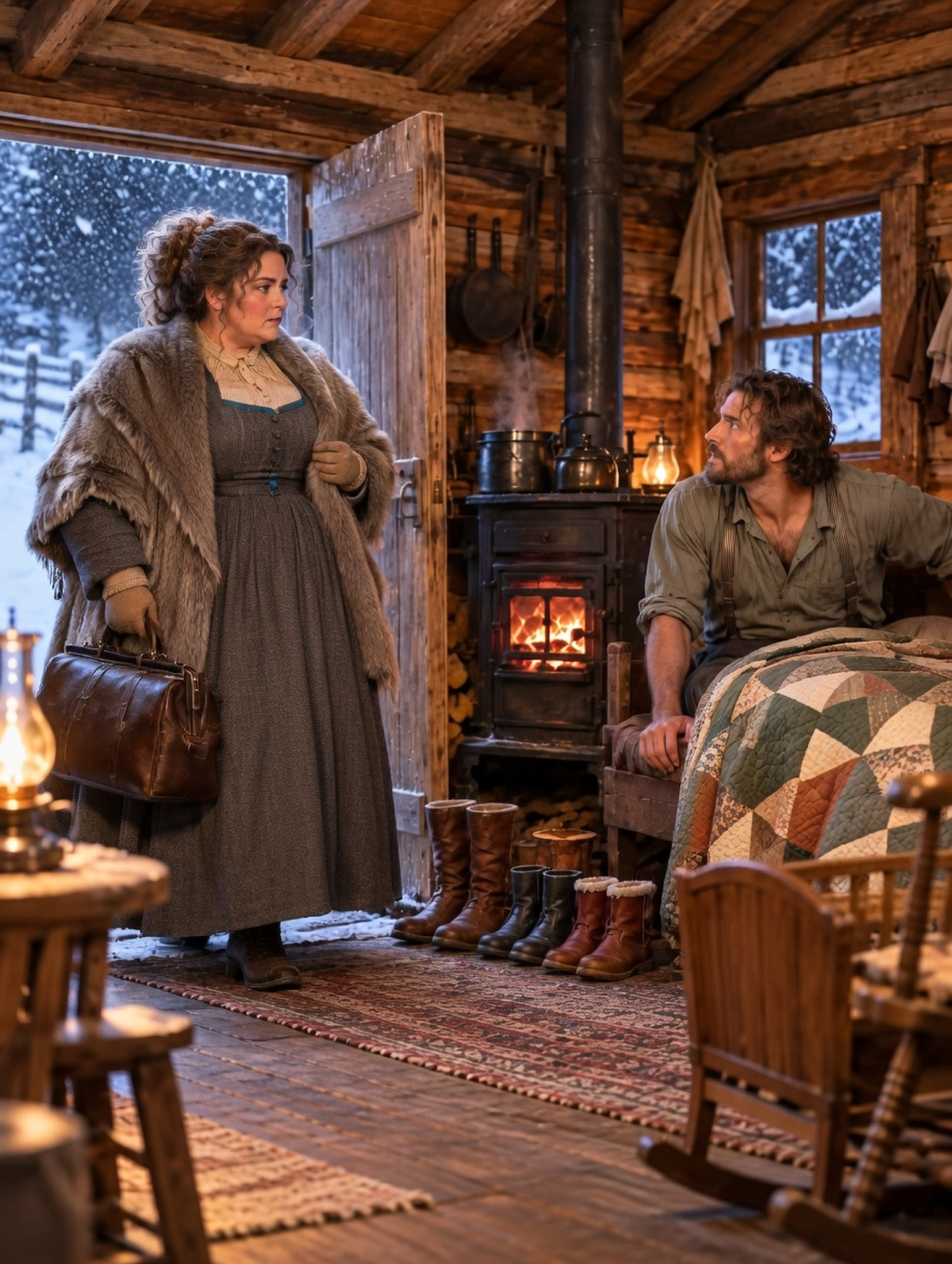
"Daddy, it's burning! Please, do something!"
Nine-year-old Daphne Chandler grabbed the handle of a smoking pot as her father stood helplessly beside the stove with a screaming baby against his shoulder.
Cole Chandler reached for the folded housekeeper notice lying on the kitchen table.
At the bottom, beneath the words Room and Board Provided, his daughter's small handwriting had added four words:
Please help our daddy.
Cole stared at the paper.
His children had been asking for help long before he was willing to admit they needed it.
And that morning, everything was about to change.
The pot had been burning for nearly a minute before Cole smelled it.
At least, he thought it had been a minute.
Time had become a slippery thing since Margaret died. Some mornings seemed to last an entire week, while whole afternoons disappeared between feeding the baby, hauling water, mending fences, and trying to remember whether the children had eaten anything besides bread.
Now the kitchen was filling with smoke, his youngest daughter was screaming against his shoulder, and his nine-year-old was trying to rescue breakfast with hands too small to lift the iron pot.
"Daphne, leave it alone!"
"But Daddy—"
"I said leave it!"
The sharpness of his own voice startled him.
Daphne immediately released the handle.
Her brown eyes widened, and for one terrible second Cole saw Margaret looking back at him.
Not because his daughter resembled her mother in every way. She didn't. Margaret had been a woman with a quick laugh and a stubborn chin, while Daphne had become painfully solemn over the past four months.
But the eyes were the same.
And the hurt in them was something Cole had put there himself.
He swallowed.
"I'm sorry, sweetheart. I didn't mean to holler."
Daphne nodded quickly.
Too quickly.
That was another thing he hated. She had learned to forgive him before he even finished apologizing.
Quinn shrieked against his shoulder.
The baby had been crying since before sunrise.
Cole shifted her higher, supporting her little back with one broad hand while trying to rub warmth into her cold feet with the other.
"There now," he murmured. "Easy, little bird. Daddy's got you."
Quinn disagreed.
Her tiny fists struck his chest, and her face turned a miserable shade of red.
He had tried everything.
He had rocked her in the chair Margaret used to sit in.
He had walked the length of the cabin until his knees ached.
He had sung an old trail song so badly that Felix had informed him the cows probably wouldn't appreciate it either.
He had even attempted the sugar-water rag Margaret sometimes used when the children were fussy.
Quinn had spat it out.
Then she had screamed harder.
Cole had never felt so thoroughly defeated by someone who weighed less than a sack of flour.
"Daddy?"
Josie tugged at his trouser leg.
At five years old, she had developed the habit of attaching herself to him whenever anything went wrong.
Which meant she spent most of her days attached to him.
"What is it, honey?"
"I'm hungry."
"I know."
"My tummy hurts."
"I know, sweetheart."
"Can Mama make breakfast?"
The question struck him harder than any blow.
Daphne looked down.
The room seemed to go still, though Quinn continued crying.
Josie stared up at him with complete innocence.
She had asked that question three times in the past week.
Each time, Cole had tried to explain.
Each time, she seemed to understand.
And each time, a few days later, she asked again.
"No, little one," he said softly. "Mama can't."
"Why?"
Cole closed his eyes.
Because your mother is buried beneath the cottonwood on the hill.
Because I stood beside that grave while the preacher spoke, and I couldn't hear a single word.
Because I promised her I would take care of all of you.
Because every day since then, I have discovered another way to fail.
He said none of those things.
Instead, he crouched awkwardly with Quinn against his shoulder.
"Because Mama's in heaven, remember?"
Josie considered this.
"Does heaven have a kitchen?"
Cole felt his throat tighten.
"I reckon it does."
"Then maybe she can make breakfast there."
He looked away.
"Maybe she can."
Josie seemed satisfied.
She pressed her cheek against his knee.
And Cole wondered how a man could survive having his heart broken by the same child a hundred times.
The front door slammed open.
"Daddy!"
Felix stumbled inside, breathing hard.
The seven-year-old had mud on his boots, straw in his hair, and the expression of someone carrying news he desperately wished belonged to somebody else.
Cole knew that expression.
He had been seeing it on his own face in the shaving mirror for months.
"What happened?"
Felix hesitated.
"Well..."
"Son."
"The red heifer got out again."
Cole stared at him.
"Which fence?"
"The one by the corn."
"The north fence?"
Felix nodded.
Cole had repaired that fence twice.
The first time, he had used old wire because he couldn't afford new.
The second time, he had replaced a post that should have been replaced the previous autumn.
Now the heifer was loose again.
"Is she in the corn?"
Felix looked at the floor.
"Yes, sir."
"How much has she eaten?"
"I don't know."
"Did you try to drive her out?"
"I did, but she ran toward the creek, and I couldn't get around her."
Cole inhaled slowly.
He could not afford to lose the corn.
The winter stores were already thinner than they should have been.
A late frost had damaged part of the garden, two calves had fallen sick, and the feed merchant in Willow Bluff had made it clear that further credit would be difficult.
He had not told the children about the credit.
He had not told them about the letter from the bank.
He had not told them that he sometimes lay awake calculating how many cattle he would need to sell before spring.
There were things a father was supposed to carry alone.
Or so he had believed.
"Daddy?" Felix asked.
Cole realized he had been staring at the boy without answering.
"Get your coat."
"Are we going after her?"
"Yes."
"What about breakfast?"
A sharp hiss came from the stove.
The pot had begun to spit.
Daphne jumped backward.
Cole turned.
For one impossible moment, every problem in his life seemed to demand his attention at precisely the same time.
The baby.
The stove.
The hungry children.
The escaped heifer.
The fence.
The bank.
The grave on the hill.
He could almost hear Margaret laughing at him.
Not cruelly.
Margaret had never laughed cruelly.
She would have pushed him aside, taken the baby, saved the breakfast, and somehow found time to remind Felix that his boots belonged outside.
She had done those things without making them look difficult.
Cole had mistaken that ease for simplicity.
Only after she died did he understand how much work had been hidden inside it.
"Felix, wait."
He carried Quinn to the cradle beside the wall.
The instant he lowered her onto the mattress, her crying sharpened.
"I know," he whispered. "I know."
He turned toward the stove.
Daphne had already moved aside.
Cole reached for the pot.
He knew it was hot.
He knew he ought to use a cloth.
But Quinn was screaming, Josie was crying because Quinn was crying, and smoke had begun gathering beneath the ceiling beams.
He grabbed the iron handle.
Pain shot through his palm.
"Blast it!"
He dragged the pot off the heat and set it on the table with a heavy thud.
His hand burned.
He stared at the reddening skin.
Then he heard Daphne whisper, "Daddy?"
He looked up.
All three older children were watching him.
Not the stove.
Not the ruined breakfast.
Him.
And he understood something that frightened him more than the unpaid bills.
They were waiting to see whether he would fall apart.
Cole forced himself to straighten.
"It's all right."
It wasn't.
But he said it anyway.
He wrapped his injured hand in a damp cloth.
Then he looked at his children.
"Daphne, get your brother and sister some bread. There's butter in the crock."
Daphne nodded.
"Felix, boots on. We'll deal with the heifer first."
"Yes, sir."
"Josie, stay close to Daphne."
The little girl nodded solemnly.
Then Cole looked at Quinn.
His baby was still screaming.
Her tiny face was wet with tears.
He crossed the room and lifted her again.
She immediately pressed against his chest, but the crying did not stop.
He held her for a long moment.
Then he made a decision he should have made weeks earlier.
"After we get that animal back," he said, "we're going into Willow Bluff."
Daphne looked up from the bread.
"Why?"
Cole hesitated.
The words felt like admitting defeat.
He had survived blizzards.
He had driven cattle through flooded crossings.
He had once spent three days searching for a missing horse in country where the temperature dropped below freezing after sunset.
He had believed there was nothing a determined man couldn't manage if he worked hard enough.
But he could not make breakfast and comfort his daughter at the same time.
He could not mend a fence while watching a five-year-old.
He could not become the mother his children had lost.
And pretending otherwise was hurting them.
"Because," he said quietly, "we need help."
Daphne studied him.
"From who?"
"I don't know yet."
"Are we getting a housekeeper?"
"That's the idea."
She looked toward the cradle.
"Will she know what to do with Quinn?"
Cole felt something twist inside his chest.
"I surely hope so."
Daphne lowered her eyes.
Then she said something he would remember for the rest of his life.
"Maybe she'll know what to do with you, too."
By the time Cole and Felix returned the heifer to the pasture, the morning had nearly disappeared.
The animal had trampled a narrow strip of corn and broken another section of the fence.
Cole made a temporary repair while Felix stood nearby holding the wire.
His burned palm throbbed.
The boy noticed.
"Does it hurt?"
"Some."
"Want me to do that part?"
Cole glanced at him.
Felix was seven.
His hands were small, and his boots were still too large because Cole had bought them with room to grow.
"No, son. I've got it."
Felix looked disappointed.
Cole softened his voice.
"You've helped plenty."
The boy brightened slightly.
Then he said, "Mama used to say you were too stubborn."
Cole stopped working.
Felix stared at the wire.
"She said it when you weren't listening."
Despite everything, Cole almost smiled.
"Did she now?"
"Yes, sir."
"What else did she say?"
Felix considered.
"She said you'd work yourself into the ground if somebody didn't make you sit down and eat."
Cole looked toward the distant cottonwood.
The tree stood on the hill above the homestead.
Its branches were bare.
Beneath it lay the woman who had known him better than anyone.
"She wasn't wrong," he murmured.
Felix kicked at the dirt.
"Daddy?"
"Yes?"
"Are we poor now?"
Cole's hands went still.
He looked at his son.
"Why would you ask that?"
Felix shrugged.
"Because you don't buy coffee anymore. And Daphne says we have to save flour. And Mr. Harlan came by twice last week, but you told us to stay inside."
Cole felt a cold weight settle in his stomach.
Children noticed everything.
Even the things adults believed they had hidden.
"We've had a hard season," he said carefully.
"Are we going to lose the ranch?"
"No."
The answer came too quickly.
Felix looked at him.
Cole took a breath.
"Not if I can help it."
The boy nodded.
Then he reached for the loose wire.
"Then I reckon we'd better fix this fence good."
Cole looked at his son.
Seven years old.
Already worrying about land and debt.
Already trying to become useful because the adults in his world had been unable to keep everything safe.
Cole handed him the wire.
"Hold it right there."
Felix gripped it with both hands.
Together, they finished the repair.
Eleven days earlier, Zoe Foster had arrived in Willow Bluff carrying a letter that promised her a future.
She had read it so many times during the journey that the folds had become soft.
Dr. Landon Vaughn had written that his medical practice needed an experienced nurse.
The position would include regular wages.
There would be opportunities to assist with childbirth, injuries, fevers, and the ordinary illnesses of a growing frontier community.
After two years of drifting through a life that no longer seemed to belong to her, Zoe had allowed herself to believe she had finally found somewhere useful to be.
She was forty years old.
Her husband, Rowan Bennett, had been dead for two years.
Before his death, they had spent twelve years working in Army hospitals and medical stations.
Rowan had been a surgeon.
Zoe had trained and worked as a nurse.
Together, they had treated soldiers, laborers, children, and women who sometimes arrived after traveling impossible distances for help.
She had learned to recognize fever from the heat of a forehead.
She had learned when a wound needed cleaning and when it needed a surgeon.
She had learned to remain calm while men twice her size shouted in pain.
And she had learned that people in distress often needed steady hands more than comforting words.
She had also learned something medicine could not teach.
Sometimes, no amount of skill could save someone you loved.
Their only child had lived four days.
That had been many years before Rowan died.
But grief did not always obey the calendar.
There were still mornings when Zoe woke with her arms curved around a space that had been empty for more than a decade.
When Rowan died, she had lost the last person who understood that silence.
Work had kept her standing.
And now Willow Bluff had offered her work.
Or so she thought.
Dr. Vaughn received her in a small office behind the town's general store.
He was a narrow man with spectacles and a carefully trimmed beard.
He read his own letter while Zoe stood before his desk.
Then he cleared his throat.
"Mrs. Foster, I'm afraid there's been a complication."
Zoe waited.
"The council has declined to authorize the wages."
She looked at him.
"I beg your pardon?"
"The town council. They oversee certain expenditures."
"I understood the position was available."
"It was my intention that it should be."
"You wrote that you needed a trained nurse."
"And I do."
"Then I don't understand."
The doctor removed his spectacles.
He rubbed the bridge of his nose.
"The gentlemen on the council believe it would be inappropriate to employ a woman in a paid medical position."
Zoe said nothing.
He continued.
"They're not opposed to women helping with the sick, of course. But a formal salary..."
He let the sentence trail away.
Zoe looked down at the letter.
There it was.
His signature.
His promise.
His invitation.
She had sold several possessions to afford the journey.
She had left behind the small rented room where she had lived since Rowan's death.
She had traveled hundreds of miles because a doctor had told her she was needed.
Now he was explaining that she could not be paid for the work she knew how to do.
"Did you know this before I came?" she asked.
Dr. Vaughn looked uncomfortable.
"I believed I could persuade them."
"Did you tell them I was coming?"
"Not in so many words."
Zoe folded the letter.
Carefully.
Once.
Then again.
"I see."
"I'm truly sorry."
She nodded.
"Of course."
"There may be sewing available. Mrs. Bell at the boardinghouse often knows of such arrangements."
Zoe looked at him for a long moment.
She wanted to ask whether he would have offered sewing work to a male surgeon.
She wanted to ask whether the town council intended to explain its principles to the next woman who died because skilled help was unavailable.
Instead, she placed the letter in her bag.
"Thank you for your time, Doctor."
He rose.
"Mrs. Foster—"
But she was already walking toward the door.
For the next eleven days, Zoe lived in a rented room above the Willow Bluff boardinghouse.
She repaired shirts.
She replaced buttons.
She mended torn sleeves for men who worked at the livery stable.
The wages were small.
The work was honest.
But every evening, when the lamps began glowing in the houses across the street, she felt the familiar ache of being useful to everyone except the people who truly needed her.
Mrs. Bell, the boardinghouse owner, was kind enough.
She was also curious.
"Have you thought about finding a husband again?" she asked one evening while Zoe repaired a coat.
Zoe did not look up.
"No."
"Forty isn't so old."
"I hadn't realized it was."
Mrs. Bell laughed awkwardly.
"I only mean that a respectable woman shouldn't have to live alone forever."
Zoe drew the needle through the fabric.
"Some women prefer it."
"Do you?"
Zoe paused.
The question was more difficult than it appeared.
Did she prefer loneliness?
No.
Did she prefer the quiet certainty of an empty room to the possibility of losing another person she loved?
Sometimes.
"I prefer earning my own keep," she answered.
Mrs. Bell sighed.
"Well, there's no shame in that."
Zoe continued sewing.
But later that night, sitting beside her window, she unfolded Dr. Vaughn's letter once more.
She read the words.
Your experience would be of considerable value to this community.
Then she folded it again.
She had begun to wonder whether coming to Willow Bluff had been a mistake.
Cole Chandler arrived in town shortly before noon.
He looked like a man who had been awake for several days.
Quinn was crying in his arms.
Daphne walked behind him holding Josie's hand.
Felix followed with his hat pulled low and straw still caught in his hair.
They entered the mercantile.
The storekeeper, Mr. Whitcomb, looked up from a crate of supplies.
"Cole. Morning."
"Morning."
Whitcomb glanced at the baby.
"Little one's having a rough day?"
"Something like that."
Cole approached the counter and placed a folded paper on the wood.
"Would you hang this where folks can see it?"
Whitcomb opened it.
His expression changed.
"You're looking for a housekeeper?"
"Yes."
"Didn't know you'd decided."
"Neither did I until this morning."
Whitcomb read the notice.
Then he looked at Cole.
"Room and board?"
"And wages, if we can agree on them."
Whitcomb hesitated.
Cole noticed.
"What?"
"Well, I wish I knew somebody."
"Anybody?"
"Most women around here have families of their own. The others are already working."
Cole rubbed his forehead.
"Maybe somebody passing through will see it."
Whitcomb nodded.
"I'll put it by the door."
Quinn screamed.
Daphne flinched.
Josie covered one ear.
Felix looked toward the shelves, embarrassed by the attention.
Cole shifted the baby.
"Easy, Quinn. Easy."
But she twisted against him.
Her small face reddened.
Her cries grew sharper.
Cole felt the familiar panic rising.
Not fear of the noise.
Fear that something was wrong and he did not know what it was.
He had lost Margaret.
He could not lose Quinn.
He would not survive it.
"Maybe she's hungry," Whitcomb suggested.
"Fed her."
"Needs changing?"
"Already did."
"Could be colic."
"Could be."
Cole had heard that word from three different people.
None had explained how to make the crying stop.
Across the store, Zoe Foster stood beside a display of thread.
She had been selecting two spools for a sewing job.
Now she was watching the baby.
Not staring.
Observing.
She noticed the way Quinn turned her head.
The way she pressed one side of her face against her father's shoulder.
The way her crying sharpened whenever he shifted her.
She noticed the exhausted man holding her.
And she noticed the oldest girl standing nearby, watching every movement as though she expected to be called upon to solve the problem.
Zoe had seen that expression before.
In hospital wards.
In field stations.
In the faces of people who had carried responsibility too long without relief.
She placed the thread on the counter.
Then she stepped forward.
"Excuse me."
Cole turned.
Zoe looked at the baby.
"Would you allow me to hold her for a moment?"
Cole stared at her.
He saw a woman in a plain dress.
A widow's brooch at her collar.
Steady eyes.
Hands that did not tremble.
Under ordinary circumstances, he might have asked who she was.
He might have wanted to know why a stranger was offering to take his child.
But ordinary circumstances had disappeared from his life four months earlier.
"She's been crying all morning," he said.
"I can hear that."
"I've tried everything."
Zoe's expression softened.
"Then perhaps another pair of hands might help."
Something about those words caught him.
Another pair of hands.
The very thing he had told Daphne they needed.
Cole looked at Quinn.
Then at the stranger.
"All right."
He passed the baby over.
Zoe received her with practiced care.
One arm supported Quinn's back.
The other steadied her head.
She held the infant upright against her chest.
She did not bounce her.
She did not shake a toy.
She did not begin singing.
She simply waited.
Quinn continued crying.
But Zoe was already examining her.
She gently touched the baby's jaw.
Then she checked her gums.
"How old is she?"
"Ten months."
"Has she been feeding normally?"
"Not as much as usual."
"Any fever?"
"Not that I've noticed."
"Has she been pulling at her ear?"
Cole hesitated.
"I don't know."
Zoe nodded.
She cupped Quinn's left ear gently.
The baby leaned toward her hand with a broken sob.
Zoe's eyes sharpened.
There it was.
A small clue.
Not a complete answer.
But enough to begin.
"Her back teeth are coming through," Zoe said. "And that ear seems to be troubling her."
Cole stared.
"Her ear?"
"Yes."
"Is something wrong with it?"
"I can't be certain without a proper examination. But she's uncomfortable, and we should keep watch for fever or worsening pain."
Cole looked at his daughter.
He had spent days carrying her.
Nights walking with her.
Hours wondering whether she simply missed Margaret.
And he had not thought to check her ear.
The realization stung.
Zoe seemed to understand what was passing through his mind.
"You couldn't be expected to know everything," she said.
Cole looked away.
He wasn't sure he believed her.
Zoe turned toward Whitcomb.
"Do you have a clean cloth?"
"Certainly."
"And a little warm water?"
"There's a kettle by the stove."
"Thank you."
Whitcomb hurried to fetch the supplies.
Daphne stepped closer.
"Are you a doctor?"
Zoe looked down at her.
"No, sweetheart. I'm a nurse."
Daphne's eyes widened.
"A real nurse?"
"Yes."
"Do you know how to make babies stop crying?"
Zoe considered the question.
"Sometimes I know how to help them feel better."
Daphne glanced at Quinn.
"She's cried every night."
"I imagine that's been hard for everyone."
Daphne nodded.
Then she whispered, "Daddy doesn't sleep."
Cole looked sharply at her.
"Daphne."
But Zoe did not seem surprised.
She only said, "Then perhaps we should see what we can do."
Whitcomb returned with the cloth.
Zoe warmed it carefully and checked the temperature against her wrist.
Then she placed it gently against Quinn's ear.
The baby jerked once.
Cole stepped forward.
But Zoe remained calm.
"Easy, little one," she murmured.
Quinn whimpered.
Then something extraordinary happened.
Her crying weakened.
Not all at once.
Not like a miracle.
First, the sharp screams became uneven sobs.
Then the sobs grew quieter.
Her little fists loosened.
Her breathing slowed.
And finally, she rested her cheek against Zoe's shoulder.
Cole stood perfectly still.
Daphne pressed both hands over her mouth.
Felix stopped pretending to examine a jar of nails.
Even Whitcomb went quiet.
For the first time that morning, Cole could hear the clock ticking behind the counter.
He stared at his daughter.
Then at Zoe.
"How did you do that?"
Zoe continued supporting the baby.
"I listened to what she was trying to tell us."
Cole swallowed.
Nobody had said anything like that to him before.
Everyone had offered advice.
Feed her.
Rock her.
Walk her.
Let her cry.
Give her time.
But this woman had looked at Quinn as though her crying meant something specific.
As though the baby wasn't being difficult.
As though she was asking for help.
Cole felt his throat tighten.
He looked at Zoe's hands.
Then at the widow's brooch.
Then at the calm expression of a woman who had arrived in his life without warning.
"What's your name, ma'am?"
"Zoe Foster."
"I'm Cole Chandler."
"I know."
He blinked.
"You do?"
"Mr. Whitcomb said your name when you came in."
For the first time in days, Cole almost laughed.
Almost.
Instead, he nodded.
"Right."
Quinn gave a small sigh.
Zoe adjusted the cloth.
Cole watched her.
"Are you working here in town?"
Zoe's expression changed.
Only slightly.
But Cole noticed.
"Not in nursing," she said.
"Why not?"
"That's a longer story."
"I've got time."
She glanced at his children.
Then at the baby.
"I suspect you have less time than you think, Mr. Chandler."
Cole looked toward the notice lying on the counter.
The paper asking for a housekeeper.
The words Daphne had written beneath it.
Please help our daddy.
He looked back at Zoe.
A trained nurse.
A widow.
A woman who had quieted his daughter in minutes.
He opened his mouth to ask the question that had suddenly become the most important one in his life.
But before he could speak, the mercantile door swung open.
Dr. Landon Vaughn stepped inside.
He stopped when he saw Zoe holding Quinn.
His expression hardened.
"Mrs. Foster," he said sharply. "Put that child down."
Zoe did not move.
Cole turned toward the doctor.
And then Vaughn said something that made every person in the store go silent.
"Mr. Chandler, before you entrust your daughter to that woman, there's something you need to know about her."






Comments 0