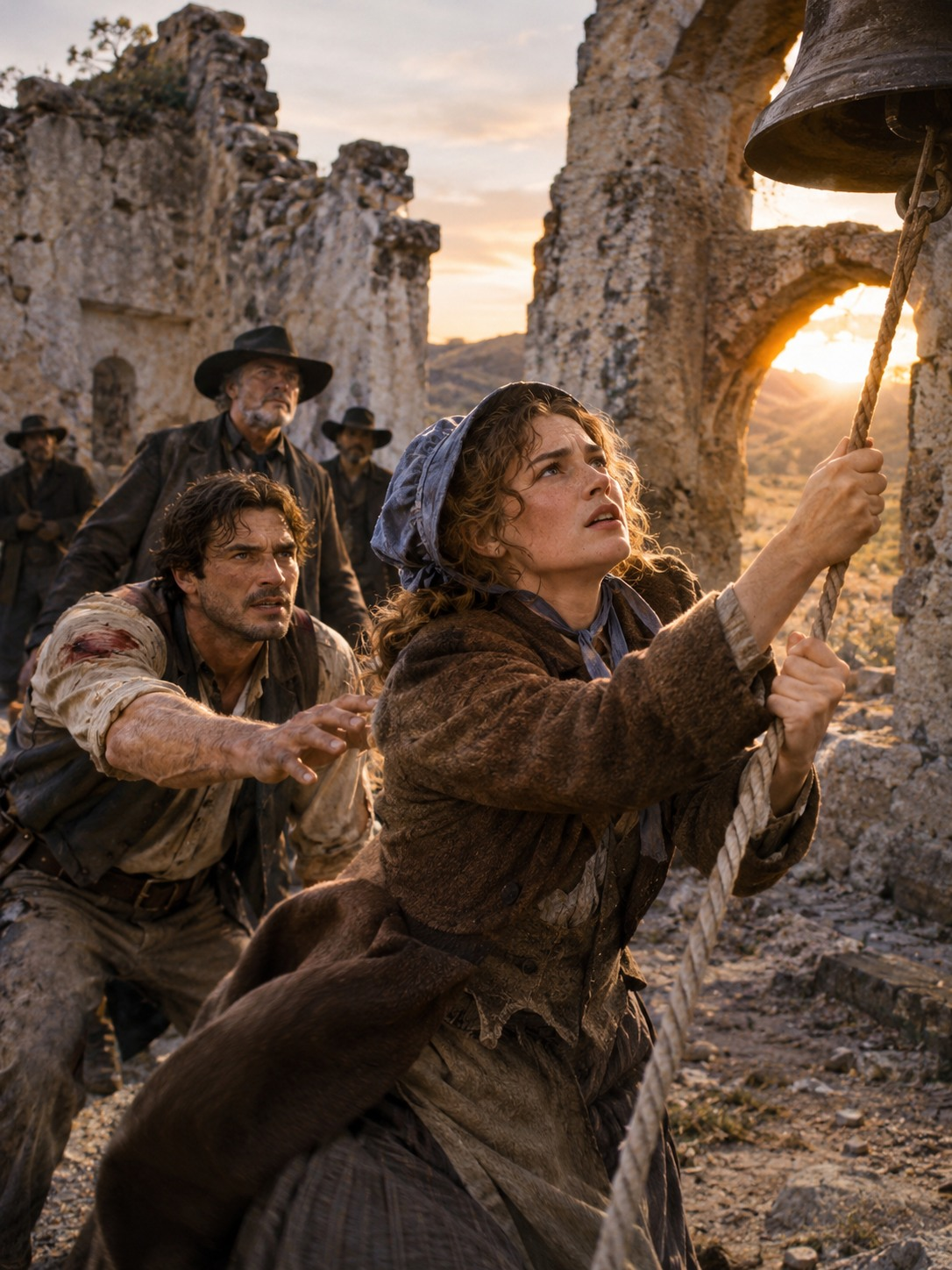
Clara Whitmore yanked the ancient mission bell rope and shouted:
"Somebody help me find Jonah Mercer!"
Sheriff Elias Boone rushed toward her, clutching an old leather mailbag.
On its inner flap, someone had scratched a single sentence:
SHE MUST NEVER READ THE LAST LETTER.
The sheriff suddenly stopped moving.
Because he recognized the handwriting.
And he knew exactly who had written it.
The bell rang again.
Its deep metallic voice rolled across the abandoned Spanish mission, shaking dust from the ancient stone archways and sending a flock of birds scattering into the December sky.
Clara pulled the rope with both hands.
Her fingers burned against the coarse leather fibers. Her shoulders ached, and her breath came in short, uneven bursts. But she refused to stop.
Behind her, Sheriff Elias Boone was trying to reach her.
"Miss Whitmore! Let go of that rope!"
She barely heard him.
Another bell strike thundered above the ruined mission.
For a moment, the entire world seemed to tremble.
Then Clara looked down at the letter pressed against her chest.
The final letter.
The one that had begun with her name.
My dearest Clara,
She had read those three words so many times that morning that they no longer looked like ordinary handwriting.
They looked like something she had spent eight years waiting to see.
Her name.
Not on a delivery receipt.
Not on a returned envelope.
Not written beside a postage stamp.
Her name, written by someone who had wanted to speak to her.
Someone who had thought about her every Saturday night.
Someone who had loved her in silence.
Jonah Mercer.
Clara pulled the rope again.
"Jonah is missing!" she shouted.
The sheriff finally reached her and caught her upper arm.
"Listen to me. Ringing that bell won't bring him back."
Clara turned toward him.
Her brown eyes were wet, but her voice was steady.
"Then tell me where he is."
The sheriff opened his mouth.
Nothing came out.
Behind him, three townsmen stood beneath the broken archway.
Thomas Reed, the local blacksmith, held his hat against his chest. Beside him stood Samuel Price, a ranch hand with a weathered face and a gray mustache. The third man, Benjamin Carter, was younger, perhaps thirty-five, and still carried the dust of the road on his boots.
All three had followed the sheriff from town.
None of them understood why a mail carrier was ringing an abandoned church bell.
Clara looked at them.
"Please," she said. "I need someone to help me."
The bell swung overhead.
The sheriff glanced toward the northern ridge.
For the briefest moment, Clara noticed something in his expression.
Not confusion.
Not surprise.
Recognition.
He knew something.
And he was afraid to tell her.
Eight years earlier, Clara had arrived in Mercy Creek with two suitcases, a worn Bible, and a letter from the territorial postal service.
She had been eighteen.
Her parents had died within six months of each other, leaving her with no close relatives and very little money. The small property they had owned had been sold to settle debts, and the only person who had offered Clara a place to stay was an elderly woman named Mrs. Bell, who ran the boardinghouse beside the post office.
Clara had accepted the position of assistant mail carrier.
She had not expected to stay forever.
She had imagined that one day she would marry, perhaps move somewhere with green fields and a proper garden, and have a family of her own.
But years passed.
The town became familiar.
The dusty roads became part of her daily life.
And delivering letters became something more important than a job.
Clara learned which elderly mothers waited for news from sons serving far away. She remembered which young women were engaged and which families had relatives working in distant mining camps.
She knew that Mrs. Dawson preferred her letters folded neatly beneath the blue ribbon around her spectacles.
She knew that the baker's wife cried whenever she received a letter from her sister in New Mexico.
She knew that old Mr. Harlan pretended not to care about mail, even though he came to the post office every morning before sunrise.
Clara remembered everything.
People often said she had a remarkable memory.
She thought it was simply important to remember people.
A letter could mean many things.
Sometimes it meant a marriage proposal.
Sometimes it meant forgiveness.
Sometimes it meant a soldier was still alive.
And sometimes it was the last message a person would ever receive.
Clara had delivered hundreds of such letters.
She had watched people embrace in the street, cry behind closed doors, and hold written words against their hearts.
She had witnessed happiness in countless forms.
Yet she had never received a love letter of her own.
Not one.
Every evening, before locking the post office, she performed the same small ritual.
She opened the wooden mailbox marked C. WHITMORE.
She checked beneath the advertisements and official notices.
She looked behind the envelopes.
She even checked the narrow space at the bottom where letters sometimes became stuck.
It was always empty.
At first, she had laughed about it.
Then she had stopped mentioning it.
Eventually, the empty mailbox became a quiet part of her life.
There had once been a man who promised to change that.
His name was Daniel.
He had been a traveling salesman who visited Mercy Creek six years earlier. He sold fine fabrics, pocket watches, and imported household goods.
He was handsome, charming, and always had a story to tell.
He had courted Clara for several weeks.
He brought her a small silver hairpin and once waited outside the post office until the evening just to walk her home.
At the railway station, before leaving town, he had kissed her hand.
"I'll write every week," he promised.
Clara had believed him.
She waited for the first letter.
Then the second.
Then the third.
Six years passed.
Daniel never wrote.
Clara never learned whether he had forgotten her, married someone else, or simply never meant any of his promises.
She had eventually stopped waiting.
But she had never entirely stopped wondering.
That morning, before the bell rang, Clara had discovered something that made those eight years of silence seem almost impossible.
She had arrived at the post office shortly after sunrise.
The cold had settled over Mercy Creek during the night, leaving a thin layer of frost on the wooden railings and rooftops.
She had tied her horse outside, removed her gloves, and reached for the key.
Then she noticed the leather bag.
It rested directly in front of the post office door.
It was old.
Very old.
Its brown leather had darkened with age, and the metal buckles were scratched and tarnished. A faded blue ribbon had been tied around its middle.
There was no delivery wagon.
No horse tracks leading toward the building.
No messenger waiting nearby.
Clara looked up and down the street.
"Hello?"
Nobody answered.
She bent down and examined the ribbon.
The knot had been tied carefully.
Almost lovingly.
Her fingers touched something beneath it.
A small folded piece of paper.
Her name was written across the front.
Miss Clara Whitmore.
The handwriting was unfamiliar.
But something about it made her chest tighten.
She carried the bag inside and placed it on the counter.
For several seconds, she simply stared at it.
Then she opened the buckles.
Inside were envelopes.
Dozens of them.
Clara counted once.
Then again.
Fifty-two.
Every envelope carried the same name.
Clara Whitmore.
Some were written on thick cream-colored paper. Others were made from cheaper stationery, their edges slightly yellowed.
Each had been sealed.
None had been mailed.
On every envelope, the sender's name appeared in the same careful handwriting.
Jonah Mercer.
Clara knew that name.
Everyone in Mercy Creek knew Jonah Mercer.
He lived alone on a ranch beyond the northern ridge. He came into town every Saturday for supplies, rarely spoke, and avoided unnecessary conversation.
He was tall and broad-shouldered, with gray eyes that seemed to carry more sadness than anger.
A scar crossed his throat.
Nobody knew exactly how he had received it.
Some people claimed he had been injured in a cattle accident.
Others said he had been attacked during a robbery.
A few believed he had survived something far worse.
Whatever the truth, Jonah had not spoken a word in twelve years.
Clara had met him regularly during her deliveries.
Every Saturday, he came to the post office.
Every Saturday, she greeted him.
"Good morning, Mr. Mercer!"
He tipped his hat.
"Lovely day, isn't it?"
He nodded.
"Any letters to send?"
He shook his head.
Then he left.
It was such a small routine that Clara had never imagined it meant anything.
She had not known that, after leaving the post office, Jonah sometimes rode past the boardinghouse just to see whether she was outside.
She had not known that he remembered the color of her bonnet, the sound of her laughter, or the way she always bent down to speak to children.
She had not known that every Saturday night he sat beneath an oil lamp, writing words he could never say aloud.
Fifty-two letters.
Fifty-two Saturdays.
One entire year of feelings kept inside an old leather bag.
Clara opened the first envelope.
The letter was dated January 8.
My dearest Clara,
Today you smiled at a little boy who had dropped his apple in the street. You picked it up, wiped the dust away, and gave him yours instead.
I don't think you realized that I was watching.
You make people feel as though the world has not forgotten them.
I wish I knew how to tell you what that means to me.
Clara read the words twice.
Then she opened another envelope.
And another.
Every letter described something different.
The way she helped an elderly woman carry groceries.
The way she remembered birthdays.
The way she never hurried someone who needed to talk.
One letter described a Saturday when Jonah had arrived in town with a wounded hand.
Clara remembered that day.
She had offered him a clean cloth.
He had nodded and accepted it.
She had thought nothing more of it.
But Jonah had written three pages about that small kindness.
Clara lowered herself into the wooden chair behind the counter.
Her hands were trembling.
She had spent eight years delivering words that made other people feel loved.
And someone had spent an entire year writing those words for her.
She reached the fifty-second envelope.
It was different.
The paper was newer, and the seal had been pressed more firmly than the others.
On the front, Jonah had written:
For Clara. Read this one first if I am not there.
Her stomach tightened.
She opened it.
The first lines were familiar.
My dearest Clara,
If you are reading this, I have failed to return to Mercy Creek as I promised myself I would.
There are men who have been searching for me. They know about the papers hidden beneath the northern ridge.
They believe I still have something that belongs to them.
I cannot explain everything in this letter. There is too little time.
Please do not trust anyone who tells you that I left willingly.
Clara stopped reading.
Her eyes moved toward the final paragraph.
If anything happens to me, find the old mission. Look beneath the bell tower. There is something I should have told you long ago.
And Clara, whatever happens, remember this.
You were never forgotten.
Not for one Saturday.
Not for one day.
Not for one moment.
She pressed the letter against her chest.
For several seconds, she could not breathe properly.
Then she looked at the date.
The letter had been written only three days earlier.
Jonah had disappeared after writing it.
Clara had immediately gone to the sheriff.
Elias Boone had listened without interrupting.
When she placed the fifty-two letters on his desk, he examined the handwriting and asked her where she had found them.
She told him.
His expression changed.
He asked whether anyone else had seen the bag.
She said no.
Then he asked to see the final letter.
Clara refused to let him take it.
"Mr. Boone, what is happening?"
He rubbed his forehead.
"I need to speak to someone."
"Who?"
He did not answer.
Instead, he told her to remain inside the post office.
Clara waited exactly eleven minutes.
Then she left.
She took the leather mailbag and rode toward the abandoned mission.
She did not know why Jonah had mentioned the bell tower.
She did not know what was hidden beneath it.
But she knew one thing.
He had expected something terrible to happen.
And he had trusted her enough to leave those letters behind.
When she reached the mission, she found the three townsmen standing near the ruined entrance.
They had been arguing with the sheriff.
The moment Clara appeared, their conversation stopped.
Thomas Reed approached her first.
"Miss Whitmore, you shouldn't be here."
"Why?"
He looked toward the sheriff.
"Because this place isn't safe."
Clara held up the letter.
"Jonah told me to come here."
Nobody spoke.
The sheriff stared at the paper.
Then his eyes moved toward the bell tower.
"Did you read the whole thing?"
"Yes."
"Every word?"
"Yes."
His face became pale.
He stepped closer.
"Clara, I need you to listen very carefully."
But before he could finish, a sharp metallic sound came from somewhere above them.
Clara turned.
The bell rope was moving.
There was no wind strong enough to explain it.
The rope swung gently, then stopped.
She approached it.
The sheriff called her name.
She ignored him.
She reached up and took hold of the rope.
And that was when she began ringing the bell.
Now, standing beneath the ancient tower, Clara watched the sheriff's expression change.
He had finally recognized the handwriting on the inside flap of the leather mailbag.
He knew the person who had written the warning.
He knew why Jonah had left the letters.
And he knew why the final letter had been hidden from the world for so long.
Clara released the rope for a moment.
"Mr. Boone."
He looked at her.
"Who wrote that sentence?"
The sheriff swallowed.
His eyes moved toward the three townsmen.
Then toward the distant northern ridge.
Finally, he answered.
"Your father."
Clara went completely still.
Her parents had been dead for years.
She had no memory of her father writing anything like that.
She looked down at the leather bag.
The words seemed to burn into her mind.
SHE MUST NEVER READ THE LAST LETTER.
Then the sheriff said something that made the cold feel suddenly unbearable.
"Clara, your father wasn't the only person who knew about Jonah's secret."
A horse whinnied beyond the broken stone wall.
All five of them turned.
Someone was approaching the mission.
And the rider was carrying a rifle.






Comments 0