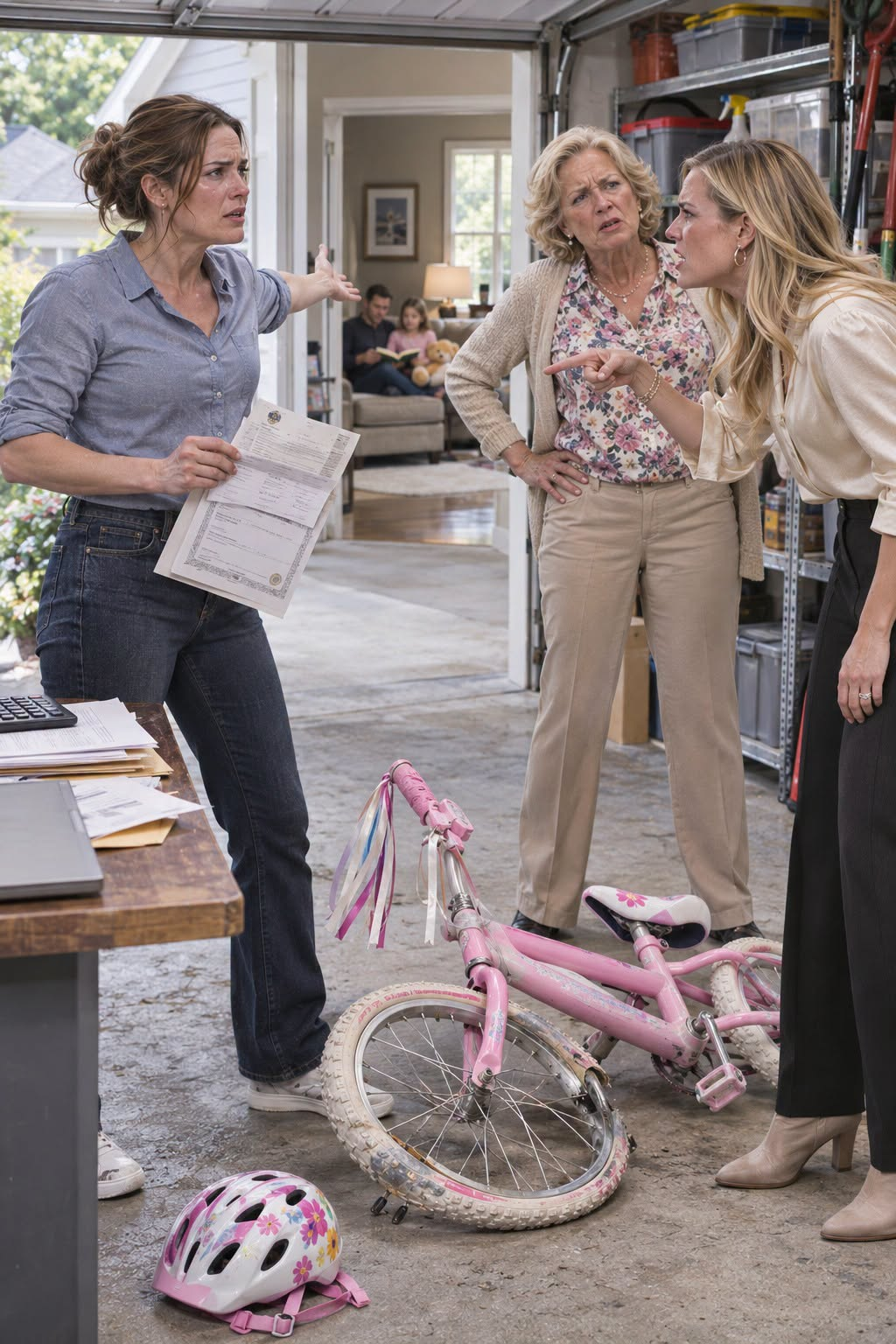
Dana brought the hammer down on the pink bicycle while my six-year-old daughter whispered, "Please stop."
I stood frozen beside Lily as my younger sister raised the hammer again.
My mother watched from the flower beds without moving.
Then I noticed the silver ribbon still tied around the handlebars.
That was when I realized my sister had just destroyed a gift intended for her own daughter.
The second strike bent the front wheel so badly that the tire twisted sideways against the concrete.
I heard Lily take a small breath behind me.
It was barely a sound, but somehow it reached me more clearly than the hammer.
"Aunt Dana?"
Dana didn't look at her.
She was too busy examining the damage she had caused.
"That should teach you," she said. "You don't get rewarded after breaking someone else's things."
I looked at the bicycle, then at my daughter.
Lily's little hands were still raised slightly in front of her chest. A moment earlier, she had been pointing excitedly at the silver streamers hanging from the handlebars. She had been talking about how pretty they looked when the sunlight caught them.
Now she was staring at the twisted metal as if she couldn't understand how something beautiful could become broken so quickly.
I was forty-one years old.
I had managed difficult clients, unexpected expenses, demanding deadlines, and more family arguments than I cared to count.
But nothing had prepared me for watching my younger sister deliberately destroy a child's bicycle while that child stood only a few feet away.
"Dana," I finally said.
My voice sounded unfamiliar.
She turned toward me, holding the hammer loosely.
"What?"
I looked at the bicycle again.
"Why did you do that?"
She gave me a disgusted look.
"Don't pretend you don't know."
My mother, Helen, stepped away from the hydrangeas.
She had been standing there with her arms folded, wearing a mustard-yellow cardigan over a navy blouse. Her silver hair was neatly arranged, and her pearl earrings caught the afternoon sunlight.
She looked more inconvenienced than shocked.
"Your sister has every right to be upset," she said.
I turned toward her.
"Mom, she just destroyed a brand-new bicycle."
"Because somebody needs to teach Lily that actions have consequences."
I felt Lily move closer to my leg.
My daughter had always been affectionate with Dana. She used to run toward her whenever she visited, carrying drawings and asking whether Sophie could come over to play.
Sophie was Dana's daughter and Lily's cousin.
The girls were close enough in age to share toys, birthdays, and occasional arguments over who got to choose the movie.
Two weeks earlier, however, something had happened that changed the atmosphere between them.
Sophie had been riding her bicycle near my mother's house when the chain assembly suddenly failed.
The bicycle stopped unexpectedly.
Sophie fell and scraped her knee.
Thankfully, she wasn't seriously hurt.
Dana immediately blamed Lily.
Her explanation was that the girls had been arguing shortly before the incident and Lily must have damaged the bicycle out of jealousy.
Nobody had actually seen Lily touch it.
Nobody had inspected the chain.
Nobody had asked why the bicycle had failed.
Dana simply announced that Lily was responsible.
My mother agreed.
And because my mother agreed, the rest of the family seemed to consider the matter settled.
I tried explaining that Lily had been nowhere near the bicycle when the chain failed.
I showed Dana the messages Sophie had sent about riding alone.
I even asked Ben, my husband, to inspect the damaged bicycle.
He found something neither woman had bothered to consider.
A manufacturing defect.
The chain assembly had failed because of a faulty component.
It wasn't Lily's fault.
It wasn't even Sophie's fault.
It was a defective bicycle.
Ben photographed the damaged mechanism and helped me document everything. I contacted the manufacturer, submitted the photographs, explained what had happened, and requested a replacement.
The company eventually acknowledged the defect.
They offered to replace the bicycle and, after reviewing the circumstances, agreed to upgrade the replacement to the model Sophie had wanted for months.
I accepted.
I thought that would finally settle everything.
Instead, I was standing in my driveway watching Dana destroy that replacement with a hammer.
My mother pointed toward the bicycle.
"You shouldn't have bought Lily something new when Sophie's bicycle was ruined."
I blinked.
"What?"
"Everyone can see what you were doing," she continued. "You bought your daughter a beautiful bicycle while your niece had nothing. What did you expect Dana to think?"
I almost laughed.
Not because anything was funny.
Because I suddenly recognized the familiar shape of the argument.
It was the same argument I had heard since childhood.
If Dana was upset, I must have done something wrong.
If Dana was embarrassed, I needed to make things easier for her.
If Dana made a mistake, I was expected to understand.
And if I defended myself, I was accused of creating unnecessary conflict.
I had spent years learning how to make myself smaller so my sister could feel comfortable.
When we were teenagers, Dana could borrow my clothes and return them damaged. My mother would tell me not to be selfish.
When we became adults, Dana could forget birthdays, miss appointments, and cancel plans at the last minute. My mother would explain that she had a lot going on.
When Dana struggled financially, I was expected to help.
When I needed something, everyone suddenly became busy.
Somewhere along the way, I had mistaken being dependable for being obligated.
But standing there, with my little girl trembling behind me, I felt that old instinct disappear.
I looked at Dana.
Then I smiled.
It wasn't a happy smile.
It was the kind of expression that appears when someone finally understands a situation they have spent years refusing to acknowledge.
Dana noticed immediately.
"What are you smiling about?"
I lowered my eyes toward the bicycle.
Then I looked directly at her.
"That bicycle wasn't for Lily."
Her expression tightened.
"What?"
"It was for Sophie."
The hammer slipped from her hand.
It struck the concrete with a sharp metallic sound.
My mother blinked.
"Don't be ridiculous."
"I'm not."
I held up the paperwork I had been carrying.
"The manufacturer confirmed the defect. They approved a replacement and upgraded the model. I ordered it for Sophie."
Dana stared at me.
For several seconds, nobody spoke.
The sunlight fell across the pink frame. One of the silver streamers had become trapped beneath the damaged wheel.
I could almost see Dana trying to rearrange the facts in her head.
"You bought that for my daughter?" she finally asked.
"Yes."
"You're lying."
"No."
"Why would you do that?"
I looked at her.
"Because she was riding a defective bicycle, and she could have been seriously hurt."
My mother stepped closer.
"Well, if that's true, then this is simply a misunderstanding."
I turned toward her.
"A misunderstanding?"
"Yes. Dana didn't know."
I glanced at the hammer.
Then at the damaged wheel.
Then at Lily.
"Mom, a misunderstanding is bringing the wrong food to dinner. This was an adult taking a hammer to a bicycle in front of a six-year-old."
Dana's face hardened.
"Don't make this into something it isn't."
I felt Lily's fingers curl around the back of my blouse.
That small movement settled everything.
I didn't need another explanation.
I didn't need another argument.
And I certainly didn't need to convince two adults that destroying a child's property was wrong.
"Leave," I said.
My mother stared at me.
"What?"
"Both of you. Leave my property."
"Mara," she said slowly, using the same disappointed tone she had used when I was twelve, "you're upset."
"I'm not."
"Of course you are."
"No, Mom. I'm finished."
Dana let out a short, bitter laugh.
"You're kicking your own family out over a bicycle?"
I looked at her.
"No. I'm asking you to leave because you destroyed something that belonged to your daughter while blaming mine."
"It wasn't my fault you decided to buy it!"
I glanced at the paperwork again.
"You don't get to decide what happens to my belongings, my daughter, or my home."
For a moment, Dana looked genuinely uncertain.
Then she searched the driveway for someone who might rescue her.
She had always been good at finding the person most uncomfortable with conflict.
My mother had usually been that person.
Sometimes it had been another relative.
Occasionally it had been Ben.
But this time, Ben wasn't going to rescue her.
He appeared in the open garage doorway, wiping his hands on a blue shop towel.
He had been inside working when the commotion started.
His expression changed as soon as he saw the bicycle.
Then he noticed Lily.
He walked toward us.
"What happened?"
Nobody answered immediately.
My mother moved first.
"Ben, you need to talk some sense into your wife."
He looked at her.
Then at Dana.
Then at the hammer on the ground.
Finally, he turned toward me.
"Mara?"
I nodded toward the bicycle.
"Dana destroyed it."
Ben's jaw tightened.
He crouched briefly beside the damaged front wheel.
He didn't need to inspect it for long.
He had seen the original bicycle. He had helped me document the manufacturing defect. He knew exactly what the replacement was supposed to represent.
He stood up.
"Mara asked you to leave," he said.
My mother frowned.
"Ben, this is a family matter."
"It became our household's matter when you came into our home and destroyed something."
Dana folded her arms.
"Fine. We'll replace it."
I shook my head.
"No."
She looked at me.
"What do you mean, no?"
"I don't want another bicycle from you."
"Then what do you want?"
"I want you to leave."
My mother took another step forward.
"We'll discuss this tomorrow."
"There's nothing to discuss tomorrow."
"You don't cut off family over a bicycle."
I looked down at Lily.
She was still holding the back of my blouse.
"No," I said quietly. "You cut people off when they teach your child that love means standing still while someone hurts her."
My mother opened her mouth.
For the first time that afternoon, she had absolutely nothing to say.
Ben opened the side gate.
He didn't threaten anyone.
He didn't raise his voice.
He simply stood beside it and waited.
Dana picked up her handbag.
Helen gave me one final disappointed look.
Then they walked out.
The gate closed behind them.
For several seconds, I remained where I was.
I could hear a lawn mower somewhere down the street.
A dog barked.
A car passed.
The neighborhood continued as if nothing had happened.
But something had changed inside my house.
Lily finally spoke.
"Mom?"
I crouched in front of her.
"Yes, sweetheart?"
"Was Aunt Dana mad at me?"
I swallowed.
"She was angry, honey."
"But I didn't break Sophie's bicycle."
"I know."
"Then why did she say I did?"
I gently moved a strand of hair away from her forehead.
"Sometimes adults decide what happened before they bother finding out the truth."
Lily considered that.
Her eyes moved toward the damaged bicycle.
"Is Sophie still going to get her present?"
I nodded.
"We'll figure something out."
"Can we still get ice cream?"
I smiled.
"Absolutely."
We went to the little ice cream shop near the grocery store.
Lily chose strawberry.
I ordered vanilla.
She talked about school, a drawing she had made, and whether silver streamers could be attached to another bicycle.
I listened.
I let her be six years old.
I didn't explain the argument again.
I didn't ask her to understand why adults sometimes behaved badly.
She deserved an ordinary afternoon.
When we returned home, Ben had moved the damaged bicycle into the garage.
He had also picked up the hammer and placed it back on the workbench.
I found the manufacturer paperwork still sitting on the kitchen counter.
The replacement confirmation was on top.
Beneath it was the note Lily had helped me write for Sophie.
It said:
Dear Sophie, I hope you love your new bicycle. You deserve something wonderful.
I stared at those words for longer than I expected.
Then I put the papers into a folder.
That evening, after Lily was asleep, I sat at the kitchen island with my laptop.
Ben came downstairs and placed a glass of water beside me.
"You okay?" he asked.
I nodded.
"I think so."
He glanced at the laptop.
"What are you doing?"
I opened my online banking account.
"Something I should have done a long time ago."
For years, I had quietly covered several expenses for my mother and Dana.
It had started with small favors.
My mother's electricity bill during a difficult month.
Dana's phone payment when she was between jobs.
A grocery-delivery subscription my mother said she couldn't manage without.
Two streaming services.
A pharmacy account.
Then there were occasional insurance payments and other expenses that somehow became my responsibility without anyone ever formally asking.
I had never complained.
I had told myself family helped family.
But as I reviewed the accounts, I noticed something uncomfortable.
Nobody had ever asked whether I could afford to keep helping.
Nobody had asked whether I wanted to continue.
The payments had simply become permanent.
I began removing my credit card from each account.
One by one.
My mother's electricity payment.
Dana's phone account.
The grocery subscription.
The streaming services.
The pharmacy account.
I didn't send a warning.
I didn't announce a decision.
I simply stopped.
Ben watched quietly.
When I finished, I closed the laptop.
For the first time in years, I felt as though I had stopped carrying something that had never belonged to me.
Then my phone vibrated.
I glanced at the screen.
It was 9:17 p.m.
A new message had appeared.
And when I read the first sentence, I immediately understood that the bicycle incident was about to become something much bigger...






Comments 0