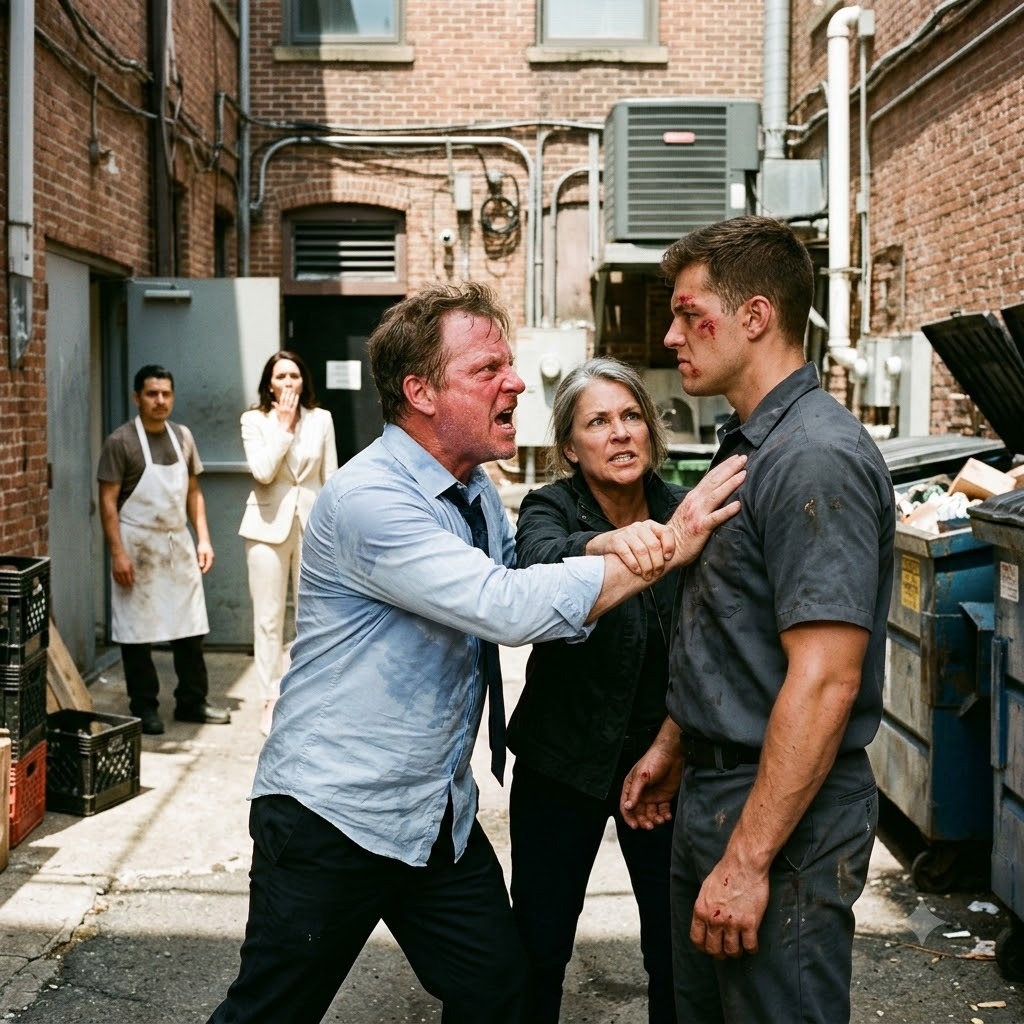
"Get your hands off my son!" I shouted as Grant slammed Caleb against the brick wall.
My brother, the owner of Halcyon, froze when he saw the folded contract in my hand.
A small handwritten notation appeared beside the signature line.
It contained a date Grant believed nobody remembered.
And suddenly, my brother was no longer the most powerful person in that alley.
Three minutes earlier, I had still been trying to convince myself that everything could be fixed.
Not the air-conditioning system. I knew almost nothing about repairing commercial cooling equipment. That was Caleb's world, not mine.
I meant the family.
For most of my sixty-two years, I had believed that families could survive almost anything if somebody was willing to swallow their pride, forgive the occasional cruelty, and keep showing up.
Unfortunately, that somebody had almost always been me.
My name is Joanie Brennan. I spent thirty-one years working the night shift on an emergency utility switchboard in Tennessee. I listened to frightened strangers describe downed power lines, gas leaks, transformer explosions, and electrical fires.
I learned to recognize the moment when a person's voice changed from irritation to genuine terror.
And I learned something else.
The loudest person in an emergency was rarely the person who understood what was happening.
My younger brother Grant had always been loud.
Even as a child, he could turn a broken toy into a family crisis and somehow make everybody else responsible for fixing it.
When our father died, Grant was twenty-three. I was already married, raising Caleb, and working nights.
Grant told everybody he was going to become a successful businessman.
I believed him.
I helped him.
That was the part I regretted.
Over the years, I had lent him money, watched his children when he needed help, handled paperwork for his early business ventures, and answered emergency calls at hours when most people were sleeping.
Grant rarely thanked me.
He preferred to remind me that he was the ambitious one.
I was simply his older sister.
The dependable one.
The woman who always answered.
Two weeks before Halcyon's grand opening, we had gathered for Sunday dinner.
Grant had been talking about the restaurant for nearly an hour.
He described the imported lighting, the custom dining chairs, the expensive kitchen equipment, and the wealthy investors who supposedly believed he was the next great name in Chattanooga dining.
Caleb sat quietly across from him.
My son was twenty-eight, with sandy blond hair that never stayed neat for long and hands that carried the little scars of somebody who worked with tools every day.
He had built a respectable career as an HVAC technician.
He had certifications, steady employment, and a reputation for being the person other technicians called when a difficult system refused to cooperate.
I was proud of him.
But I had not always defended him properly.
That Sunday, Grant lifted his wineglass and smiled.
"Hey, Caleb, you really plan on crawling through attics fixing air conditioners forever?"
Several people laughed.
I laughed too.
Not because I thought it was funny.
Because I knew what happened when somebody challenged Grant at the dinner table.
He would sulk.
He would accuse everyone of being too sensitive.
He would turn an ordinary family gathering into a courtroom where he was simultaneously the victim, the judge, and the injured party.
I had spent decades trying to prevent those scenes.
So I laughed.
Caleb looked directly at me.
He did not look angry.
That would have been easier.
He looked disappointed.
Then he put down his fork, folded his napkin, and stood.
"I'm going home," he said.
I followed him onto the porch.
"Caleb, honey—"
"Don't."
One word.
I stopped.
He looked at me with an expression I had never seen before.
"Mom, I don't need Uncle Grant to respect what I do. But I thought you did."
"I do."
"Then why did you laugh?"
I opened my mouth.
Nothing came out.
Caleb nodded once.
"That's what I thought."
He drove away.
For two weeks, that conversation lived inside me.
I replayed it while washing dishes.
While driving to the grocery store.
While lying awake in the middle of the afternoon, still unable to sleep like a normal person after three decades of night shifts.
I wanted to apologize properly.
Instead, I kept waiting for the right moment.
Then Grant's air-conditioning system failed.
It happened at 4:45 PM on the afternoon of Halcyon's grand opening.
The temperature outside had climbed to ninety-seven degrees.
Inside the restaurant, the digital thermometer mounted near the stainless-steel kitchen pass showed 106.
The rooftop cooling unit had stopped with a mechanical groan that sounded like a truck trying to climb a hill in the wrong gear.
Grant had sixty high-profile guests arriving in seventy-five minutes.
Among them were a prominent food critic and his wealthy business partner, Celeste Varga.
Celeste had invested heavily in Halcyon.
Grant had spent months boasting that her connections would make his restaurant the most talked-about dining destination in Chattanooga.
Now the kitchen felt like an oven.
The dining room was barely better.
The ventilation hoods pulled hot air through the building, and every time somebody opened the rear service door, another wave of summer heat rolled inside.
Raw steaks waited in the kitchen while the staff scrambled to protect anything that needed refrigeration.
Grant paced the hallway, his dark green shirt soaked through beneath the arms.
He called one repair company.
Then another.
Then a third.
Nobody could promise an immediate commercial service appointment.
Finally, he remembered Caleb.
I was standing near the kitchen doorway when Grant pulled out his phone.
"Your boy's going to save me a fortune," he said.
I frowned.
"Grant, he's working today."
"Then he can leave."
"He can't just abandon a customer."
Grant looked at me as though I had said something ridiculous.
"I'm his uncle."
He typed a message.
I saw the words before he pressed send.
Bring your tools right now. Family emergency.
No greeting.
No explanation.
No request.
Just an order.
Three minutes later, his phone buzzed.
Grant read the reply.
His face changed.
"What the hell is this?"
He shoved the screen toward me.
Caleb had written:
Call this dispatch line to book a technician.
Underneath was the number for his company's official service department.
I stared at the message.
For the first time in two weeks, I felt a small surge of pride.
Caleb had not insulted Grant.
He had not refused to help.
He had simply insisted that the work be handled professionally.
Grant saw it differently.
"Your son just sent me a corporate hotline."
"That's how his company schedules emergency calls."
"Don't explain his job to me, Joanie."
"Then don't ask me to explain his message."
Grant blinked.
I almost surprised myself.
He stepped closer.
"Call him. Tell him to get down here and fix this thing for free."
"No."
The word came out quietly.
Grant stared at me.
"What?"
"I said no."
His mouth opened.
Before he could answer, the rear service door slammed.
Caleb stood in the doorway.
He was wearing his olive-gray work uniform, charcoal utility pants, and black work boots.
There was grease on one sleeve.
He had come straight from another job.
For one foolish second, I thought he had changed his mind.
Then I saw his expression.
He was not there to surrender.
He was there to establish a boundary.
"Uncle Grant," he said, "I came because Mom called me earlier. I wanted to make sure she was okay."
Grant moved toward him.
"Good. Where are your tools?"
"In my truck."
"Then get them."
"Dispatch needs to open a service ticket first."
Grant laughed.
It was not a pleasant sound.
"You're standing in my restaurant telling me about paperwork?"
"Yes."
"Do you have any idea what tonight means?"
"I know your cooling system is down."
"Then fix it."
"I can help you get emergency service arranged. But I can't do commercial work off the books using company equipment."
Grant stepped closer.
"You're going to charge your own family?"
Caleb looked at him.
"You spent Sunday dinner making fun of the work you need me to do."
The kitchen went quiet.
Even the staff seemed to stop moving.
Grant's face darkened.
"Watch your mouth."
Caleb did not raise his voice.
"I'm not here to fight."
"Then stop acting like a spoiled little brat."
"Call dispatch."
Grant reached for Caleb's shirt.
I moved forward.
"Grant, don't."
He ignored me.
Caleb stepped backward through the open service door into the alley.
Grant followed.
I went after them.
The alley was narrow, bordered by old red-brick walls and industrial equipment.
A large blue dumpster stood beside the loading area.
Electrical conduits ran above utility boxes.
White drainage pipes climbed toward the roof.
The concrete smelled of hot grease and summer garbage.
A kitchen worker named Luis had followed us as far as the doorway.
A woman from the restaurant's business office, Rebecca, stood several feet away, one hand near her mouth.
Then Grant shoved Caleb.
Hard.
My son struck the brick wall with his shoulder.
He stumbled.
His forehead caught the edge of a protruding metal fixture near the service entrance.
When he straightened, blood was running from a cut above his right eyebrow.
Something inside me went cold.
"Grant!"
My brother grabbed Caleb's shirt.
"You're family!" he roared. "You fix this for free, or I'll ruin you!"
Caleb's hands remained open at his sides.
"Let go of me."
"You're going to learn some respect."
I stepped between them.
I pushed Grant backward with both hands.
"Don't touch my son again."
He stared at me.
For a moment, I saw genuine surprise.
Then he laughed.
"Joanie, get out of the way."
"No."
"Your boy needs to understand how the world works."
"He understands it better than you think."
Grant pointed at Caleb over my shoulder.
"You think your little repair company is going to protect you when I start making calls?"
Caleb shifted forward.
I raised one hand to stop him.
"Stay behind me."
"Mom—"
"Please."
He stopped.
Grant's breathing was heavy.
Sweat ran down his face.
He looked from Caleb to me.
Then he smiled.
That familiar smile.
The one he wore whenever he believed he had pushed me far enough to make me apologize.
"You're going to fix this, Joanie," he said. "You always do."
I looked at my brother.
Then at the blood on my son's face.
And I understood something that should have been obvious years earlier.
Keeping the peace had never created peace.
It had only taught Grant that cruelty carried no consequences.
My hand moved toward the inside pocket of my charcoal jacket.
The folded paper was still there.
I had carried it for eleven days.
Eleven days of wondering whether I should confront him.
Eleven days of hoping there was an innocent explanation.
Eleven days of knowing that once I asked the right question, our family would never be the same.
Grant noticed my movement.
"What's that?"
I did not answer.
I pulled out the contract.
The paper had been folded so many times that the creases had begun to whiten.
Grant's eyes dropped to the heading.
His expression changed.
He reached toward me.
"Where did you get that?"
I held the paper away from him.
"Don't."
"Joanie."
His voice had changed.
It was quieter now.
Sharper.
He glanced toward Luis.
Then Rebecca.
Then Caleb.
"Put that away."
I looked at the top page.
The contract carried the name of his restaurant.
Beneath it was a signature.
And beside that signature was a handwritten date.
I had seen that date before.
Not on a restaurant document.
Not in any of Grant's business records.
I had seen it in a hospital waiting room, on the afternoon our mother signed the last important papers of her life.
Grant stared at the page.
Then he whispered something I had never expected to hear from him.
"Joanie, you weren't supposed to find that."
I unfolded the second page.
There, beneath a paragraph marked Personal Guarantee, was another signature.
My signature.
Except I had never signed it.
And just as I looked up, Rebecca's phone began ringing.
She checked the screen.
Her face went pale.
"It's Celeste," she whispered.
Then she answered, and the first words from the other end made Grant reach for the phone...






Comments 0