Caleb Dawson stopped chewing in the middle of the Cottonwood Creek harvest gathering.
"Who made this bread?"
The wealthiest rancher in the county held up a half-eaten golden loaf with three small diagonal cuts across its crust.
Nobody answered.
Then the entire room began looking at one another.
Caleb had eaten in the finest dining rooms in Denver. He had paid for expensive meals in Kansas City and Chicago. He had hired cooks who could prepare almost anything a man might desire.
But nothing had ever tasted like this.
He took another bite.
The crust broke softly beneath his teeth. The inside was warm, delicate, and almost impossibly light. There was a faint sweetness of honey, followed by the rich flavor of freshly milled wheat.
It wasn't merely good bread.
It was the kind of food that made a person remember a kitchen from childhood, even if he couldn't quite explain why.
Caleb swallowed.
"I'm asking again," he said. "Who baked it?"
A woman standing beside the refreshments table laughed.
"Mr. Dawson, you're making it sound like somebody committed a crime."
"Maybe they did."
The room erupted in laughter.
Caleb didn't join them.
He was forty-two years old, owned more cattle than most men in Nebraska could count, and had never been accused of lacking common sense.
Yet there he stood, holding a loaf of bread as though it were the most important discovery of his life.
He turned toward the long table.
There were apple pies, roasted chickens, biscuits, preserves, and cakes covered in cream.
None of them interested him anymore.
"Where did this come from?"
"Someone brought it," a man answered.
"Who?"
"I don't know."
"Who put it on the table?"
The man shrugged.
Caleb looked toward his ranch foreman, Samuel Reed, who was standing near the entrance with a cup of coffee.
Samuel had worked beside him for eleven years.
He knew his employer's habits, his temper, and his stubbornness.
He also knew when Caleb had decided something was important enough to become a problem for everyone around him.
Samuel approached.
"You're frightening the church ladies."
"I'm asking a simple question."
"About bread."
"Exactly."
Samuel glanced at the remaining loaf.
"Is it really that good?"
Caleb held it out.
"Try it."
Samuel took a bite.
He chewed.
Then he took another.
His expression changed.
Caleb raised an eyebrow.
"Well?"
Samuel swallowed.
"That's unusually good."
"Unusually?"
"All right. It's excellent."
"Now you understand."
"I understand that you've eaten too much and need to ride home."
Caleb ignored him.
He approached an older woman who had spent the afternoon arranging the harvest dishes.
"Ma'am, do you know who made this?"
She adjusted her spectacles.
"I believe it came from somewhere outside town."
"Where?"
"North, perhaps."
"Perhaps isn't an answer."
"Mr. Dawson, I organize a harvest gathering. I don't investigate bread."
Caleb almost smiled.
Almost.
He returned to the table and carefully wrapped the remaining half loaf in a clean cloth.
Samuel watched him.
"You're taking it home?"
"I'm keeping it."
"For what?"
"Evidence."
Samuel stared at him.
Then he laughed so hard that a nearby farmer turned around.
"You're serious."
"Completely."
By the time the gathering ended, Caleb had questioned eleven people.
Not one could identify the baker.
He rode home that evening with the bread secured in his saddlebag.
The prairie stretched beneath the fading autumn light.
He should have been thinking about cattle prices, winter feed, and the repairs needed on the north pasture fence.
Instead, he kept thinking about the bread.
He remembered the softness.
The honey.
The smell that rose from the loaf when he broke it open.
Most of all, he remembered the feeling it had awakened.
For a moment, he had been a little boy again, sitting at his mother's kitchen table.
His mother had been gone for eighteen years.
And he had not tasted anything that reminded him of her cooking since.
That was what bothered him.
Not the mystery itself.
The memory.
The next morning, Caleb rode into Cottonwood Creek before the general store had finished opening.
Samuel was already there, speaking with the blacksmith.
He spotted Caleb approaching and shook his head.
"You're back."
"Good morning."
"You came thirty miles yesterday for bread. Now you're here again."
"I came for the baker."
Samuel folded his arms.
"You don't even know whether the person who made it is a man or a woman."
Caleb dismounted.
"It was a woman."
Samuel laughed.
"How could you possibly know that?"
Caleb handed his reins to a stable boy.
"Because a man would have rushed the dough."
"That's your evidence?"
"Patience leaves a mark on things."
Samuel looked at him for several seconds.
Then he sighed.
"Lord help us."
Caleb began with the general store.
Mr. Whitcomb, the storekeeper, was a thin man with a gray mustache and an impressive ability to remember what everyone in town owed him.
He listened to Caleb's question while weighing a sack of flour.
"Harvest bread?"
"Golden crust. Honey. Fresh wheat."
"Sounds expensive."
"It wasn't."
"Then it sounds suspicious."
Caleb smiled.
"Have you any idea who brought it?"
Whitcomb shook his head.
"No."
Caleb went to the blacksmith next.
Then the preacher.
Then the schoolteacher.
He even stopped at the boardinghouse and questioned Mrs. Bell, who had served three generations of traveling merchants and considered herself an authority on nearly every person within twenty miles.
Nobody knew.
By noon, Samuel had stopped pretending the search was amusing.
"You're going to spend your entire week asking people about flour."
"Possibly."
"There's cattle to inspect."
"I inspected them yesterday."
"The west fence needs repairing."
"I'll send two men."
Samuel rubbed his forehead.
"You own the biggest ranch in the county. You have a hundred things to do."
"And one question to answer."
Samuel shook his head.
"You're impossible."
Caleb mounted again.
"That's what I've been told."
The days passed.
Caleb returned to Cottonwood Creek several times.
He asked the same questions in different places.
He visited the church hall.
He spoke with the women who prepared meals for the schoolchildren.
He questioned farmers who sold wheat.
He even asked a traveling merchant whether he had encountered anyone selling unusual bread.
The merchant suggested a bakery in Lincoln.
Caleb rode there two days later.
The baker listened carefully, examined Caleb's description, and shook his head.
"That's not my recipe."
"Have you tasted anything like it?"
"Not recently."
Caleb thanked him and left.
The trip had accomplished nothing.
Still, he wasn't ready to abandon the search.
At the Dawson ranch, the kitchen staff began joking about the mysterious loaf.
One afternoon, Samuel found Caleb examining the remaining piece.
"You're studying it again?"
Caleb looked up.
"Look at the texture."
"I've looked at it."
"Not carefully."
Samuel leaned closer.
The bread had been kept wrapped in linen.
Even after several days, it retained some of its softness.
Caleb broke off a small piece.
"Whoever made this understands flour."
Samuel nodded.
"Apparently."
"And understands heat."
"Yes."
"And knows when to stop kneading."
Samuel straightened.
"Are we discussing bread or preparing to hire a professor?"
Caleb laughed.
It was the first time Samuel had seen him genuinely amused in days.
Then Caleb's expression became thoughtful again.
"I wonder where she learned."
Samuel noticed the word.
"She?"
Caleb looked at him.
"The baker."
"You've already decided?"
"I have."
Samuel raised both hands.
"Then I surrender."
A week after the harvest gathering, Caleb was beginning to believe the baker might never be found.
Cottonwood Creek wasn't a large town.
People knew who had bought flour, who had sold eggs, and whose wagon had broken a wheel on the road.
A stranger should have been easy to identify.
Yet the bread had appeared without explanation.
It was as if someone had quietly entered the gathering, placed a small miracle on the table, and disappeared.
Then, on Thursday afternoon, Caleb visited Mrs. Hargrove.
She was an elderly widow who lived near the church.
Her memory was sometimes unreliable, but she had spent most of her life observing the town.
Caleb described the bread once more.
Mrs. Hargrove listened.
Then she suddenly lifted one finger.
"Wait."
Caleb leaned forward.
"What is it?"
"I remember something."
His attention sharpened.
"What?"
"A little boy."
"What boy?"
"He brought something to the gathering."
"Was it the bread?"
"I think so."
Caleb straightened.
"Can you describe him?"
Mrs. Hargrove closed her eyes.
"Red hair. Freckles. Small fellow. Maybe ten years old."
"Did he come with his parents?"
She shook her head.
"Never seen them."
"Do you know where he lives?"
"No, but I remember his basket."
"What about it?"
"Old wicker. One handle had been repaired with a strip of leather."
Caleb took out a small notebook.
He wrote down every detail.
A boy.
Red hair.
Freckles.
A repaired wicker basket.
For the first time in days, he had something useful.
He thanked Mrs. Hargrove and rode directly to the general store.
He questioned the storekeeper again.
Then the stable owner.
Then a farmer who delivered eggs.
No one recognized the description.
As the afternoon wore on, Caleb began to worry that the boy might have been passing through.
But Samuel noticed something.
Near the back of the general store, a small figure was arranging eggs inside a wicker basket.
The boy had bright red hair.
Freckles covered his nose.
His boots were worn nearly through at the toes.
Samuel touched Caleb's arm.
"Is that him?"
Caleb turned.
For a moment, he said nothing.
Then he walked toward the child.
The boy looked up.
He immediately became cautious.
Caleb stopped a few feet away.
"Good afternoon."
The child nodded.
"Afternoon, sir."
Caleb glanced at the basket.
"Are those eggs for sale?"
"Yes, sir."
"How much?"
The boy named a modest price.
Caleb reached into his coat pocket.
"I'll take every one."
The boy stared.
"All of them?"
"Every last one."
He handed over more money than the eggs were worth.
The child counted it twice.
Then he looked up.
"Thank you, sir."
Caleb nodded toward the basket.
"Did you bring bread to the harvest gathering a couple of weeks ago?"
The boy froze.
His fingers tightened around the wicker handle.
For the first time, Caleb noticed that the child's eyes were an unusually pale blue.
"Why?"
"Because I tasted it."
The boy looked toward the road.
Then toward the store entrance.
Caleb lowered his voice.
"Don't worry. I'm not angry."
The child said nothing.
Caleb crouched so that they were at eye level.
"I'm simply trying to find out who made it."
The boy swallowed.
His gaze dropped to the eggs.
Then he whispered two words.
"My sister."
Caleb felt a sudden rush of satisfaction.
Finally.
"What's her name?"
The boy hesitated.
"Emily."
"Emily what?"
The child looked away.
"Turner."
Caleb repeated the name quietly.
"Emily Turner."
The boy nodded.
"Does she live nearby?"
Silence.
Caleb waited.
The child shifted his weight.
Then he spoke so softly that Caleb almost missed it.
"Near Dry Creek."
Caleb knew the area.
It was a lonely stretch of prairie west of town, where the grasslands rolled into low hills and only a handful of families had ever settled.
"Is there a house?"
The boy shook his head.
"Not exactly."
Caleb studied him.
"Can you tell me how to find it?"
The boy looked frightened.
Then he asked a question Caleb hadn't expected.
"Are you going to make her leave?"
Caleb blinked.
"What?"
"My sister."
The boy's voice trembled.
"Are you going to take her away?"
Caleb slowly shook his head.
"No. I only want to meet her."
The boy stared at him, searching his face.
Finally, he pointed west.
"Follow Dry Creek until the water bends around the second hill. You'll see a chimney."
Caleb nodded.
"Thank you."
The boy took a breath.
Then he added something else.
"Please don't bring anyone."
Caleb frowned.
"Why not?"
The child gripped his basket.
"Emily doesn't like visitors."
Caleb looked at him carefully.
He had spent two weeks looking for a baker.
Now he was beginning to understand that there might be a reason nobody knew where she lived.
He stood and returned the empty basket to the boy.
"I won't bring anyone."
The child nodded.
Caleb mounted his horse.
Samuel approached from the store.
"Did you find her?"
Caleb looked west.
"I found her brother."
"And?"
"Her name is Emily Turner."
Samuel waited.
"Where does she live?"
"Near Dry Creek."
Samuel's expression changed.
"That's three hours across open country."
Caleb adjusted his saddle.
"Then I'd better leave early."
Samuel studied him.
"You're actually going?"
Caleb looked down at the half-remembered warmth of that bread, at the small mystery that had followed him through two weeks of unanswered questions.
Then he glanced toward the western horizon.
"Tomorrow."
He rode back to the ranch before sunset.
That night, he prepared his saddle himself.
He checked the bridle.
He filled his canteen.
He wrapped the remaining piece of bread carefully in fresh linen.
And before dawn, Caleb Dawson would set out for a place where almost nobody lived.
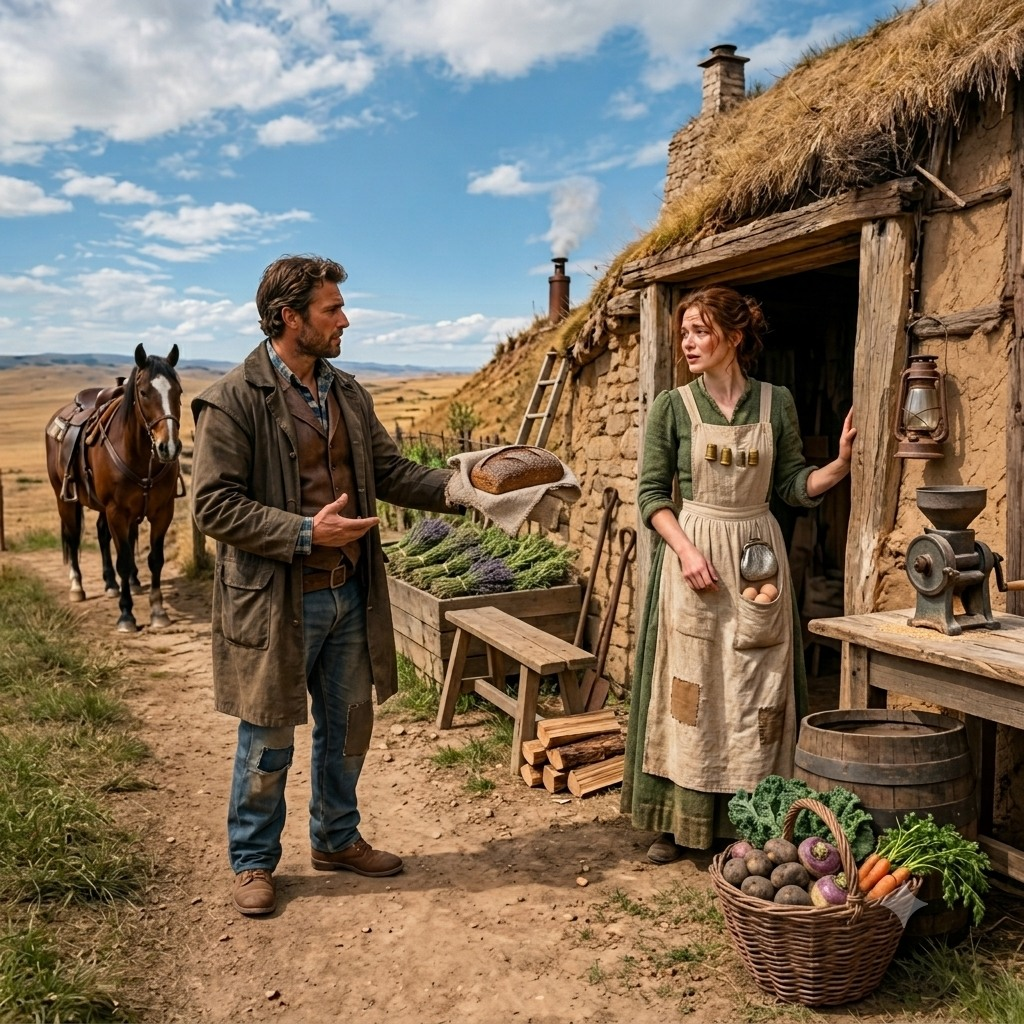
He had no idea that the woman he was searching for had spent years making sure nobody found her.
And he had no idea what waited behind the wooden door in the side of that hill.
But as he tightened the last strap on his saddle, he remembered the boy's final warning.
Please don't bring anyone.
The next morning, he would discover why.






Comments 0