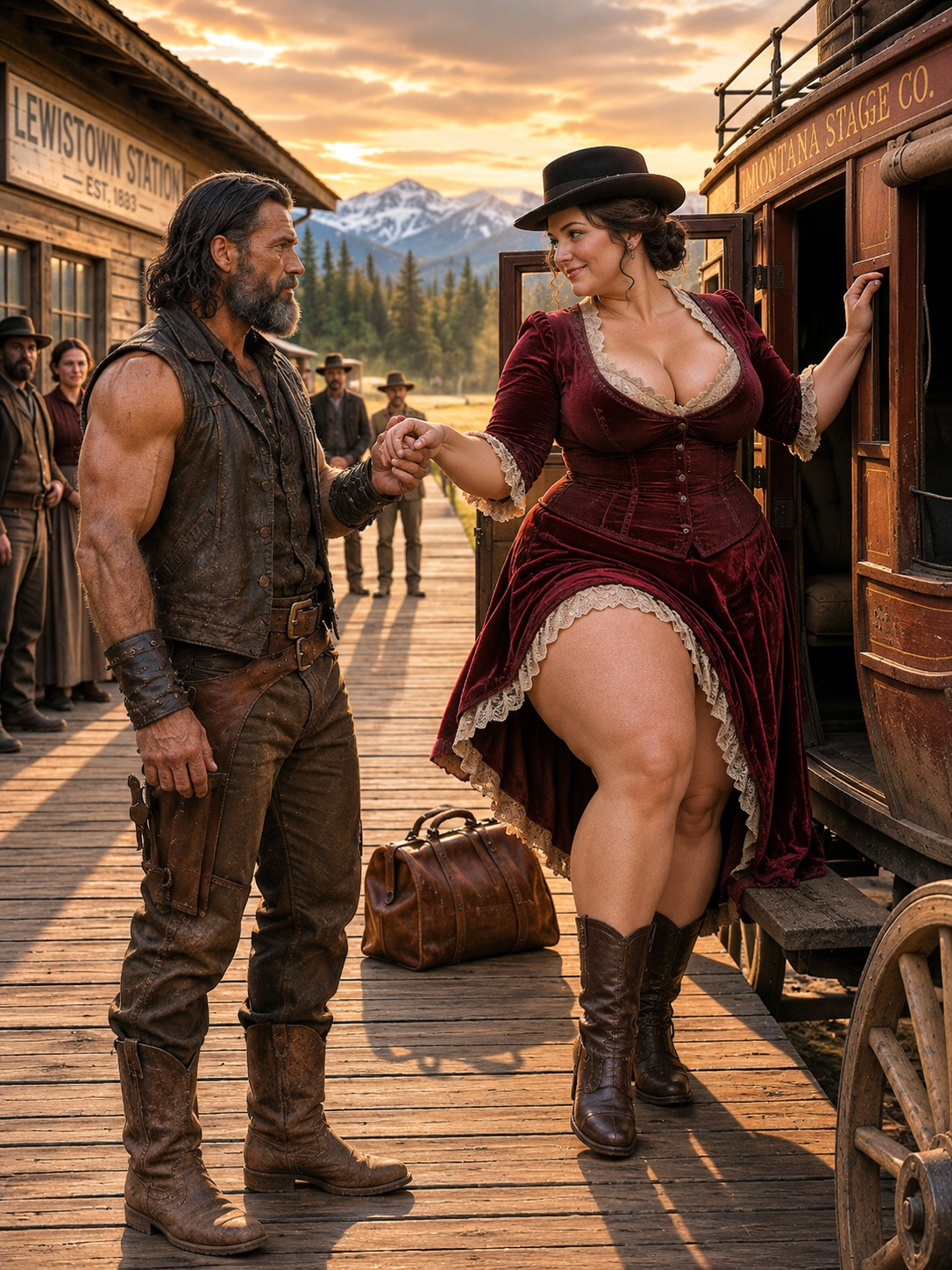
A woman stepped off the stagecoach and heard a man whisper:
"That can't be her."
Owen Renick stared at the sealed letter in his hand.
At the bottom, beneath his signature, were five words he had written without thinking: "I expect nothing from marriage."
The woman standing before him had come prepared to prove him wrong.
For several seconds, nobody on the platform moved.
The stagecoach driver was still holding the door open. A little dust drifted across the wooden boards. Somewhere behind the station, a horse stamped impatiently against the ground.
But Owen Renick barely heard any of it.
He was looking at the woman who had just stepped down from the coach.
She was not what he had expected.
Not even close.
Her traveling dress was a deep teal-blue, fitted neatly at the waist, with delicate ivory lace at the collar and cuffs. A muted gold shawl rested over her shoulders. Her auburn hair had been pinned into a braided bun beneath a modest traveling hat, although a few loose strands had escaped during the long journey.
She carried a brown leather traveling case.
Not a servant.
Not a companion.
Not a nervous young woman waiting for someone to tell her where to stand.
She looked like a woman who had made a decision and intended to see it through.
Owen had imagined somebody considerably different.
In his mind, the woman answering his advertisement would be quiet, perhaps a little shy, and grateful for the opportunity to leave whatever difficult circumstances had brought her to a marriage arrangement in Montana.
He had not expected elegance.
He had not expected confidence.
And he certainly had not expected her to look at him as though she were evaluating whether he was suitable for her.
"Mr. Renick?"
Her voice was clear.
Owen blinked.
"Yes."
She glanced at the letter in his hand.
"Then I believe you're expecting me."
He looked down at the envelope.
Her name was written across the front in his own handwriting.
He had addressed it three weeks earlier.
He had written about the ranch, the distance from town, the work, the weather, and the practical advantages of having another person in the house.
He had deliberately avoided making promises about affection.
He had been honest.
At least, he had thought he was.
"You're Clara?" he asked.
"Clara Whitcomb."
She extended her hand.
He looked at it for a moment before taking it.
Her handshake was firm, warm, and brief.
"Welcome to Sixmile," he said.
"Thank you."
A silence followed.
It was not particularly long, but with eleven people watching, it felt considerably longer.
Owen noticed Renshaw standing nearby.
The old man had spent most of his life in Sixmile and possessed an extraordinary ability to appear wherever something interesting happened.
At the moment, he was pretending to examine a wooden post.
He was not examining anything.
He was listening.
Amity Peele, who operated the boarding house, stood beside the station entrance with her hands folded over her apron.
The Vance boys were sitting on a feed barrel.
One of them whispered something to the other.
Owen heard a suppressed laugh.
He tightened his jaw.
Clara noticed.
"Am I interrupting something?" she asked.
"No."
Her eyes moved briefly across the platform.
"Everyone seems very interested in the arrival."
"They're curious."
"About me?"
"About us."
She looked back at him.
"Is there a difference?"
Owen had no immediate answer.
He reached for her traveling case.
"I'll take that."
"I can carry it."
"I can see that."
"Then why offer?"
For the first time that afternoon, Renshaw nearly laughed out loud.
Owen gave him a warning look.
Clara's expression remained perfectly composed.
Finally, Owen took the case.
It was heavier than he expected.
"You brought a lot."
"I brought what I need."
"How long did you travel?"
"Two days by stagecoach, with a night in Helena."
"Long journey."
"Longer than I expected."
He nodded toward the wagon waiting beside the platform.
"Come on. The ranch is some distance from town."
Clara followed him.
As they crossed the boards, she noticed the people watching.
She had expected curiosity.
She had expected questions.
What she had not expected was the particular expression on their faces.
It was not simple interest.
There was something almost uncomfortable about the way they looked at Owen.
As though they remembered something he did not want remembered.
When she reached the wagon, Amity Peele stepped forward.
"You must be Miss Whitcomb."
"Clara, please."
Amity smiled.
"Well, Clara, welcome to Sixmile."
"Thank you. It's a beautiful town."
"You're being kind. It's a dusty little place."
"I've seen worse."
Amity's eyes moved toward Owen.
"Have you been told about the ranch?"
"Some of it."
"And about the house?"
Owen interrupted.
"Amity."
The older woman stopped.
Her expression changed slightly.
"Of course. I was only being friendly."
Clara noticed the exchange.
She also noticed that Amity seemed to be choosing her words carefully.
"Is there something I should know?" Clara asked.
"Nothing that can't wait," Owen replied.
That answer did not satisfy her.
But she did not challenge him in front of the entire platform.
Instead, she thanked Amity and climbed into the wagon.
Owen placed her traveling case beside the seat.
Before he climbed up, Renshaw approached.
"Well, Renick."
Owen looked at him.
"What?"
"She's certainly not what I expected."
"Nobody asked what you expected."
Renshaw chuckled.
Then he lowered his voice.
"Elizabeth was a good woman."
The words landed heavily.
Owen's expression hardened.
"Don't."
Renshaw raised both hands.
"I didn't mean anything by it."
"Then don't say it."
The old man stepped away.
Clara had heard the name.
Elizabeth.
She looked at Owen, but he was already climbing onto the wagon.
He picked up the reins.
"Ready?"
"Yes."
The wagon rolled away from the station.
Behind them, Sixmile continued watching.
Clara did not turn around.
Owen did.
He looked toward the station until the buildings disappeared behind a bend.
"You don't have to worry about those people," he said.
"I wasn't."
"They talk."
"People usually do."
"They'll have opinions about you."
"People usually do that, too."
He glanced at her.
There was something in her voice that made him reconsider his assumptions.
"You're not easily bothered."
"I have learned not to be."
He looked ahead.
For several minutes, neither spoke.
The road stretched north through open country.
Pine trees covered the lower slopes of the mountains. Farther away, the peaks rose against the evening sky, their upper ridges still holding traces of snow.
Clara watched the landscape.
It was beautiful.
Different from the towns and farms she had known before.
She had spent months imagining this journey.
Not because she believed marriage would solve every problem in her life, but because she had reached a point where remaining where she was had become more difficult than leaving.
Her circumstances had been complicated.
Her father was gone.
The small dressmaking business she had helped maintain had failed after a series of unpaid debts.
She had no brothers, no husband, and no wealthy relatives waiting to rescue her.
When she saw Owen's advertisement, she had not immediately answered.
She had read it three times.
He wanted a wife who understood that ranch life was demanding.
He wanted someone capable of managing a household.
He promised a respectable home, financial security, and honesty.
He did not promise romance.
In fact, one sentence had stood out.
"I have no wish to pretend that a practical arrangement will automatically become a love match."
Clara had appreciated the honesty.
She had also written back with her own conditions.
She would not be treated as hired help.
She would not be expected to surrender her judgment.
And she would not accept cruelty simply because a man provided her with a home.
Owen had agreed to all three.
At least, in writing.
Now, sitting beside him, she wondered whether he remembered that agreement.
"How long have you lived here?" she asked.
"Most of my life."
"Do you enjoy it?"
He considered the question.
"It's home."
"That's not quite an answer."
"It's the only one I have."
She turned toward him.
"Are you always this talkative?"
He looked at her.
For a moment, he seemed genuinely surprised.
Then something almost resembling amusement passed across his face.
"Usually I'm worse."
Clara smiled faintly.
It was the first time since arriving that her expression softened.
Owen looked away.
He did not understand why that small change in her face made him feel uncomfortable.
He had spent two years teaching himself not to notice such things.
Two years avoiding conversations that lasted longer than necessary.
Two years keeping his house quiet.
Elizabeth had once loved conversation.
She had filled the kitchen with stories, questions, and laughter.
After her death, Owen had discovered that silence could become a habit.
Eventually, he had begun to prefer it.
The wagon continued north.
When the road narrowed, he pointed toward a distant ridge.
"That's the western boundary of the property."
Clara followed his gesture.
"How much land?"
"Nearly six hundred acres."
"That's a great deal."
"Most of it is grazing land. There's timber farther up the slope."
"And the house?"
"Beyond that ridge."
"Do you have workers?"
"Three regular hands. More during roundup."
"Do they live at the ranch?"
"Two have cabins. The third has a family in town."
Clara nodded.
"Then I suppose I'll have plenty to learn."
Owen glanced at her.
"You've never lived on a ranch?"
"No."
"That may be difficult."
"I imagine so."
"There's work every day."
"I know."
"Winter can be severe."
"I know that, too."
He studied her.
"Then why did you answer my letter?"
Clara took a moment before replying.
"Because I wanted a life that belonged to me."
Owen looked at the road.
He understood the words.
He did not understand the feeling behind them.
"Well," he said, "you'll have that here."
She looked at him.
"I hope so."
The wagon rounded the ridge.
The ranch appeared below them.
It was larger than Clara had imagined.
The main house stood on a gentle rise overlooking a wide pasture. A stable and barn occupied the eastern side of the property. Several fenced fields stretched toward a line of pine trees.
A creek ran along the lower edge of the land.
The house itself was a handsome two-story structure with a broad porch and tall windows.
It was well maintained.
But something about it felt strangely empty.
The curtains were drawn in several rooms.
The garden beds near the porch had been cleared but not replanted.
A wooden swing hung beneath the western veranda.
It moved slightly in the wind.
Owen noticed her looking at it.
"Elizabeth liked that swing."
Clara turned toward him.
"Your first wife?"
He nodded.
"Yes."
"I'm sorry."
He said nothing.
After a moment, he added, "She died in March. Two years ago."
Clara looked down at her hands.
"That must have been difficult."
"It was."
He spoke with such finality that she understood the subject was not open for discussion.
She did not push.
Instead, she looked toward the house again.
"Would you like me to help with the garden?"
Owen frowned.
"What?"
"The flower beds. They look as though they could use some attention."
He followed her gaze.
"There's no need."
"Flowers don't require much attention once they're established."
"I said there's no need."
Clara turned toward him.
"All right."
He realized he had spoken more sharply than intended.
"I'm not saying you can't."
"I didn't think you were."
The wagon reached the front gate.
Owen jumped down and opened it.
As he climbed back up, Clara noticed a small brass plaque beside the entrance.
ELIZABETH RENICK.
The name had been engraved beneath a simple floral design.
She looked at it for a long moment.
Owen saw where her attention had gone.
"She loved this place," he said.
Clara nodded.
"I can understand why."
He drove through the gate.
The house grew larger.
A woman in her fifties appeared on the porch.
She wore a dark brown dress, a white apron, and her gray hair was pulled tightly into a bun.
This was Mrs. Hattie Bell, the woman who had managed the house since Elizabeth's death.
She had been expecting Owen.
She had not been expecting Clara to look quite like this.
Her eyes moved from the woman's dress to her traveling case, then to Owen.
"You're back."
"Yes."
Hattie came down the steps.
"And this must be Miss Whitcomb."
"Clara," she said, offering her hand.
Hattie took it.
"Welcome to the Renick ranch."
"Thank you."
"I've prepared the upstairs room."
Owen looked at her.
"The upstairs room?"
"Yes."
"The room at the end of the hall?"
Hattie hesitated.
"That's the room you told me to prepare."
Owen's jaw tightened.
Clara noticed.
"Is there a problem?"
"No."
Hattie looked between them.
Then she turned toward the house.
"Come inside. I'll bring some water."
Clara stepped onto the porch.
The floorboards creaked beneath her boots.
Inside, the house was clean and carefully arranged.
There was a large sitting room with a stone fireplace, a dining room with a long table, and a staircase leading to the upper floor.
Several framed photographs stood on a cabinet.
Clara noticed one immediately.
A wedding portrait.
Owen stood beside a woman in a simple ivory dress.
Elizabeth.
She was smiling.
Not a polite smile.
A genuine, unguarded smile.
Clara looked at the photograph for only a moment before turning away.
She had no desire to compete with a dead woman.
Nor did she intend to pretend that the woman had never existed.
Hattie carried a pitcher of water into the sitting room.
"Would you like something to eat?"
"That would be wonderful."
"I'll prepare supper."
Owen removed his coat.
"She can eat with me."
Hattie looked surprised.
"Of course."
Clara glanced at him.
He seemed to regret the invitation almost immediately.
But he did not withdraw it.
Hattie led Clara upstairs.
The bedroom was spacious.
A large bed stood against the far wall. A dressing table sat beside the window. Fresh linen covered the mattress.
There was a small fireplace.
Clara set her traveling case beside the wardrobe.
"This is lovely."
Hattie nodded.
"It used to be Elizabeth's sewing room."
Clara looked toward the dressing table.
There were faint marks on the wood where something heavy had once rested.
"I see."
"She was a talented woman."
"I'm sure she was."
Hattie hesitated.
Then she said something Clara had not expected.
"Mr. Renick hasn't been the same since she died."
Clara turned toward her.
"How long have you worked here?"
"Seven years."
"Then you knew her well."
"Very well."
Hattie looked toward the open door.
"She was kind. She could be stubborn, too. She had opinions about everything."
Clara smiled.
"That sounds familiar."
For the first time, Hattie smiled back.
Then her expression became serious.
"I should tell you something."
Clara waited.
"Mr. Renick doesn't like people moving things."
"I understand."
"Especially anything that belonged to Elizabeth."
"I won't touch her belongings without permission."
Hattie seemed relieved.
"Thank you."
She turned to leave.
Then stopped.
"Miss Whitcomb?"
"Yes?"
"There's one more thing."
Clara looked at her.
Hattie lowered her voice.
"Whatever happens in this house, don't mistake his silence for indifference."
Clara studied her face.
"Why would I?"
Hattie looked as though she wanted to explain.
Instead, she shook her head.
"Never mind. Supper will be ready shortly."
She left.
Clara stood alone in the bedroom.
She walked toward the window.
From there, she could see the pasture, the stable, and the road she had traveled.
She had imagined this moment many times.
She had imagined a strange house, an unfamiliar husband, and the beginning of a difficult adjustment.
She had not imagined a house that seemed to be waiting for someone who would never return.
She turned toward the dressing table.
A small drawer stood slightly open.
Inside was a piece of pale blue ribbon.
Clara did not touch it.
She simply closed the drawer.
Downstairs, a door shut.
Owen was moving through the house.
She heard his boots cross the sitting room.
Then she heard him stop.
A moment later, his voice rose.
"Hattie!"
"Yes, Mr. Renick?"
"Where did you put it?"
"I haven't moved anything."
"Then where is it?"
Clara stepped toward the bedroom door.
There was a pause.
Then Hattie answered in a quieter voice.
"It's in the study. Where it always was."
Owen said nothing.
Clara heard his footsteps move away.
She looked down the hall.
At the far end stood a closed door.
The room Owen had told Hattie to prepare.
She had not noticed it when she first entered the house.
The door was dark walnut.
A small brass keyhole sat beneath the handle.
And hanging from the handle was a faded ribbon.
The same pale blue color as the ribbon in the drawer.
Clara stared at it.
She had not come to Montana to investigate her husband's past.
She had come to build a future.
But before she could turn away, she heard footsteps on the stairs.
Owen appeared at the end of the hallway.
He looked at her.
Then he looked at the door.
His expression changed immediately.
"Clara."
She turned.
"Yes?"
"Stay away from that room."
His voice was quiet.
But there was something beneath it that made her stop breathing for a moment.
"Of course," she replied.
Owen walked toward her.
He reached into his pocket and pulled out a small brass key.
For a moment, he held it tightly in his palm.
Then he looked at her and said:
"There's something about Elizabeth you need to understand before we begin this marriage."
He placed the key into the lock.
And slowly turned it.






Comments 0