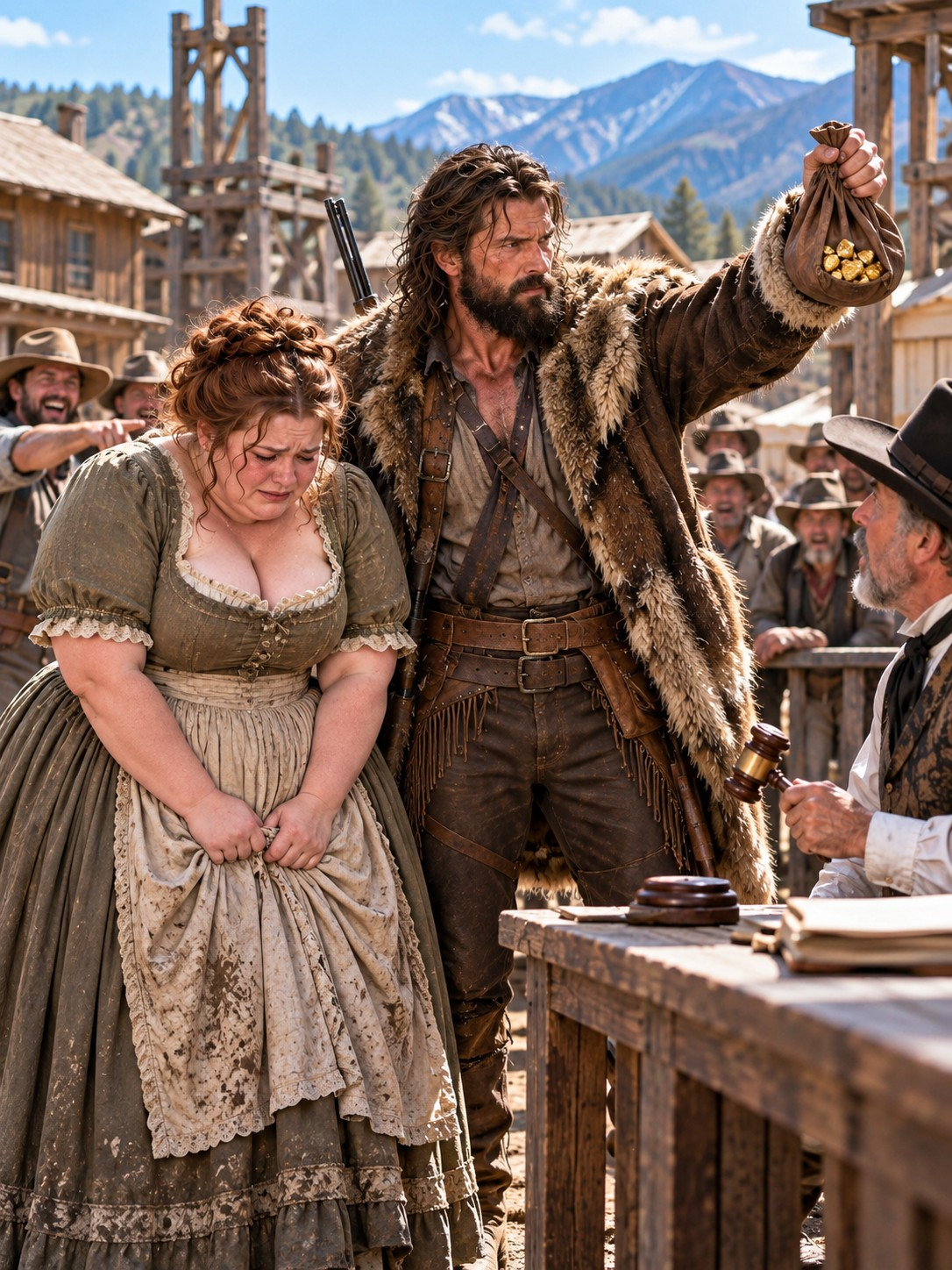
"One silver dollar!" Amos Buckley shouted, pointing his wooden gavel at Clementine Foster. "Surely somebody wants her!"
Mayor Josiah Caldwell stepped toward the auction table and noticed a folded paper protruding from Clementine's worn leather satchel.
Three words were written across its corner.
Elias Foster's Claim.
The mayor stopped smiling.
He knew exactly what that name meant.
"Well?" Amos demanded, turning toward the crowd. "Are we going to stand here all afternoon, gentlemen? Or is somebody going to show this poor creature a little charity?"
The laughter came again.
It rolled across the wooden platform, spilled into the dusty street, and bounced between the storefronts of Bitter Creek like a sound that had nowhere decent to go.
Clementine Foster kept her eyes on her boots.
She had spent twenty-eight years learning how to survive embarrassment. She had endured the whispers of customers at her father's bakery, the pitying looks of women who thought marriage was the only measure of a woman's worth, and the cruel remarks of men who believed a large woman ought to be grateful for any attention at all.
But nothing had prepared her for this.
Not the wooden platform.
Not the auctioneer's gavel.
Not the crowd of strangers who had gathered to decide what she was worth.
And certainly not the terrible silence that followed when no one offered even a dollar.
"Come on, boys," Amos said. "She's a strong one. Look at those arms. Could probably chop firewood all winter without needing a rest."
A miner near the front raised his hand.
For one beautiful, foolish second, Clementine thought he intended to bid.
"I'll give you a sack of oats!" he called.
The crowd erupted.
"Make it half a sack!" another man shouted.
"Better include a wagon to haul her home!"
A third man laughed so hard he nearly fell against the railing.
Clementine felt her face burning.
Her fingers tightened around the front of her faded blue dress until the cloth twisted painfully between them.
She would not cry.
She had promised herself that much before stepping onto the platform.
She would not give these men the satisfaction of watching her break.
"Enough," Mayor Caldwell said.
His voice was quiet, but the crowd immediately settled.
Caldwell was a tall, carefully dressed man with silver hair, a neat mustache, and the sort of smile that made strangers trust him before they had learned anything about his character.
He owned the largest house in Bitter Creek.
He controlled the town bank.
And according to the women who had been stranded when the matrimonial agency collapsed, he had personally arranged the auction.
"Miss Foster," he said pleasantly, "perhaps you should understand that we're trying to help you."
Clementine raised her head.
"Help me?"
"Naturally. The town has paid for your food and lodging. We cannot support you indefinitely."
"I offered to work."
"Yes, you did."
"I can bake. I can keep accounts. I can sew, clean, mend clothing, and manage a household. I worked in my father's bakery for fifteen years."
Caldwell gave a patient smile.
"Unfortunately, none of those talents pays your outstanding expenses today."
"I have money coming from St. Louis."
"So you have said."
"My father's estate—"
"Has apparently been delayed."
Something in his voice made her hesitate.
Caldwell looked at her satchel again.
Then he turned toward Amos.
"Finish the auction."
Clementine swallowed.
"Please, Mayor Caldwell. I never agreed to be sold."
The mayor's expression hardened.
"Your matrimonial contract authorized the agency to arrange a suitable marriage. The agency transferred its outstanding obligations to the town. This auction is simply our method of finding husbands for the remaining women."
"Then let me leave."
"And travel where, Miss Foster? Into the mountains alone?"
"I'll find work."
"Without references? Without transportation? Without money?"
He leaned closer.
"Be reasonable."
Clementine looked beyond him at the street.
A stagecoach stood near the livery stable. Two horses drank from a trough. Beyond the buildings, the mountains rose against a blue summer sky.
Freedom was right there.
She could see the road.
But she had no fare, no provisions, and nowhere to sleep.
The mayor knew it.
That was what made his smile so unbearable.
"Twenty dollars!" Amos announced. "A fine opportunity, gentlemen!"
Silence.
"Ten!"
Nothing.
"Five!"
A man spat tobacco into the dirt.
"One silver dollar!"
Clementine stared at the wooden planks beneath her feet.
She had crossed half a continent for this.
Three months earlier, she had been standing inside her father's bakery in St. Louis, watching rain slide down the windows.
The bakery had been sold to settle debts after Elias Foster's death.
For most of her life, the little building had been her entire world.
She knew the sound of dough being kneaded before sunrise.
She knew how much flour a family of six needed for a week.
She knew how to stretch a dollar, repair a broken oven, and keep a business alive through a hard winter.
What she did not know was how to build a future when the only person who had ever loved her without conditions was gone.
Her father had called her his greatest blessing.
He had never once told her to become smaller.
When customers mocked her weight, he had sent them away without their bread.
When she cried after a young man publicly rejected her at a church social, he had sat beside her until midnight.
"Don't you ever mistake somebody else's blindness for your own lack of worth," he had told her.
She remembered those words now.
She held on to them as tightly as she held her dress.
But her father was dead.
And the men of Bitter Creek were laughing.
"Maybe she could marry the blacksmith's horse!" someone shouted.
Clementine closed her eyes.
A memory rose without warning.
Her father standing behind the bakery counter.
His sleeves rolled to his elbows.
Flour on his beard.
A small leather satchel lying beside the cash register.
He had been strangely protective of that satchel during the final weeks of his life.
Once, when she asked what it contained, he had said only, "Something I should have told you about years ago."
But he never had.
A fever took him before winter ended.
After the funeral, Clementine found the satchel beneath his bed.
Inside were several letters, a worn map, and a folded document marked with the words Elias Foster's Claim.
She had not understood it.
There was a reference to Colorado.
There were signatures.
There was a hand-drawn sketch of mountains and a river.
And there was a note in her father's handwriting.
Keep this safe, Clem. There are things a man can lose that are worth more than money. And there are things he must never surrender.
She had carried the papers west because they were among the few things he had left her.
Now the satchel rested at her feet on an auction platform.
And the mayor of Bitter Creek was staring at it.
"Miss Foster."
She opened her eyes.
Caldwell stood closer than before.
"That bag," he said.
She looked down.
"What about it?"
"Where did you get it?"
"It belonged to my father."
"Your father was Elias Foster?"
"Yes."
For an instant, something moved across the mayor's face.
It was gone almost immediately.
"Interesting."
"Did you know him?"
"No."
The answer came too quickly.
Clementine noticed.
Caldwell straightened his coat.
"Mr. Buckley, I believe we've wasted enough time."
Amos sighed dramatically.
"Well, gentlemen, it appears our last bride is going home without a husband."
Someone laughed.
"Send her back east!"
"Put her on a freight wagon!"
"Let the bears have her!"
Clementine bent to retrieve her satchel.
She had made her decision.
She would walk out of Bitter Creek if she had to.
She would sleep beneath a tree.
She would find a farmhouse and ask for work.
She would scrub floors until her hands bled.
But she would not stand another moment while strangers argued over whether she was worth less than a horse.
She took one step toward the edge of the platform.
Amos caught her arm.
"Not so fast, sweetheart."
"Let go of me."
"We haven't finished."
"You said nobody wanted me."
"That doesn't mean you can walk away."
His fingers tightened.
Pain shot through her upper arm.
Clementine pulled back.
"You're hurting me."
"Then stop struggling."
The crowd watched.
Nobody intervened.
Mayor Caldwell looked toward the bank.
For the first time that afternoon, Clementine felt something stronger than humiliation.
Anger.
She had been polite.
She had been patient.
She had followed every instruction given to her since arriving in Bitter Creek.
And none of it had earned her the smallest measure of respect.
"Take your hand off me," she said.
Amos grinned.
"Or what?"
She stared directly at him.
"Or you'll discover that being a large woman doesn't mean I'm a helpless one."
A few men chuckled.
Amos's smile vanished.
He raised his gavel.
"Now listen here—"
"Take your hand off her."
The voice came from the back of the crowd.
It was deep.
Quiet.
And somehow more commanding than all the shouting that had filled the square.
Amos stopped.
Heads turned.
A man stood near the shadow of the general store.
He was enormous.
Not merely tall, though he stood several inches above the men around him. He had the broad shoulders and powerful frame of someone who had spent his life cutting timber, climbing mountains, and carrying burdens that would break ordinary men.
His long dark hair was tied behind his neck.
A thick beard framed his weathered face.
He wore a dark green coat beneath a heavy fur-trimmed mantle, and a rifle rested across his back.
Dust covered his boots.
His steel-gray eyes remained fixed on Amos's hand.
"I said," the stranger repeated, "take your hand off her."
Amos released Clementine.
Not because he wanted to.
Because something in the man's expression told him there would be consequences if he refused.
Clementine rubbed her arm.
The stranger stepped forward.
The crowd parted.
Nobody laughed now.
He walked slowly, his boots striking the hard earth with deliberate weight.
Mayor Caldwell turned.
"Can I help you, sir?"
The man ignored him.
He stopped in front of the platform and looked up at Clementine.
For a moment, neither spoke.
His eyes moved over her face.
Not her body.
Not her dress.
Her face.
He noticed the tears she had fought to hide.
He noticed the red marks on her arm.
Then he looked toward Amos.
"What's the highest price paid today?"
Amos blinked.
"What?"
"The highest bid."
"Three hundred dollars."
The stranger reached beneath his coat.
Several men stiffened.
His hand emerged holding a heavy leather pouch.
He tossed it onto the auction table.
The impact made the ledger jump.
The pouch opened.
Gold nuggets spilled across the wood.
A collective gasp rose from the crowd.
Amos stared.
Mayor Caldwell took an involuntary step forward.
The stranger spoke.
"I'll pay six hundred dollars."
Silence.
Clementine could hear the horses moving near the stable.
A fly buzzed around the auction ledger.
Somewhere down the street, a loose shutter struck a wooden wall.
Amos slowly looked up.
"Six hundred?"
"That's what I said."
"For her?"
The stranger's expression did not change.
"For the amount you claim is owed under her contract."
Amos swallowed.
"That's twice what anybody paid for the prettiest bride here."
"I can count."
A nervous laugh escaped someone in the crowd.
The stranger turned his head.
The laughter stopped.
Mayor Caldwell approached the table.
"Sir, perhaps we should discuss this privately."
"No."
"The terms of this arrangement—"
"Are simple enough. You wanted money. There it is."
Caldwell glanced at the gold.
"May I ask your name?"
"Silas Mercer."
The mayor went still.
Only for a heartbeat.
But Clementine saw it.
She had spent years watching customers across a bakery counter. She knew the difference between surprise and recognition.
Caldwell recognized this man.
And he did not look pleased.
"Mercer," the mayor repeated.
Silas said nothing.
"I wasn't aware you'd returned to Bitter Creek."
"I hadn't planned on staying."
"Then perhaps we can conduct this transaction without unnecessary attention."
Silas looked around at the crowd.
"Funny. You didn't seem concerned about attention when you were humiliating her."
A murmur moved through the miners.
Caldwell's cheeks tightened.
"This is a lawful proceeding."
"Then you won't object to putting everything in writing."
Amos cleared his throat.
"Now, hold on. If you're willing to pay six hundred dollars for a woman nobody else wants, that's your business. But don't come crying to us when you realize—"
Silas placed one hand on the table.
The wood creaked beneath his palm.
Amos stopped talking.
"Finish that sentence carefully," Silas said.
Clementine looked at him.
She did not know whether to be frightened or grateful.
Six hundred dollars.
She had never seen that much money in one place.
And this stranger had offered it for her contract without knowing a single thing about her.
Or had he?
There was something unsettling about the way he had looked at her.
Not like a man admiring a bride.
Like a man confirming something he had spent years searching for.
"Mr. Mercer," she said quietly.
He turned.
"Ma'am."
"I don't understand."
"Neither do they."
"Why would you pay so much?"
Silas glanced toward Caldwell.
"Because the price they're asking isn't the price that matters."
The mayor's expression changed.
"Mercer."
Silas ignored him.
He looked at Clementine's satchel.
"Your name is Clementine Foster?"
She nodded.
"Your father's name was Elias?"
Her heart stumbled.
"Yes."
"From St. Louis?"
"Yes."
Silas took a slow breath.
Something painful crossed his face.
For the first time, his composure faltered.
"Did he ever tell you about Colorado?"
Clementine shook her head.
"Not much. He lived here when he was younger, but he wouldn't talk about it."
"Did he leave you any papers?"
Mayor Caldwell stepped forward.
"That is entirely irrelevant."
Silas turned toward him.
"Is it?"
"Miss Foster's private belongings have nothing to do with this auction."
"Then why were you staring at her bag?"
The mayor's face reddened.
"I beg your pardon?"
"You heard me."
A heavy silence settled over the square.
Clementine looked from one man to the other.
The mayor had asked about her satchel.
Now Silas wanted to know about the papers inside it.
And both men knew her father's name.
Something was wrong.
Very wrong.
She pulled the satchel closer.
"What is this about?"
Silas looked at her.
"I knew your father."
The words struck harder than any insult she had heard that afternoon.
"You knew him?"
"Yes."
"How?"
"We worked together once."
"Where?"
"In the mountains north of here."
Clementine felt dizzy.
Her father had spoken of his years in Colorado only in fragments.
He had mentioned difficult winters.
A mining camp.
A friend who had saved his life.
But whenever she asked for details, he changed the subject.
"Was he a miner?" she whispered.
Silas nodded.
"Among other things."
Caldwell slammed his palm against the table.
"Enough!"
Everyone turned.
The mayor was breathing harder now.
"This auction is concluded. Mr. Mercer has made his offer, and the town accepts it."
He grabbed the ledger.
"Mr. Buckley, prepare the papers."
Silas did not move.
"Not yet."
Caldwell stared at him.
"What?"
"Miss Foster hasn't agreed."
Amos looked confused.
"Agreed to what?"
"To leave with me."
A miner laughed.
"She doesn't get a choice!"
Silas turned toward him.
"She does now."
The miner lowered his eyes.
Clementine stared at the mountain man.
He had paid a fortune.
He had silenced the crowd.
And now he was telling her that she could refuse him.
It made no sense.
"Mr. Mercer," she said, "are you asking me to marry you?"
"No."
The answer startled her.
Amos nearly dropped his gavel.
Silas continued.
"I'm offering to settle the amount they're demanding so you can walk away from this platform."
Clementine looked at the gold.
"Six hundred dollars?"
"Yes."
"And you expect nothing?"
"I expect you to decide what happens to your own life."
For the first time since arriving in Bitter Creek, Clementine felt the ground beneath her become steady.
Not because she trusted him.
She did not.
Not yet.
But because he had spoken to her as though her wishes mattered.
She had almost forgotten what that felt like.
"Why?" she asked.
Silas's gaze shifted toward the mayor.
"Because your father once did something for me that I can never repay."
Caldwell suddenly reached for the leather pouch.
Silas caught his wrist.
The movement was swift but controlled.
The mayor froze.
"Don't," Silas said.
Caldwell stared at him.
"You have no authority here."
"Neither do you over her."
The men faced one another across the table.
Clementine saw fear in the mayor's eyes.
Real fear.
Not anger.
Not embarrassment.
Fear.
Silas released his wrist.
Then he reached inside his coat.
Slowly.
Deliberately.
He withdrew a folded document.
The paper was yellowed with age.
Its edges were worn.
A faded red seal marked the bottom.
Clementine recognized the handwriting across the front before he even opened it.
Her father's handwriting.
She took an involuntary step forward.
"Where did you get that?"
Silas looked at her.
"Your father gave it to me."
"When?"
"Seventeen years ago."
Clementine's mouth went dry.
"Why?"
Silas unfolded the paper.
Mayor Caldwell backed away.
"Mercer," he said quietly. "Think very carefully about what you're doing."
Silas looked directly at him.
"I've had seventeen years to think about it."
The crowd was silent.
Silas turned the document so Clementine could see.
At the top was her father's name.
Beneath it was a description of a mining claim.
A river.
A ridge.
Several acres of land.
And a second name.
Josiah Caldwell.
Clementine stared.
The mayor's signature appeared beside her father's.
But someone had drawn a heavy line through part of the document.
"What is that?" she whispered.
Silas's voice remained low.
"Proof that your father owned something powerful men wanted badly enough to destroy his life."
Clementine looked at Caldwell.
The mayor was pale.
"What did you do to him?"
Caldwell opened his mouth.
No words came.
Silas folded the document.
"That's the question I've come back to answer."
A miner near the front stepped away from the platform.
Another followed.
The crowd that had mocked Clementine only minutes earlier now watched the mayor with growing unease.
Amos cleared his throat.
"Mr. Mercer, perhaps we ought to finish the transaction."
Silas looked at him.
"Write down that the town's claim against Miss Foster is settled."
Amos hesitated.
"Six hundred dollars?"
"Every last cent."
"And the marriage contract?"
"Released."
"That's not how we normally—"
"Write it."
Amos obeyed.
His hand trembled as he dipped the pen into the ink.
Clementine watched him write.
She had never seen a man so eager to complete paperwork.
When he finished, Silas examined the document and handed it to her.
"This is yours."
She accepted it carefully.
Her hands were still shaking.
"Thank you."
Silas nodded.
Then he turned toward the mayor.
"Now we can discuss Elias Foster."
Caldwell's expression became strangely calm.
Too calm.
He adjusted his cuffs.
"Of course."
Silas narrowed his eyes.
"Here?"
The mayor smiled.
"Why not? I've nothing to hide."
Clementine felt a chill despite the summer heat.
The mayor looked toward the crowd.
"Gentlemen, I believe the entertainment is over."
Men began drifting away.
Some looked embarrassed.
Others avoided Clementine's eyes.
Zeke Dawson, the miner who had offered a sack of oats, muttered something and disappeared toward the saloon.
Within minutes, the square had begun returning to normal.
But Clementine knew nothing would ever be normal again.
Silas helped her down from the platform by offering his hand.
He did not pull.
He waited until she chose to take it.
His palm was rough and warm.
She stepped onto the dirt.
For a moment, she stood beside him without speaking.
Then she looked at the document in her hand.
"Mr. Mercer?"
"Silas."
"Silas."
He waited.
"My father died believing he had failed me."
Something changed in his expression.
"He didn't fail you."
"He lost the bakery. He left debts. He worked himself sick trying to keep us fed."
Silas looked toward the mountains.
"Your father was one of the bravest men I ever knew."
Clementine's throat tightened.
"Then why did he never tell me about you?"
Silas took a long breath.
"Because telling you might have put you in danger."
She stared at him.
"Danger from whom?"
Before he could answer, a voice interrupted.
"Miss Foster."
Mayor Caldwell stood behind them.
He held her leather satchel.
Clementine immediately reached for it.
"That's mine."
"Naturally."
But he did not release it.
Instead, he looked at Silas.
"I believe you and I should have a private conversation."
Silas's expression hardened.
"Give her the bag."
Caldwell smiled.
"Of course."
He handed it to Clementine.
She took it and immediately noticed something wrong.
The buckle was open.
She was certain she had fastened it.
She looked inside.
Her father's letters were still there.
The worn map remained folded beneath them.
But the old document marked Elias Foster's Claim was missing.
Her stomach dropped.
She looked up.
Mayor Caldwell was already walking away.
"Stop!" she called.
He turned.
"Yes, Miss Foster?"
"My father's paper."
"What paper?"
"The one from my bag."
Caldwell looked mildly offended.
"I assure you, I have no interest in your personal correspondence."
Silas stepped forward.
"Then you won't mind emptying your pockets."
The mayor's smile vanished.
"Careful, Mercer."
Silas did not move.
"Give it back."
A long silence followed.
Then Caldwell laughed.
"You always were a stubborn fool."
Silas's eyes narrowed.
"And you always were a thief."
The mayor's face darkened.
For a moment, Clementine thought the two men might come to blows.
Instead, Caldwell leaned closer to Silas.
His voice dropped so low she could barely hear it.
"You should have stayed in the mountains."
Silas answered just as quietly.
"You should have left the girl alone."
Caldwell's eyes flicked toward Clementine.
Something cold entered them.
"She was never supposed to come here."
Clementine stopped breathing.
"What?"
The mayor straightened.
"I said nothing of the sort."
"Yes, you did."
Caldwell looked at Silas.
"Take your charity case and leave town before sunset."
Silas moved slightly in front of Clementine.
"She isn't a charity case."
"Call her whatever you please."
The mayor's voice became hard.
"But if you know what's good for either of you, you'll be gone before dark."
He turned and walked away.
Clementine stood frozen.
The square suddenly felt much smaller.
She looked at Silas.
"Why wasn't I supposed to come here?"
He did not answer immediately.
Instead, he watched Caldwell disappear into the bank.
Then he looked down at her satchel.
"Did your father leave you anything else?"
"Letters. A map. A little silver key."
Silas went still.
"A key?"
She nodded.
"It's sewn into the lining."
"Has anyone seen it?"
"No."
"Good."
His voice was suddenly urgent.
"Don't show it to anyone."
Clementine stared at him.
"Silas, what is happening?"
He looked toward the mountains.
Then back at the bank.
"Your father found something seventeen years ago. Something Caldwell has spent his life trying to keep buried."
"What?"
Silas took a breath.
Before he could speak, a sharp sound cracked across the square.
A rifle shot.
Clementine flinched.
Silas grabbed her shoulders and pulled her behind the auction platform.
Another shot struck the wooden railing above them.
Splinters exploded into the air.
People screamed.
Horses reared.
Silas drew his revolver.
"Stay down!"
Clementine crouched behind the platform, clutching her father's satchel against her chest.
She could barely breathe.
Through a gap in the boards, she saw a man standing in the second-story window of the bank.
A rifle rested against his shoulder.
He was aiming directly at them.
Silas saw him too.
But instead of firing, he stared.
His expression changed.
For the first time since entering the square, the mountain man looked genuinely shaken.
Clementine whispered, "Who is he?"
Silas lowered his revolver a fraction.
His voice was barely audible.
"That man died seventeen years ago."
The rifleman slowly stepped into the sunlight.
And when Clementine saw his face, she recognized him from the photograph hidden inside her father's satchel.
It was the man standing beside her father in the last photograph ever taken of him.






Comments 0