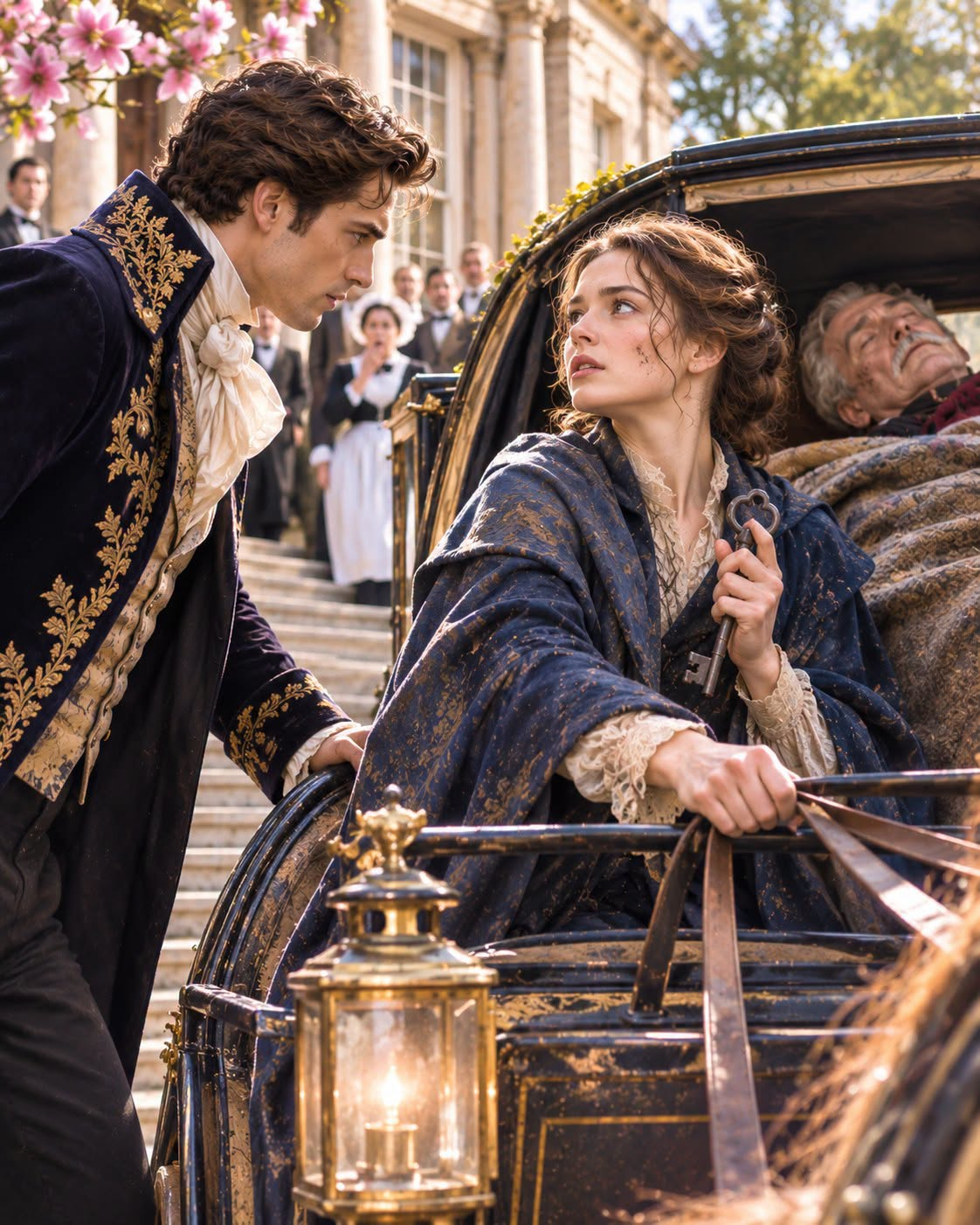
"Your Grace! The coachman is dying!"
The stable boy stumbled onto the steps, clutching a mud-covered leather glove.
Arthur, Duke of Colwick, caught it before it fell.
Inside the cuff, someone had scratched three small letters.
E. R. C.
Arthur stopped breathing.
Those were his mother's initials.
And his mother had been dead for twenty-two years.
"Where did you get this?"
The boy bent forward, fighting for air.
"From the carriage, Your Grace. Mr. Bray collapsed on the Reading road. The lady sent me ahead."
Arthur's fingers tightened around the glove.
"What lady?"
"Your bride, sir."
For three hours, Arthur had stood on the same stone step, waiting for a woman he had agreed to marry but had never met.
Now a boy was telling him that his future wife had taken control of his carriage, that his oldest servant was dying, and that an object bearing his dead mother's initials had somehow appeared on the road.
"Who is driving my horses?" Arthur demanded.
The boy swallowed.
"She is, Your Grace."
Arthur stared at him.
"Miss Renworth?"
"Yes, sir."
"With four horses?"
The boy nodded.
"All four, Your Grace. And she told me not to waste another minute."
Arthur turned toward the gates.
A moment later, he heard them.
Hooves.
Four horses moving together.
Not galloping.
Not stumbling.
A steady, controlled trot.
Then the black carriage appeared beneath the avenue of ancient beech trees.
It was covered in mud.
The wheels were filthy.
One brass lantern hung crookedly from its bracket.
And on the driver's box sat a young woman wearing a coat much too large for her.
She had no bonnet.
Copper-red hair had escaped its braid and whipped across her face.
Her hands held the reins with the confidence of someone who understood horses better than most men who earned their living driving them.
Arthur had spent thirty-seven years learning to recognize incompetence.
He recognized none in her.
The carriage came around the circular drive in a wide, precise curve.
The horses slowed.
The wheels turned.
And the carriage stopped with its door exactly opposite the bottom of the staircase.
Arthur felt a strange tightening in his chest.
Old Bray had stopped there every day for as long as Arthur could remember.
No other coachman ever managed the same position.
Yet this exhausted stranger had done it on her first attempt.
She wrapped the reins around the rail and looked down at him.
Her face was pale.
There was mud along her jaw.
Her lips were almost colorless.
"Is the surgeon coming?"
No greeting.
No curtsy.
Not even an acknowledgment of his title.
Arthur found himself answering immediately.
"He has been sent for."
"Then please hurry."
She pointed toward the carriage door.
"Mr. Bray has been unconscious for nearly an hour. I kept him on his side when I could, but the road was terrible."
Arthur was already moving.
He opened the carriage door.
And everything else disappeared.
Edmund Bray lay across the velvet seat beneath a heavy wool rug.
The old man's face had changed.
One side of his mouth drooped.
His left hand lay motionless against his chest.
His breathing was shallow and irregular.
Arthur had known Bray since childhood.
The old man had taught him how to hold a rein, how to approach a nervous horse, and how to recognize a liar by the way he avoided looking at his own hands.
Bray had been there when Arthur's father died.
He had been there when Arthur inherited the dukedom.
And he had been there on the night Arthur's mother disappeared from his life.
"Bray?"
The old man did not respond.
Arthur touched his shoulder.
"Edmund. Can you hear me?"
Nothing.
Arthur slipped one arm beneath the coachman's shoulders and the other beneath his knees.
Two footmen hurried forward.
"Your Grace, allow us—"
"I have him."
Arthur lifted the old man himself.
Bray weighed almost nothing.
That frightened Arthur more than anything else.
He turned toward the house.
"Mrs. Oaks!"
The elderly housekeeper appeared immediately.
"Prepare the blue room. Fresh linen, hot water, and every blanket you can find."
"The blue room, Your Grace?"
"Now."
Mrs. Oaks looked at the unconscious coachman.
Then at Arthur.
And nodded.
"Of course."
Arthur started up the steps.
Halfway to the entrance, he stopped.
The young woman had climbed down from the driver's box.
She stood beside the carriage wheel, one hand resting on its wooden rim.
Her shoulders were straight.
Her expression was composed.
But Arthur noticed something strange.
She was leaning against the wheel more heavily than she wanted anyone to see.
"Miss Renworth?"
She turned.
"Your Grace."
"I assume you are Juliet Renworth."
"I am."
She attempted a curtsy.
The movement was correct.
Unhurried.
And completely absurd beneath the enormous coachman's coat.
"I apologize for arriving late," she said. "We took the Reading road, and I underestimated the hill."
Arthur looked at her.
Then at Bray.
Then back at her.
"You drove four horses through the hills with an unconscious man inside my carriage?"
"Yes."
"Alone?"
"The stable boy helped until I sent him ahead."
Arthur studied her face.
"Do you understand how dangerous that was?"
For the first time, something changed in her expression.
Not fear.
Not embarrassment.
A faint suggestion of impatience.
"Yes, Your Grace."
"Then why did you do it?"
She looked toward Bray.
"Because stopping would not have helped him."
Arthur had no answer.
He carried his coachman inside.
Behind him, the servants began whispering.
Juliet heard every word.
She had been hearing whispers about herself for most of her life.
Poor relation.
Unfortunate circumstances.
No proper fortune.
An arrangement that benefits everyone.
She had imagined her arrival at Iron Park a hundred times.
In some versions, she stepped from the carriage with her bonnet straight and her gloves clean.
In others, the Duke offered his hand.
Perhaps he would be polite.
Perhaps distant.
Perhaps disappointed.
She had never imagined meeting him with mud on her face, blood beneath her gloves, and a dying man stretched across his carriage seat.
Nor had she imagined the object hidden inside her pocket.
The iron key pressed against her thigh.
She resisted the urge to touch it.
Not yet.
Not while forty strangers were watching.
"Miss Renworth?"
An elderly woman approached.
Her gray hair was arranged beneath a neat lace cap.
She wore a dark plum dress and carried a cream shawl.
"I am Mrs. Oaks, the housekeeper."
"How do you do?"
Mrs. Oaks glanced at the muddy coat.
Then at Juliet's hands.
Her expression softened.
"My dear, you must be frozen."
"I am quite well."
"That is what people say immediately before falling over."
Juliet almost smiled.
Almost.
Mrs. Oaks placed the shawl around her shoulders.
"Come inside. We shall have you warm before you know it."
Juliet looked toward the entrance.
"Will someone tell me how Mr. Bray is?"
"Of course."
"Please don't forget."
Mrs. Oaks hesitated.
Then she said quietly, "You have my word."
Juliet followed her into Iron Park.
The entrance hall was enormous.
Black-and-white marble stretched beneath a painted ceiling.
A staircase curved toward a gallery lined with ancestral portraits.
There were flowers in silver urns.
A grandfather clock stood against one wall.
Everything smelled of polished wood, beeswax, and old money.
Juliet had never seen a house like it.
Her father's entire estate could have fitted inside the west wing.
Yet the grandeur did not impress her as much as she had expected.
Instead, she noticed the silence.
Servants moved without speaking.
Doors closed softly.
Footsteps seemed to disappear into the carpets.
Even the clock sounded reluctant to disturb the house.
Mrs. Oaks led her upstairs.
"You will have the east apartments until the wedding arrangements are completed."
Juliet stopped.
"Apartments?"
"Your sitting room, bedchamber, dressing room, and private bathing room."
"All for me?"
Mrs. Oaks looked puzzled.
"Naturally."
Juliet said nothing.
At home, she had shared a bedchamber with her younger cousin until she was twenty.
After her father's debts consumed the last of the family money, she had lived in three rooms above a solicitor's office.
Now she had been given enough space to lose herself.
The bedchamber was magnificent.
Cream walls.
Blue silk curtains.
A fireplace framed in white marble.
A four-poster bed large enough for four people.
Juliet stared at it.
Mrs. Oaks mistook her silence for admiration.
"His Grace ordered the rooms prepared especially for you."
"That was kind of him."
Mrs. Oaks looked at her more carefully.
"The Duke is a good man, Miss Renworth."
Juliet turned.
"Is he?"
The housekeeper seemed surprised.
"Yes."
"Then I am fortunate."
There was no sarcasm in her voice.
But Mrs. Oaks looked as though she had heard something beneath the words.
"The Duke has suffered a great deal," she said.
Juliet waited.
Mrs. Oaks glanced toward the door.
"More than most people know."
Then she changed the subject.
"I shall send up hot water and something to eat."
When the housekeeper left, Juliet stood alone in the center of the room.
She listened until the footsteps faded.
Then she locked the door.
Only then did she remove the enormous coat.
Her hands were shaking.
She looked down.
Both palms were raw.
The reins had rubbed through her gloves.
Blood had dried along the creases of her fingers.
She tried opening her right hand.
Pain shot through it.
She closed her eyes.
"Foolish girl," she whispered.
It was what her father used to say when she insisted on riding horses he considered too difficult.
Then he would smile.
And let her ride them anyway.
Juliet swallowed.
Her father had been dead for six years.
There was no one left to call her foolish with affection.
She placed the coat across a chair.
Something heavy struck the wooden arm.
The key.
Juliet reached into the pocket.
Slowly, she drew it out.
It was old.
Far older than the coat.
The iron was dark and rough.
The bow was shaped like two intertwined branches.
Its teeth were unusually long.
She had never seen anything quite like it.
Mr. Bray had given it to her shortly before losing consciousness.
She remembered the moment clearly.
The carriage had been climbing the hill when she heard a strange sound above her.
A choking gasp.
Then a heavy thud.
The horses had immediately begun to lose their rhythm.
Juliet had shouted to the stable boy.
"Take the reins!"
She had climbed forward and found Bray slumped sideways across the driver's box.
His face was distorted.
His right hand clutched his chest.
His left arm hung uselessly.
She had helped lower him into the carriage with the boy's assistance.
At first, Bray had been able to speak.
Only a little.
Only in broken phrases.
"Pocket," he had whispered.
Juliet leaned close.
"What?"
"Inside."
She searched his coat.
His fingers caught her wrist.
"No."
His eyes widened.
"Yours."
She looked at him.
"My pocket?"
He nodded.
With great difficulty, he pushed the iron key into her hand.
"Keep."
"Mr. Bray, what is this?"
His breathing became ragged.
He tried to speak.
Juliet bent closer.
And heard three words.
"Not the Duke."
She stared at him.
"What do you mean?"
Bray's fingers tightened.
"Not yet."
Then his eyes closed.
He had not spoken again.
Now Juliet stood in a beautiful room holding the key of a dying man who had apparently wanted her to conceal something from his master.
Her future husband.
A Duke.
A stranger.
She placed the key on the bedside table.
It looked terribly out of place against the polished mahogany.
She considered handing it to Mrs. Oaks.
Then she remembered Bray's expression.
The fear in his eyes.
The desperate pressure of his fingers.
Not the Duke. Not yet.
Juliet wrapped the key in a handkerchief.
She put it beneath her pillow.
Then she rang for hot water.
At five o'clock, the surgeon arrived.
Arthur met him at the entrance to the blue room.
Dr. Hargreaves was a thin man with tired eyes and a black medical bag.
He had attended the Colwick family for nineteen years.
One look at Bray told him enough to become serious.
"How long has he been unconscious?"
"Nearly two hours."
"Any movement?"
"His right hand. Once."
"Speech?"
"None since arriving."
The doctor examined the old man.
Arthur stood beside the bed.
He did not move.
After a long silence, Hargreaves straightened.
"It is apoplexy, Your Grace."
Arthur's jaw tightened.
"Will he live?"
"I cannot promise that."
"Then tell me what you can promise."
The doctor looked at him.
"I shall do everything within my ability."
Arthur turned toward the bed.
Bray lay beneath clean linen.
His silver hair had been combed.
His face looked strangely peaceful.
Arthur remembered another room.
Another bed.
Another person lying very still.
He pushed the memory away.
"Whatever he requires," Arthur said, "he will have."
Hargreaves nodded.
"I understand."
The doctor remained until seven.
When he finally left, Arthur stayed.
Mrs. Oaks brought a tray.
Arthur ignored it.
She returned an hour later.
The food was untouched.
"Your Grace."
"Not now."
"You must eat."
"I said not now."
Mrs. Oaks set the tray down.
For several moments, she said nothing.
Then she approached the bed.
"Mr. Bray has served this house for fifty-one years."
Arthur looked at her.
"I know."
"He has survived two Dukes, three head grooms, and a winter that killed half the horses."
Arthur's mouth tightened.
Mrs. Oaks continued.
"He is stubborn."
"Yes."
"Very stubborn."
Arthur lowered his eyes.
"And he has never once failed me."
The housekeeper watched him.
"Neither have you failed him."
Arthur said nothing.
She touched his shoulder.
"He is not your mother, Arthur."
The words struck him like a blow.
He turned.
"Do not."
Mrs. Oaks withdrew her hand.
"I'm sorry."
Arthur looked toward the fireplace.
For twenty-two years, nobody in the house had spoken his mother's name without first looking at him.
He hated that.
He hated it more because he understood why.
At fifteen, he had watched a coffin carried through the same entrance hall Juliet Renworth had entered that afternoon.
He remembered the black ribbons.
The closed curtains.
The smell of lilies.
He remembered standing on the left side of the staircase while his father told him to behave like a man.
He remembered asking to see his mother one last time.
And being told no.
The coffin had remained closed.
It had always remained closed.
"Leave me," Arthur said quietly.
Mrs. Oaks obeyed.
He sat beside Bray until the clock struck eleven.
Then he stood.
There was something he had not told anyone.
The glove.
The one the stable boy had brought him.
He had placed it inside his coat.
Now he removed it.
Mud stained the leather.
The cuff was worn.
Inside were three scratched letters.
E. R. C.
Eleanor Rose Colwick.
His mother.
Arthur had not seen those initials together since the day she died.
He turned the glove over.
The leather was old.
The stitching had been repaired.
It was not a woman's glove.
It belonged to a coachman.
He remembered something.
A winter morning.
A carriage waiting in the courtyard.
His mother standing beside Bray.
She had been wearing a blue dress.
Arthur could not remember what she had said.
But he remembered the way Bray had bowed his head.
And the way his mother had touched the old man's sleeve.
Arthur looked at Bray.
"What were you carrying?"
The old man did not move.
Arthur leaned closer.
"What happened on that road?"
Silence.
Then Bray's right hand shifted against the blanket.
Arthur froze.
"Edmund?"
The fingers moved again.
Very slightly.
Arthur reached for his hand.
"I'm here."
Bray's lips trembled.
A sound escaped.
Arthur bent closer.
"Tell me."
The old man struggled.
His eyes remained closed.
But his mouth formed something.
One word.
Arthur thought it sounded like a name.
"Eleanor?"
Bray's breathing grew uneven.
Arthur waited.
The old man's lips moved once more.
Then the effort passed.
His hand fell still.
Arthur remained bent over him.
He had not heard his mother's name spoken in that room for twenty-two years.
At midnight, Juliet gave up trying to sleep.
Her hands hurt.
The bed was too large.
The silence was worse.
She rose and put on a plain dressing gown.
Then she looked beneath her pillow.
The key was still there.
She took it.
For a moment, she considered leaving it behind.
But the thought of someone entering the room while she slept made her uncomfortable.
She slipped it into her pocket.
Then she picked up a candle and a small folding chessboard.
The board had belonged to her father.
It was one of the few possessions she had refused to sell.
The wooden pieces fitted into shallow compartments.
She had learned to play at seven.
By twelve, she could defeat her father.
By sixteen, she had learned that most people revealed more of themselves across a chessboard than they ever intended to reveal in conversation.
She wanted somewhere quiet.
Somewhere smaller.
Somewhere she could think.
The corridor was dim.
Candles burned in wall sconces.
She passed a portrait of a stern man in a powdered wig.
Then another of a woman holding a child.
She stopped before the second portrait.
The woman's eyes were blue.
Her hair was dark.
She wore a pale blue gown.
A small gold locket rested against her throat.
Juliet stepped closer.
There was something strange about the portrait.
Not the woman.
The frame.
A narrow strip of wood along the bottom appeared newer than the rest.
Juliet raised her candle.
The nameplate read:
ELEANOR ROSE COLWICK
1778–1795
Juliet frowned.
Seventeen.
The woman in the portrait had died at seventeen?
She looked again.
Then she realized the dates could not be correct.
The woman was holding a child who appeared at least five years old.
Juliet leaned closer.
The second date had been altered.
A faint line showed beneath the final digit.
Someone had replaced the original inscription.
She heard footsteps.
Immediately, she lowered the candle.
A servant passed at the far end of the corridor.
Juliet continued walking.
She found the library by accident.
The door stood slightly open.
Inside, a fire glowed beneath a carved marble mantel.
Bookshelves rose from floor to ceiling.
A long table stood near the windows.
Several leather chairs surrounded the hearth.
It was the first room in the house that felt inhabited rather than displayed.
Juliet entered.
She placed her candle on a small table.
Then she sat on the rug before the fire.
She opened the chessboard.
Her father had once taught her a position called the Bell.
A peculiar arrangement in which the player with the apparent advantage was actually one move from disaster.
He used to say it was the finest lesson in chess.
"Never trust the position simply because everyone agrees who is winning."
Juliet arranged the pieces.
White king.
Black rook.
Two bishops.
A knight.
She stared at the board.
Then she moved a pawn.
No.
That was wrong.
She returned it.
Her fingers hurt.
She unwrapped the cloth around her left palm.
The skin beneath was swollen.
She touched it gently.
Then she heard a voice behind her.
"Show me your hands."
Juliet turned sharply.
The Duke stood in the doorway.
He had removed his coat.
His white shirt sleeves were rolled to the elbows.
In one hand, he carried a small stone jar.
His expression was unreadable.
Juliet began to rise.
"Your Grace—"
"Stay where you are."
She hesitated.
Arthur approached.
"I was told you injured yourself driving."
"It is nothing."
"That was not what I asked."
Juliet looked at him.
"You did not ask anything."
For a moment, Arthur seemed surprised.
Then he looked at her hands.
"May I?"
She considered refusing.
Instead, she held them out.
He knelt beside her.
His movements were careful.
He examined the torn skin across her palms.
The injuries were worse than he expected.
"These should have been dressed hours ago."
"I managed."
"That is apparent."
He opened the stone jar.
A sharp medicinal scent filled the air.
Juliet watched him.
"Do Dukes usually tend their guests' injuries?"
"No."
"Then why are you?"
Arthur applied a little ointment to her palm.
"Because you were injured saving someone who matters to me."
Juliet looked down.
He was surprisingly gentle.
She had expected arrogance.
Perhaps coldness.
Instead, the man who had stood like a statue on the staircase was kneeling beside her, tending the hands of a woman he barely knew.
"How is Mr. Bray?" she asked.
Arthur paused.
"Alive."
Juliet exhaled.
"Thank God."
"But the surgeon cannot say whether he will recover."
She closed her eyes briefly.
Arthur noticed.
"You care about him."
"He was kind to me."
"You knew him for one afternoon."
"That was enough."
Arthur looked at her.
Juliet continued.
"When we stopped to change horses, he noticed I had not eaten. He bought bread from the innkeeper and pretended it was extra."
A faint change crossed Arthur's face.
"That sounds like Bray."
"He told me you were a difficult boy."
Arthur raised an eyebrow.
"Did he?"
"Very."
"What else?"
Juliet looked directly at him.
"That you were lonely."
The Duke's hand stopped.
For several seconds, neither spoke.
Then Arthur returned to the bandage.
"Bray talks too much."
"He spoke kindly of you."
Arthur secured the cloth.
"That is worse."
Juliet almost laughed.
But something in his face stopped her.
She realized he was grieving.
Not loudly.
Not visibly.
But in the controlled, private way of a man who had learned that showing pain invited questions he could not bear to answer.
Arthur finished dressing her hands.
"There."
"Thank you."
He closed the jar.
Then his eyes moved to the chessboard.
"The Bell."
Juliet looked up.
"You know it?"
"My mother taught it to me."
Her heart gave a small, unexpected jolt.
"Your mother?"
Arthur nodded.
"She was an excellent player."
Juliet looked toward the pieces.
"My father taught me."
Arthur studied the board.
"You have the black bishop in the wrong position."
"No."
He leaned closer.
Juliet moved the bishop.
"Now it is wrong."
Arthur stared.
Then he understood.
"The knight."
"Exactly."
He looked at her with new interest.
"You set a trap."
"I set a choice."
"Is there a difference?"
"Usually."
Arthur sat opposite her.
For the first time that day, he seemed almost relaxed.
Juliet moved a pawn.
He answered with his rook.
They played in silence.
Three moves.
Four.
Five.
Then Arthur stopped.
His gaze had fallen on the folding board itself.
He reached toward its edge.
Juliet looked up.
"What is it?"
Arthur did not answer immediately.
He ran one finger along a small scratch in the wood.
A crescent-shaped mark.
His expression changed.
"Where did you get this board?"
"It belonged to my father."
"His name?"
"Edward Renworth."
Arthur went very still.
Juliet watched him.
"Your Grace?"
He turned the board slightly toward the fire.
Beneath the scratched crescent was a tiny engraved letter.
C.
Arthur knew that mark.
He had seen it before.
On a box in his mother's dressing room.
On the back of her silver hairbrush.
On the inside of a small wooden case she kept locked.
His mother had marked certain possessions herself.
A crescent.
And the letter C.
"How long did your father own this?"
"As long as I can remember."
"Where did he get it?"
"I don't know."
Arthur lifted his eyes.
"Miss Renworth, did your father ever speak of my mother?"
Juliet stared at him.
"No."
"Never?"
"Not that I recall."
Arthur looked back at the board.
His face had become pale.
Juliet felt the iron key pressing against her leg.
She had intended to keep it secret.
At least until Bray recovered.
But something about the Duke's reaction disturbed her.
She reached slowly into her pocket.
Arthur noticed.
"What is it?"
Juliet hesitated.
Then she withdrew the handkerchief.
She placed it beside the chessboard.
"I believe Mr. Bray wanted me to have this."
Arthur looked at the wrapped object.
"What is it?"
"I don't know."
She unfolded the cloth.
The ancient iron key lay between them.
Arthur did not move.
The fire cracked behind him.
Juliet watched the color drain from his face.
"Your Grace?"
He stared at the key.
Then at the chessboard.
Then at Juliet.
"Where did you get that?"
"Mr. Bray gave it to me."
"When?"
"Before he lost consciousness."
Arthur reached toward it.
Then stopped.
His fingers trembled.
Juliet had not expected that.
"Do you recognize it?"
Arthur swallowed.
For a moment, he looked much younger than thirty-seven.
He looked like a frightened boy.
"My mother had a key like that."
Juliet said nothing.
Arthur leaned closer.
"There were two branches carved into the bow."
He pointed.
"Just there."
Juliet looked down.
The carving matched his description exactly.
Arthur's voice dropped.
"She kept it on a ribbon beneath her dress."
"What did it open?"
Arthur did not answer.
He was staring at the iron.
Juliet waited.
Finally, he said, "I was told it had been destroyed."
"By whom?"
"My father."
The room seemed to grow colder.
Arthur looked toward the library door.
Then back at Juliet.
"Did Bray say anything when he gave it to you?"
She remembered the old man's desperate eyes.
Not the Duke.
Not yet.
She could lie.
It would be easy.
She could say he had spoken nothing.
But she had already seen what silence had done to this house.
And something told her that the man sitting opposite her had spent most of his life surrounded by people who knew more than they were willing to tell him.
"He told me to keep it safe," she said.
Arthur watched her carefully.
"Anything else?"
Juliet hesitated.
"He seemed afraid."
"Of what?"
"I don't know."
Arthur looked at the key again.
Then he stood.
"Come with me."
Juliet rose.
"Where?"
He walked toward the far wall of the library.
A large painting hung between two bookshelves.
It showed a hunting scene.
Arthur reached behind the frame.
A small click sounded.
The painting swung outward.
Behind it was a narrow wooden cabinet.
Juliet stared.
Arthur opened the cabinet.
Inside was a single drawer.
It had no handle.
Only an old iron keyhole.
The exact shape of the key lying on the table.
Arthur looked at Juliet.
For the first time, she saw unmistakable fear in his eyes.
"My father ordered this cabinet sealed the night my mother died."
Juliet stepped closer.
"Why?"
"He said there was nothing inside."
"Then why lock it?"
Arthur did not answer.
He returned to the table and picked up the key.
For a moment, he simply held it.
Then he approached the cabinet.
Juliet stood beside him.
The Duke inserted the key.
It fitted perfectly.
He turned it.
A heavy mechanism clicked inside the wood.
Arthur slowly pulled the drawer open.
There was a folded piece of blue paper inside.
And beneath it—
a small silver locket.
Arthur stopped.
He recognized the locket immediately.
His mother had worn it every day.
He reached toward it.
Then Juliet saw something written across the folded paper.
A date.
March 14, 1795.
And beneath it, in faded ink, four words.
ARTHUR MUST NEVER KNOW.
The Duke stared at the handwriting.
His lips parted.
"That's my father's hand."
Juliet looked at him.
Arthur unfolded the paper.
There was another line beneath the first.
His eyes moved across it.
His entire body went rigid.
Juliet stepped closer.
"What does it say?"
Arthur did not answer.
She touched his arm.
"Your Grace?"
He turned toward her.
His face was white.
Then he looked past her, toward the library entrance.
Someone had opened the door.
A familiar voice spoke from the darkness.
"Put that letter down, Arthur. Your mother was not the woman you thought she was."






Comments 0