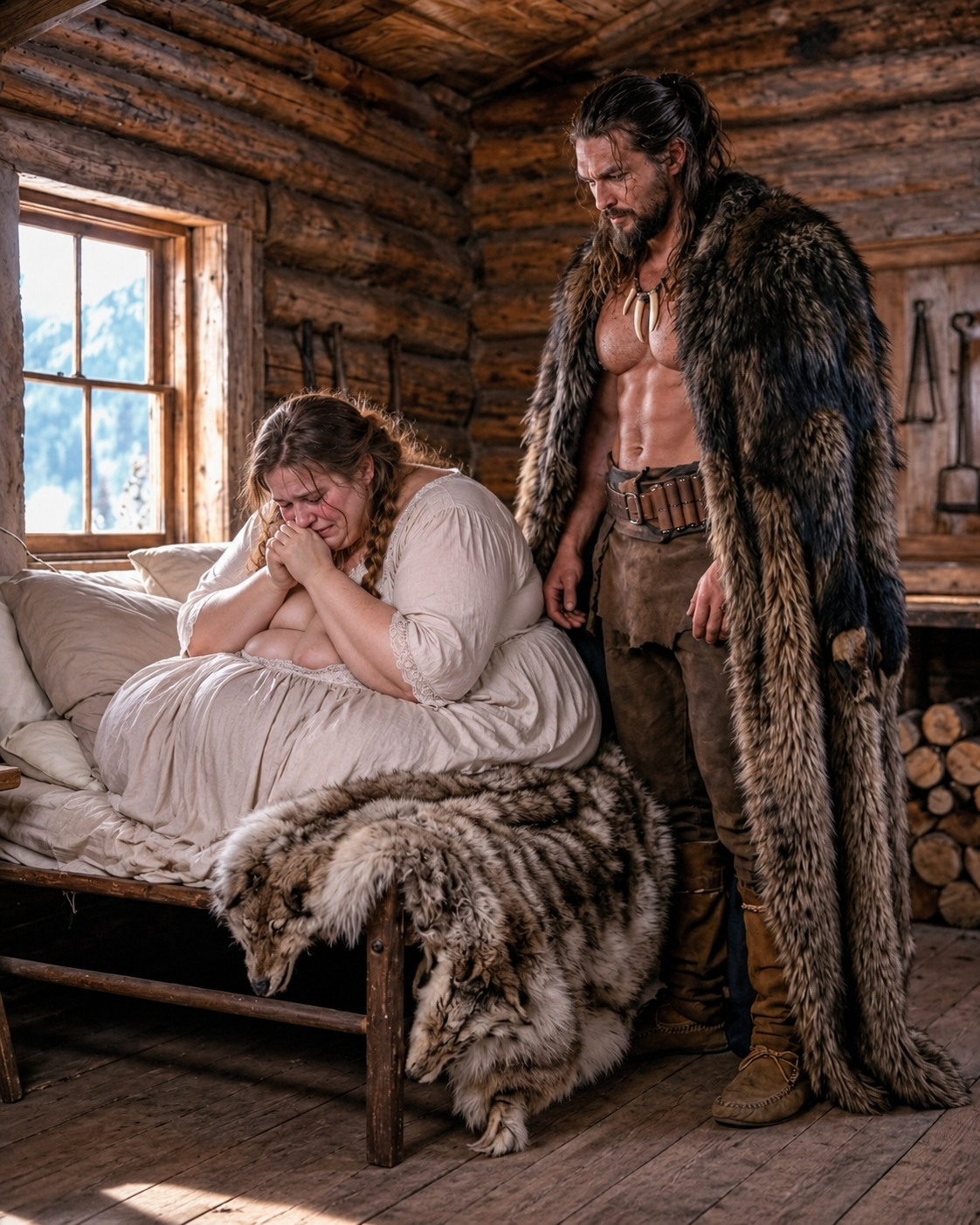
"It hurts," Josie whispered, pushing against her husband's chest. "Please."
Caleb Hayes reached for the marriage contract lying on the wooden chest beside their bed.
There was a second name written beneath hers.
Someone had crossed it out with black ink.
And suddenly, Josie wondered whether she had been the woman Caleb intended to marry at all.
The thought lasted only a moment before pain and fear swallowed everything else.
She was twenty-eight years old, newly married, and lying beneath a man whose strength frightened her more than the freezing wilderness outside.
Caleb was forty-two, with enormous shoulders, scarred hands, and a thick beard threaded with silver. He smelled of pine smoke, leather, and the cold mountain air. His gray-blue eyes had barely revealed an emotion since the day they met.
Josie had been his wife for less than twelve hours.
And she was already certain she had disappointed him.
"I'm sorry," she whispered.
Caleb went still.
The mattress creaked beneath his weight.
"Sorry for what?"
She couldn't answer.
Her throat felt too tight.
She turned her face toward the wall, ashamed of the tears slipping down her cheeks.
In Chicago, she'd learned that apologizing quickly was often the difference between a cruel word and a crueler hand.
The textile mill foreman had taught her that.
So had the boardinghouse owner who charged extra whenever a tenant broke a plate.
And so had the men who believed a woman without money had no right to refuse anything.
Josie swallowed.
"We can try again tonight," she managed. "When I've rested."
Caleb stared at her.
She braced herself for anger.
Instead, he moved away.
The sudden absence of his weight startled her.
He sat on the edge of the bed, looking down at his hands.
For several seconds, neither spoke.
Only the fire made any sound.
Then Caleb stood.
Josie flinched.
He noticed.
Something changed in his face.
Not anger.
Something quieter.
Something that looked almost like regret.
He reached toward the foot of the bed.
Josie squeezed her eyes shut.
But instead of touching her, he lifted a thick fur blanket and carefully pulled it over her shoulders.
"You're cold," he said.
She opened her eyes.
He tucked the blanket around her without pressing against her body.
Then he stepped back.
"Get some sleep."
Josie stared.
"But I said—"
"I heard you."
His voice was deep and rough, but there was no impatience in it.
"You don't have to try again tonight."
She struggled to understand.
"But we're married."
Caleb looked toward the fireplace.
"That doesn't mean you stop being a person."
The words struck her harder than shouting would have.
For a moment, she couldn't speak.
Then she asked the question that had haunted her since the train carried her west.
"Are you angry with me?"
Caleb turned.
"No."
"Disappointed?"
His expression tightened.
"Josie."
She lowered her eyes.
He waited until she looked up again.
"I didn't bring you here to hurt you."
A tear slipped down her cheek.
She wiped it away quickly.
Caleb noticed that too.
He moved toward the wooden chair beside the fireplace and sat.
"What are you doing?" she asked.
"Keeping the fire going."
"Aren't you coming back to bed?"
"Not tonight."
She stared at the empty space beside her.
The cabin suddenly felt larger.
And for the first time since leaving Chicago, Josie realized that she might have misunderstood the man she married.
But understanding him would take more than one night.
Because Caleb Hayes had secrets.
And some of them had already begun finding their way into her life.
Three weeks earlier, Josie had been standing outside a Chicago textile mill with an eviction notice folded inside her coat.
The factory whistle had blown at six.
By six-thirty, the foreman had informed her that her employment was terminated.
She had coughed blood into a handkerchief that morning.
Not much.
Just enough to frighten the supervisor.
"We can't have sick girls slowing production," he'd said.
Josie had worked at the mill for eleven years.
She'd started when she was seventeen, sweeping cotton scraps from beneath the machines.
By twenty-eight, she could operate three looms faster than most women could operate one.
None of that mattered.
The foreman handed her a final envelope containing less than two dollars.
"You're fortunate we're paying you at all."
Josie hadn't argued.
She'd learned long ago that arguments rarely filled an empty stomach.
Outside, the wind carried coal smoke through the narrow streets.
Her boardinghouse was four blocks away.
When she reached it, Mrs. Pritchard was waiting in the hallway.
The older woman's expression told Josie everything.
"Friday," Mrs. Pritchard said.
"Please. I just lost my position."
"Friday, Miss Bennett. I run a business, not a charity."
Josie climbed the stairs to her tiny room.
The bed sagged in the middle.
A cracked washbasin stood beneath the window.
Everything she owned fit inside a canvas traveling bag.
She sat down and stared at the eviction notice.
Then she unfolded a newspaper she'd taken from the mill's rubbish pile.
One advertisement had been circled in pencil.
WIFE WANTED.
Respectable mountain homesteader, Wyoming Territory.
Established cabin. Reliable income from trapping and timber.
Seeking hardworking woman willing to share an isolated frontier life.
Travel expenses provided.
Marriage upon arrival.
Inquiries directed to Caleb Hayes, care of Miller's Mercantile.
Josie read the advertisement five times.
There was nothing romantic about it.
No promise of love.
No mention of companionship beyond practical necessity.
But there was a roof.
There was food.
And there was air that didn't carry cotton dust.
That night, she wrote a letter.
She told the truth about her circumstances.
She was twenty-eight.
She had no living family.
She could cook, sew, clean, and manage a household.
She had little money.
She was willing to work.
She did not describe herself as beautiful.
She did not ask whether the man was handsome.
At the bottom, she wrote one sentence.
I am not looking for luxury, Mr. Hayes. I am looking for somewhere I can be useful.
She posted the letter the following morning.
Nine days later, a reply arrived.
The handwriting was heavy and uneven.
Miss Bennett,
I have a cabin, food enough for two, and work that never ends. Winters are hard. The nearest town is several hours away. I cannot promise an easy life.
If you still wish to come, your train fare is enclosed.
Caleb Hayes.
Inside were enough dollars to purchase passage west.
Josie held the money for a long time.
It was more than anyone had given her without demanding something in return.
She should have been suspicious.
Perhaps she was.
But desperation had a way of making dangerous choices look reasonable.
Three days later, she boarded the train.
The journey west lasted longer than Josie expected.
She slept sitting upright, with her canvas bag clutched against her chest.
At each station, the landscape changed.
Factories disappeared.
Brick buildings gave way to wooden storefronts.
Then came open fields, rolling hills, and finally mountains that seemed to rise straight into the clouds.
She had never seen anything so enormous.
The farther the train traveled, the smaller her old life seemed.
Yet fear remained.
What kind of man advertised for a wife he had never met?
What if he was cruel?
What if he drank?
What if he expected gratitude for every mouthful of food?
She'd heard stories about frontier marriages.
Some were happy.
Others were little better than servitude.
By the time she reached the railhead, her stomach had been twisted into knots for hours.
Caleb Hayes was waiting beside a wagon.
She recognized him immediately.
No other man at the station looked quite like him.
He was taller than nearly everyone around him, with broad shoulders beneath a dark wool coat and a face weathered by years outdoors.
His beard was thick.
His boots were muddy.
His hands looked capable of breaking a fence post.
He approached her.
"Miss Bennett?"
Josie nodded.
"Mr. Hayes?"
"Caleb."
He looked at her canvas bag.
"That everything?"
"Yes."
He picked it up.
She followed him toward the wagon.
He didn't offer compliments.
Didn't ask whether she had enjoyed the journey.
Didn't make conversation.
After several minutes, Josie finally spoke.
"Are you disappointed?"
Caleb glanced at her.
"About what?"
"Me."
He seemed genuinely confused.
"Why would I be?"
She looked down at her hands.
"I'm not particularly strong."
"Can you work?"
"Yes."
"Can you tell me when you're tired?"
She hesitated.
"I suppose."
"Then we'll manage."
He helped her into the wagon.
His hand was warm despite the cold.
That small detail stayed with her.
They married that afternoon.
The ceremony took place inside Miller's Mercantile.
The preacher stood between sacks of flour and barrels of salted pork.
A potbellied stove smoked near the entrance.
Two strangers served as witnesses.
Josie wore her best dress.
Caleb wore a clean shirt beneath his coat.
The preacher read the vows.
Caleb answered steadily.
Josie's voice trembled.
When the preacher pronounced them husband and wife, Caleb did not kiss her.
He simply looked at her and asked, "Ready?"
She nodded.
He paid the preacher three silver dollars.
Then they climbed back into the wagon.
Josie watched the little town disappear behind them.
She didn't know it then, but one of the witnesses had remained standing outside the mercantile long after they left.
And that man had been watching Caleb with an expression that was anything but friendly.
The road to the cabin was brutal.
The wagon bounced over frozen ruts.
Branches scraped against its sides.
The horses climbed narrow paths bordered by steep slopes.
Josie gripped the wooden seat until her fingers ached.
Caleb drove without complaint.
Once, when the wagon lurched violently, he caught her arm to keep her from falling.
"Easy," he said.
His hand released her immediately.
As darkness approached, they reached a clearing beneath a granite ridge.
The cabin stood among tall pines.
It was built from heavy logs, with a stone chimney and a small window facing the mountains.
Smoke rose from the chimney.
A stable stood nearby.
Snow gathered along the roof.
Josie stared.
This was her new home.
Caleb climbed down and helped her from the wagon.
"Watch your step."
She followed him to the door.
Inside, the cabin smelled of smoke, dried herbs, and old wood.
There was a fireplace, a table, two chairs, shelves of supplies, and a handmade bed covered with thick furs.
Everything was simple.
Everything was sturdy.
Nothing was decorative.
Caleb placed her bag beside the bed.
"There's water in the bucket. Coffee in the blue tin."
He paused.
"I'll see to the horses."
Then he left.
Josie stood alone.
She looked around the room.
There were no curtains.
No photographs.
No flowers.
Nothing to suggest a woman had ever lived there.
Yet the cabin was cleaner than she'd expected.
The shelves were orderly.
The dishes were washed.
The blankets were neatly folded.
She removed her coat and began building the fire.
By the time Caleb returned, the flames were roaring.
He looked at the hearth.
"Good fire."
It was the first compliment he'd given her.
She remembered it for the rest of the evening.
Dinner was beans, dried venison, and hard bread.
Josie ate slowly.
Caleb ate in silence.
She tried asking about the mountains.
He answered.
She asked about the horses.
He told her their names.
She asked how long he'd lived alone.
His spoon stopped.
"Long enough."
Something in his voice discouraged another question.
After dinner, he secured the door.
Then he extinguished the oil lantern.
Only the fireplace remained lit.
Josie's heart began pounding.
She knew what was expected.
She had signed the marriage papers.
Caleb had paid her passage.
He had brought her into his home.
Now she was his wife.
She changed behind a hanging burlap screen.
Her cotton nightdress was thin.
The floor was freezing beneath her feet.
When she emerged, Caleb was sitting on the bed.
He had removed his boots and outer shirt.
Scars crossed his chest and shoulders.
Some were old and pale.
Others looked deep enough to have nearly killed him.
Josie stared before she could stop herself.
Caleb noticed.
"Trapping accident," he said.
She nodded.
He pulled back the blanket.
"Come on. It's cold."
She approached the bed.
Every step felt heavier than the last.
And when the moment came for them to be husband and wife, fear overwhelmed her.
She tried.
She truly tried.
But discomfort turned to pain, and pain turned to panic.
She pushed against his chest.
"It hurts."
Caleb stopped.
"We can try again tonight," she whispered desperately.
That was when everything changed.
Now, hours later, Josie lay beneath the heavy fur blanket.
Caleb remained beside the fireplace.
He had pulled the chair close to the hearth and leaned back with his arms crossed.
His eyes were closed.
Josie wasn't sure whether he was sleeping.
She watched him through the dim light.
He looked uncomfortable in the chair.
A man his size could hardly fit into it.
She felt guilty.
"Caleb?"
His eyes opened immediately.
"What is it?"
"You can sleep in the bed."
"I'm fine."
"There's room."
"I know."
She hesitated.
"Are you sure?"
He looked at her for a long moment.
Then he said, "Sleep, Josie."
She obeyed.
But she couldn't stop thinking about what he'd said.
That doesn't mean you stop being a person.
Nobody had ever spoken to her quite that way.
Eventually, exhaustion pulled her under.
She dreamed of Chicago.
Of rattling looms.
Of the foreman's angry face.
Of hands grabbing her wrists.
Then she dreamed of the mountain cabin.
A door opening.
Boots crossing the floor.
Someone whispering her name.
She woke with a start.
The fire had burned low.
Caleb was asleep in the chair.
The cabin was silent.
Josie sat up carefully.
Her blanket slipped from one shoulder.
She reached to pull it back.
That was when she noticed the wooden chest beside the bed.
Its lid wasn't completely closed.
A folded paper protruded from beneath the edge.
She hadn't intended to pry.
But the paper looked familiar.
It was the same heavy cream-colored stock used for their marriage certificate.
She glanced toward Caleb.
He didn't move.
Josie leaned over and gently pulled the paper free.
It was a copy of the marriage contract.
Her name appeared near the bottom.
Josephine Bennett.
Below it was Caleb's signature.
But something else caught her attention.
Another name.
Written in older ink.
A woman's name.
Someone had crossed it out so heavily that the letters were nearly impossible to read.
Josie brought the paper closer to the fading firelight.
She could make out the first name.
Eleanor.
Her breath caught.
She looked toward Caleb.
He was still asleep.
Josie turned the document over.
On the back, in smaller handwriting, someone had written a date.
Three years earlier.
Beneath it were five words.
She was never supposed to leave.
Josie stared at the message.
Then she heard the sound.
A slow, deliberate scrape against the outside of the cabin door.
She froze.
The scrape came again.
Caleb's eyes opened.
He rose from the chair without making a sound.
Josie clutched the paper.
"Caleb?"
He held one finger to his lips.
Then he reached for the rifle hanging above the fireplace.
A man's voice came from the other side of the door.
"Hayes. I know she's in there."
Caleb's face changed.
Josie had never seen that expression before.
The stranger knocked three times.
Then he spoke again.
"Open up, Caleb. I've come for the woman you took from me."






Comments 0