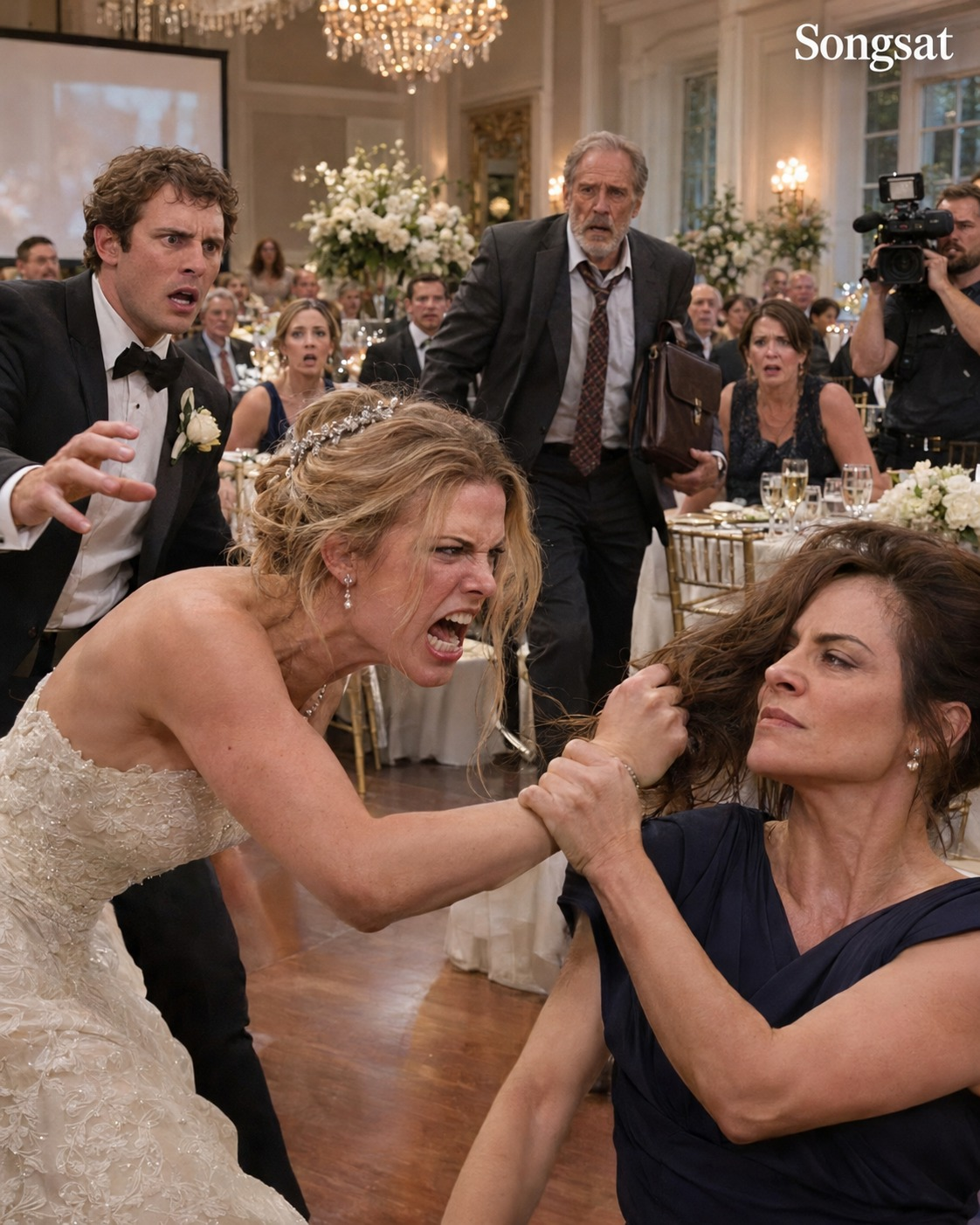
"GET OUT! YOU'RE AN EMBARRASSMENT TO THIS FAMILY!" my sister screamed as she grabbed my hair and yanked my head backward.
Near the ballroom doors, Malcolm Reeves, the groom's father, stood holding a leather briefcase.
A small silver Northstar identification tag hung from its handle.
He looked at me and stopped breathing for a second.
My sister had just attacked the wrong woman.
The first thing I felt was pain.
Not the kind that makes you scream. The kind that flashes white behind your eyes before your mind has time to understand what happened.
Kelsey's fingers were tangled in the hair at the back of my head. One of the decorative pins securing my updo scraped against my scalp as she pulled.
I could smell her expensive perfume.
I could see the tiny pearls sewn into the bodice of her wedding dress.
And somewhere behind her, I heard a champagne glass shatter.
Two hundred and fifty people had come to celebrate my younger sister's wedding.
Now every one of them was watching her attack me.
"You're not going to ruin this for me!" Kelsey shrieked.
I didn't answer immediately.
I reached up, caught her wrist, and turned my shoulder just enough to relieve the pressure on my scalp.
"Let go of me," I said.
She pulled harder.
My eyes watered from the pain, but I kept my voice steady.
"Kelsey. I'm not touching you."
A few feet away, Dean Parker stood in his black tuxedo, looking as though someone had struck him across the face.
"Kelsey?" he said.
She ignored him.
"You've been jealous of me my entire life!"
That accusation almost made me laugh.
Not because anything about the situation was funny.
Because I had spent sixteen years making sure Kelsey had a life worth being jealous of.
I was thirty-nine years old.
My sister was thirty-two.
And somehow, despite everything that had happened between us, she still believed she could hurt me badly enough to make me apologize for it.
"Security!" she screamed. "Get her out!"
A man in a dark suit near the stage hesitated.
I noticed his hand move toward the earpiece tucked behind his right ear.
That small movement told me something important.
He had been expecting trouble.
Maybe not this particular kind of trouble.
But trouble involving me.
I looked toward the videographer.
His camera was still pointed directly at us.
Good.
"Please keep recording," I said.
Kelsey's eyes widened.
"You want everyone to see what you've done?"
"No," I answered. "I want everyone to see what you're doing."
Her face changed.
For a fraction of a second, the rage slipped.
Something colder appeared underneath it.
Fear.
Then she tightened her grip again.
Dean finally moved.
"Kelsey, stop!"
He caught her forearm and pulled it away from my head.
Several hairpins fell onto the polished hardwood floor.
I stumbled half a step, recovered my balance, and straightened my navy dress.
My scalp throbbed.
I could feel loose strands of hair against my neck.
But I was standing.
And Kelsey was still screaming.
"She's manipulating you!" she shouted at Dean. "That's what she does! She makes everyone think she's the victim!"
Dean looked at me.
Then at his bride.
His mouth opened, but nothing came out.
I couldn't blame him entirely.
The man had just watched the woman he planned to marry physically attack her sister in front of everyone they knew.
Unfortunately, that was only the smallest part of what Kelsey had planned.
Behind us, the enormous projection screen still displayed my name.
VIVIEN MONROE.
Not Vivien Cross.
Monroe was the name I'd been born with.
Cross was my legal surname.
I had changed it years earlier, after I finally began building a life that didn't revolve around repairing my family's disasters.
Kelsey had insisted that my wedding place card use Monroe.
At the time, she'd called it a sentimental gesture.
Standing there with my hair half pulled out of its pins, I understood how carefully she'd chosen every detail.
The name.
The seating arrangement.
The camera.
The security guard.
Even the moment she expected me to break.
But I hadn't broken.
And that was why she was losing control.
"Vivien!"
The voice came from behind the guests.
Deep.
Male.
Unmistakably startled.
I turned.
An older man was moving toward us through the crowd.
He wore a charcoal suit, a white shirt, and a burgundy tie that had been loosened at the collar.
His gray hair was slightly disheveled.
A dark leather briefcase swung from his left hand.
Malcolm Reeves.
Dean's father.
I had known Malcolm professionally for years.
Not as a family friend.
Not as someone connected to my sister.
And certainly not as the father of the man she was about to marry.
When Kelsey first mentioned Dean Parker, I hadn't recognized the connection.
Dean had his mother's surname.
Malcolm's name had never appeared in the wedding information Kelsey allowed me to see.
Now he was standing twenty feet away, staring at me.
"Vivien Cross?" he said.
The ballroom seemed to grow quieter.
I nodded.
"Hello, Malcolm."
Kelsey stopped moving.
Her eyes darted between us.
"You know her?"
Malcolm didn't answer.
He looked at my disheveled hair.
Then at the pins scattered across the floor.
Then at Kelsey's hand, still raised where Dean had stopped her.
His expression hardened.
"What happened here?"
Kelsey recovered first.
"She tried to destroy my wedding!"
Malcolm looked at the projection screen.
A cropped screenshot of one of my messages remained visible.
I AM DONE PAYING FOR YOUR MISTAKES.
Below it was a photograph of me taken from my corporate biography.
The image had been enlarged until my face dominated the screen.
Malcolm stared at it.
Then he looked at me again.
"Why is your Northstar photograph being displayed at my son's wedding?"
Kelsey's face drained of color.
It was the first time all evening that she had looked genuinely frightened.
And I understood why.
She hadn't known Malcolm recognized me.
She hadn't known he had worked with me.
More importantly, she hadn't known he could identify the woman behind the accusations she had spent months spreading.
But to understand how we reached that moment, you need to understand something about my sister.
Kelsey didn't begin hating me at her wedding.
She began resenting me when I stopped paying for her mistakes.
And the first mistake I ever made was believing that keeping her safe meant giving her everything she wanted.
Sixteen years earlier, our father died unexpectedly.
I was twenty-three.
Kelsey was sixteen.
Our mother, Elaine, was already struggling with serious medical problems.
Dad's death didn't just leave us grieving.
It left us with a mortgage, hospital bills, and a household that had depended on his income.
I remember standing in our kitchen three days after the funeral, looking at a stack of envelopes spread across the table.
Mortgage statement.
Electric bill.
Insurance notice.
Medical invoice.
Kelsey walked in wearing her private-school uniform.
"Are we going to lose the house?" she asked.
I told her no.
I didn't know whether that was true.
But I knew she needed to hear it.
So I made it true.
I took extra shifts.
I sold Dad's car.
I negotiated payment plans.
I learned how to stretch groceries across two weeks and how to sound confident on the telephone when a collection agency threatened legal action.
I paid Kelsey's tuition because she was already halfway through school, and Dad had been proud of how well she was doing.
When she needed a dress for her senior formal, I bought it.
When she needed money for college applications, I found it.
When she cried because everyone else's parents could afford graduation trips, I worked another weekend.
I thought I was protecting her childhood.
What I didn't understand was that Kelsey had started confusing my sacrifices with her entitlement.
By the time she was twenty, she expected me to fix every emergency.
By twenty-five, she expected me to fund them.
And by thirty, she had convinced herself that my refusal to hand over money was an act of cruelty.
The last serious argument we'd had before the wedding concerned her rent.
It was the third time that year she'd fallen behind.
I offered to pay the landlord directly.
Kelsey demanded cash instead.
When I refused, she accused me of trying to control her.
"You're just like Dad," she snapped.
That hurt more than she knew.
Our father had been a good man.
He'd worked hard, loved us, and died before he could see either of us build the lives he wanted for us.
I told Kelsey I would not continue financing expenses she refused to explain.
She hung up.
We barely spoke for six months.
During that silence, I bought a townhouse.
I concentrated on my career at Northstar.
I started sleeping through the night without expecting another emergency phone call.
For the first time since I was twenty-three, my life belonged to me.
Then Kelsey called.
Three days before her wedding.
Her voice was unusually sweet.
"Vivien," she said, "I don't want to start my marriage carrying old pain."
I sat at my kitchen counter, looking at the caller ID.
"I understand."
"I want you there."
I closed my eyes.
Despite everything, a part of me still wanted my little sister back.
The girl who used to fall asleep on my shoulder during thunderstorms.
The girl who cried when Dad died.
The girl who once told me I was the strongest person she knew.
"I'd like that," I said.
Then Kelsey began explaining her conditions.
I had to use Monroe instead of Cross.
I wasn't allowed to contact Dean.
I wasn't allowed to speak privately with his family until the reception speeches were finished.
And I needed to be prepared to acknowledge the pain I'd supposedly caused her.
I listened without interrupting.
When she finished, I asked her to put everything in writing.
She went silent.
"Why?"
"Because I want us to understand each other."
"You're making this legal."
"No, Kelsey. I'm making it clear."
She laughed nervously.
Then she agreed.
The email arrived twenty minutes later.
At first, it looked like a normal wedding invitation with additional family requests.
But near the bottom, one sentence caught my attention.
The bride reserves the right to address unresolved family matters during the reception.
I read it twice.
Then I saved the message.
Something about it bothered me.
Not the words themselves.
The formality.
Kelsey had never been especially organized.
She rarely planned further ahead than her next credit-card payment.
Yet suddenly she was writing conditions like a corporate event manager.
I wondered who had helped her.
I didn't have to wait long to discover that the wedding invitation was only the beginning.
The next morning, our cousin Paula called.
She didn't bother with small talk.
"Vivien, I need to ask you something."
"Go ahead."
"Did you take money from your mother's medical fund?"
I nearly dropped my coffee.
"What?"
Paula hesitated.
"Kelsey told people you did."
I stared at the wall.
"Who did she tell?"
"Everyone at the bridal shower."
My stomach tightened.
Paula continued carefully.
"She said your mother went without treatment because you used the money for yourself."
For several seconds, I couldn't speak.
I had paid those medical bills.
Every one of them.
I had bank statements, clinic receipts, and confirmation numbers.
I had spent years worrying about whether I could afford the next appointment.
And my sister had turned those payments into a story about theft.
"Paula," I said slowly, "none of that is true."
"I was hoping you'd say that."
"Why didn't anyone ask me?"
"Because Kelsey cried when she told us."
I closed my eyes.
Of course she had.
Tears were Kelsey's most reliable form of evidence.
Paula lowered her voice.
"Vivien, there's something else."
I waited.
"Dean thinks you've been threatening him."
My pulse quickened.
"I've never spoken to Dean."
"That's what I thought."
"Why would he think that?"
Paula took a breath.
"Because he's been getting emails from someone using your name."
I stood so quickly that my chair scraped across the kitchen floor.
"What emails?"
"Threats about the wedding."
I gripped the counter.
"Paula, I don't even have his email address."
"I know."
"How long has this been happening?"
"Months."
I looked toward my laptop.
Then toward the folder where I kept my family's financial records.
For years, documentation had been the only thing standing between me and Kelsey's version of reality.
Now I was beginning to understand that I might need more than receipts.
"Can you get me one of those messages?" I asked.
"I'll try."
We ended the call.
I opened my computer and searched for every email Kelsey had sent me during the previous year.
Requests for money.
Accusations.
Apologies.
More requests for money.
Then I opened the family archive I'd maintained since Dad's death.
Every payment to our mother's medical providers was there.
Every invoice.
Every bank confirmation.
Every transaction date.
Nothing was missing.
But while I was reviewing the records, a new email appeared in my corporate inbox.
The sender was Dean Parker.
I had never received a message from him before.
The subject line read:
PLEASE EXPLAIN THIS.
I opened it.
There was no greeting.
Only one sentence.
Vivien, if you really want to stop this wedding, you need to tell me why.
Below the message was an attachment.
A screenshot of an email supposedly written by me.
The sender's name was Vivien Monroe.
The address was unfamiliar.
And the final sentence made my blood run cold.
I will make sure there is no wedding.
I stared at the screen.
Then I noticed the timestamp.
The message had been sent at 11:43 p.m. on a night when I had been working late at Northstar.
I knew exactly where I'd been.
I knew who had been with me.
And I knew I hadn't sent that email.
I reached for my phone to call Paula.
Before I could dial, another message arrived.
This one was from Kelsey.
It contained only six words.
I know what you told Dean.






Comments 0