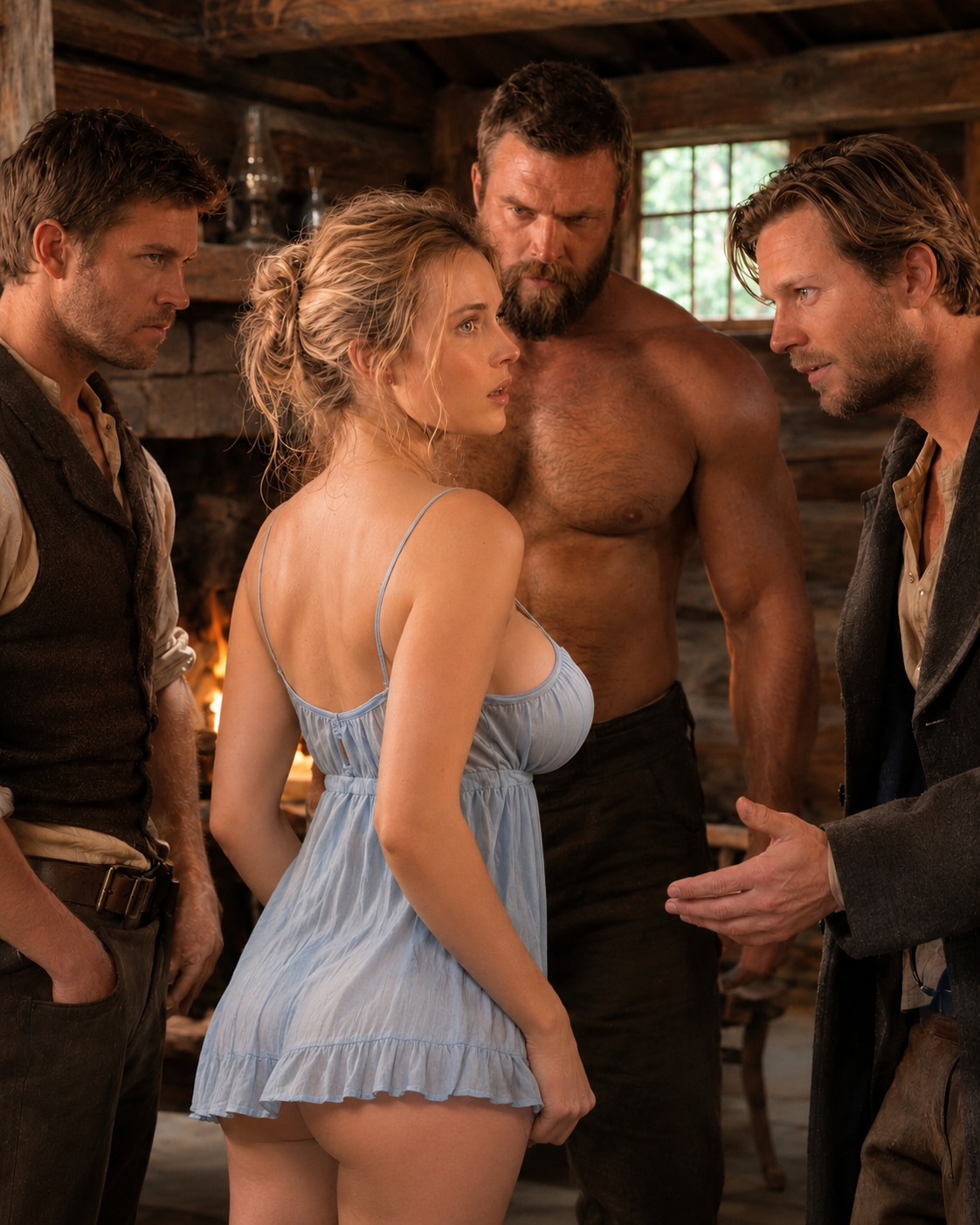
"Don't touch that saddlebag!" the enormous man shouted as Dorothy reached across the filthy dining table.
Caleb Whitfield stepped forward and caught the old leather bag before she could lift it.
A small brass plate hung from its broken buckle.
Four words had been scratched into the metal.
She never left us.
Dorothy looked at the three brothers.
They weren't angry anymore.
They were frightened.
And she had no idea why.
Three hours earlier, Dorothy Pembrook had been standing alone at Darby Station with eleven dollars in her pocket and a marriage proposal she was beginning to suspect had been the greatest mistake of her life.
The stagecoach had disappeared around a bend in the mountain road, leaving behind a cloud of dust that settled over her worn leather valise.
She watched until even the sound of the horses was gone.
Then she looked at the mountains.
They rose around her like walls.
Pine forests covered their lower slopes. Higher up, bare stone cliffs disappeared into clouds. The first snow of autumn had already settled along the distant ridges.
Somewhere in that wilderness was Elkridge Ranch.
Somewhere on that ranch lived three brothers who had advertised for a wife.
And somewhere between desperation and hope, Dorothy had decided to answer them.
She was twenty-six years old, unmarried, penniless by any respectable standard, and carrying a secret she had never told another living soul.
She had not come west looking for romance.
She had come because staying in Philadelphia had become more dangerous than leaving.
The bruise around her left wrist had faded to a yellow shadow, but she could still remember the fingers that had made it.
Mr. Hendricks had grabbed her the night she announced she was leaving.
"You think somebody out there is going to want a girl like you?" he had demanded.
Dorothy had looked him in the eye.
"Somebody already does."
She had not known whether that was true.
She still didn't.
The advertisement had been unusually brief.
Three brothers seek a capable wife for mountain ranch. Honest work. Respectable home. Courage required. Write to Caleb Whitfield, Elkridge Ranch, Bitterroot Valley, Montana Territory.
Dorothy had read those words until the paper nearly tore along its folds.
Three brothers.
One wife.
She had wondered about that arrangement from the beginning.
But the reply she received after writing to Caleb had made one thing clear: the Whitfields wanted someone willing to help build a home, not a woman who expected luxury.
That suited her.
Luxury had never done much for Dorothy Pembrook.
A safe place to sleep, food on the table, and the freedom to close a door without fearing who might open it—those were the things she wanted.
She had spent the better part of her life learning how expensive such simple comforts could be.
Now, standing at an abandoned mountain station, she began to wonder whether she had traded one kind of danger for another.
A horse whinnied somewhere beyond the trees.
Dorothy turned.
Three riders emerged from the forest.
They came down the trail at an unhurried pace, their horses stepping carefully over stones and exposed roots.
The men were enormous.
Even from a distance, Dorothy could see that their shoulders were broad enough to fill a doorway.
All three sat their saddles with the easy confidence of men who had spent more time on horseback than walking city streets.
But their size was not what startled her.
It was their faces.
They were identical.
The same square jaws.
The same steel-blue eyes.
The same dark hair touched with silver.
The same thick beards.
For a moment, Dorothy wondered whether exhaustion had begun playing tricks on her.
The rider in the middle dismounted first.
He wore a dark burgundy work shirt and charcoal trousers. His boots were dusty, his hands rough, and his expression so guarded that Dorothy could not decide whether he was pleased or disappointed to see her.
"Miss Pembrook?"
His voice was deep and steady.
"Yes."
"I'm Caleb Whitfield."
Dorothy extended her hand.
Caleb looked at it.
There was a brief pause before he took it.
His palm was warm, his grip careful despite its strength.
"Welcome to Montana," he said.
It was not much of a welcome.
But it was more than she had received from most people in Philadelphia.
The brother to his left remained mounted.
He wore a mustard-colored shirt beneath a weathered leather vest.
His eyes traveled from Dorothy's boots to the small valise at her feet.
"That's everything?"
Dorothy glanced at her bag.
"Everything I need."
The man made a doubtful sound.
"She looks like a stiff wind could carry her clean over the ridge."
Caleb gave him a warning look.
"Jonah."
"What? I'm only saying what we're all thinking."
Dorothy turned toward the man on horseback.
"Then perhaps you should think more carefully."
Jonah stared at her.
The third brother laughed.
It was a quiet, surprised sound.
He wore a slate-blue shirt and tan suspenders, and although his face was identical to the others, his expression was noticeably kinder.
"I'm Elias," he said. "Don't mind Jonah. He was born complaining."
"I was born three minutes before you."
"And you've been complaining for every minute since."
Dorothy almost smiled.
Almost.
But she had learned to be cautious with strangers, especially men who appeared accustomed to having the final word.
Caleb picked up her valise.
"We should go. The trail gets difficult after dark."
Dorothy glanced at the horses.
"I should tell you something."
Caleb stopped.
"What is it?"
"I've never ridden before."
Jonah closed his eyes.
"Oh, this is going to be a long afternoon."
Elias dismounted immediately.
"Then we'll make sure your first ride is a good one."
He brought forward a gentle gray mare.
"Her name is Dove. She won't give you trouble."
Dorothy touched the horse's neck.
The animal lowered its head toward her hand.
For the first time since leaving the stagecoach, Dorothy felt some of the tightness in her chest loosen.
"Hello, Dove," she whispered.
The mare breathed warmly against her fingers.
Elias helped her into the saddle.
Caleb watched without speaking.
Jonah shook his head.
Then the four of them started toward the mountains.
The ride to Elkridge Ranch took nearly two hours.
Dorothy's legs began aching after the first thirty minutes.
By the time they crossed a narrow wooden bridge over a rushing creek, she was convinced she would never walk normally again.
But she refused to complain.
Jonah glanced back at her several times.
Each time, she sat a little straighter.
Finally, he slowed his horse until they rode beside each other.
"You don't have to pretend you're comfortable."
"I'm not pretending."
"Your hands are white."
Dorothy looked down.
She was gripping the saddle horn so tightly that her knuckles had lost their color.
She loosened her fingers.
"Thank you for your concern."
Jonah frowned.
"That wasn't concern."
"Of course not."
He looked at her for another moment.
Then he rode ahead.
Behind her, Elias chuckled.
"You're going to give him a headache."
"Does he always speak to people that way?"
"Only the ones who surprise him."
Dorothy glanced toward Jonah.
"Then he must be surprised quite often."
Elias laughed again.
Ahead of them, Caleb raised one hand.
Everyone stopped.
Dorothy looked around.
The forest had become unusually quiet.
Caleb studied the ground near a fallen tree.
He dismounted, crouched, and touched something in the dirt.
Jonah rode forward.
"What is it?"
"Fresh tracks."
"Deer?"
Caleb shook his head.
"Boots."
Elias's expression changed.
Dorothy noticed immediately.
"Is something wrong?"
Caleb stood.
"Probably nothing."
But he looked into the trees before returning to his horse.
Jonah reached toward the rifle secured beside his saddle.
Caleb shook his head once.
Jonah lowered his hand.
The exchange lasted less than two seconds.
Dorothy understood enough to know they were hiding something.
She said nothing.
They continued riding.
But the easy conversation had ended.
Elkridge Ranch appeared just as the afternoon sun began sinking behind the western mountains.
Dorothy saw the fences first.
Then a corral.
Then a stable built from enormous pine logs.
Finally, the cabin came into view.
It stood in the center of a small valley, surrounded by open pasture and thick forest.
Smoke rose from a stone chimney.
A narrow creek ran behind the property.
Beyond the ranch, mountain peaks climbed into the sky.
Dorothy stopped her horse.
For a moment, she forgot her aching legs.
"It's beautiful."
Caleb turned in his saddle.
He studied her face.
"You think so?"
"How could anyone not?"
Something flickered in his expression.
It disappeared almost immediately.
"Most people see how far it is from town."
"I see how much room there is to breathe."
Caleb looked away.
Jonah muttered something under his breath.
Elias smiled.
They rode toward the cabin.
Dorothy had imagined many things during her journey west.
She had imagined a small kitchen with clean curtains.
A wooden table where people gathered for supper.
A warm fireplace.
Perhaps a shelf where she could place her mother's cameo box and the few books she had managed to save.
She had imagined a place where she might finally belong.
Then Caleb opened the front door.
And Dorothy stepped inside.
The smell reached her first.
Old grease.
Wood smoke.
Unwashed clothing.
Leather.
Dust.
And something that might once have been stew.
The cabin itself was large and solid.
Massive wooden beams crossed the ceiling.
A stone fireplace occupied one wall.
Golden afternoon light entered through square-paned windows.
The furniture was sturdy.
The floorboards were thick.
The building had clearly been constructed by skilled hands.
Unfortunately, those hands appeared to have abandoned all interest in housekeeping.
Dirty plates covered the kitchen counter.
Three pairs of boots stood beside the fireplace, each coated in dried mud.
A heap of clothing occupied one chair.
Another chair held a coil of rope and a broken harness.
The dining table had disappeared beneath tools, saddle parts, leather scraps, and several objects Dorothy could not identify.
An iron skillet sat on the stove.
Something black and hardened clung to its bottom.
Dorothy stared.
Behind her, the brothers went silent.
She looked toward the fireplace.
Ash had spilled onto the floor.
She looked toward the windows.
Dust covered the glass.
She looked toward the table.
A dirty spoon rested inside a boot.
Dorothy blinked.
Once.
Then again.
Jonah folded his arms.
"Well?"
Dorothy turned.
"Well what?"
"Go ahead."
"Go ahead and do what?"
"Tell us how terrible it is."
She looked around the room again.
"Would you prefer the truth?"
Jonah gave a humorless laugh.
"I'd prefer you didn't start crying."
Dorothy studied him.
There it was.
The expectation.
She recognized it immediately.
She had seen that expression on Mr. Hendricks's face whenever he believed he had found a new way to humiliate her.
Men like that expected a particular response.
Tears.
Apologies.
Fear.
Submission.
Dorothy had learned that giving them what they expected rarely made them kinder.
Caleb set her valise beside the door.
"This is how we live."
His voice was calm, but his shoulders were tense.
Dorothy looked at him.
"Do you enjoy living this way?"
The question seemed to catch him off guard.
"What?"
"The mess. The dirty dishes. The smell. Do you enjoy it?"
Jonah snorted.
"We work from sunrise until dark. We don't have time to fuss over plates."
Dorothy looked at the spoon in the boot.
"I see."
Elias cleared his throat.
"That particular arrangement wasn't intentional."
Jonah glared at him.
Dorothy walked toward the dining table.
She examined the clutter.
Then she turned back toward the brothers.
"Where do you wash your dishes?"
Elias pointed toward a wooden basin near the stove.
"Over there."
"And where do you keep clean towels?"
Nobody answered.
Dorothy waited.
Jonah shifted his weight.
Caleb looked toward the kitchen.
Elias rubbed the back of his neck.
Dorothy nodded.
"Very well."
She set her valise on the floor.
Then she began rolling up her sleeves.
Jonah stared.
"What are you doing?"
"Making room for supper."
"We haven't asked you to cook."
"I didn't say I was cooking."
"Then what are you doing?"
Dorothy picked up a dirty plate.
"Finding the table."
Elias made a strangled sound.
He was trying not to laugh.
Jonah turned toward Caleb.
"Are you going to say something?"
Caleb watched Dorothy move a pile of leather straps onto an empty chair.
"She hasn't done anything wrong."
"She's rearranging our things."
"Then perhaps you should have put them away."
Jonah stared at his older brother.
Dorothy continued working.
She did not rush.
She did not complain.
She simply began restoring order to the room.
A plate went beside the basin.
A hammer went into a wooden toolbox.
A length of rope was coiled and placed on a shelf.
She found three forks beneath a saddle blanket.
One of them was bent.
She set it aside.
Within minutes, a small section of the table became visible.
Elias stepped forward.
"Would you like some help?"
Dorothy glanced at him.
"Yes, please."
He looked surprised.
"What should I do?"
"Bring me a bucket of clean water."
Elias nodded.
"All right."
He went toward the back door.
Jonah watched him leave.
Then he looked at Dorothy.
"You've been here less than ten minutes."
"That sounds about right."
"And you're already giving orders."
Dorothy turned toward him.
"No, Mr. Whitfield. Your brother offered to help, and I accepted."
Jonah opened his mouth.
Then closed it.
Caleb lowered his eyes.
Dorothy suspected he was hiding a smile.
But when she looked directly at him, his expression became serious again.
The first disagreement came over the stove.
Dorothy lifted the iron skillet and examined the blackened remains inside.
"What was this?"
Jonah looked over.
"Breakfast."
"When?"
"Yesterday."
Dorothy studied the skillet.
"Are you certain?"
Elias returned carrying a bucket.
He set it beside the basin.
"She's got you there."
Jonah ignored him.
Dorothy filled the skillet with water.
Then she examined the stove.
The fire had nearly gone out.
She crouched and opened the iron door.
A few red coals remained beneath the ash.
She reached for a piece of kindling.
Caleb stepped forward.
"Careful. That door gets hot."
Dorothy glanced up.
"I noticed."
He hesitated.
Then he handed her a folded cloth.
She accepted it.
"Thank you."
For a brief moment, their eyes met.
Something passed between them.
Not affection.
Not yet.
Something quieter.
The recognition that neither was accustomed to being taken care of.
Dorothy looked away first.
She added kindling to the stove.
The coals brightened.
Soon a small flame began licking the dry wood.
Elias watched from beside the table.
"Where did you learn to do that?"
"Philadelphia."
Jonah raised an eyebrow.
"They have woodstoves in Philadelphia?"
"They have poor people in Philadelphia."
The room fell quiet.
Dorothy regretted the sharpness of her answer.
But she did not apologize.
Caleb studied her.
"You worked?"
"Since I was sixteen."
"Doing what?"
"Whatever paid."
"Your family?"
Dorothy's hands paused.
For the first time since entering the cabin, her composure faltered.
Only slightly.
"My parents died when I was young."
Elias's expression softened.
"I'm sorry."
"Thank you."
Jonah looked toward the window.
Caleb said nothing.
Dorothy returned to the stove.
She had not come to Montana to collect sympathy.
She had come to build something.
And she was determined to begin.
By the time the sun touched the mountain ridge, the dining table was half cleared.
Dorothy had washed a stack of plates, swept the worst of the ashes from the fireplace, and discovered that the cabin possessed more cooking utensils than the brothers seemed to realize.
She had also learned several things about the Whitfields.
Caleb spoke only when necessary.
Jonah spoke whenever silence made him uncomfortable.
Elias had a habit of helping without being asked.
All three avoided discussing the years before Dorothy's arrival.
And all three became strangely quiet whenever she mentioned the marriage advertisement.
Eventually, Dorothy decided the subject could not be postponed.
She dried her hands on a clean piece of linen.
"Mr. Whitfield?"
Caleb looked up from the chair he was repairing.
"Yes?"
"May I ask you something?"
"Of course."
"Why did you advertise for a wife?"
Jonah stopped sharpening his knife.
Elias looked toward Caleb.
The room changed.
Dorothy felt it immediately.
Caleb set down his tools.
"We needed someone willing to live here."
"That much was clear from the advertisement."
He waited.
Dorothy continued.
"But there are three of you."
Jonah leaned back.
"Very observant."
She ignored him.
"And only one of me."
Caleb's expression remained guarded.
"We intended to explain everything when you arrived."
"Then perhaps now would be a good time."
Elias shifted uncomfortably.
Jonah looked toward the fireplace.
Caleb studied Dorothy for several seconds.
Finally, he spoke.
"The advertisement was my responsibility."
"Did your brothers agree to it?"
A pause.
Elias answered first.
"I did."
Dorothy looked at Jonah.
He shrugged.
"I didn't think anybody would actually come."
Dorothy absorbed that.
Then she looked at Caleb.
"And what exactly did you expect me to do here?"
"Help us make this place a home."
"Only that?"
Caleb's jaw tightened.
"We won't ask you to do anything against your will."
Dorothy held his gaze.
"That's important to me."
"I understand."
"No," she said quietly. "I don't believe you do. Not yet."
Caleb looked at her for a long moment.
Then he nodded.
"Fair enough."
It was the first answer he had given that Dorothy entirely trusted.
They ate supper late.
Dorothy found potatoes in a wooden crate, onions hanging near the stove, and a small piece of salted pork wrapped in cloth.
With Elias's help, she made a simple skillet meal.
It was nothing remarkable.
But when she placed the food on the newly cleared table, all three brothers stared as though she had performed a miracle.
Jonah took one bite.
Then another.
He looked at Dorothy.
"This is good."
She nodded.
"Thank you."
He took a third bite.
"Really good."
Elias grinned.
"Careful, Jonah. That almost sounded like gratitude."
"Shut up."
Dorothy lowered her eyes toward her plate.
This time, she did smile.
Just a little.
Caleb noticed.
She could tell by the way his expression softened.
But he said nothing.
For several minutes, the four of them ate in relative peace.
The fireplace crackled.
The wind brushed against the windows.
Somewhere outside, a horse whinnied.
Dorothy felt the unfamiliar warmth of sitting at a table where nobody was shouting.
It was such a small thing.
Yet it nearly brought tears to her eyes.
She blinked them away before anyone noticed.
Then Jonah spoke.
"There's something you should know."
Caleb's fork stopped.
"Jonah."
"No. She deserves to hear it."
Dorothy looked between them.
"Hear what?"
Elias set down his cup.
Jonah leaned forward.
"Winter up here isn't like anything you've known back east."
"I understand that."
"No, you don't. The snow gets deep enough to bury the fences. The roads disappear. Sometimes we go weeks without seeing another soul."
Dorothy listened.
Jonah continued.
"The mountains don't care how brave you think you are."
"I never expected them to."
"And if you decide you can't handle it, there won't be a stagecoach waiting outside."
Caleb's voice hardened.
"That's enough."
But Dorothy raised one hand.
"It's all right."
She looked at Jonah.
"I appreciate the warning."
He seemed disappointed by her calm response.
"That's it?"
"What would you prefer?"
"I'd prefer you understood what you're getting into."
Dorothy rested her hands on the table.
"Mr. Whitfield, I spent ten years working in a house where I never knew whether I would be paid, fed, or allowed to sleep without interruption."
The room became still.
She continued in the same quiet voice.
"I know what it means to be cold. I know what it means to be hungry. And I know what it means to wake every morning wondering whether the people around me intend to make the day miserable."
Jonah's expression changed.
Dorothy held his gaze.
"I didn't travel two thousand miles because I thought life would become easy."
Nobody spoke.
"I traveled because I wanted the chance to decide what kind of life I would have."
Elias lowered his eyes.
Caleb watched her with an expression she could not read.
Jonah looked down at his plate.
For the first time all evening, he had nothing to say.
After supper, Elias showed Dorothy a small room near the back of the cabin.
It contained a narrow bed, a wooden dresser, and a window overlooking the pasture.
A clean quilt lay folded at the foot of the mattress.
Dorothy touched it.
"Who made this?"
Elias hesitated.
"Our mother."
Dorothy looked at him.
"She must have been talented."
"She was."
His voice changed on the last word.
Dorothy noticed.
But she did not ask another question.
Elias placed her valise beside the bed.
"The door has a lock."
Dorothy turned.
He pointed toward a simple iron latch.
"From the inside."
She looked at him.
For a moment, neither spoke.
Then Dorothy said, "Thank you."
Elias nodded.
"We want you to feel safe here."
She believed he meant it.
That did not mean she was ready to trust him.
Trust was something Dorothy had learned to give slowly.
And sometimes not at all.
When Elias left, she closed the door.
She tested the lock.
It worked.
She sat on the bed and opened her valise.
Inside lay her spare dress, stockings, soap, a worn book, and the small cameo brooch that had belonged to her mother.
She picked up the brooch.
For a moment, she could almost hear her mother's voice.
You don't have to be the strongest person in the room, Dorothy. You only have to remember who you are.
Dorothy closed her fingers around the cameo.
Then she placed it carefully on the dresser.
She was tired.
Her body ached from the journey.
Her hands smelled of soap and wood smoke.
But for the first time in years, she was sitting in a room with a door she could lock.
That mattered.
More than she had expected.
A sound from the main room interrupted her thoughts.
A chair scraped across the floor.
Then Jonah's voice.
"You should have told her."
Dorothy went still.
Caleb answered.
"Not tonight."
"When, then?"
"When I decide."
Elias spoke next.
"She's going to find out eventually."
Dorothy slowly stood.
The floorboards creaked beneath her boots.
She approached the door.
Outside, the conversation continued.
"She came all this way," Elias said. "She deserves to know."
Caleb's voice dropped.
"Keep your voice down."
Jonah gave a bitter laugh.
"That's what we always do, isn't it? Keep quiet. Pretend nothing happened."
"Jonah."
"No. I'm tired of it."
A heavy silence followed.
Dorothy pressed her hand against the door.
Then Caleb spoke again.
"Tomorrow, we'll explain."
"And if she leaves?" Elias asked.
Caleb did not answer immediately.
When he finally spoke, his voice sounded different.
Older.
Tired.
"Then she leaves."
Dorothy stepped away from the door.
She had heard enough to know there was something the brothers had deliberately kept from her.
Something important.
Something connected to their past.
But she had no intention of confronting three strangers in the middle of the night.
She returned to her bed.
She would ask questions in the morning.
And this time, she would insist on answers.
She might have fallen asleep if she had not remembered the leather saddlebag.
The one Caleb had snatched from her hands.
The one with the broken brass buckle.
The one that had made all three brothers fall silent.
Dorothy sat up.
She could still picture the scratched metal plate.
She never left us.
The words had been crude, uneven, and deeply carved.
Not the kind of inscription a craftsman would make.
They looked like the work of someone desperate to leave a message.
Dorothy frowned.
She had assumed the saddlebag belonged to one of the brothers.
But what if it didn't?
What if it belonged to someone else?
Someone whose absence explained the silence that seemed to settle over the cabin whenever the past was mentioned?
She looked toward the door.
The voices had stopped.
The cabin was quiet.
Dorothy waited another minute.
Then she stood.
She opened her door carefully.
The main room was empty.
The fireplace had burned down to glowing coals.
A lantern remained on the dining table.
Beside it lay the old leather saddlebag.
Caleb had left it there.
Dorothy approached.
She knew she should not touch another person's belongings.
But something about those four scratched words troubled her.
She leaned closer.
The brass plate caught the lantern light.
She never left us.
Below the words was a smaller mark.
Dorothy had not noticed it earlier.
A single letter.
M.
Her heart gave an unexpected thud.
She reached toward the buckle.
Then stopped.
There was another sound.
Not from the brothers' rooms.
Not from the fireplace.
From beneath the floor.
A faint scraping.
Dorothy turned toward the kitchen.
The sound came again.
Three slow knocks.
Then silence.
She stared at the floorboards.
Her first thought was an animal.
A trapped raccoon, perhaps.
But the sound had been too deliberate.
She took one careful step forward.
Then another.
Near the stove, she noticed something she had missed while cleaning.
A narrow wooden panel had been fitted into the floor.
Its edges were almost invisible beneath the dust.
A small iron ring lay flat against the boards.
Dorothy crouched.
She touched the ring.
It was cold.
She pulled gently.
The panel did not move.
She tried again.
This time, the wood shifted.
Only an inch.
But enough for a breath of cold air to rise from beneath the cabin.
Dorothy froze.
There was a smell.
Damp earth.
Old timber.
And something else.
Something faintly familiar.
She leaned closer.
A thin strip of folded paper had been wedged between the boards.
Dorothy pulled it free.
The paper was yellowed and brittle.
One corner had been torn away.
Across the front, someone had written a name.
Caleb Whitfield.
Dorothy stared.
Then she turned the paper over.
There were only five words on the back.
Don't let another woman come.
Her pulse quickened.
Behind her, a floorboard creaked.
Dorothy slowly turned.
Caleb stood in the doorway.
He was barefoot, wearing his burgundy shirt, his face pale beneath his beard.
His eyes were fixed on the paper in her hand.
"Where did you find that?"
Dorothy stood.
"Under the floor."
Caleb did not move.
For several seconds, he seemed unable to speak.
Then his gaze shifted toward the open panel.
Something changed in his expression.
Not anger.
Not suspicion.
Fear.
Real fear.
"Dorothy," he said quietly, "step away from that opening."
She looked down.
From beneath the floorboards came another sound.
This time, it was unmistakable.
Someone was knocking.
And then a woman's voice whispered her name.






Comments 0