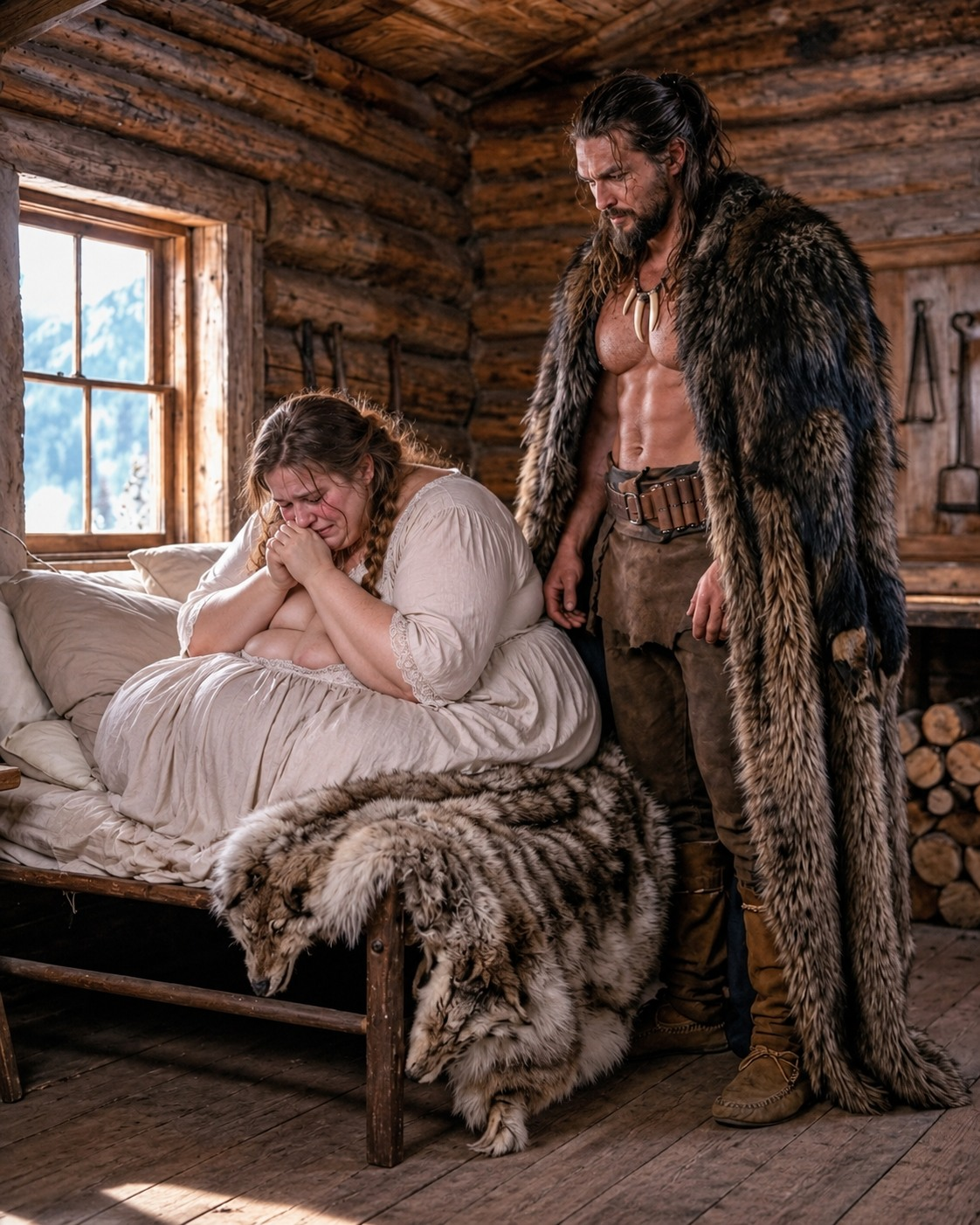
I pressed both hands against the mountain man's chest and whispered:
"It hurts!"
Caleb Hayes immediately pulled away.
But something on the wooden table caught his attention.
A small amber bottle sat beside a folded strip of clean white cotton.
And for the first time that night, I saw something in his eyes I had never expected.
Fear.
Not fear of me.
Fear of what he might have done.
The cabin was silent except for the crackling fireplace.
Josie Hayes lay curled beneath the heavy wolf-fur blanket, her fingers gripping its edges so tightly that her knuckles had turned white.
Across the room, Caleb sat in a wooden chair.
He had not touched his boots again. His shirt remained on the floor beside the bed, and the orange firelight revealed the old scars crossing his broad shoulders.
He stared into the flames.
Josie watched him cautiously.
She had spent her entire life learning to recognize the moods of men.
In Chicago, a foreman could change from laughing to vicious in the time it took a machine to break. At the boardinghouse, landlords raised their voices before raising their fists. Even the men who offered help often expected something in return.
She had learned that silence was sometimes safer than speaking.
But Caleb's silence frightened her in a different way.
She could not understand it.
He had paid for her train ticket. He had arranged their marriage. He had brought her hundreds of miles into the wilderness.
And yet, when she had begged him to stop, he had stopped.
Without argument.
Without anger.
Without reminding her of the money he had spent.
Josie swallowed.
"Mr. Hayes?"
His head turned slightly.
"Caleb," he corrected.
She lowered her eyes.
"Caleb."
He waited.
"Are you angry?"
His expression barely changed.
"No."
She studied his face, searching for the lie.
"You don't have to pretend."
"I ain't pretending."
He rose from the chair and approached the fireplace, adding another split log.
The flames brightened.
"You need sleep," he said. "We'll talk tomorrow."
Josie nodded, although sleep seemed impossible.
Caleb returned to the chair.
He did not come back to the bed.
Eventually, exhaustion overcame her. She closed her eyes beneath the thick fur and listened to the steady sounds of the fire until the cabin disappeared into darkness.
For the first time in years, she slept without listening for approaching footsteps.
But she did not know that Caleb had remained awake almost until morning.
The first thing Josie heard after waking was the sharp sound of an axe.
Thwack.
Thwack.
Thwack.
She opened her eyes.
Gray winter light entered through the small window, illuminating the rough wooden walls.
Caleb's side of the bed was empty.
She sat up slowly, pulling the blanket around herself.
For several seconds, she simply stared at the empty space beside her.
Then she remembered the previous night.
Her cheeks burned.
She quickly dressed in her wool skirt and high-collared blouse before leaving the bed.
The cabin was cold.
The fireplace contained only a few gray embers.
Josie hurried to rebuild the fire, using the dry kindling stacked beside the hearth.
She knew what was expected of a wife.
She had heard enough stories from other mill girls to understand that marriage was rarely an escape from hardship.
Sometimes it was simply a different kind of hardship.
Caleb had given her shelter.
She needed to prove that she could be useful.
She found flour, lard and salt in the pantry.
There was enough to make biscuits.
She had prepared them dozens of times in Chicago, usually in a crowded boardinghouse kitchen where three women fought for space around one small stove.
This stove was different.
Its iron surface was old, uneven and temperamental.
Josie mixed the dough, shaped the biscuits and placed them inside the oven compartment.
She waited.
The smell of burning flour reached her before she understood what had happened.
"Oh, no."
She pulled the iron sheet out.
The bottoms were black.
The tops were barely cooked.
In her hurry, she grabbed the hot edge without thinking.
Pain shot through her thumb.
She dropped the sheet with a metallic crash.
"Ah!"
She instinctively put her thumb in her mouth.
At that exact moment, the cabin door opened.
Caleb entered carrying an armful of split wood.
He stopped.
His eyes moved from Josie's injured hand to the ruined biscuits.
She froze.
"I'm sorry."
He set down the wood.
"I tried to make breakfast. I didn't know the stove would—"
"Left side runs hotter."
Josie blinked.
"What?"
"The draft pulls the heat toward the left. Put the pan on the right next time."
He picked up one of the blackened biscuits.
Josie stared at him.
He took a bite.
The biscuit cracked loudly between his teeth.
He chewed, swallowed and reached for his coffee.
"Ain't the worst thing I've eaten."
She almost laughed.
Then she remembered she was not supposed to laugh when a man was displeased.
Caleb noticed.
"You burn yourself?"
She looked down at her thumb.
"Just a little."
He examined her hand without touching it.
"Keep it away from that stove for a while."
"I can finish breakfast."
"Didn't ask you to."
His voice was not unkind, but it carried the weight of a man accustomed to being obeyed.
Josie stepped aside.
Caleb poured his coffee and looked toward the window.
"Got a trap line to check. I'll be back before dark."
She nodded.
"Don't go down toward the creek. Bear tracks were fresh yesterday."
"All right."
He reached for the door.
Josie gathered enough courage to ask the question that had been troubling her since morning.
"Caleb?"
He turned.
"What?"
"About last night..."
His expression changed.
Only slightly.
"There's nothing to explain."
"But I—"
"You said it hurt."
He paused.
"That was enough."
Then he opened the door and disappeared into the cold.
Josie stood motionless.
Those four words followed her long after the sound of his footsteps had faded.
That was enough.
The day passed slowly.
Josie cleaned the table, swept the floor and arranged the pantry shelves.
She discovered that the cabin contained little beyond what was necessary for survival.
There were dried beans, flour, salt, coffee, venison and several jars of preserved vegetables.
Everything had its place.
Everything except her.
At noon, she sat beside the fireplace and looked at her hands.
Her fingers were rough from years of handling cotton.
A small scar crossed her left palm.
She remembered the textile mill.
The constant machinery.
The dust.
The coughing women.
The foreman who had once told her that an orphan without family had no right to complain about working conditions.
She had left because her lungs could no longer tolerate the cotton dust.
When the boardinghouse owner threatened to throw her belongings into the street, a letter had arrived from Wyoming.
A marriage advertisement.
A man named Caleb Hayes wanted a wife.
He owned a cabin.
He had land.
He needed someone to share his home.
The letter had been brief.
There had been no poetry, no promises of romance.
Only an offer.
At the time, Josie had considered it her last chance.
She had signed the agreement because she believed a cold cabin was better than a freezing street.
Now she wondered whether she had misunderstood everything.
The sound of boots outside announced Caleb's return.
The door opened.
He entered carrying two rabbits and a bundle of firewood.
He placed the animals beside the washstand and removed his gloves.
"Stew smells good."
Josie looked up from the stove.
"I hope so."
He glanced at the pot.
"Potatoes?"
"Yes. I found a few in the pantry."
"Good."
He washed his hands and sat down.
They ate together.
The silence was still there, but it no longer felt quite as dangerous.
Caleb ate three bowls of stew.
Josie watched him carefully.
He seemed to appreciate the meal, although he said very little.
When she reached for the dishes, he stopped her.
"Leave them."
Her stomach tightened.
It was dark outside.
The fire was burning low.
She remembered his words from the previous evening and felt her shoulders stiffen.
Caleb noticed immediately.
He looked at her.
"Josie?"
She stood beside the table, unable to meet his eyes.
"I know."
"Know what?"
"I know I should try harder."
His brows drew together.
"At what?"
She swallowed.
"Being your wife."
For a long moment, Caleb said nothing.
Then he pushed his chair back.
"Sit down."
She obeyed slowly.
He walked toward the old wooden chest at the foot of the bed.
Its lid creaked when he opened it.
He moved aside a folded wool shirt, an old leather pouch and several pieces of carefully stored clothing.
Josie watched him.
He reached beneath the clothing and removed a small amber glass bottle.
Then he found a clean strip of white cotton.
He closed the chest.
When he returned to the table, he placed both objects in front of her.
"Give me your hand."
Josie looked at the bottle.
Then at him.
"Why?"
"Because you burned yourself."
She slowly extended her injured hand.
Caleb pulled his chair closer and examined her thumb.
His large fingers moved carefully, avoiding the tender skin.
He opened the bottle.
The smell of medicinal herbs filled the space between them.
"This'll sting a little," he warned.
Josie nodded.
He applied a small amount to the burn and wrapped the cotton strip around her thumb.
His movements were surprisingly gentle.
When he finished, he released her hand.
"There."
Josie looked at the neat white bandage.
"Thank you."
Caleb nodded and returned the bottle to the table.
Then he looked at her with an expression she could not quite understand.
"There's something you ought to know about this marriage, Josie."
Her heart began beating faster.
He glanced toward the old wooden chest.
Then back at her.
"That contract you signed wasn't the whole reason I sent for you."
Josie slowly raised her eyes.
"What do you mean?"
Caleb reached into his pocket and removed a folded piece of paper.
It was yellowed with age.
A name had been written across the front in faded black ink.
And when he placed it in her hands, Josie recognized the handwriting immediately.
It belonged to someone who had been dead for twelve years.






Comments 0