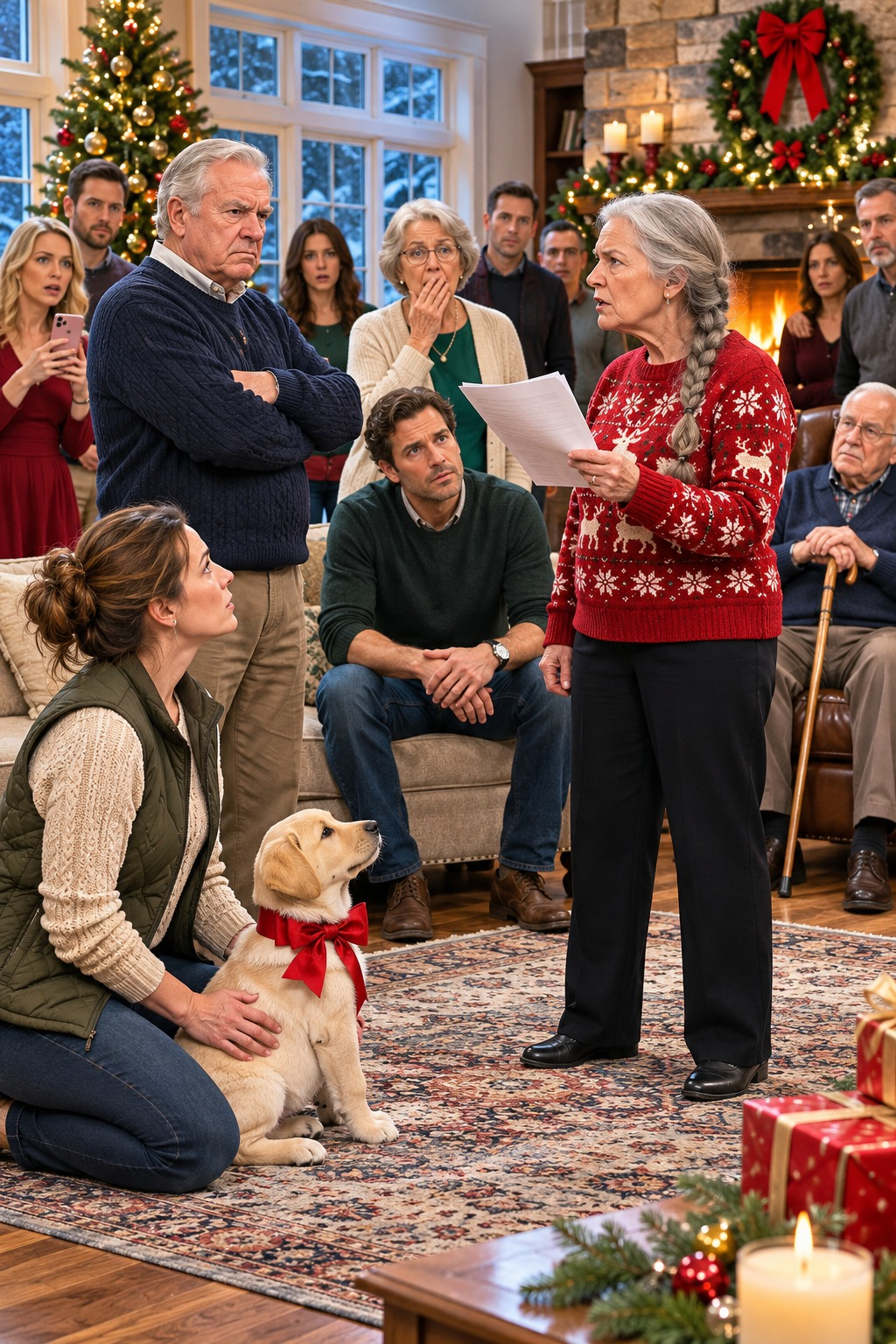
"Everybody, meet Claire!" my father-in-law shouted, lifting a yellow Labrador puppy above his head.
Leonard Whitcomb stood in front of twenty-two relatives, holding a red velvet bow that had slipped beneath the puppy's chin.
Underneath it was a narrow blue ribbon.
I recognized that ribbon immediately.
And suddenly, I knew his Christmas joke was about to become something much bigger.
"Isn't she adorable?" Leonard asked, turning in a slow circle so everyone could admire his newest purchase.
The puppy dangled awkwardly in his hands. Her little paws moved against the air, and one floppy ear had folded backward.
"She's sweet," my sister-in-law Vanessa said, already pointing her phone at him.
"Sweet?" Leonard repeated. "She's practically perfect. Doesn't argue. Doesn't question everything I say. And best of all, she comes when she's called."
He looked directly at me.
"Finally, a Claire who listens!"
The room exploded with laughter.
His younger brother Robert nearly spilled his eggnog. Vanessa laughed so hard that her phone shook. Someone behind the sofa clapped.
I sat perfectly still.
Beside me, my husband Daniel released an uncomfortable chuckle.
It was the kind of laugh people make when they know something is wrong but don't want to be the first person to admit it.
Leonard noticed my expression.
"Oh, come on, Claire. Don't look so serious. It's Christmas!"
More laughter.
He lowered the puppy slightly.
"See, everybody? Big Claire's already jealous of little Claire."
I could have answered him.
After twelve years of marriage, I had accumulated enough responses to fill an entire notebook.
I could have reminded him that humiliating someone wasn't humor.
I could have asked why a seventy-six-year-old man needed an audience to feel powerful.
I could have pointed out that purchasing a living animal for a practical joke was an astonishingly cruel thing to do.
But I didn't.
Because I was staring at the blue ribbon.
And because I knew that puppy.
Her name wasn't Claire.
At least, it hadn't been when I last held her.
Her name was Bluebell.
And three days earlier, I had believed she was going to a loving home.
My name is Claire Whitcomb.
I was forty years old that Christmas, and I had spent sixteen years working with dogs.
Not simply teaching them to sit or shake hands.
I trained service dogs.
Dogs that could retrieve dropped medication bottles, alert their handlers to certain sounds, open specially adapted doors, and help people navigate daily life with greater independence.
My work demanded patience.
Some dogs learned quickly.
Others needed months before they trusted a new environment.
I had learned that fear could produce obedience, but it rarely produced genuine trust.
And that distinction had shaped almost everything I believed about life.
Eight years earlier, I had opened a small training program in a rented barn outside Worcester, Massachusetts.
The building wasn't impressive.
Its roof leaked during heavy storms, the heating system complained every winter, and the gravel driveway turned into a muddy disaster every spring.
But inside those walls, extraordinary things happened.
I had watched a veteran who struggled to leave his house walk into a crowded grocery store with his service dog beside him.
I had watched a little girl with limited mobility laugh when her dog learned to bring her favorite stuffed rabbit.
I had watched frightened rescue dogs discover that human hands could offer kindness instead of punishment.
Those moments mattered more to me than any prestigious job title.
Leonard Whitcomb had never understood that.
He called my career "playing with puppies."
At Thanksgiving, he asked whether I planned to get a real job before I turned fifty.
At Easter, he announced that Daniel must be the only man in Massachusetts who needed his wife's permission to choose a restaurant.
At our wedding, he had stood before nearly a hundred guests and raised his champagne glass.
"Good luck, son," he said. "This one's got opinions!"
Everyone laughed.
So did I.
Back then, I thought he was teasing me affectionately.
I was wrong.
Leonard didn't dislike my opinions because they were unreasonable.
He disliked the fact that I had them at all.
And whenever I defended myself, Daniel offered the same exhausted explanation.
"That's just Dad."
Four words.
Four words that had excused twelve years of disrespect.
"He's getting older, Claire."
"He's always been like that."
"He doesn't mean anything by it."
"Can't we just enjoy the holiday?"
For a long time, I tried.
Not because Leonard deserved my silence.
But because I loved Daniel.
And because there were people in that family I genuinely adored.
Elaine Whitcomb, Leonard's wife, was one of them.
She had a gentle way of making everyone feel welcome, even when her husband made that difficult.
Every winter, she knitted me a scarf.
Every birthday, she remembered exactly which kind of chocolate I liked.
She asked about the dogs in my program and listened carefully when I told her about them.
Then there was Arthur.
Leonard's ninety-seven-year-old father.
Arthur Whitcomb was a retired mail carrier who had survived two hip replacements, one heart attack, and seventy years of listening to his son's opinions.
He had an outrageous sense of humor and an unwavering devotion to the New England Patriots.
Arthur called me "the Dog Lady."
Coming from him, it sounded like a royal title.
He once told Daniel that I was the only person in the family who could teach a stubborn creature anything.
Then he looked directly at Leonard.
"Well, almost anything."
I had laughed for five minutes.
Leonard hadn't.
But that Christmas Eve, Arthur wasn't laughing either.
He was watching the puppy.
And there was something strange about his expression.
Something I wouldn't understand until much later.
"Well?" Leonard demanded.
His voice pulled me back into the room.
"Don't you have anything to say, Claire?"
I looked at the puppy.
"She's beautiful."
Leonard smirked.
"See? Even big Claire admits little Claire's better behaved."
Vanessa laughed again.
I turned toward her.
"Would you mind lowering your phone?"
She blinked.
"What?"
"Your phone, Vanessa. The puppy looks frightened."
Vanessa glanced at her screen.
"Oh, relax. I'm just recording Christmas memories."
I didn't answer.
The puppy was squirming harder now.
Leonard was holding her beneath her front legs, allowing her back feet to hang without support.
She was only nine weeks old.
At that age, a puppy's confidence could be damaged by surprisingly small experiences.
Being lifted awkwardly above a room full of shouting strangers certainly wasn't helping.
"Leonard," I said, keeping my voice steady, "please support her back legs."
He looked offended.
"I know how to hold a dog."
"She's uncomfortable."
"She's fine."
The puppy gave a small distressed whine.
Elaine moved closer.
"Leonard, perhaps you should put her down."
He ignored her.
Instead, he turned toward Daniel.
"Son, tell your wife to stop giving instructions at Christmas."
Daniel shifted beside me.
"Dad, maybe just put the puppy on the floor."
Leonard stared at him.
Then he laughed.
"Good grief. She's got you trained too."
A few people chuckled.
Daniel looked down at his hands.
And something inside me went very quiet.
I had spent years waiting for my husband to recognize that his father's behavior wasn't harmless.
Not every joke needed a confrontation.
Not every irritating remark deserved an argument.
But there was a difference between maintaining peace and allowing someone to hurt another person for entertainment.
I was tired of pretending that difference didn't exist.
Still, I wasn't going to fight Leonard.
Not that night.
Not in front of twenty-two relatives.
And certainly not while he was holding a frightened puppy.
I stood.
"Leonard," I said, "please put her down."
He grinned.
"Oh, this should be interesting."
He lowered the puppy onto the large patterned carpet.
Her paws touched the floor.
She looked around uncertainly.
Then her nose lifted.
She sniffed once.
Twice.
And turned toward me.
I recognized that movement.
My heart gave a small, painful squeeze.
Three days earlier, I had been sitting on the wooden floor of Margaret Ellis's kitchen with that same puppy asleep against my boot.
Margaret lived next door to Leonard and Elaine.
She was seventy-four, wore her long gray hair in a braid, and had spent more than thirty years breeding Labrador Retrievers.
She was also one of my closest professional partners.
Many of the dogs in my training program came from her breeding lines.
Margaret cared deeply about temperament.
She didn't simply choose dogs because they were attractive.
She studied how they responded to unfamiliar noises, new people, unexpected surfaces, and changes in their environment.
She believed a dog's early experiences shaped its entire future.
So did I.
That October, Margaret's yellow Labrador, Daisy, had delivered seven healthy puppies.
Four males.
Three females.
Margaret had tied different colored ribbons around their necks so she could identify them.
Red.
Green.
Yellow.
Purple.
Orange.
White.
And blue.
The blue-ribbon puppy had been the smallest female.
She was also the most curious.
At three weeks old, she crawled toward my hand while her siblings slept.
At five weeks, she followed me across Margaret's kitchen.
At seven weeks, she discovered that my shoelaces were fascinating.
By eight weeks, she had learned to recognize my voice.
I called her Bluebell.
Not because it was an especially clever name.
Because every time I visited, she came bouncing toward me like a little bell announcing my arrival.
I had begun teaching her simple attention exercises.
Nothing demanding.
Just gentle, age-appropriate games.
A quiet "Sit."
A finger near my nose.
"Eyes."
A reward when she looked at me.
We repeated those exercises for a few minutes at a time.
Never forcing.
Never shouting.
Always allowing her to succeed.
She loved them.
And I loved her.
I had even told Margaret that I hoped Bluebell might eventually join my service-dog program.
Then, several days before Christmas, I visited Margaret's house.
Only six puppies came running toward me.
I counted twice.
"Where's my little shadow?"
Margaret hesitated.
That should have been my first warning.
"She went to her new home."
"Already?"
"A local family wanted her for Christmas."
I remember smiling.
"Well, that's wonderful."
Margaret looked away.
"She's supposed to be a companion for an older woman."
"That sounds perfect."
Margaret's hands had tightened around her coffee mug.
"You'll probably see her around."
I thought she meant the puppy had been sold to someone in Worcester.
I didn't ask more questions.
I trusted Margaret.
And I believed Bluebell was safe.
Now, watching Leonard stand over that same puppy with a triumphant smile, I understood what had happened.
He had purchased her.
He had tied a red bow over the blue ribbon.
He had named her after me.
And he had brought her into a crowded room for the sole purpose of making me look foolish.
I felt anger rise in my chest.
Not because of the name.
Because of the puppy.
Bluebell deserved better than becoming a prop in Leonard's performance.
I knelt.
The carpet was thick beneath my knees.
I placed one hand loosely against my thigh.
The puppy looked at me.
Her ears shifted.
I softened my voice.
"Hi, sweetheart."
Her tail began to move.
Leonard chuckled.
"Look at that. Big Claire's making friends with little Claire."
I ignored him.
The puppy took two uncertain steps toward me.
I waited.
Then I said one word.
"Sit."
Her little bottom touched the carpet.
Immediately.
No hesitation.
No confusion.
Just a happy little puppy performing a familiar exercise.
A few people stopped laughing.
I raised one finger toward my nose.
"Eyes."
Bluebell lifted her face.
Her dark brown eyes met mine.
She held my gaze.
One second.
Two.
Her tail wagged.
I smiled gently.
"Good girl."
The room went silent.
Not gradually.
Not politely.
Completely.
It was the kind of silence that makes people suddenly aware of the sound of their own breathing.
Somewhere behind me, the fireplace crackled.
A Christmas ornament shifted softly against a tree branch.
Leonard stared.
"What was that?"
I kept my hand resting beside Bluebell.
"Basic training."
He frowned.
"She hasn't been trained."
"Actually, she has."
"That's impossible. I just bought her."
I looked up.
"That doesn't mean she didn't have a life before you purchased her."
Someone near the kitchen made a small sound.
I couldn't tell whether it was a laugh or a cough.
Leonard's face tightened.
"Claire!"
The puppy's ears moved.
"Come here!"
She stayed beside me.
Leonard slapped his thigh.
"Come on, girl!"
Bluebell pressed closer to my knee.
I gently stroked her back.
"Leonard, please lower your voice."
He stared at me.
"Excuse me?"
"You're frightening her."
His expression hardened.
"She's my dog."
"She's nine weeks old."
"I paid for her."
"That doesn't make shouting helpful."
He looked around the room, searching for support.
Nobody spoke.
Vanessa had lowered her phone.
Daniel was watching me with an expression I couldn't quite read.
Elaine stood near the kitchen entrance, her hands wrapped around a dish towel.
Arthur leaned forward in his chair.
Then he spoke.
"Leonard."
My father-in-law turned.
"What, Dad?"
Arthur pointed his cane toward the puppy.
"You've spent seventy years trying to make everybody do exactly what you say."
A few relatives smiled.
Arthur continued.
"Your mother never listened to you either. Leave the poor little dog alone."
This time, several people laughed.
But the laughter sounded different.
It wasn't aimed at me.
Leonard's cheeks turned red.
"Very funny, Dad."
Arthur shrugged.
"Wasn't trying to be funny."
That made Robert laugh into his eggnog.
Leonard turned sharply toward him.
Robert immediately looked away.
For a moment, I thought the situation might end there.
Leonard would complain.
Someone would change the subject.
Elaine would offer dessert.
The family would pretend nothing uncomfortable had happened.
That was usually how things worked.
But Leonard couldn't tolerate losing an audience.
Especially to me.
"Fine!" he snapped.
Bluebell flinched.
I kept my hand against her back.
"If the little thing won't listen, I'll take her back Monday."
Elaine looked startled.
"Take her back?"
"Yes, Elaine. Take her back."
"But Leonard—"
"I'll get my money back. I'm not keeping an animal that doesn't obey."
I looked at him.
"She's not defective."
"Nobody asked you."
"She's a puppy."
"And I said nobody asked you!"
His voice echoed through the room.
Daniel stood.
"Dad, that's enough."
Leonard looked at him with open disbelief.
"What?"
"I said that's enough."
For twelve years, I had wanted to hear those words.
Yet when Daniel finally spoke them, I felt almost nothing.
Maybe because I had stopped expecting them.
Maybe because I was more concerned about Bluebell.
Or maybe because I had noticed Margaret Ellis standing near the Christmas tree.
She had been unusually quiet all evening.
Normally, Margaret was impossible to miss at a holiday gathering.
She laughed loudly, told terrible jokes, and never attended a party without bringing something homemade.
That night, she wore a cheerful red reindeer sweater and had been eating meatballs from a small paper plate.
But now the plate sat untouched on the coffee table.
Her expression had changed.
She was watching Leonard with an intensity that made my stomach tighten.
"Leonard," she said.
He turned impatiently.
"What now?"
Margaret stepped forward.
"There's something you need to explain."
The room quieted again.
Leonard crossed his arms.
"About what?"
"The puppy."
He rolled his eyes.
"Oh, for heaven's sake. Not you too."
Margaret didn't smile.
"You told me she was going to be a Christmas companion for Elaine."
Elaine looked up.
"For me?"
Margaret nodded.
"That's what he said."
Leonard shifted his weight.
"It was supposed to be a surprise."
Margaret continued.
"You told me Elaine had been feeling lonely."
Elaine's face changed.
"Lonely?"
"You said she wanted a dog to keep her company."
Elaine stared at her husband.
"Leonard, I never said that."
He waved one hand dismissively.
"I thought you'd enjoy having one."
"Then why did you name her Claire?"
He didn't answer.
Margaret stepped closer.
"And why did you tell me Elaine would choose the name herself?"
Leonard's mouth tightened.
"Margaret, you're making a mountain out of nothing."
"No," Margaret replied. "I don't believe I am."
She reached for her handbag.
It was a dark brown leather bag she had carried for years.
I had seen her pull everything from dog treats to emergency sewing supplies out of that bag.
But this time, she removed a folded document.
I recognized the type immediately.
An ownership agreement.
Margaret always used them when placing puppies with families.
They recorded the buyer's information, the dog's identification, and the terms of the placement.
She unfolded the paper.
"Leonard, whose name did you put on this agreement?"
He stared at her.
"What?"
"Whose name?"
He glanced toward Elaine.
"Mine, obviously."
Margaret shook her head.
"No."
A strange feeling moved through me.
Something about her tone told me this was no longer a disagreement about a puppy.
She turned the document toward Elaine.
"Your name is here."
Elaine took one step forward.
"My name?"
Margaret nodded.
"Elaine Whitcomb."
Leonard shrugged.
"So what? She's my wife."
Margaret's expression hardened.
"You signed her name."
The room fell completely silent.
Elaine slowly lowered her dish towel.
"Leonard?"
He didn't look at her.
"Don't start."
"What paperwork did you sign?"
"It's nothing."
"Then why won't you answer me?"
Leonard looked around the room.
His face was flushed now.
"This is ridiculous. I bought a puppy. That's all."
Margaret held the document steady.
"You told me Elaine had agreed to be the registered owner. I gave you the form to take home so she could sign it."
Leonard looked away.
"When you brought it back, her signature was already there."
Elaine's lips parted.
"I never signed anything."
"I know," Margaret said quietly.
A cold feeling settled in my stomach.
Daniel moved closer.
"Margaret, what exactly are you saying?"
She looked at him.
For one brief moment, something like sorrow crossed her face.
"Daniel, I'm saying your father gave me a document bearing your mother's name, and your mother says she never signed it."
Leonard threw up his hands.
"Oh, good grief. I filled out a form for my wife. Call the police!"
Nobody laughed.
That seemed to make him angrier.
"Are we seriously going to ruin Christmas over a piece of paper?"
Elaine stared at him.
"You used my name without asking me."
"We've been married fifty years!"
"That wasn't my question."
Her voice was quiet.
But I had never heard her speak to him that way.
Leonard blinked.
Arthur shifted in his chair.
And Margaret looked down at the document.
I noticed her thumb resting against a handwritten line near the bottom.
She seemed to be studying it.
Then she looked at Daniel.
"There's something else."
Leonard went still.
It was subtle.
A tiny change in his posture.
His shoulders stopped moving.
His eyes fixed on Margaret.
"What else?" Daniel asked.
Margaret swallowed.
"I didn't recognize the significance of this at first."
She turned the paper over.
On the back were several handwritten notes.
I couldn't read them from where I knelt.
Margaret looked toward Arthur.
The old man's expression had become strangely serious.
For a moment, neither spoke.
Then Margaret asked a question that made the entire room feel colder.
"Daniel, do you remember the dog you had when you were thirteen?"
Daniel stared at her.
I felt him go rigid beside me.
"What?"
"Your dog."
His face changed.
Slowly.
Painfully.
"Buddy?"
Margaret nodded.
"Yes."
Daniel looked toward his father.
Then back at Margaret.
"Of course I remember Buddy."
His voice had become very quiet.
I knew about Buddy.
Daniel had told me the story early in our marriage.
Buddy was a black Labrador mix his family adopted when Daniel was eleven.
For two years, the dog followed him everywhere.
He slept beside Daniel's bed.
Waited at the school bus stop.
Sat beside him when he did homework.
Then one afternoon, Buddy disappeared.
Leonard told Daniel that someone had left the backyard gate open.
They searched the neighborhood.
Posted flyers.
Called shelters.
Buddy never came home.
Daniel had blamed himself for years because he was supposed to check the gate before leaving for school.
Even as an adult, he sometimes spoke about that dog with an unmistakable sadness.
Now Margaret was looking at him as though she knew something he didn't.
"Why are you bringing up Buddy?" Daniel asked.
Margaret's eyes moved toward Leonard.
"Because there's something about these papers that reminds me of what happened thirty-one years ago."
Leonard stepped forward.
"Margaret."
His voice was low.
Warning.
She ignored him.
Daniel looked at his father.
"Dad?"
Leonard forced a laugh.
"This is absurd."
Margaret didn't move.
"Leonard, I think Daniel deserves to know."
"Know what?" Daniel demanded.
Arthur closed his eyes.
Elaine pressed one hand against her chest.
And suddenly, I understood that everyone wasn't equally confused.
Some people looked surprised.
Others looked frightened.
There was a difference.
Margaret's hand trembled slightly as she turned the document over again.
"Daniel," she said, "I need you to remember something."
He stared at her.
"What?"
"The day Buddy disappeared."
Daniel swallowed.
"I remember."
"Do you remember what your father told you?"
Daniel looked toward Leonard.
"He said the gate was open."
Margaret nodded.
"And what else?"
Daniel's expression tightened.
"He said Buddy must have run away."
Margaret took a slow breath.
Leonard moved toward her.
"That's enough."
Daniel stepped between them.
"Dad, sit down."
The words came out sharper than anything I had ever heard my husband say to his father.
Leonard stopped.
For the first time in twelve years, I watched him obey Daniel without arguing.
Margaret looked toward Arthur again.
The ninety-seven-year-old man was gripping his cane.
His knuckles had turned white.
Then he whispered something.
So softly that I almost missed it.
"I told him this day would come."
My heart began beating faster.
Daniel heard him too.
He turned.
"Grandpa?"
Arthur didn't answer.
Margaret slowly reached into her handbag again.
This time, she removed a second piece of paper.
It was smaller.
Older.
Yellowed around the edges.
Folded into quarters.
Daniel stared at it.
"What's that?"
Margaret didn't answer immediately.
Instead, she looked directly at Leonard.
"Before I say another word, I want you to tell your son the truth yourself."
Leonard's face had gone pale.
"Margaret, please."
That single word shocked me more than his anger had.
Please.
I had never heard Leonard Whitcomb plead with anyone.
Margaret's expression softened for a moment.
But she didn't lower the paper.
"You had thirty-one years."
Daniel took a step toward her.
"What truth?"
Margaret unfolded the yellowed sheet.
I saw a faded handwritten date near the top.
December 1993.
Daniel stared at it.
His breathing changed.
Then Margaret said, "Daniel, the afternoon Buddy disappeared, your father didn't find the backyard gate open."
Leonard made a strangled sound.
"Stop."
Margaret looked at him.
"You need to tell him."
Daniel turned toward his father.
"Dad?"
Leonard's lips moved.
No sound came out.
Daniel's voice rose.
"What happened to my dog?"
Arthur slowly pushed himself upright in his chair.
Elaine covered her mouth.
And Margaret, still holding the old paper, said something that made Daniel take a step backward.
"Your father knew exactly where Buddy went."
Daniel stared at Leonard.
For several seconds, nobody moved.
Then Arthur lifted his cane and pointed toward the locked wooden cabinet beside the fireplace.
"Margaret," he whispered, "before you tell him anything else, open that cabinet."
Leonard spun toward his father.
"Dad, don't."
Arthur's hand was trembling.
But his voice was clear.
"The truth is in there."
Daniel crossed the room.
He reached for the cabinet handle.
It was locked.
Then Arthur slowly removed a small brass key from his cardigan pocket.
He held it out to his grandson.
"Open it, Danny."
Leonard lunged one step forward.
"NO!"
Daniel froze.
Everyone turned toward Leonard.
Arthur's eyes filled with tears.
And then he said the six words that made my husband stop breathing.
"Buddy wasn't the only one missing."






Comments 0