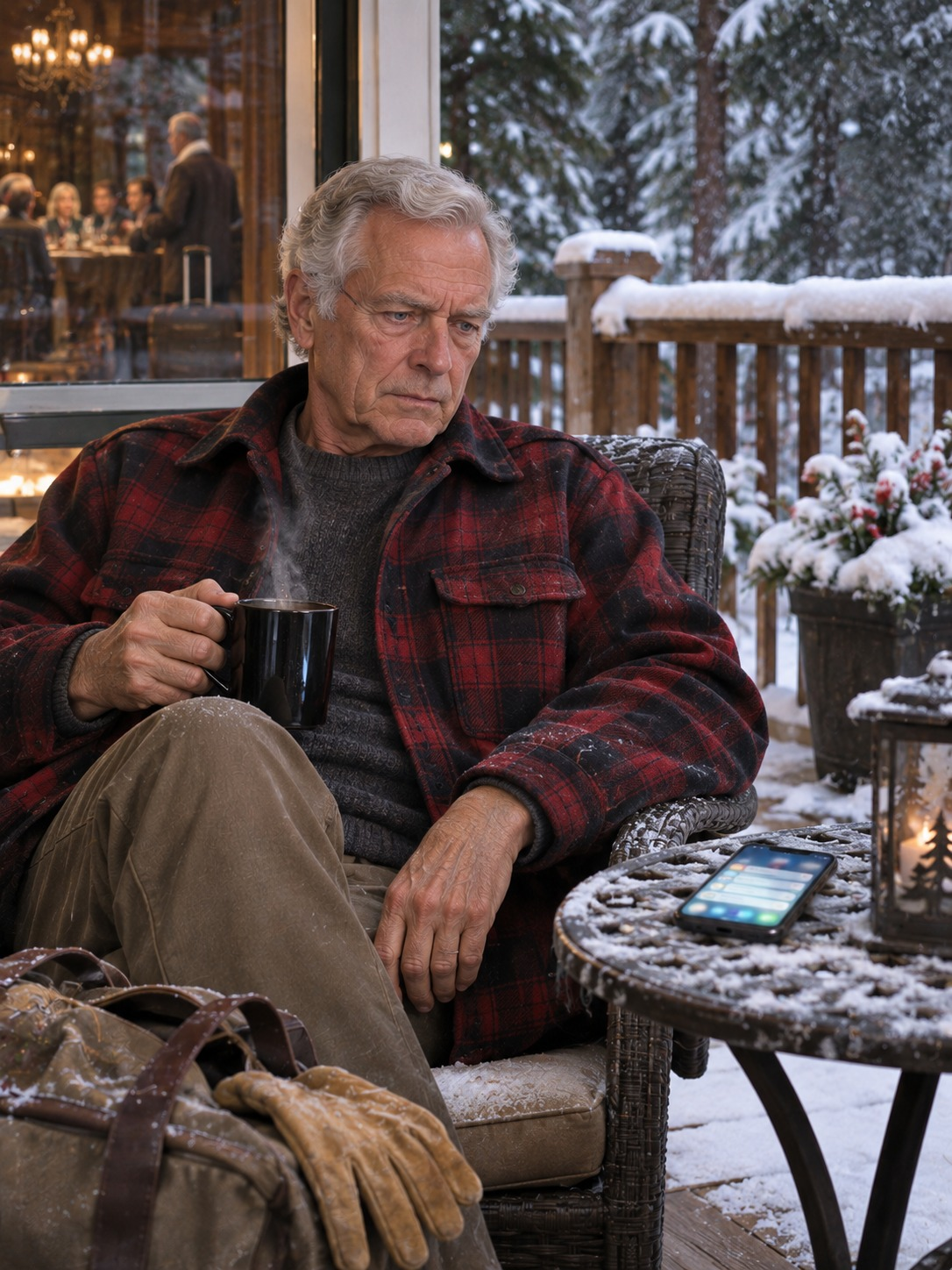
The moment I heard Jared's voice in the background, I stood up.
"Rachel?"
The line was dead.
I stared at my phone.
For the second time in less than a month, my daughter had been interrupted while trying to tell me something important.
This time, it involved letters from Carol.
My wife had been gone for years, but somehow her name had become part of the confusion surrounding my family.
I called Rachel immediately.
She answered after three rings.
"Dad?"
"Are you all right?"
"Yes."
"Where are you?"
"At the house."
"Is Jared there?"
"Yes, but he's leaving."
I closed my eyes.
"Rachel, you don't have to explain anything right now. I just need to know you're safe."
"I am."
Her voice was steadier than before.
Then she said, "Dad, I told him I'm taking the letters."
I sat down.
"What did he say?"
"He said they belonged to the family."
I looked at Carol's photograph on my desk.
"They do."
Rachel was quiet.
Then she said, "He wanted to know why I was bringing them to you."
I felt my stomach tighten.
"And what did you tell him?"
"That you're my father."
I closed my eyes.
For a moment, I couldn't speak.
She continued.
"And that Mom wrote your name on one of them."
I felt tears gathering.
"Rachel—"
"Dad, I'm coming over tomorrow. Justin's going to drive me."
I took a breath.
"All right."
"And Dad?"
"Yes?"
"I'm not going to let Jared tell me what I can talk about anymore."
I sat very still.
"Good," I whispered.
After we hung up, I remained in my office.
The old memorandum was still on my computer.
The court petition was still unresolved.
The question of Jared's motives still hung over everything.
But something had changed.
Rachel was beginning to make her own decisions.
And I was beginning to understand that I couldn't make those decisions for her.
The following morning, Justin's car pulled into my driveway.
I watched from the front window.
Rachel stepped out carrying a small cardboard box.
Justin followed her.
Neither looked particularly happy.
But they were together.
And for the first time in months, they were coming to my house without asking for money.
I opened the door.
"Come in."
Rachel hugged me immediately.
I held her for a long moment.
Then Justin stepped forward.
"Hi, Dad."
"Hello, son."
He gave me a brief hug.
It wasn't awkward this time.
That mattered more than I could explain.
We went into the living room.
Rachel placed the box on the coffee table.
"I found these while sorting through some things Jared moved into storage," she said.
I looked at the box.
It was familiar.
Carol had used it for photographs.
A faded blue ribbon was tied around the lid.
I remembered that ribbon.
She had saved it from Rachel's sixteenth birthday.
"Where was it?" I asked.
"In a cabinet in Jared's office. He'd moved some of our old family boxes there when we renovated."
I nodded.
"Did he know what was inside?"
"I don't think so. He said he hadn't looked through it."
She hesitated.
"But when he saw the envelopes, he wanted to know why I was taking them."
I looked at the box.
Then at my children.
"Well," I said quietly, "let's see what your mother left us."
Rachel untied the ribbon.
Inside were photographs, old Christmas cards, birthday notes, and several envelopes.
I recognized Carol's handwriting immediately.
It was neat, slightly slanted, and unmistakably hers.
Rachel handed me the first envelope.
For Bruce, when the children are old enough to understand.
I ran my thumb over the words.
My throat tightened.
Carol had always been better at saying difficult things than I was.
She could tell someone the truth without making them feel small.
I had admired that about her.
I opened the envelope carefully.
Inside was a letter.
I unfolded it.
The paper had yellowed slightly.
I began to read.
My dear Bruce,
If you're reading this, I hope our children are grown and have found lives that make them happy.
I know how hard you work for us. I know you believe providing is one of the greatest ways a husband and father can show love.
And it is one way.
But I want you to remember something.
Our children will not remember every gift. They will not remember every vacation. They will remember whether you listened when they were frightened, whether you came when they needed you, and whether you loved them enough to tell them no.
I stopped reading.
My eyes filled.
Rachel reached for my hand.
I continued.
I worry sometimes that you give so much because you're afraid of disappointing people.
You don't have to earn your place in this family, Bruce.
You already belong.
I covered my mouth.
For years, I had tried to hold the family together with money.
Expensive Christmas trips.
Lavish dinners.
Financial assistance.
Business investments.
I had convinced myself that if I could keep everyone comfortable, I could keep everyone close.
Carol had seen the danger long before I did.
I looked at Justin.
His eyes were wet.
Rachel was crying quietly.
I read the final paragraph.
When the children are adults, I hope you will let them carry their own responsibilities. Not because you love them less, but because you believe they are capable.
And when you are old, I hope they will come to see you because they want your company, not because you have arranged something wonderful for them.
All my love,
Carol.
I lowered the letter.
Nobody spoke.
The room was silent except for the ticking clock.
Finally, Justin wiped his eyes.
"Mom really knew us, didn't she?"
I smiled through my tears.
"She did."
Rachel nodded.
"She knew you, too."
I laughed softly.
"Better than anyone."
For a long time, we sat together.
Then Rachel reached into the box.
"There's another envelope."
She handed it to Justin.
His name was written across the front.
He opened it slowly.
Inside was a photograph.
He stared at it.
Then he began to cry.
I leaned forward.
"What is it?"
He turned the picture toward me.
It showed Justin at twelve years old.
He was sitting on the steps of our old house.
I was beside him.
We were both holding fishing rods.
I remembered that day.
I had canceled a business meeting to take him fishing.
We hadn't caught anything.
But we had laughed all afternoon.
On the back of the photograph, Carol had written:
The day Bruce remembered that the best gift he could give his son was himself.
Justin stared at the words.
Then he looked at me.
"Dad, I remember this."
"So do I."
He swallowed.
"You told me we didn't need to catch anything to have a good day."
I smiled.
"That sounds like something I would say."
He laughed through his tears.
Then his expression changed.
"I forgot that."
I looked at him.
"Forgot what?"
"That we used to have fun without spending money."
I felt my throat tighten.
Justin continued.
"I think I started believing the expensive things were what made Christmas special."
Rachel nodded.
"Me too."
I looked at both of them.
For months, I had wanted to hear those words.
But now that they were being spoken, I didn't feel triumphant.
I felt sad about the years we had wasted.
And grateful that we still had time.
We spent the rest of the morning looking through photographs.
There were pictures of ordinary Christmas mornings.
Children in pajamas.
Carol making pancakes.
Justin opening a toy truck.
Rachel wearing a paper crown.
There were no luxury lodges.
No private chefs.
No expensive restaurants.
Just a family.
At one point, Rachel found a photograph of Carol standing beside our old Christmas tree.
She held it for a long time.
Then she said, "I miss her."
I put my arm around her.
"So do I."
Justin leaned back.
"Every day."
We sat together quietly.
And for the first time in nearly a year, I didn't feel like a bank account.
I felt like their father.
The following week, Arthur called with news about the court petition.
"Bruce, the matter has been resolved."
I sat forward.
"Resolved?"
"Jared has withdrawn his request. The court has dismissed the proceeding."
I closed my eyes.
"Thank God."
Arthur continued.
"The independent evaluation and financial records were included in the response. There is no appointment, no restriction on your accounts, and no pending request to transfer financial authority."
I let out a long breath.
For months, I had lived with the possibility that someone might use my age and financial decisions to question my independence.
Now that threat was over.
"Arthur," I said, "thank you."
"You're welcome."
I hesitated.
"What about the old memorandum?"
Arthur was quiet.
"We completed our review."
I sat forward.
"And?"
"The document appears to be authentic. Michael Grant confirmed its place in the old company records."
I closed my eyes.
"Then Jared really wrote my name down thirteen years ago?"
"The available records indicate that he did."
I felt a familiar ache.
Arthur continued.
"But the context matters. It was part of a speculative investor-development proposal. We found no evidence that Jared used the memorandum to arrange his marriage to Rachel."
I took a slow breath.
That was important.
I didn't want to believe my daughter's entire marriage had been a financial scheme.
Arthur continued.
"Michael described Jared as ambitious and willing to pursue wealthy investors aggressively. The old civil dispute involved disagreements over financial representations, but it ended without a finding of fraud."
I nodded.
"So we can't say he married Rachel for money."
"No. The evidence doesn't support that conclusion."
I closed my eyes.
"Good."
Then I asked, "What about Thomas Caldwell?"
"Thomas provided his original notes and correspondence. They show Jared sought advice about your finances before the Aspen dinner."
I felt my stomach tighten.
"And Thomas?"
"He acknowledged discussing general legal options despite having no basis to conclude you lacked capacity. He also confirmed that he did not have access to your current accounts."
I nodded.
Arthur continued.
"The alarming letter you received was assembled from those notes and a draft prepared by Jared. Thomas did not send it as a final instruction."
I looked toward the window.
"And the line about Rachel?"
"Jared wrote that Rachel should not be involved in the preliminary discussions. Thomas confirmed it."
I closed my eyes.
So the truth was complicated.
Jared had sought information.
Thomas had exercised poor judgment.
The old memorandum was genuine but didn't prove every fear I had imagined.
And my children had participated in a process they hadn't fully understood.
I wasn't happy about any of it.
But I was relieved to have facts instead of suspicions.
"Arthur," I said, "what happened to the anonymous attachment?"
"It was reviewed through a secure process. It contained copies of some of the same historical records, mixed with commentary we couldn't independently verify. We haven't relied on the anonymous claims."
I nodded.
"Good."
"And Martin confirmed the attempted account-information request did not result in any unauthorized disclosure or access."
I let out a breath.
"That's a relief."
"The earlier travel authorization issue is also closed. The old signature image was carried forward from a template, and the attempted new guarantee was never accepted."
I smiled faintly.
"One less thing to worry about."
Arthur laughed.
"Several less."
I looked at Carol's photograph.
Then I asked the question that mattered most.
"Arthur, is my money still mine to manage?"
"Yes, Bruce."
I closed my eyes.
"Good."
He paused.
"And your family?"
I looked toward the living room, where the box of photographs still sat on the table.
"We're working on that."
Rachel came to see me again a few days later.
This time, she came alone.
We sat in the kitchen with coffee.
She looked tired, but calmer.
"Dad, Jared and I are separating."
I put down my cup.
"Are you sure?"
She nodded.
"Yes."
I didn't say I was relieved.
I didn't say I had been waiting for her to make that decision.
I simply asked, "How are you feeling?"
She looked down.
"Sad."
I nodded.
"That makes sense."
"And embarrassed."
"Rachel—"
"I defended him for years."
I reached across the table.
"Sweetheart, loving someone doesn't make you foolish."
She began crying.
"I kept telling myself he was just trying to help."
I squeezed her hand.
"Sometimes people convince themselves they're helping when they're really trying to control a situation."
She nodded.
"I know."
We sat quietly.
Then she said, "He admitted he wanted the hundred thousand dollars."
I closed my eyes.
"He told you that?"
"Yes."
"He said he believed you were being unreasonable and that the family should have a say in your financial decisions."
I shook my head.
Rachel continued.
"He said he thought the petition would make you take us seriously."
I looked toward the window.
There it was.
Not a grand criminal conspiracy.
Not a hidden fortune.
Not some elaborate plan that had begun before my daughter was born.
Just a man who had become accustomed to getting his way.
And who had gone too far when I finally said no.
Rachel looked at me.
"Dad, I'm sorry."
I felt my throat tighten.
"I know."
"No. I need to say it properly."
I waited.
She took a breath.
"I'm sorry I signed those papers. I'm sorry I accused you of using money to control us. And I'm sorry I treated your generosity like something we were entitled to."
My eyes filled.
"Thank you, sweetheart."
She wiped her cheeks.
"I don't expect you to forget."
"I won't."
She looked down.
"But I hope you can forgive me."
I reached for her hand.
"I already want to."
She began crying again.
I stood and walked around the table.
She rose.
I held her.
For a long time, neither of us spoke.
Then she whispered, "I miss Mom."
I closed my eyes.
"So do I."
December arrived quietly.
For the first time in decades, I wasn't planning an expensive family vacation.
I wasn't reviewing travel invoices.
I wasn't coordinating flights.
I wasn't making sure everyone had the right rooms.
I wasn't paying for a chef.
I wasn't arranging transportation.
I was helping Denise organize Christmas deliveries.
I was having lunch with Walter.
I was reading books I had been meaning to read for years.
And I was spending time with my children in ways that didn't involve money.
Justin came over twice that month.
Once to help me fix a loose railing on the back porch.
Once simply to have coffee.
Rachel came on a Sunday afternoon.
We made Carol's old sugar-cookie recipe.
The cookies were uneven.
Some were too brown.
Some were too thick.
But we laughed.
And when Rachel left, she hugged me and said, "That was nice, Dad."
I smiled.
"It was."
I didn't need to pay twenty-five thousand dollars to hear those words.
A week before Christmas, Justin called.
"Dad, can I ask you something?"
"Of course."
He hesitated.
"Are you coming to Aspen?"
I looked at the phone.
"No."
There was a pause.
"Okay."
I waited.
He continued.
"Monica and the kids are still planning to go."
"I hope you have a good time."
He sounded uncomfortable.
"Dad, I know you're not paying."
"That's right."
"I understand."
I smiled faintly.
"Good."
Then he said, "I just wanted to make sure you knew you were welcome."
My throat tightened.
For nearly a year, I had remembered his words from the previous Christmas.
We would be better off doing Christmas without you.
Now he was inviting me.
I believed he meant it.
But I also knew I wasn't ready to return to Aspen.
Not yet.
"Thank you, Justin," I said. "That means a lot."
He was quiet.
"Maybe next year?"
"Maybe."
We talked for a few more minutes.
Then he told me the children were excited about the snow.
I listened.
I asked about their school projects.
I told him I loved him.
And when we hung up, I felt peaceful.
I hadn't changed my mind.
I hadn't reopened the holiday fund.
I hadn't offered to pay.
And my son hadn't asked.
That was progress.
Christmas Eve arrived cold and clear.
I woke early.
Made coffee.
And looked out at the frost covering the lawn.
For years, Christmas Eve had meant airports, luggage, reservations, and expensive dinners.
This year, it meant something simpler.
At eight-thirty, I drove to the community center.
Denise was already there.
"Bruce, Merry Christmas Eve!"
"Merry Christmas."
She handed me a clipboard.
"We've got twelve deliveries."
I smiled.
"Then we'd better get started."
For the next several hours, I helped deliver groceries and holiday meals.
We visited older residents.
We carried boxes into kitchens.
We listened to stories.
At one house, an elderly man named Henry insisted on showing me photographs of his grandchildren.
At another, a woman named Margaret gave us homemade cookies.
At the final stop, a little boy handed me a drawing of a Christmas tree.
"Thank you for helping my grandma," he said.
I looked at the picture.
It was crooked.
The star was too big.
The ornaments were different sizes.
I smiled.
"You're very welcome."
I placed the drawing carefully in my jacket pocket.
When I returned to the community center, Denise offered me lunch.
I stayed.
We ate sandwiches and soup.
People laughed.
Someone played Christmas music.
There were no arguments about money.
No demands.
No accusations.
Just people sharing a meal.
At two-thirty, I drove home.
I made fresh coffee.
Then I carried a cup onto the back porch.
The sun was bright.
The air was cold.
I wrapped a blanket around my shoulders.
For a while, I simply sat there.
I thought about Carol.
I thought about the children.
I thought about the year that had changed everything.
Then I looked at the clock.
3:00 p.m.
My phone vibrated.
A message from Justin.
I opened it.
"Dad, the lodge says our reservation was canceled in March. Call me."
I stared at the screen.
There it was.
The moment I had known might come.
The original recurring Aspen reservation had been canceled in March.
The automatic family holiday fund had been closed.
The old payment arrangements were gone.
I had told Justin and Rachel repeatedly that they needed to make their own arrangements.
But somewhere along the way, Justin had continued believing the old lodge would still be waiting.
I took a sip of coffee.
The phone rang.
Justin.
I watched it.
Then let it ring.
A second call came.
I didn't answer.
Then a message.
Dad, we're at the lodge. They say there's no reservation under our family account.
Another message.
Please call me.
I looked out at the garden.
For months, I had wondered what I would feel when this happened.
Anger?
Satisfaction?
Vindication?
Instead, I felt sadness.
My son was standing in Aspen with his family, discovering that the arrangements he had taken for granted no longer existed.
I didn't want him humiliated.
I didn't want my grandchildren disappointed.
But I also knew I couldn't keep rescuing everyone from the consequences of their assumptions.
I had made my position clear.
I had closed the fund properly.
I had canceled the recurring reservation in March.
I had honored existing obligations.
And I had refused to guarantee new ones.
Justin had known the financial arrangements were over.
He simply hadn't confirmed the booking.
My phone rang again.
I let it go to voicemail.
Then I turned the phone face down.
I drank my coffee.
The sun warmed my face.
For the first time in years, I wasn't responsible for fixing Christmas.
Later that afternoon, Monica sent a message.
Bruce, I understand you're upset with us, but the children are here and we need somewhere to stay.
I read it carefully.
I thought about the grandchildren.
They hadn't caused any of this.
They didn't understand the family holiday fund.
They didn't know about the court petition.
They didn't know about the arguments.
They just wanted Christmas.
For a moment, I considered calling the lodge and paying.
It would have been easy.
I could have arranged something expensive.
I could have solved the problem in minutes.
But then I remembered Carol's letter.
Love them enough to tell them no.
I set the phone down.
I wasn't going to reopen the old arrangement.
I wasn't going to use money to erase another uncomfortable conversation.
But I also didn't want my grandchildren stranded.
So I sent one message to Justin.
I hope you and the family are safe. The recurring lodge reservation was canceled in March when I ended the holiday arrangements. I won't be paying for a replacement. Please make suitable accommodations for your family. We can talk after Christmas.
Then I put the phone away.
I didn't answer the next calls.
I didn't negotiate.
I didn't argue.
I didn't send money.
And I didn't apologize for making a decision I had every right to make.
That evening, I went to Walter's house.
His sister had invited several friends for Christmas Eve dinner.
The table was crowded.
There was roast chicken.
Mashed potatoes.
Green beans.
Homemade rolls.
Nothing fancy.
Everything delicious.
Walter handed me a plate.
"Glad you came, Bruce."
I smiled.
"Me too."
We sat together.
We talked.
We laughed.
Someone told a terrible joke.
I laughed anyway.
For the first time in years, Christmas Eve felt like a holiday instead of an obligation.
When I returned home, I checked my phone.
There were several messages.
The last was from Justin.
We found a hotel. Everyone's okay.
I closed my eyes.
Relief washed over me.
Then I read the next message.
Dad, I should have checked the reservation. You told us the old arrangements were over.
I sat down.
Another message followed.
I'm sorry I expected you to fix it.
I stared at the words.
For a long moment, I didn't move.
Then I typed:
I'm glad you're all safe. Merry Christmas, son.
He replied:
Merry Christmas, Dad.
I put the phone down.
And smiled.
Christmas morning was quiet.
I woke to sunlight coming through the curtains.
I made pancakes.
Carol's recipe.
I burned the first one.
She would have laughed.
I ate breakfast at the kitchen table.
Then I opened the small box of photographs Rachel had brought.
I looked through them slowly.
Justin fishing.
Rachel baking.
Carol laughing.
Our old Christmas tree.
I realized something.
The memories I treasured most were never the expensive ones.
They were the ordinary moments.
The ones that couldn't be purchased.
At ten o'clock, Rachel called.
"Merry Christmas, Dad."
"Merry Christmas, sweetheart."
She sounded happy.
"Are you doing anything today?"
"I'm having lunch with Walter's family."
"That sounds nice."
"It is."
She hesitated.
"Can I come by this afternoon?"
I smiled.
"Of course."
"Justin said he'd like to video call later, too."
My throat tightened.
"That would be wonderful."
Rachel paused.
"Dad?"
"Yes?"
"Thank you for not giving up on us."
I closed my eyes.
"I never stopped loving you."
"I know."
She was quiet.
Then she said, "I think I'm finally beginning to understand the difference."
I smiled through my tears.
"So am I."
The months that followed were different.
Not perfect.
Different.
Justin and Monica paid for their own holidays.
They chose smaller trips.
Sometimes they stayed home.
Sometimes they visited friends.
They learned that a family vacation didn't need a luxury lodge to be meaningful.
Rachel moved into a small apartment while she worked through her separation from Jared.
She found a new job.
She began making financial decisions independently.
I helped her understand a few practical things when she asked.
But I didn't take over.
I didn't write large checks.
I didn't solve every problem.
And she didn't expect me to.
Jared's petition remained dismissed.
His request for the hundred thousand dollars was never renewed.
Rachel and Jared eventually completed their divorce.
It was painful.
There were difficult conversations.
But Rachel emerged more confident and more willing to trust her own judgment.
Thomas Caldwell sent me a letter of apology.
He acknowledged that his old resentment had affected his judgment and that he should never have discussed my financial circumstances with Jared without proper grounds.
I accepted the apology.
I didn't invite him back into my life.
Some relationships could be forgiven without being restored.
Arthur and Martin helped me update my estate documents.
I made sure my wishes were clear.
I included safeguards for the future.
I arranged for independent professional oversight if I ever genuinely needed assistance.
And I made certain that no family member would have automatic control simply because they expected it.
The old holiday fund stayed closed.
The automatic Aspen reservation stayed canceled.
The remaining accounts were organized properly.
Everything was documented.
Everything was clear.
And for the first time in years, I felt comfortable with the arrangements.
Not because I had less money.
But because my money was no longer the center of every family conversation.
The following spring, Justin invited me to his house for dinner.
I arrived carrying a pie.
Not a check.
Not a gift card.
Not an envelope.
A pie.
Monica opened the door.
"Bruce, come in."
She smiled.
It was a little awkward.
But genuine.
The grandchildren ran toward me.
"Grandpa!"
I laughed.
They hugged me.
One of them grabbed my hand.
"Come see what I made!"
I followed him into the living room.
There was a model airplane on the table.
He had built it himself.
He explained every part.
I listened.
I asked questions.
I admired his work.
And I realized I was enjoying myself more than I had at any of the expensive Aspen dinners.
Later, we sat around the kitchen table.
Justin had cooked.
The chicken was slightly dry.
The potatoes were excellent.
Monica apologized for the simple meal.
I shook my head.
"Don't apologize. It's wonderful."
Justin looked at me.
Then smiled.
"Dad, I think Mom would have liked this."
I felt my throat tighten.
"She would have."
We ate.
We talked.
We laughed.
Nobody mentioned money.
Nobody asked for a loan.
Nobody complained about vacations.
And when dinner was over, Justin helped me put on my coat.
He stood beside me at the door.
"Dad?"
"Yes?"
He hesitated.
"I've been thinking about last Christmas."
I looked at him.
He continued.
"Not the hotel. Not the lodge."
I waited.
"The Christmas before that. The dinner when I told you we'd be better off without you."
I felt the old ache.
But it wasn't as sharp anymore.
Justin looked down.
"I was wrong."
I nodded.
"I know."
He swallowed.
"I thought your money was what made our holidays special."
I looked at him.
"And now?"
He smiled faintly.
"Now I think we were so busy spending it that we forgot to enjoy being together."
My eyes filled.
I placed a hand on his shoulder.
"That's a good lesson to learn."
He nodded.
"I'm sorry it took me so long."
I smiled.
"You're here now."
He hugged me.
And this time, I didn't feel like I was holding on to someone who was about to walk away.
I felt like I was holding my son.
That summer, Rachel and Justin came over for a family barbecue.
Just the three of us at first.
Later, Monica and the grandchildren joined us.
We cooked hamburgers.
Made lemonade.
Sat outside.
The children played in the yard.
Rachel brought a salad.
Justin brought corn.
Monica brought dessert.
Nobody expected me to provide everything.
Everyone contributed.
At one point, I went into the kitchen to get more napkins.
When I returned, I stopped in the doorway.
Justin was laughing.
Rachel was telling a story.
The grandchildren were arguing over a board game.
Monica was helping the youngest one count his pieces.
For a moment, I saw the family I had been trying so hard to preserve.
Not the expensive version.
Not the polished holiday photograph.
The real one.
Imperfect.
Noisy.
Sometimes difficult.
But together.
I stood there for a few seconds.
Then Rachel looked up.
"Dad, are you coming?"
I smiled.
"Of course."
I walked outside.
And took my place at the table.
Later that evening, after everyone had gone home, I sat on the back porch.
The garden was full of flowers.
The air was warm.
The house was quiet.
I looked at the photograph of Carol that I had brought outside.
"Well," I said softly, "we finally figured it out."
I smiled.
"You were right."
I thought about the twenty-five-thousand-dollar Christmas dinner.
The words Justin had spoken.
The napkin I had folded.
The way I had walked away from the table.
At the time, I thought I was losing my family.
I didn't know I was beginning to change the way we loved one another.
It had been painful.
There had been mistakes.
There had been anger.
There had been fear.
But there had also been apologies.
Honest conversations.
New boundaries.
And a chance to build something better.
I looked toward the house.
On the kitchen counter sat a small framed photograph.
Justin, Rachel, and me.
Taken at the summer barbecue.
We were smiling.
No luxury lodge.
No private chef.
No twenty-five-thousand-dollar bill.
Just three people who had finally learned that love didn't need to be purchased.
I took a sip of coffee.
Then I looked up at the evening sky.
For years, I had believed my greatest responsibility was to give my children everything I could.
Now I understood that sometimes the greatest gift was trusting them to stand on their own.
And sometimes the greatest gift I could give myself was permission to stop paying for a place I already deserved.
I was seventy-one years old when my son told me Christmas would be better without me.
I was seventy-two when I discovered that my family could still find its way back.
Not because I paid for another holiday.
Not because I surrendered my boundaries.
But because we finally began choosing one another without a price attached.
And that was the Christmas gift I had wanted all along.






Comments 0