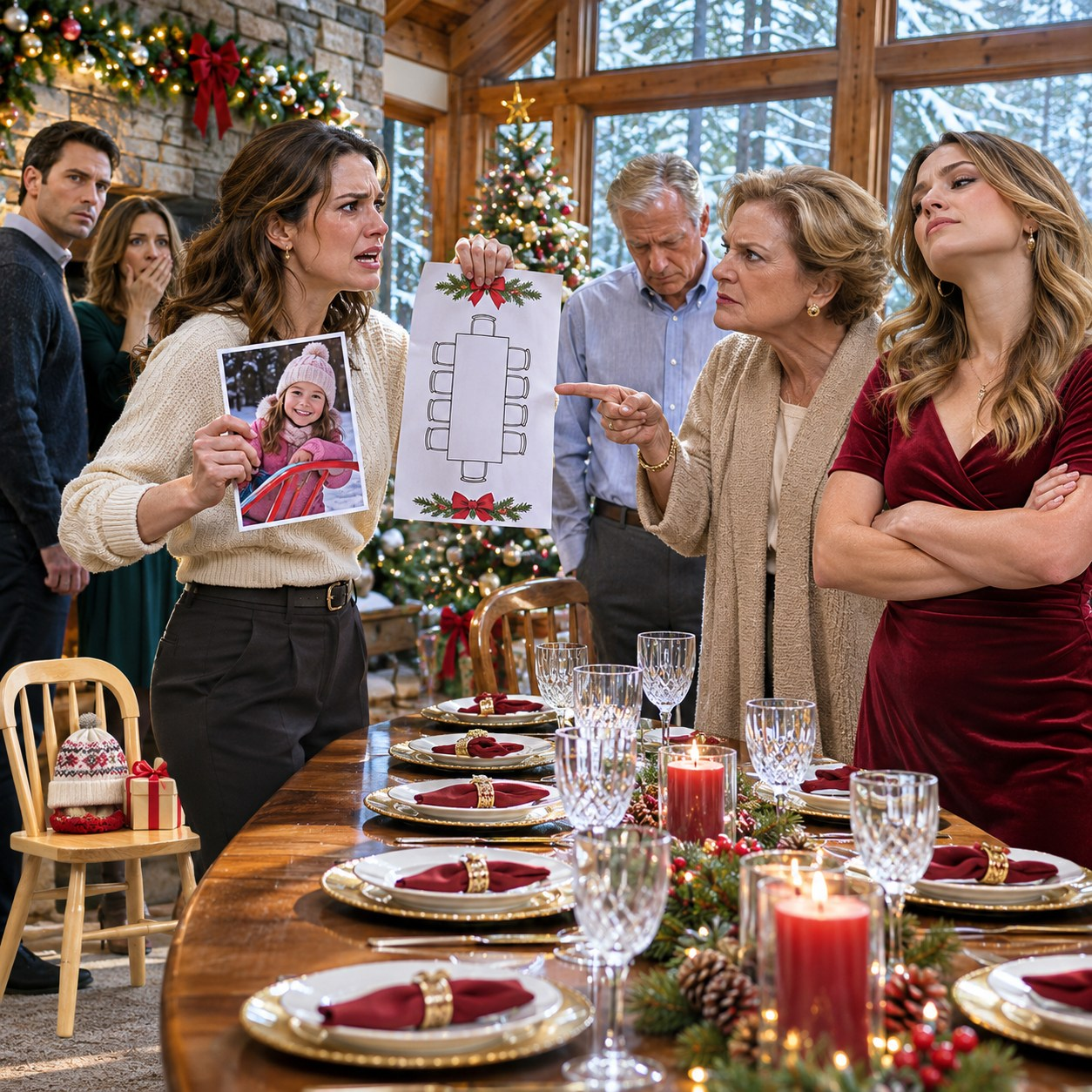
My father called my office and said, "Your daughter isn't welcome at Christmas."
Then he mentioned the mountain cabin.
I opened my leather portfolio and found an old business card.
Four words were written on the back.
Ask about owner's rights.
My father had no idea what those words meant.
Neither did I.
Not yet.
The call came at 4:17 on a Tuesday afternoon, twelve days before Christmas.
I remember the exact time because I had just finished reviewing the capitalization rate on a warehouse in Troutdale, Oregon. The number on my computer screen was 6.75 percent. I'd been staring at it for twenty minutes, trying to decide whether the property's deferred maintenance justified an adjustment.
My name is Mara Breslin. I was thirty-five years old, a commercial property appraiser in Portland, and a single mother to a nine-year-old girl named Lily.
I had spent most of my adult life learning that numbers were more dependable than people.
Numbers didn't smile while disappointing you.
Numbers didn't pretend that cruelty was a misunderstanding.
And numbers certainly didn't call you during your busiest workday to explain why your only child wasn't good enough to sit at the family Christmas table.
My office phone rang.
I glanced at the caller ID.
Dennis Breslin.
Dad.
That alone was unusual.
My father had never been comfortable calling me at work. He considered my profession something mysterious involving paperwork, banks, and buildings he couldn't afford.
He preferred contacting me through my mother.
Usually when somebody needed something.
I picked up.
"Hey, Dad. Everything okay?"
There was a pause.
Then he cleared his throat.
"Mara, it's Dad."
"I know."
"Right. Well. Listen, I wanted you to hear something from me before your mother brought it up."
I leaned back in my chair.
Something about his voice made me sit perfectly still.
"Okay."
"It's about Christmas."
I looked toward the small framed photograph beside my monitor.
Lily was standing in our backyard wearing a ridiculous purple raincoat, holding a worm she'd rescued from the sidewalk.
She had been seven when I took that picture.
She looked so proud.
"What about Christmas?" I asked.
My father cleared his throat again.
"Amber wants to do things a little differently this year."
My younger sister, Amber, was thirty-one and worked in brand strategy. She had a beautiful Pearl District condominium, an expensive wardrobe, and an extraordinary talent for convincing our parents that whatever she wanted was what the entire family needed.
"What does differently mean?"
"Well, she thought it might be nice to have a more sophisticated gathering."
I stared at the warehouse report.
"A sophisticated gathering."
"An adults-only Christmas, actually."
For a moment, I didn't understand.
Then I did.
"You're saying Lily can't come?"
"Now, Mara, don't make it sound like that."
"Like what?"
"Like we're excluding her."
I pressed my palm flat against my desk.
"Dad, she's nine."
"I know how old she is."
"She's your granddaughter."
"Of course she is."
"And you're telling me she isn't invited to Christmas?"
He sighed.
The familiar sigh.
The one that meant he thought I was making an uncomplicated situation unnecessarily difficult.
"Amber's had a demanding year. Your mother thinks it would be easier if we kept things peaceful."
I looked again at Lily's photograph.
Peaceful.
That was the word my family used whenever they wanted me to swallow something painful without complaining.
Peaceful meant not questioning my mother's decisions.
Peaceful meant pretending Amber hadn't said something deliberately hurtful.
Peaceful meant teaching Lily to be grateful for whatever attention her grandparents decided to spare.
"What exactly do you expect me to do with my daughter on Christmas Eve?"
"Maybe you could arrange a sitter."
I laughed.
It wasn't a happy sound.
"A sitter?"
"Just for the evening."
"On Christmas Eve?"
"Or perhaps her father could take her."
I closed my eyes.
Lily's father lived in Denver.
He had missed four consecutive Christmases.
My parents knew that.
They also knew I had spent years trying to protect Lily from feeling abandoned by him.
"Her father isn't coming," I said.
"Well, I'm sure you can figure something out."
There it was.
The sentence that had followed me through thirty-five years of being Diane and Dennis Breslin's oldest daughter.
I'm sure you can figure something out.
When Amber needed help with college tuition, our parents figured something out.
When Amber wanted a new car after graduating, they figured something out.
When Amber's first business venture failed, they figured something out.
When I needed childcare so I could attend a mandatory professional conference, I was told to figure something out.
And I had.
Every single time.
"Dad," I said quietly, "does Mom agree with this?"
"Your mother thinks it's for the best."
"And you?"
Another pause.
"I think we should try to have a nice Christmas."
I looked at the spreadsheet on my screen.
A commercial property worth several million dollars.
Every assumption documented.
Every conclusion supported.
I could explain that building's value to a room full of skeptical bankers.
But I couldn't explain why my daughter's presence made Christmas less enjoyable for the people who were supposed to love her.
"Mara?"
"I'm here."
"Good. Your mother thought you'd take it better coming from me."
That sentence hurt more than anything else.
Not because it was cruel.
Because it was honest.
They had discussed this.
Planned it.
Decided who should deliver the news.
And somewhere during that conversation, nobody had apparently suggested that excluding a nine-year-old child from Christmas might be wrong.
"I heard you," I said.
My father sounded relieved.
"Good. We'll talk soon."
He hung up.
I remained seated with the receiver in my hand.
Outside my office window, downtown Portland was disappearing into the early winter darkness.
Cars moved through wet intersections.
Office workers hurried toward parking garages.
Somewhere below, a delivery truck backed into an alley.
The world continued.
Mine had shifted.
I set the receiver down.
Then I finished my report.
That might sound strange.
Maybe I should have cried.
Maybe I should have called my mother and screamed.
Maybe I should have driven directly to Amber's condominium and demanded an explanation.
But the warehouse in Troutdale had done nothing to deserve my anger.
And I had a client waiting.
So I checked the comparable sales, finalized the valuation, and sent the report at 5:42.
Then I went to collect my daughter.
Lily was at our neighbor's house.
Mrs. Bennett, who lived two doors down, opened the door before I reached the porch.
"She's been drawing again," she whispered with a smile.
That wasn't surprising.
Lily drew constantly.
Animals.
Houses.
Imaginary cities.
Maps of places she wanted to visit.
She had inherited my fascination with buildings, although her designs usually included secret tunnels and rooms for rescued dogs.
I found her sitting cross-legged on the living room carpet.
Three sheets of paper were spread around her.
"Mom!"
She jumped up and ran into my arms.
I held her a second longer than usual.
"Hey, bug."
"Look what I made!"
She pulled me toward the carpet.
The drawings were maps of the mountain cabin.
Our family's Christmas destination.
The cabin sat among the pines outside Mount Hood, a few hours from Portland. It had a broad wooden deck, enormous windows, a stone fireplace, and enough snow in December to make Lily believe she'd stepped into a Christmas movie.
She loved that place.
More specifically, she loved the eastern slope behind the cabin.
That was where Rosa Delgado, the property caretaker, had taught her how to sled without drifting toward the frozen creek.
Lily pointed to a red arrow.
"This is the good route."
"Looks pretty fast."
"It is. But Rosa said I should start on the east side because the west steps get icy."
She pointed to another drawing.
"And this is where we're putting the snowman."
I swallowed.
"That's a very detailed plan."
"I know."
She grinned.
"Do you think Grandma will let me help decorate the tree this year?"
The question landed like a stone in my stomach.
Last Christmas, Diane had told Lily she was too young to handle the glass ornaments.
Amber had been allowed to decorate the entire tree.
Lily had stood beside me holding a paper snowflake she'd made at school.
Eventually, Rosa quietly helped her hang it on a branch near the back.
"I don't know, sweetheart," I said.
Lily considered that.
"Maybe if I ask nicely."
I couldn't answer.
On the drive home, she talked about Christmas cookies.
She wanted to make cinnamon stars.
She wanted to bring Rosa a present.
She wanted to show Grandpa Dennis the chapter book she'd finished.
Every plan involved the cabin.
Every plan assumed she belonged there.
I gripped the steering wheel.
At home, I made grilled-cheese sandwiches and tomato soup.
Lily sat at the kitchen table, adding another sledding route to her map.
"Mom?"
"Yeah?"
"Did Grandma say what time we're going up?"
I turned toward the stove.
"We're still sorting out Christmas."
"Oh."
She went back to drawing.
For a moment, I thought I'd escaped.
Then she said something that nearly broke me.
"If Grandma wants quiet time, I can be really quiet."
I turned off the burner.
"What?"
Lily looked up.
"I know Aunt Amber doesn't like when I talk too much."
My chest tightened.
"Who told you that?"
"Nobody."
She shrugged.
"She just gets that face."
"What face?"
Lily pressed her lips together and lifted her eyebrows in a perfect imitation of my sister's disapproval.
I would have laughed if it hadn't been so accurate.
"Sweetheart," I said, kneeling beside her chair, "you don't have to make yourself smaller to make other people comfortable."
She studied me.
"Even at Grandma's?"
I couldn't lie.
But I couldn't tell her the truth yet.
"Especially there."
She smiled faintly.
Then she returned to her drawing.
I watched her for a long moment.
Nine years old.
Still willing to believe that if she behaved well enough, the people who hurt her might finally decide she was worth loving.
I recognized that hope.
I'd carried it for most of my life.
After dinner, Lily took a bath, put on her Christmas pajamas, and asked me to read two chapters of her book instead of one.
I read three.
When she finally fell asleep, her hand was resting on a folded drawing of the mountain cabin.
I gently removed it.
On the back, she'd written:
Christmas at Grandma's.
Underneath were seven stick figures.
Grandma.
Grandpa.
Aunt Amber.
Tom.
Mom.
Rosa.
And Lily.
Everyone was smiling.
I sat on the edge of her bed until my eyes stopped burning.
Then I went downstairs.
My phone was waiting on the kitchen counter.
There were two messages.
The first was from my mother.
Your father told you. Amber deserves a peaceful Christmas. You could hire a sitter, or maybe Lily's father could take her.
I read it twice.
Not once did she ask how Lily would feel.
The second message was from Amber.
Already told my friends we're using the cabin! Photographer booked for the 23rd. Such an elevated adults-only vibe. Can you wire the $1,650 catering deposit? Mom said you'd handle it.
I stared at the amount.
One thousand six hundred and fifty dollars.
For a dinner my daughter wasn't allowed to attend.
I opened our family group chat.
It had been muted for months.
There were photographs of centerpieces.
Links to expensive wine glasses.
A discussion about whether the photographer should arrive before sunset.
Then I found the seating chart.
My mother had photographed a handwritten page.
At the top were the words:
CHRISTMAS EVE TABLE SEATING.
Beneath them were nine names.
Diane.
Dennis.
Amber.
Tom.
Two of Amber's friends.
A photographer.
A cousin.
And one additional guest from Amber's professional circle.
I checked again.
No Lily.
No Mara.
They hadn't simply excluded my daughter.
They had erased both of us.
Yet somehow, I was still expected to finance the evening.
I placed my phone facedown.
For several minutes, I sat without moving.
Then I walked to the hallway closet.
On the top shelf was my old leather portfolio.
I hadn't used it regularly since moving into my current office.
Inside were old property reports, professional certificates, handwritten notes, and business cards collected over years of work.
Near the back was a cream-colored card.
Priya Nair, Attorney at Law.
I remembered meeting Priya at a commercial real estate conference.
We'd spoken about property ownership, estate planning, and family arrangements that became complicated when people assumed legal rights they didn't actually possess.
At the time, I'd mentioned the mountain cabin.
Priya had asked me a question.
I hadn't known how to answer it.
Now, holding her card beneath the kitchen light, I turned it over.
Four words were written in my handwriting.
Ask about owner's rights.
I stared at them.
Then I remembered something else.
Three years earlier, when the cabin's insurance policy had been renewed, Rosa had called me instead of my father.
She'd said my name appeared on a document.
I'd assumed it was an administrative mistake.
My mother had told me not to worry about it.
And I hadn't.
Until now.
I opened my laptop.
Searched my old email.
Typed the cabin's address into the search bar.
Several results appeared.
Insurance correspondence.
A maintenance invoice.
An old message from Rosa.
Then one email caught my attention.
It had been sent nearly four years earlier.
The subject line was simple.
Cabin ownership documents — please retain.
I didn't recognize the sender.
But I recognized the attachment.
A recorded property instrument.
I clicked it.
The document opened.
At the top was the mountain cabin's legal description.
Below it were several names.
I leaned closer.
My mother's name wasn't where I expected it.
Neither was my father's.
And beside the words Grantee of Record, I saw a name that made my hands go cold.
Mine.
I reached for my phone.
Before I could call Priya, a new message appeared.
It was from Rosa.
Mara, I'm sorry to bother you so late. Your mother called me tonight about the Christmas gathering. There's something about the cabin I think you need to know.
A second message followed.
And I don't think your parents ever told you why your name is on the deed.
Then my phone began ringing.
It was Rosa.
She sounded frightened when I answered.
"Mara," she whispered, "are you alone?"
I looked toward the stairs where Lily was sleeping.
"Yes."
Rosa took a shaky breath.
"Then you need to listen carefully. Because there's something your grandmother left behind, and your mother has been trying to keep you from seeing it."
I stood up.
"What did she leave?"
Rosa lowered her voice.
"A letter."
"Where is it?"
A long silence followed.
Then Rosa said:
"I'm standing in front of the place where she hid it."
Behind her, I heard a door creak open.
And then a man's voice spoke.
"Rosa? Who are you talking to?"






Comments 0