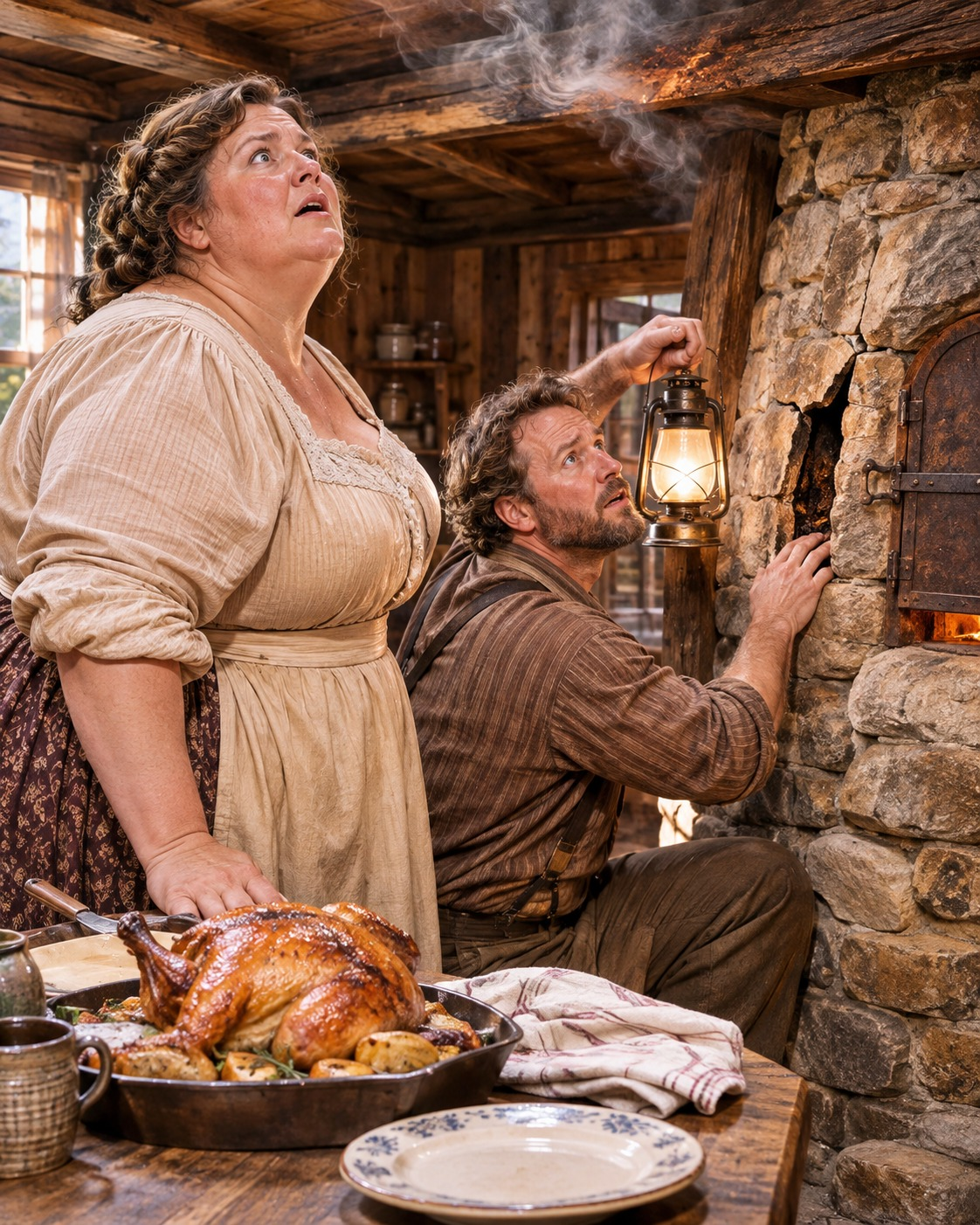
"Thomas, get away from that wall!" Martha shouted.
Her husband froze beside the stone oven, holding a brass lantern over a broken piece of clay mortar.
A narrow black mark ran across the fallen fragment.
At its center was a tiny red ember.
The fire was no longer where it belonged.
For several seconds, neither of them moved.
The lantern trembled in Thomas's hand. Its small flame cast restless shadows across the rough stones, making the crack behind the oven appear wider than it really was.
Martha stood beside the dining table, one hand gripping the edge so tightly that her knuckles had turned white.
Behind her sat the remains of their Sunday supper.
The roasted chicken was golden brown, its skin still shining with butter. Potatoes lay scattered around the bird, their edges crisp from the oven's heat. A few softened onions had fallen into the rich juices at the bottom of the pan.
An hour earlier, Martha would have called it the finest meal she had prepared that autumn.
Now she could barely stand the smell.
"Thomas," she said again, more quietly. "Tell me what you're looking at."
He did not answer immediately.
Instead, he raised the lantern another inch.
The crack climbed behind the oven, disappearing into the narrow space where the stonework met the timber wall.
Thomas leaned closer.
Martha saw the change in his face before he spoke.
Her husband was not a man who frightened easily.
He had spent years clearing land, cutting timber, repairing wagons, and building their little cabin with tools that were often older than either of them.
He had worked through winter storms and summer heat.
He had once carried an injured neighbor nearly two miles after a logging accident.
But now his mouth had gone dry.
"The mortar's burned through," he said.
Martha frowned.
"Burned through?"
"There's a hollow behind these stones."
"There's supposed to be space behind the oven, isn't there?"
"Not there."
He pointed toward the opening.
"The heat should travel through the flue and out the chimney. It shouldn't be going into the wall."
Martha glanced upward.
A thin ribbon of smoke drifted from the ceiling.
It was so faint that she might have mistaken it for dust if the sunlight had not caught it.
"Then where is it going?"
Thomas swallowed.
"Toward the roof."
The words settled between them.
Outside, the autumn wind pushed against the shutters.
A branch scraped the side of the cabin.
Martha looked toward the ceiling beam.
It was the oldest piece of timber in the entire house.
Thomas had salvaged it from a fallen barn before they built the cabin. He had chosen it because it was thick, straight, and strong enough to support the roof.
Martha remembered helping him lift it into place.
She remembered the ropes biting into her palms.
She remembered Thomas laughing when she told him that if the beam ever fell, she would hold him personally responsible.
At the time, they had been young enough to believe that hard work could solve almost anything.
Now that same beam hung above their heads.
And smoke was coming from it.
"How long?" Martha asked.
Thomas turned toward her.
"What?"
"How long has the heat been getting inside that wall?"
"I don't know."
"Since this morning?"
He hesitated.
"Maybe."
"Since last week?"
"Martha—"
"Since we built the oven?"
Thomas said nothing.
That silence frightened her more than any answer.
She remembered the strange behavior of the oven earlier that day.
The chicken had refused to brown.
For nearly an hour, it had remained pale despite the strong fire burning beneath it.
Martha had checked the roasting pan repeatedly, wondering whether the bird was too large or whether she had arranged the potatoes too tightly around it.
Thomas had returned from the settlement that morning carrying the freshest chicken he could find.
It had been a fine bird, plump and clean, with enough meat to last them several meals.
Martha had rubbed its skin with butter, salt, cracked pepper, and dried sage.
Thomas had chopped onions and tart apples for the cavity.
She had placed potatoes around the chicken to catch the dripping juices.
For the first thirty minutes, the cabin had smelled wonderful.
Butter.
Herbs.
Sweet apple.
The kind of smell that made a hard day's work feel worthwhile.
Then the fragrance had begun to fade.
Martha had opened the iron oven door and found that the roasting pan was not as hot as it should have been.
The fire beneath it was still burning fiercely.
Yet the oven seemed unable to hold its heat.
"More wood?" Thomas had asked, reaching for a split log.
"The fire is strong," Martha had replied. "The oven simply isn't holding the heat."
Thomas had crouched beside the lower vent.
He had scraped away a thick layer of ash.
The fire had immediately drawn a stronger breath, sending sparks dancing across the hearth.
At the time, he had looked pleased with himself.
"There," he had said. "That ought to do it."
And for a while, it had.
The chicken's skin had slowly changed from pale yellow to amber.
Then it had turned a rich golden brown.
Butter and juices had bubbled around the potatoes.
The onions had softened.
The edges of the bird had crisped beautifully.
"That's more like it," Thomas had said.
But Martha had noticed something else.
The wall behind her had felt unusually warm.
She had dismissed it because the oven had been burning for so long.
Now she wished she had listened to that small warning.
"Thomas," she whispered, "when you cleared the ash..."
He looked at her.
"The fire drew harder."
"Yes."
"Could that have pushed more heat into the wall?"
His expression tightened.
"It could have."
Martha closed her eyes briefly.
She had spent the entire afternoon waiting for the chicken to cook.
And all that time, the oven might have been feeding heat into the dry timber above them.
When she opened her eyes, Thomas was examining the blackened hollow again.
"Don't touch it," she said.
"I need to see how far the damage goes."
"You already know it's dangerous."
"I need to know how dangerous."
He reached toward the stonework.
Martha caught his wrist.
For a moment, they looked at each other.
His hand was rough beneath hers.
She could feel the old scars across his knuckles.
They had spent years arguing over small things.
Whether the garden needed another fence.
Whether the roof should be repaired before winter.
Whether Thomas had used too much salt in the stew.
Whether clearing ash from an oven counted as repairing it.
But Martha had never doubted that her husband would do everything he could to protect their home.
And that was precisely what frightened her now.
Because Thomas was looking at the wall as though he had finally encountered something he did not know how to fix.
"We need to get outside," she said.
He nodded slowly.
"Yes. But first we need to stop the fire."
Martha glanced toward the lower firebox.
Orange embers glowed behind the iron opening.
A few small flames still danced around the remaining wood.
"Water?"
"Bring the bucket."
She moved toward the corner near the door.
The bucket stood beneath a shelf of cooking jars.
She lifted it.
It was only half full.
Martha frowned.
She had meant to fetch more water before supper.
But the chicken had finally finished roasting, and she had been too hungry to bother.
Now that ordinary decision seemed unforgivably foolish.
She carried the bucket back to Thomas.
He took one look inside.
"That won't be enough."
"I can fetch more."
"Not yet. Help me close the draft."
Thomas reached for the iron vent handle.
The metal was hot.
He wrapped a folded cloth around his hand and pushed the vent shut.
The fire's breathing changed.
The bright flames began to settle.
He closed the remaining air opening, cutting off the strong draft that had been feeding the fire.
Martha watched the embers dim.
"Will that stop it?"
"It should slow the fire below."
"And above?"
Thomas looked toward the ceiling.
"That's what worries me."
A faint sound came from the beam.
Tick.
It was so small that Martha almost missed it.
Then came another.
Tick.
Thomas raised the lantern.
The smoke had become more visible.
A thin gray strand escaped from the joint between the beam and the wall.
It curled lazily through the warm air before disappearing into the shadows beneath the roof.
Martha stared.
"That wasn't there this morning."
"No."
"Are you certain?"
"I would have noticed."
She wanted to believe him.
But she remembered how often they had sat beside the oven during cold evenings.
How often they had gone to bed while the last embers glowed.
How many times Thomas had banked the fire before sleeping.
The thought made her stomach tighten.
They had trusted the oven.
It had cooked their meals.
Warmed their hands.
Dried their wet clothes.
Kept them alive through bitter winter nights.
And now it seemed that the very thing that had protected them might have been slowly destroying their home.
Martha looked toward the table.
Two plates remained beside the roasting pan.
Thomas's knife lay across his plate.
Her cup was still half full.
Only a short while earlier, they had been laughing.
Thomas had carved the chicken and tasted the first piece.
"Tender," he had declared.
"Because I waited," Martha had answered.
"Because I repaired the fire."
She had raised an eyebrow.
"Clearing ash isn't repairing anything."
Thomas had laughed so hard that he nearly dropped the carving knife.
Afterward, they had eaten beside the stove while the autumn wind rattled the shutters.
Thomas had remembered their first night in the unfinished cabin.
Rain had leaked through the roof.
The floor had been bare earth.
The stone oven had been their only source of warmth.
"We slept right here," he had said, pointing toward the floor.
"You slept," Martha had corrected. "I spent half the night making sure the roof didn't fall on us."
"And it didn't."
"Because I stayed awake."
Thomas had smiled.
Then he had noticed her staring past him.
A thin dark line had appeared in the clay behind the oven.
That was where everything had changed.
Martha had asked what it was.
Thomas had said it was a crack.
He had fetched the lantern.
She had moved the table aside.
And when he touched the mortar, a small piece had crumbled away.
Now they stood in the same place, looking at the same wall, understanding that the danger was far greater than either of them had imagined.
"Martha."
Thomas's voice brought her back.
"Get your shawl."
She stared at him.
"What?"
"Your shawl. And your boots."
"You're coming with me."
"I will."
"Now, Thomas."
He looked toward the ceiling again.
"I need one more minute."
"No."
"If I can find where the heat is entering the timber, I may be able to stop it before—"
A sharp crack interrupted him.
Both of them froze.
The sound had come from overhead.
Not from the hearth.
Not from the wall.
From the beam.
Martha slowly raised her eyes.
A dark line had appeared along the timber near the chimney.
It was narrow, but unmistakable.
Thomas stepped backward.
"Dear God," he whispered.
Martha felt the floor shift beneath her feet.
Or perhaps it was only her knees trembling.
"Thomas?"
He did not answer.
He was watching the beam.
The smoke thickened slightly.
A tiny fragment of blackened wood fell from the ceiling and landed beside the oven.
Thomas crouched and examined it.
He did not touch it with his bare fingers.
Instead, he turned it with the tip of his knife.
The underside glowed faintly red.
Martha covered her mouth.
"The wood is burning."
Thomas nodded.
"Inside."
She looked toward the door.
It was only a few steps away.
Beyond it lay the yard, the woodpile, the garden, and the narrow path leading toward the settlement.
They could leave.
They could save themselves.
But Martha looked around the cabin and felt something break inside her.
Every shelf had been built by Thomas.
Every curtain had been sewn by her hands.
The table had been made from timber they had cut together.
Their few dishes had survived years of hardship.
The little home contained nearly everything they owned.
And above it all, the roof beam was burning.
"We can't lose it," she whispered.
Thomas turned toward her.
"We're not losing anything worth more than you."
Martha's eyes filled.
She wanted to argue.
She wanted to tell him that the cabin was their life.
But the expression on his face stopped her.
He meant every word.
Thomas reached for her hand.
"Listen carefully. We're going outside. We'll get water from the barrel. Then we'll see what can be done safely."
Martha nodded.
They moved toward the door.
Thomas kept the lantern low.
Martha took one last glance at the table.
The chicken sat untouched in the roasting pan, its golden skin catching the last of the afternoon sunlight.
It seemed impossible that something so ordinary could belong to the same moment as the danger above them.
Then she heard it.
A low sound.
Not a crack this time.
Something deeper.
A slow, strained groan from inside the wall.
Thomas stopped.
Martha tightened her grip on his hand.
The sound continued for another second.
Then it ceased.
Thomas turned toward the oven.
His face had gone pale.
"What was that?" Martha whispered.
He raised the lantern toward the stonework.
The crack had widened.
A faint red glow appeared deep inside the hollow.
Thomas took a step closer before Martha could stop him.
He stared into the opening.
Then he noticed something that made him lower the lantern.
A second line of smoke was escaping from the wall.
This one was much lower.
Almost level with the floor.
Thomas followed it with his eyes.
Martha watched his expression change.
"Thomas?"
He slowly turned toward her.
"The heat isn't only going up."
Before Martha could ask what he meant, a sudden hollow knock sounded from beneath the floorboards.
Thomas looked down.
The board beside the oven shifted.
And from the narrow gap beneath it, something began to rise...






Comments 0