The name on the document was Susan Whitmore.
My father's wife.
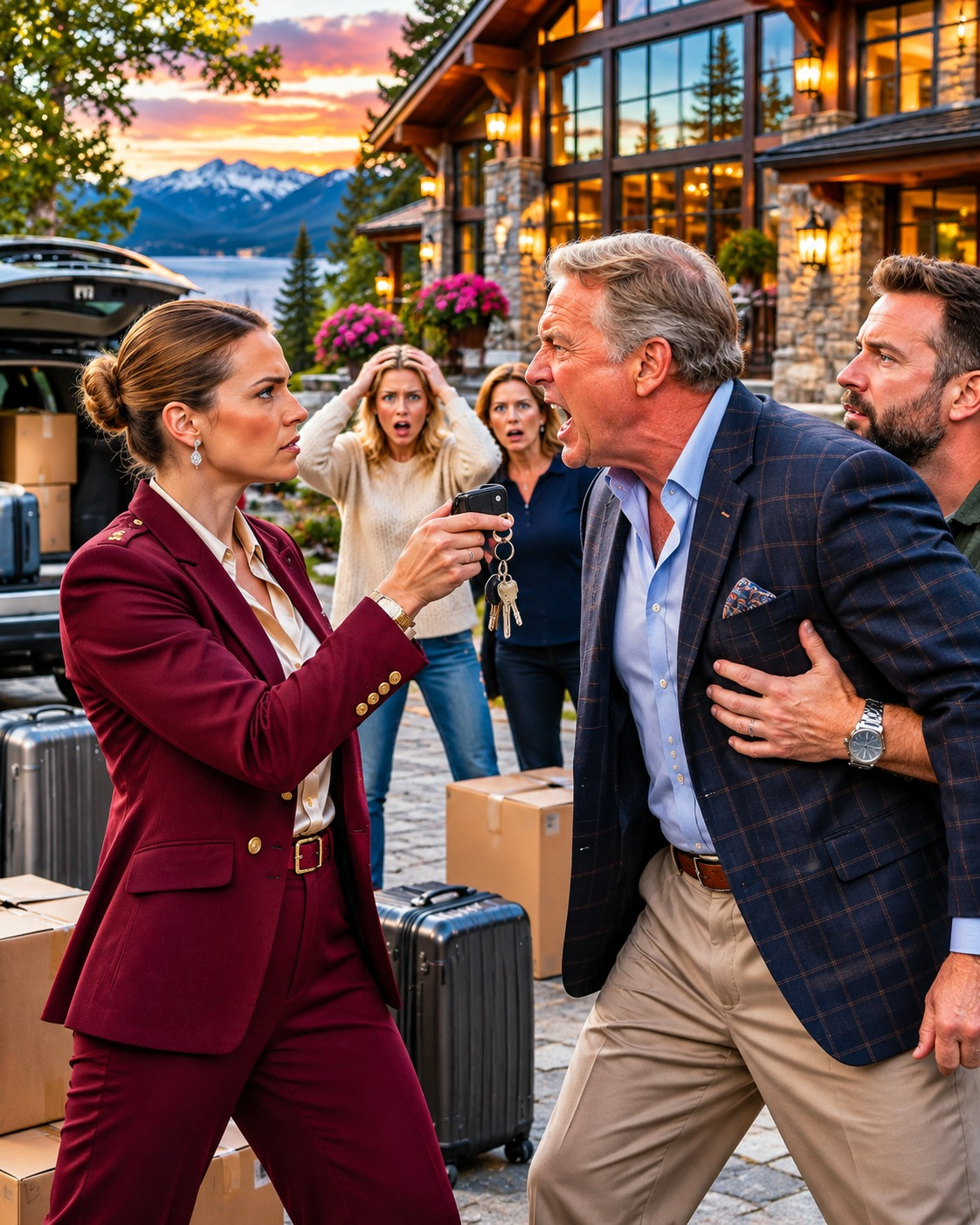
The woman who had stood in my living room less than twenty minutes earlier, arms folded, watching my father order me out of the house I'd purchased with my own money.
According to the document on my phone, Susan had witnessed my signature on a property authorization form.
There was only one problem.
I had never signed that form.
And two weeks earlier, when the document was dated, I'd been aboard a Navy vessel hundreds of miles from Lake Tahoe.
I enlarged the signature until the letters filled my screen.
It looked like mine.
Almost.
Whoever had written it knew I used a sharp upward stroke on the first letter of my last name. They knew I rarely lifted my pen between my initials. They even copied the small hook I sometimes made at the end.
But they'd missed something.
James used to tease me about my signature because I always crossed one particular letter backward when I was tired. I'd been doing it since college. It was an unconscious habit, one I couldn't have corrected without thinking about it.
The signature on the document was too perfect.
Someone had practiced.
I sat behind the steering wheel, staring at Susan's name.
Then I looked toward the villa.
Through the enormous windows, I could see her carrying a cardboard box toward the hallway.
My father's wife.
The woman who had spent the last fifteen years telling me that family loyalty required sacrifice.
The woman who always remembered to ask about my Navy benefits but rarely remembered my birthday.
She had apparently decided that witnessing a signature I never wrote was another acceptable family favor.
I took a screenshot.
Then another.
I saved the original email and attachment without changing either file.
Only after that did I call Michael Vance.
He answered on the fourth ring.
"Commander? Everything okay?"
"No."
His voice changed immediately.
"What happened?"
"My father just ordered me out of my own house."
There was a pause.
"Your Lake Tahoe property?"
"Yes."
"Are you safe?"
"I'm sitting in my truck."
"Good. Stay there for a moment. Tell me exactly what happened."
I explained the champagne, the moving boxes, Olivia's family, and Dad's announcement that he'd given her the villa.
Michael listened without interrupting.
Then I mentioned the document.
"Send it to me," he said.
I forwarded the email.
Thirty seconds passed.
Then another thirty.
I watched Susan disappear into the kitchen.
Finally, Michael spoke.
"Do not confront them about this document tonight."
"Why?"
"Because I need to establish what it is, where it was submitted, and whether anyone relied on it. A forged signature can be serious, but we don't make accusations before we verify the records."
I closed my eyes.
"So you think it's fake?"
"I think you told me you didn't sign it. That's enough reason to investigate."
I appreciated that about Michael.
He didn't tell people what they wanted to hear.
He told them what he could prove.
"Can they take my house?"
"Not simply because your father says so. But I want to examine every page before I give you a complete answer."
I looked toward the fireplace.
Dad was standing where James used to sit with his morning coffee.
"Michael?"
"Yes?"
"I don't want to lose this place."
His voice softened.
"I know."
For the first time that evening, I felt close to crying.
Not because I doubted the deed was mine.
Because I was exhausted from having to defend something that should never have been threatened.
Michael asked me to send copies of my purchase agreement, insurance documents, and property tax records when I reached a safe place.
Then he said something I hadn't expected.
"One more thing. Has your father ever had access to your personal paperwork?"
I stared at the steering wheel.
"Yes."
"Recently?"
I thought about it.
Then I remembered.
Six months earlier, Dad had visited the villa while I was away for a training assignment. I'd allowed him to stay for a weekend.
He'd called afterward to say he'd noticed some old paperwork in the study and organized it for me.
At the time, I'd thanked him.
Now my stomach turned.
"He had access to my study," I said.
"Did he have a key?"
"Yes."
"Does he still?"
I looked toward the house.
"Apparently."
Michael exhaled.
"All right. We'll handle this carefully."
After we hung up, I sat in silence.
I wanted to march back inside, hold the document in Susan's face, and demand an explanation.
Instead, I started the truck.
Because somewhere between the age of twelve and forty-two, I'd learned that my father's favorite weapon was my reaction.
If he could make me angry enough, he could make everyone forget what he'd done.
He'd been doing it for decades.
And I was finally beginning to understand how.
I was nine years old the first time my father told me I was difficult to love.
It happened on a Saturday afternoon in our old family kitchen.
Olivia was four.
She'd knocked over a glass of orange juice while reaching for a cookie.
The juice spilled across the table and onto a stack of bills Dad had been reviewing.
He jumped up.
Olivia started crying.
I grabbed a towel.
And somehow, within thirty seconds, the accident became my fault.
"Why weren't you watching your sister?" Dad demanded.
"I was doing my homework."
"That's not an excuse."
"She reached for the cookie herself."
He pointed toward the hallway.
"Go to your room."
I remember standing there with the towel in my hands.
I remember Olivia peeking around his leg.
And I remember asking a question that made everything worse.
"Why am I always the one who gets punished?"
Dad looked at me for a long moment.
Then he said, "Because your sister is easy to love, and you insist on making everything difficult."
I didn't understand what that meant.
Not completely.
But I understood enough.
That night, I lay awake trying to figure out how to become easier.
Maybe I could do more chores.
Maybe I could get better grades.
Maybe I could stop asking questions.
Maybe if I became good enough, Dad would look at me the way he looked at Olivia.
I spent the next thirty years trying.
When I was twelve, I won a regional science competition.
Dad said I should have won first place instead of second.
When I was fifteen, I made the honor roll.
He asked why I hadn't been selected for student council.
When I was seventeen, I told him I wanted to attend college through a Navy scholarship program.
He stared at me across the dinner table.
"Why would you want to run away from your family?"
"I'm not running away."
"Then why leave?"
"Because I want to serve."
He laughed.
"Girls like you always think they know everything."
Olivia was twelve then.
She sat beside him, swinging her legs beneath the table.
Dad turned toward her and smiled.
"At least your sister knows how to appreciate being home."
I didn't argue.
I filled out my applications.
I studied.
I trained.
And when the acceptance letter came, I read it alone in my bedroom because I already knew nobody downstairs would celebrate.
My mother had died when I was young.
For years, I'd told myself Dad was simply overwhelmed by raising two daughters.
I'd convinced myself he was stricter with me because I was older.
Because he expected more.
Because he believed I could handle it.
It took me a long time to consider another possibility.
Maybe he was strict with me because I was the daughter who kept trying to earn his love.
And Olivia was the daughter who never had to.
I stopped at a small roadside diner outside Tahoe City.
The parking lot was nearly empty.
I ordered coffee I didn't want and sat in a booth near the window.
My phone lay beside the cup.
There were six missed calls from Olivia.
Three from Susan.
One from Dad.
Then the messages started.
Olivia: You really embarrassed everyone tonight.
Olivia: The kids were excited. You could've handled this better.
Olivia: Dad is furious.
I stared at the screen.
Not one message asked whether I was okay.
Not one acknowledged that they'd moved into my house without permission.
Not one apologized for removing James's photograph.
Then Dad sent a message.
You owe your sister an apology.
I read it twice.
And suddenly I was seventeen again, standing in the kitchen after Olivia had borrowed my car without asking and damaged the bumper.
Dad had told me to apologize for making her cry when I confronted her.
I was twenty-three again, home on leave, being accused of showing off because I'd worn my dress uniform to a family dinner after an official ceremony.
I was thirty-one again, listening to Dad complain that my promotion had made me arrogant.
Every achievement became an insult to him.
Every boundary became disrespect.
Every refusal became proof that I didn't care about family.
And every time I gave in, he demanded something larger.
My phone rang.
Olivia.
I almost ignored it.
Then I answered.
"What?"
"Finally."
Her voice was sharp.
"Do you have any idea how upset Dad is?"
I looked at the coffee cooling in front of me.
"Olivia, you moved your belongings into my house."
"Don't start."
"You didn't ask me."
"Dad said it was fine."
"Dad doesn't own it."
She sighed dramatically.
"You're being so technical."
I almost laughed.
"Technical?"
"Yes. It's a house. You're acting like we're strangers trying to rob you."
I looked through the window at a passing truck.
"You replaced James's photograph."
Silence.
Then she said, "We needed room for our family picture."
I closed my eyes.
"You could have moved it to another shelf."
"Why does everything have to be about James?"
The words landed with a dull, familiar force.
I didn't speak.
Olivia continued.
"He's been gone for four years. You can't keep acting like nobody else matters."
My hand tightened around the phone.
"Don't talk about my husband that way."
"I'm just saying what everyone thinks."
"No. You're saying what you think."
She gave a bitter laugh.
"You know, Dad was right. You've always believed you're better than us."
I stared at the table.
"Because I bought a house?"
"Because you think money gives you the right to control everything."
I let the silence stretch.
Then I asked, "Who paid for your SUV?"
She stopped talking.
"Who sent Dad money when he said creditors were threatening him?"
"That's different."
"Who helped when he claimed the family home was in danger?"
"Why are you bringing up old things?"
"Because you keep telling me I don't care about this family."
Olivia's voice rose.
"So now you're keeping score?"
"No," I said. "I'm finally looking at the score."
She hung up.
I sat there with the phone against my ear long after the call ended.
Then I placed it on the table.
The waitress approached with a fresh pot of coffee.
"Rough night, honey?"
I looked up.
She was an older woman with silver hair and kind eyes.
I managed a small nod.
"Family trouble."
She filled my cup.
"That can be the hardest kind."
I looked down at the dark coffee.
"You ever spend your whole life trying to make somebody proud of you?"
She didn't answer immediately.
Then she said, "My mother died when I was sixty-two. I spent my whole life waiting for her to tell me I was enough."
I looked at her.
"Did she?"
The waitress shook her head.
"No."
She set the pot down.
"But I wish I'd stopped waiting sooner."
She walked away before I could respond.
I sat there for a long time.
Because a stranger had just given me more understanding in thirty seconds than my father had given me in forty-two years.
James had understood my family long before I did.
We met when I was twenty-seven.
He was an engineer working on a civilian contract connected to naval communications systems.
He was funny without trying to be.
Patient.
Quietly confident.
He listened when people spoke.
And unlike my father, he never treated my independence as a personal insult.
The first time James met Dad, we went to dinner at a restaurant near the waterfront.
Dad spent most of the evening talking about Olivia.
Her job.
Her boyfriend.
Her plans.
Then he turned to James.
"So, how do you feel about marrying a woman who's never home?"
James smiled.
"I feel pretty lucky."
Dad laughed.
"Give it a few years."
James didn't laugh.
He reached beneath the table and took my hand.
Later, when we were walking to the car, he asked me something that changed the way I saw my childhood.
"Does your father ever tell you he's proud of you?"
I stopped walking.
"Of course."
James waited.
I tried to remember an example.
A real one.
Not a compliment followed by criticism.
Not a statement about how my achievements reflected well on the family.
Not a joke about how stubborn I was.
I couldn't think of one.
James squeezed my hand.
"Well, I am."
Three words.
That was all.
And I nearly cried in the parking lot.
Over the years, James watched me send money home.
He watched me rearrange leave schedules to attend family emergencies that somehow disappeared once I arrived.
He watched me apologize for things I hadn't done.
He never ordered me to stop helping.
He simply asked questions.
"Do they thank you?"
"Sometimes."
"Do they repay you?"
"They're family."
"Would they help you if you needed them?"
I always said yes.
Because the alternative was too painful.
Then James became ill.
Everything changed.
Our world narrowed to appointments, treatment schedules, hospital rooms, and brief stretches of hope.
I took leave when I could.
I learned the language of medical reports.
I sat beside him through nights when neither of us slept.
And during those months, my father called repeatedly.
Not to ask how James was doing.
To ask whether I could help Olivia with another expense.
To complain that I hadn't visited.
To remind me that Susan was feeling neglected.
One afternoon, after a particularly difficult appointment, I answered Dad's call in the hospital corridor.
He wanted money.
Again.
I told him I couldn't discuss it.
He became angry.
"You've forgotten who raised you."
I remember leaning against the wall, feeling completely empty.
Then James appeared at the end of the corridor.
He'd come looking for me.
He saw my face.
And without asking what had happened, he took the phone gently from my hand.
"This is James," he said.
Dad must have spoken.
James listened.
Then he answered quietly.
"She's taking care of her husband right now. You'll have to manage without her."
He ended the call.
I stared at him.
"You shouldn't have done that."
"Probably not."
"Dad's going to be furious."
James slipped the phone into my pocket.
"Then he can be furious."
I remember laughing.
A small, surprised laugh.
Because the idea that my father's anger wasn't an emergency had never occurred to me.
James kissed my forehead.
"You don't have to earn the right to be loved."
I carried those words with me after he died.
But I didn't know how to live by them.
Not yet.
By the time I left the diner, the sky had turned black.
I checked into a hotel instead of returning to the villa.
Michael had advised me to avoid another confrontation until we understood the document.
In my room, I removed my uniform jacket and hung it carefully in the closet.
Then I opened my laptop.
I pulled up the folder containing the villa's financial records.
Purchase agreement.
Mortgage payoff confirmation.
Insurance policy.
Property tax statements.
Renovation invoices.
Everything was there.
Every document carried my name.
Not Dad's.
Not Olivia's.
Not Susan's.
Mine.
I had worked for that house.
James and I had saved for it.
And after his death, I'd continued saving until I could complete the purchase without risking my financial security.
There had been no family contribution.
No shared ownership.
No agreement to let Olivia live there.
Nothing.
I opened the suspicious authorization form again.
It claimed to give my father limited authority to manage certain property-related matters during my military absences.
The wording was carefully chosen.
It didn't directly transfer ownership.
But it appeared designed to make outsiders believe Dad could make decisions on my behalf.
That frightened me more than an obvious fake deed would have.
Someone had thought this through.
Someone had understood that my Navy career could be used as an excuse.
Someone had counted on my absence.
I scrolled to the signature page.
Susan's name appeared beneath the witness line.
Beside it was a date.
I checked my deployment calendar.
On that exact day, I had been participating in an exercise at sea.
I opened the location records from my official travel documentation.
Then I compared the signature with several genuine signatures from my files.
The differences were small.
But they were there.
I organized everything into a separate folder.
Then I sent Michael another email.
I can document that I was not present when this was supposedly signed. Please preserve the original submission records if possible.
His reply arrived twenty minutes later.
Understood. Do not contact the listed witness. I'll investigate the document's origin and any associated filings.
I leaned back in the chair.
For the first time that night, I felt something besides grief.
Not satisfaction.
Not revenge.
A sense of direction.
My father had spent years convincing me that being a good daughter meant surrendering whenever he demanded something.
But I'd spent twenty years in a profession built on responsibility, documentation, and accountability.
I knew how to follow procedures.
I knew how to remain calm under pressure.
And I knew the difference between an order issued by someone with authority and a demand made by someone who simply wanted control.
Dad had confused those things for decades.
He was about to discover the difference.
At 11:43 p.m., my phone rang again.
This time, it was Susan.
I watched her name appear on the screen.
I considered letting it go to voicemail.
Then I answered.
"Hello, Susan."
Her voice was unusually gentle.
"Sweetheart, we need to talk."
I almost smiled at the word.
Sweetheart.
She used it when she wanted something.
"I'm listening."
"Your father is very upset."
"I'm aware."
"He doesn't understand why you had to make such a scene."
I looked at the laptop.
"I didn't make a scene. I left."
"Exactly. You walked out in front of everyone."
"After he told me to leave."
She sighed.
"You know how he gets."
I stared at the wall.
There it was.
The sentence that had excused almost everything my father had ever done.
You know how he gets.
As though his behavior were weather.
Unpleasant but unavoidable.
As though the rest of us were responsible for carrying umbrellas.
"Susan," I said, "did you know Olivia was moving into my house?"
A pause.
"Your father discussed it with me."
"Did you know I hadn't agreed?"
Another pause.
"We assumed you'd understand."
"That's not what I asked."
Her tone sharpened.
"There's no need to interrogate me."
I let the silence settle.
Then she said, "Your father has always done his best for you."
I thought about the nine-year-old girl holding a juice-soaked towel.
The seventeen-year-old hiding her acceptance letter.
The young officer standing alone at a promotion ceremony because Dad had decided Olivia's weekend plans were more important.
The grieving widow sending fifty thousand dollars because her father claimed he might lose the family home.
"I know what he's done for me," I said.
Susan seemed relieved.
"Good. Then you'll understand why he expects some gratitude."
I closed my eyes.
"Good night, Susan."
"Wait."
Something in her voice changed.
I opened my eyes.
"What?"
She lowered her voice.
"Your father said you've been looking into property documents."
My hand went still.
I hadn't told Dad about the email.
I hadn't told Olivia.
I hadn't told Susan.
Only Michael knew.
"Why would he say that?" I asked.
Susan hesitated.
"I don't know. He just mentioned it."
I looked at the suspicious document on my screen.
"Did he say which documents?"
"No."
"Did he mention a signature?"
Silence.
Then Susan spoke very carefully.
"You should be careful about accusing family members of things you don't understand."
My pulse quickened.
"I haven't accused anyone."
"Well, good."
Her voice became brisk again.
"Because your father is trying to do what's best for everyone."
She hung up.
I sat motionless.
Susan had just warned me against making an accusation I hadn't made.
How did she know what I was investigating?
I immediately wrote down the time of the call and everything I remembered her saying.
Then I emailed Michael.
A few minutes later, he replied.
Don't engage further tonight. We'll review this tomorrow.
I shut the laptop.
But I couldn't sleep.
I kept thinking about the signature.
About Susan's warning.
About Dad's confidence.
About how quickly Olivia had started moving her belongings into the villa.
They hadn't behaved like people asking for a favor.
They'd behaved like people who believed the outcome had already been arranged.
At 12:26 a.m., I got out of bed and opened the curtains.
The hotel parking lot was empty.
I could see my truck beneath a streetlamp.
My duffel bag was still on the passenger seat.
For a moment, I remembered the girl I'd been at nine years old.
The one who thought love was something she could earn by being useful.
I wished I could go back and tell her she didn't have to spend her life apologizing.
Then my phone vibrated.
A message from an unknown number.
No greeting.
No explanation.
Just one sentence.
You need to ask your father what happened to the money you sent after James died.
I stared at the screen.
Fifty thousand dollars.
The money Dad had claimed he needed to save the family home.
My fingers went cold.
Before I could respond, another message appeared.
I have proof. But you need to see it before they find out I contacted you.
Then a photograph arrived.
It showed an old bank envelope lying on a wooden desk.
Across the front, someone had written my name.
Beneath it was a date.
The same week I'd transferred the money.
I enlarged the photograph.
There was a second envelope underneath.
Only one corner was visible.
But I recognized the handwriting.
It belonged to James.
My phone rang.
The same unknown number.
I answered.
"Who is this?"
For several seconds, nobody spoke.
Then a woman's frightened voice whispered, "Commander, your husband found something before he died."
I stood up.
"What did he find?"
A door slammed on the other end of the line.
The woman gasped.
Then I heard a man's voice.
A voice I recognized immediately.
My father.
"Who are you talking to?"
The woman whispered one final sentence.
"He's coming. And he knows I have the letter."
The line went dead.
Seconds later, my phone lit up with a new photograph.
It showed a sealed envelope addressed to me in James's handwriting.
Someone had written three words across the front in red ink.
DO NOT DELIVER.
And beneath those words was my father's signature.






Comments 0