"Because I was the one who gave Thomas permission."
My father's voice came from the doorway.
I turned so quickly that my chair scraped against the floor.
Richard Collins stood beneath the fluorescent lights of Laura Whitmore's office, holding a document with both hands.
His face was pale.
His shoulders were hunched.
And for the first time in my thirty-seven years, he looked like a man who had finally decided to stop hiding behind someone else's decisions.
I stared at the words written beneath his signature.
USE MEREDITH'S NAME. DO NOT CONTACT HER.
My name.
My life.
My financial future.
Reduced to an instruction on a piece of paper.
"Dad," I whispered. "Tell me that isn't what it looks like."
He closed his eyes.
"I can't."
Laura stood.
"Mr. Collins, before you say anything further, you should understand that this document could have legal consequences for you. I strongly recommend that you obtain independent counsel."
My father nodded.
"I know."
"You're not obligated to make a statement here."
"I understand."
He looked at me.
"But my daughter deserves to hear the truth."
I wanted to stand up.
I wanted to walk out.
I wanted to throw every document in that room onto the floor and demand that someone explain how my family had turned my love into a financial instrument.
Instead, I sat perfectly still.
"Then tell me," I said.
My father pulled out the chair opposite mine.
He didn't sit immediately.
"I knew your mother wanted to use your name on the refinancing documents."
My throat tightened.
"Did you know I hadn't agreed?"
"Yes."
The word struck harder than I expected.
I had spent the previous night discovering that my mother had signed my name without permission.
Some small part of me had still hoped my father was simply weak.
That he'd been deceived.
That he'd misunderstood.
But he'd known.
"You knew," I repeated.
He nodded.
"And you let me keep paying?"
Tears filled his eyes.
"Yes."
I looked away.
For a moment, I couldn't bear to see his face.
Laura remained silent.
She wasn't going to rescue either of us from the conversation.
Neither was I.
"Why?" I asked.
My father finally sat down.
"Because I thought I could fix everything before you found out."
I laughed once.
There was nothing funny about it.
"That's exactly what Mom said."
"I know."
"Did you both think I was stupid?"
"No."
"Then what?"
He stared at his hands.
"We knew you loved us."
The room went silent.
I felt something inside me go cold.
Not because he had insulted me.
Because he'd finally described the mechanism of the betrayal.
They hadn't needed me to be foolish.
They had needed me to be loving.
And they had counted on that love to keep me from asking questions.
My father told us what happened in March 2022.
Not the shortened version.
Not the explanation about saving the house.
The whole sequence, as he remembered it.
Eleanor had borrowed money from Adrian Voss after Brooke's small clothing business collapsed. What began as an attempt to cover inventory debts had expanded into a much larger obligation through additional borrowing, fees, and interest.
My mother had concealed the full amount from everyone.
Including Brooke.
Including my father.
And especially me.
When Adrian demanded repayment, Eleanor became desperate.
Thomas Vale offered to arrange financing and move money between accounts while the family's debts were reorganized.
Evelyn Mercer agreed to provide financial support under a written arrangement tied to the property.
Then my parents asked me to take out a personal loan.
They told me foreclosure was imminent.
It wasn't.
The mortgage was behind, but there was no scheduled foreclosure sale.
They had time to review their options.
They had time to consult independent professionals.
They had time to tell me the truth.
Instead, they created an emergency.
I borrowed the money.
And when the refinancing became complicated, Thomas suggested using my financial position to support the arrangement.
The institution required my direct consent.
I hadn't given it.
My mother wanted to proceed anyway.
And my father had signed an instruction authorizing Thomas to use my name without contacting me.
"You knew that was wrong," I said.
Richard nodded.
"Yes."
"Why did you sign?"
He wiped his eyes.
"Because your mother said we'd lose the house, Evelyn's money, and everything we'd put into the arrangement."
"Did Thomas tell you the lender had approved it?"
"He told us he could handle the paperwork."
"Did he explain how?"
"No."
I stared at him.
"You didn't ask?"
"I should have."
I looked down at the document.
My father's handwriting was unmistakable.
The same handwriting that had appeared on my childhood birthday cards.
The same handwriting that had written Proud of you, sweetheart when I graduated from college.
Now it appeared beneath an instruction to use my identity without permission.
"Did you sign my name?" I asked.
"No."
"Did Mom?"
"She told me she did."
I swallowed.
"And Brooke?"
"Your mother told Brooke you'd already signed. Brooke witnessed a signature she hadn't actually seen you make."
I closed my eyes.
That didn't erase Brooke's responsibility.
But it explained how she'd become involved.
Laura made careful notes.
Then she looked at Richard.
"Mr. Collins, the document you brought is important. But we will still need independent verification of the transaction records and signatures."
He nodded.
"I'll cooperate."
I looked at him.
"Even if it means admitting what you did?"
He met my eyes.
"Yes."
For the first time, I believed he understood that an apology was not enough.
Then I opened the envelope addressed to me.
FOR MEREDITH — IF SHE FINDS OUT.
Inside was a handwritten letter from Eleanor.
It had been written months earlier.
The paper was folded twice.
My mother's handwriting filled both sides.
I read it silently.
She admitted that she'd hidden the private debt because she was ashamed.
She said she hadn't wanted Brooke to lose her financial stability or Sophie to suffer because of decisions made when Brooke's business failed.
She described becoming trapped in increasingly expensive borrowing.
She said she had convinced herself that the refinancing would eventually solve everything.
Then came the sentence that made me stop.
I knew Meredith would help us if she thought the house was in danger, but I knew she might refuse if she understood the whole situation.
I read it again.
And again.
My mother hadn't misunderstood me.
She had understood me perfectly.
She knew I would sacrifice for the family.
She also knew I might draw a boundary if I had the facts.
So she withheld them.
The letter continued.
I told myself I was protecting everyone. But I was protecting myself from the shame of telling the truth.
I lowered the paper.
My eyes burned.
I had spent years waiting for my mother to acknowledge what she'd done.
Now the acknowledgment was in my hands.
But it didn't make the pain disappear.
It simply gave it a name.
I folded the letter.
"Laura, can you keep a copy?"
"Of course."
I handed it to her.
Then I looked at my father.
"I'm not going to pretend this is okay."
He nodded.
"I don't expect you to."
"And I'm not paying another four thousand dollars to make everyone comfortable."
"I understand."
"I need you to repay what you promised, as far as you're able, through a real agreement. Not another family conversation."
His voice broke.
"Yes."
"And I need you to stop asking me to protect you from the consequences of your choices."
He looked down.
Then nodded.
"Yes."
I stood.
For the first time since New Year's Day, I felt no need to explain myself further.
The following weeks were difficult.
There was no miraculous phone call that erased the debts.
No secret inheritance.
No instant confession that solved every legal question.
The truth required documents, independent reviews, and people willing to accept responsibility.
Laura helped me notify the appropriate institutions that I disputed the signatures and the account opened under my name.
I completed identity-verification procedures, submitted my travel records from Chicago, and provided copies of the documents my family had given me.
My employer confirmed that I had attended the financial management conference on March 15, 2022.
The hotel records matched.
The flight records matched.
My conference attendance was documented.
The evidence established where I had been on the day the disputed agreement claimed I had signed.
A forensic document examiner later concluded that the signatures attributed to me on the relevant documents were not consistent with my authenticated signatures.
That finding became part of the formal review.
Thomas Vale's records were examined.
The financial institutions traced the transactions.
The account opened under my identity was restricted and then closed after the review established that I had not authorized its creation.
The disputed guarantor arrangement was withdrawn as a claim against me.
The relevant records were corrected.
Laura explained every step before I signed anything.
For once, my name was being used only with my permission.
The investigation also established that Thomas had submitted documents without completing the verification the institution required.
He had received fees for his role in arranging the transactions and had routed funds through an intermediary account.
His conduct was referred to the appropriate authorities and professional oversight bodies.
The financial institution reversed the fees it determined had been improperly charged and cooperated with the process of recovering misdirected funds.
Thomas was no longer in a position to control the family's paperwork.
Caroline Bennett's company, after reviewing the corrected records, withdrew the ownership claim it had suggested during our confrontation.
My parents remained the recorded owners of their house.
But that didn't mean they could keep it without addressing the debts.
Evelyn's financial interest was real.
So were the legitimate mortgage obligations.
And Adrian Voss was still owed money under the enforceable portion of the private borrowing arrangement.
The difference was that those obligations could no longer be hidden behind my name.
Brooke called me on a Thursday evening in February.
I was sitting at my kitchen table, reviewing a budget that no longer included my parents' recurring four-thousand-dollar payment.
When I saw her name, I hesitated.
Then I answered.
"Hi."
"Hi," she whispered.
For a moment, neither of us spoke.
Then Brooke said, "I owe you an apology."
I looked out the window.
"Okay."
She took a shaky breath.
"Not just for the documents."
I waited.
"For New Year's brunch."
My throat tightened.
"Sophie didn't come up with that garbage-can joke herself," Brooke said.
"I know."
"I said it."
The words hurt, even though I'd known the truth from the moment Sophie repeated them.
Brooke began crying.
"I was angry because you wouldn't pay for the dance competition. I was jealous because you had a career and seemed to have everything figured out. And I was embarrassed that I kept needing help."
I stared at the wall.
"So you made me the joke."
"Yes."
"While I was paying for things you couldn't afford."
"Yes."
She didn't defend herself.
She didn't tell me I was too sensitive.
She didn't say I should understand how difficult her life had been.
She simply admitted it.
"I'm sorry, Meredith."
I closed my eyes.
"That really hurt me."
"I know."
"No, Brooke. I don't think you did. You let your daughter humiliate me at the table, and then you acted like I was the problem for being upset."
Her voice broke.
"You're right."
I took a breath.
"I love Sophie. None of this changes that. But I'm not going to be treated like a bank account anymore."
"I don't want you to be."
"Then don't ask me for money."
A pause.
"Okay."
"And don't make Sophie responsible for your feelings about me."
Brooke began crying harder.
"I won't."
We talked for nearly an hour.
She told me she'd met with an independent attorney and cooperated with the document review.
Her lawyer had explained that signing as a witness without actually witnessing a signature was serious, even if she'd believed what Eleanor told her.
Brooke accepted responsibility for that.
She also provided the original emails and the photographs she'd saved before Eleanor asked her to delete the folder.
Those records helped establish the transaction history.
The review confirmed that Brooke Collins Property Holdings LLC had been used primarily as a holding and transfer vehicle under Eleanor's direction.
Brooke had been careless and had signed documents she didn't understand, but the records did not establish that she had personally taken the large transfers for her own use.
Her SUV had been financed separately.
Her handbags had been purchases she couldn't comfortably afford.
She had plenty of financial problems.
But the enormous transfers were not evidence of a secret fortune she'd hidden from me.
That mattered.
I didn't need Brooke to be innocent of every bad decision.
I needed to know which decisions were actually hers.
By the end of the call, I wasn't ready to forget what she'd done.
But I was willing to see whether she could become someone I trusted again.
In March, my parents made a decision I never expected.
They put the house on the market.
My father told me during a meeting at Laura's office.
Eleanor sat beside him.
She looked older than she had at New Year's brunch.
Her hair was still carefully styled, but her face had lost the sharp confidence I'd always associated with her.
"We can't afford to keep it," Richard said.
I looked at him.
"Are you sure?"
He nodded.
"We've reviewed the numbers with an independent financial adviser. Even after the disputed claims were corrected, the legitimate obligations are more than we can comfortably manage."
Eleanor looked down.
"We should have done this years ago."
I said nothing.
My mother continued.
"We wanted the house to mean that we'd succeeded. That we'd given our children something permanent."
She looked at me.
"Instead, we used it as an excuse to take from you."
I felt my throat tighten.
It was the first time she'd said something like that without adding a justification.
No mention of family duty.
No reminder of what she'd sacrificed raising us.
No accusation that I was ungrateful.
Just the truth.
Richard placed a folder on the table.
"We've agreed to sell it, satisfy the valid obligations, and repay what we can."
Laura reviewed the proposed plan with us.
The sale proceeds would be handled through a documented settlement process.
The mortgage and other valid secured obligations would be addressed.
Evelyn would receive repayment under a negotiated settlement of her financial interest.
The private debt to Adrian would be resolved under terms reviewed by independent counsel, without treating me as responsible for it.
Any recoveries from improperly routed funds would be applied according to the verified claims and settlement agreements.
And my parents had agreed to a separate written repayment arrangement concerning the money they'd promised to return to me.
I looked at the numbers.
The amount wasn't enough to erase every sacrifice I'd made.
It couldn't give me back the years I'd spent worrying about their bills.
It couldn't return the opportunities I'd postponed.
But it was substantial.
And it was real.
There were signatures.
Dates.
Clear terms.
No hidden conditions.
No demands that I keep paying while everyone else decided what I was allowed to know.
I looked at my mother.
"Why now?"
Eleanor's eyes filled with tears.
"Because I finally understand that keeping the house was costing us our daughters."
I studied her face.
For years, I'd wanted her to say something that would make everything right.
Now I understood there was no single sentence capable of doing that.
But there could be different choices.
Repeated over time.
Choices that didn't require me to surrender myself.
The house sold in early summer.
The closing was handled by professionals, with the financial claims reviewed and the proceeds distributed under the documented settlement.
Evelyn received the agreed repayment of her contribution and related valid amounts.
My parents settled the legitimate property obligations and the remaining private debt through the negotiated arrangements.
The misdirected funds recovered during the investigation reduced what had to be paid from the sale proceeds.
My parents moved into a smaller two-bedroom condominium they could afford on their retirement income.
There was no grand staircase.
No formal dining room.
No marble countertop.
But there was sunlight in the kitchen.
A small balcony.
And a monthly budget that didn't require me to rescue them.
My parents also made the agreed repayment to me from the proceeds.
I used a large portion of it to pay down my personal loan.
For the first time in years, the balance looked manageable.
I didn't feel triumphant.
I felt relieved.
A quiet, unfamiliar kind of relief.
The kind that came from opening a banking app without immediately wondering which family emergency would empty the account next.
The institutions completed their reviews of the disputed documents. My name was cleared from the unauthorized financial obligations, and the identity-theft alerts I'd placed on my records remained as an extra precaution.
Thomas's conduct had been formally reported and documented. I no longer had to rely on him, my mother, or anyone in the family to explain the transactions.
Laura closed my matter after the corrections and settlements were confirmed.
She handed me the final folder.
"Keep these records," she said.
"I will."
Then she smiled.
"And Meredith?"
"Yes?"
"You did the hard part."
I shook my head.
"I had a lot of help."
"You did. But you were the one who decided to ask questions."
I looked down at the folder.
It was strange how much my life had changed because of something so simple.
I had asked where my money went.
And refused to accept silence as an answer.
In August, Sophie turned eleven.
Brooke invited me to her birthday dinner.
I almost declined.
Our relationship was better, but it wasn't what it had been.
Maybe it never would be.
Then Sophie called me herself.
"Aunt Meredith?"
"Hi, sweetheart."
"Are you coming to my birthday?"
I smiled.
"I haven't decided yet."
She was quiet for a moment.
Then she said, "Mom told me I hurt your feelings at Grandma's house."
My chest tightened.
"Yes, honey. You did."
"I'm sorry."
"I know."
"I didn't understand what I was saying."
"I believe you."
She took a breath.
"Mom said grown-ups shouldn't teach kids to be mean when they're angry."
I closed my eyes.
"She's right."
"Are you still my aunt?"
The question nearly broke my heart.
"Always."
"Even if you don't come?"
"Even if I don't come."
There was a small silence.
Then Sophie whispered, "I hope you do."
I went.
Not because Brooke pressured me.
Not because Eleanor demanded it.
Not because anyone reminded me that family came first.
I went because I wanted to.
I brought Sophie a set of watercolor paints and a sketchbook.
When she opened the gift, she threw her arms around my neck.
"Thank you!"
I hugged her tightly.
Across the room, Brooke watched us.
Her eyes filled with tears.
Later, while Sophie was showing her friends the paints, Brooke approached me.
"Thank you for coming."
I nodded.
"She's a good kid."
"I know."
Brooke hesitated.
"I'm trying to be better."
I looked at her.
"I can see that."
She smiled faintly.
It wasn't a complete repair.
But it was a beginning.
And for once, a beginning didn't require me to pay for it.
My relationship with Eleanor took longer.
There were uncomfortable conversations.
Moments when she slipped back into old habits.
Times when she began a sentence with, "After everything I've done—"
Then stopped herself.
Sometimes she apologized.
Sometimes she needed space.
So did I.
We met for coffee once a month.
In public.
On neutral ground.
At first, the conversations were awkward.
She asked about work.
I asked about the condominium.
We discussed books and recipes and Sophie's school.
We didn't pretend the past hadn't happened.
But we didn't let every conversation become another trial.
One afternoon, Eleanor placed her coffee cup on the table and looked at me.
"I miss the way things used to be."
I felt my stomach tighten.
Then she added, "But I understand why you don't."
I looked at her.
She continued.
"I used to think you were the strongest person in the family because you could carry everything."
I waited.
"Now I think I was wrong to ask you to."
My throat tightened.
"Mom, I wanted to help."
"I know."
"I just wanted to be allowed to say no."
Tears filled her eyes.
"You should have been."
I nodded.
We sat quietly for a while.
Then she reached across the table.
She didn't grab my hand.
She simply placed hers nearby.
An invitation.
Not a demand.
After a moment, I took it.
By September, I had paid off the remaining balance of my personal loan.
I made the final payment on a Friday morning.
I was sitting at my kitchen table with a cup of coffee.
The same table where I'd canceled the recurring four-thousand-dollar transfer months earlier.
The screen displayed a confirmation.
LOAN BALANCE: $0.00
I stared at it.
Then I laughed.
Not because anything was funny.
Because I didn't know what else to do.
I had imagined that moment so many times.
I thought I might cry.
I thought I might call someone.
I thought I might feel angry about everything it had cost me.
Instead, I sat there smiling at a number.
Zero.
For years, zero had frightened me.
Zero in savings.
Zero left after bills.
Zero room for mistakes.
Now it meant freedom from a debt I'd carried for my parents.
I took a screenshot.
Then I opened the budget spreadsheet I'd created after New Year's brunch.
The first version had been filled with payments to other people.
Mortgage support.
Household expenses.
Brooke's emergencies.
Dance competitions.
Repairs.
Insurance.
Now the categories looked different.
Emergency savings.
Retirement contributions.
Travel.
Home down payment.
Art supplies for Sophie.
And one line that made me smile.
Meredith's Life.
I entered the amount I could finally save each month.
Then I closed the spreadsheet.
For once, I didn't need to check whether anyone else approved.
In October, I bought my first home.
It wasn't a luxury apartment.
It wasn't enormous.
It was a bright two-bedroom condominium with a small balcony, hardwood floors, and a kitchen window overlooking a row of maple trees.
The second bedroom would become my home office.
The living room had enough space for a comfortable sofa and a bookshelf.
The kitchen was small, but the countertops were mine.
Every room felt like a promise I had made to myself.
On closing day, I signed the documents slowly.
I read every page.
I asked questions.
I checked the numbers.
The closing agent smiled.
"You've done this before?"
I shook my head.
"No."
"You seem very prepared."
I looked at the papers.
"I've learned to be."
When she handed me the keys, I held them in my palm for a long moment.
A year earlier, I'd believed owning a home was something other people could afford.
People who didn't send thousands of dollars to their parents.
People who weren't constantly rescuing their families.
Now I was standing in a home I had chosen.
A home I could afford.
A home no one had guilted me into buying or saving.
I walked into the empty living room.
Sunlight streamed through the windows.
I set my purse on the floor.
Then I sat down beside it.
For a few minutes, I simply listened to the quiet.
No demands.
No urgent calls.
No one asking whether I'd made the payment.
Just the soft hum of the refrigerator and the distant sound of traffic.
I smiled.
That Thanksgiving, I hosted dinner.
Not at my parents' house.
At mine.
I invited Richard, Eleanor, Brooke, and Sophie.
I made it clear that nobody was obligated to come.
And nobody was allowed to turn the meal into a conversation about money.
Everyone agreed.
My father arrived first, carrying a pumpkin pie.
He stood in the doorway and looked around.
"Meredith," he said softly. "This place is beautiful."
"Thank you."
He smiled.
"I'm proud of you."
I looked at him.
For a moment, I remembered the father who had failed to protect me.
Then I looked at the man standing in my doorway.
He had spent months cooperating with the financial review, honoring the repayment agreement, and learning to speak honestly even when Eleanor disagreed.
He couldn't undo the past.
But he was doing something different now.
"Thanks, Dad."
I hugged him.
Eleanor arrived with a salad and a small potted plant.
"For your kitchen," she said.
I smiled.
"It's lovely."
She looked around the condominium.
Then her eyes filled with tears.
"You did this."
I nodded.
"Yes."
She swallowed.
"All by yourself."
I thought about Laura.
Evelyn.
The colleagues who'd helped me retrieve my travel records.
The people who'd treated my questions seriously.
I shook my head.
"Not entirely. But I made the decisions."
Eleanor nodded.
"That's what I meant."
Brooke arrived last with Sophie.
My niece ran straight toward me.
"Aunt Meredith!"
I laughed as she hugged me.
"Hi, sweetheart."
She looked around.
"Can I see your office?"
"Of course."
She took my hand and pulled me down the hallway.
When she saw the desk, bookshelves, and watercolor paintings I'd hung on the wall, her eyes widened.
"You kept my picture!"
Above my desk was a painting she'd made after her birthday.
A small house beneath a bright yellow sun.
Three flowers grew beside the front steps.
At the bottom, in careful handwriting, she'd written:
For Aunt Meredith, because she makes people feel loved.
I smiled.
"Of course I kept it."
Sophie studied the picture.
Then she looked at me.
"Can I paint you another one?"
"Anytime."
She grinned.
"Maybe one with all of us."
I felt my throat tighten.
"I'd like that."
Dinner was simple.
Turkey.
Mashed potatoes.
Green beans.
Cranberry sauce.
My father's pumpkin pie.
We laughed about Sophie's school play.
Brooke told us about the bookkeeping course she'd completed and the administrative job she'd recently started.
Richard talked about the vegetable garden he wanted to grow on their condominium balcony.
Eleanor complimented the meal without once mentioning how she would have prepared it differently.
That alone felt remarkable.
After dessert, Sophie carried her plate toward the kitchen.
Then she stopped beside my chair.
She looked at the little piece of pie she'd left unfinished.
I knew what she was remembering.
So did Brooke.
For one brief moment, the room became quiet.
Sophie looked at me.
"Aunt Meredith?"
"Yes?"
"Can I save this for later?"
I smiled.
"Of course."
She grinned.
"Good. Because I'm not putting it on your plate."
Brooke covered her mouth.
My father looked down.
Eleanor's eyes filled with tears.
Then I laughed.
A real laugh.
The kind that came from somewhere deep inside me.
Sophie laughed too.
And just like that, the memory of New Year's brunch became something we could acknowledge without pretending it hadn't happened.
Brooke looked at me.
"I'm still sorry," she said quietly.
"I know."
"And I won't ever let that happen again."
I believed she meant it.
More importantly, I knew I would protect myself if she forgot.
After everyone left, I stood in my kitchen washing the last few dishes.
The apartment was quiet.
The counters were covered with leftovers.
A small potted plant sat beside the window.
Sophie's laughter still seemed to linger in the hallway.
I dried my hands and walked into the living room.
On the bookshelf stood a framed photograph from Thanksgiving.
My father was smiling.
Brooke had one arm around Sophie.
Eleanor stood beside me.
And I was in the center.
Not because I was holding everyone together.
Not because I was paying everyone's bills.
Not because I was responsible for keeping the family happy.
I was there because I wanted to be.
I picked up the photograph.
Then I thought about the woman I'd been on New Year's morning.
Thirty-seven years old.
Exhausted.
Financially stretched.
Desperate to be appreciated.
She had walked into her parents' dining room carrying a homemade coffee cake and a gift for her niece.
She had believed that if she gave enough, worked hard enough, and never complained, someone would finally tell her she mattered.
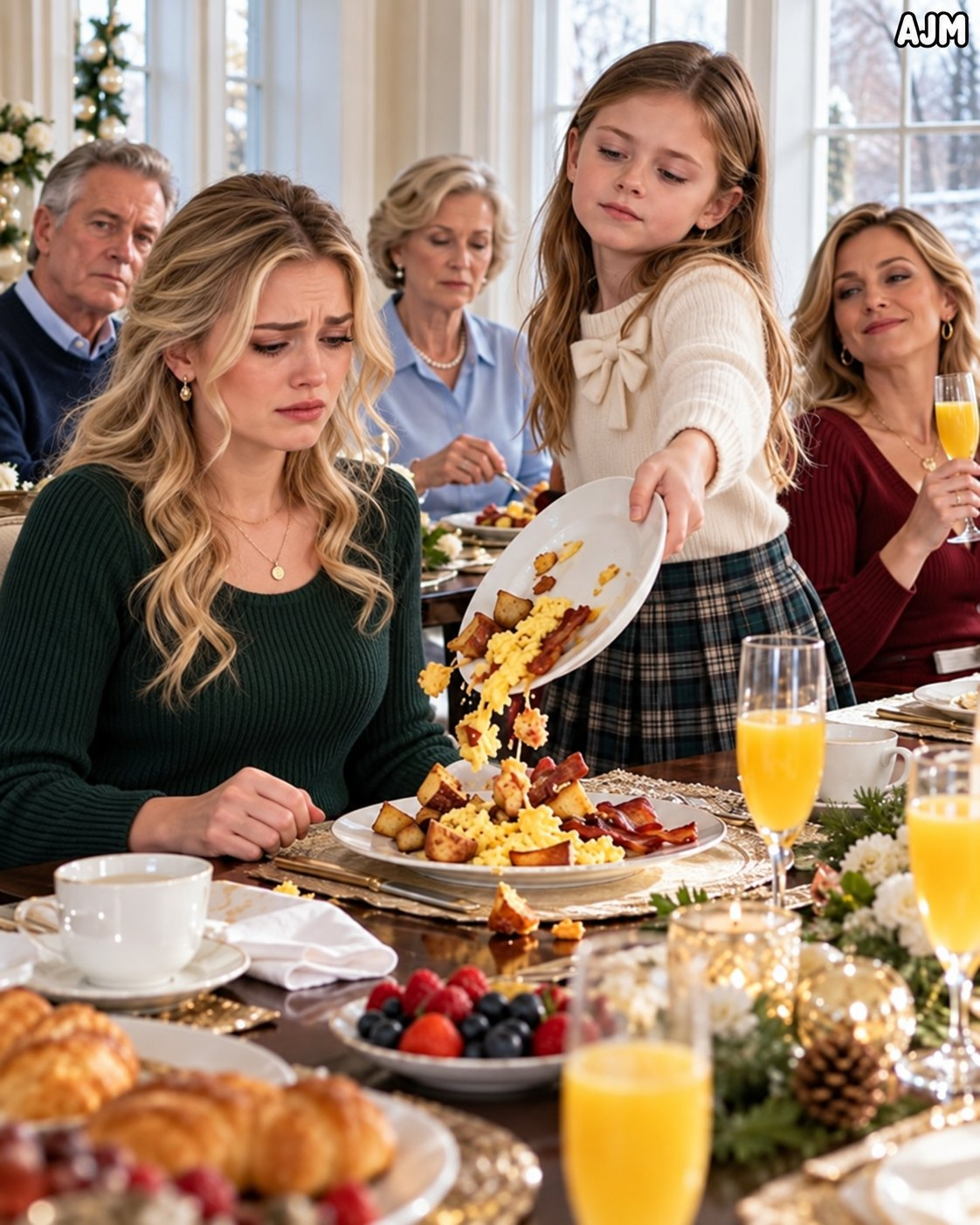
Instead, a little girl had dumped leftovers onto her plate.
And the adults had laughed.
I wished I could go back to that morning.
Not to change what happened.
But to sit beside that version of myself and tell her what she hadn't yet learned.
That love wasn't something she had to purchase.
That generosity didn't require self-destruction.
That saying no didn't make her cruel.
And that being needed wasn't the same as being cherished.
I placed the photograph back on the shelf.
Then I opened the balcony door.
Cool evening air drifted into the room.
The maple trees outside had lost most of their leaves.
Beyond them, the neighborhood glowed beneath the streetlights.
I thought about Italy.
The trip I'd postponed year after year.
The dream I'd kept moving farther into the future because someone else always needed something first.
I walked back to my desk and opened my laptop.
A travel itinerary waited in a folder.
Rome.
Florence.
Venice.
Two weeks in the spring.
I had researched the trip months earlier, after the last of my personal loan had been paid.
Now I reviewed the dates.
Checked my savings.
Confirmed the time off I'd arranged with my manager.
Then I booked it.
The confirmation appeared on my screen.
I sat back and smiled.
For years, I'd been the person everyone called when they needed something.
The dependable daughter.
The generous sister.
The aunt who always said yes.
I still loved my family.
I still wanted to help when I could.
But I no longer confused love with surrender.
My parents had a home they could afford.
Brooke was building a life she could support.
Sophie knew she was loved.
And I finally had a future that belonged to me.
I closed the laptop.
Then I walked to the kitchen, cut myself a small slice of leftover pumpkin pie, and placed it on my favorite plate.
I carried it to the living room.
Sat down on my own sofa.
In my own home.
And enjoyed every bite.
For the first time in my life, I wasn't eating what everyone else had left behind.
I had chosen something for myself.
And it was enough.






Comments 0