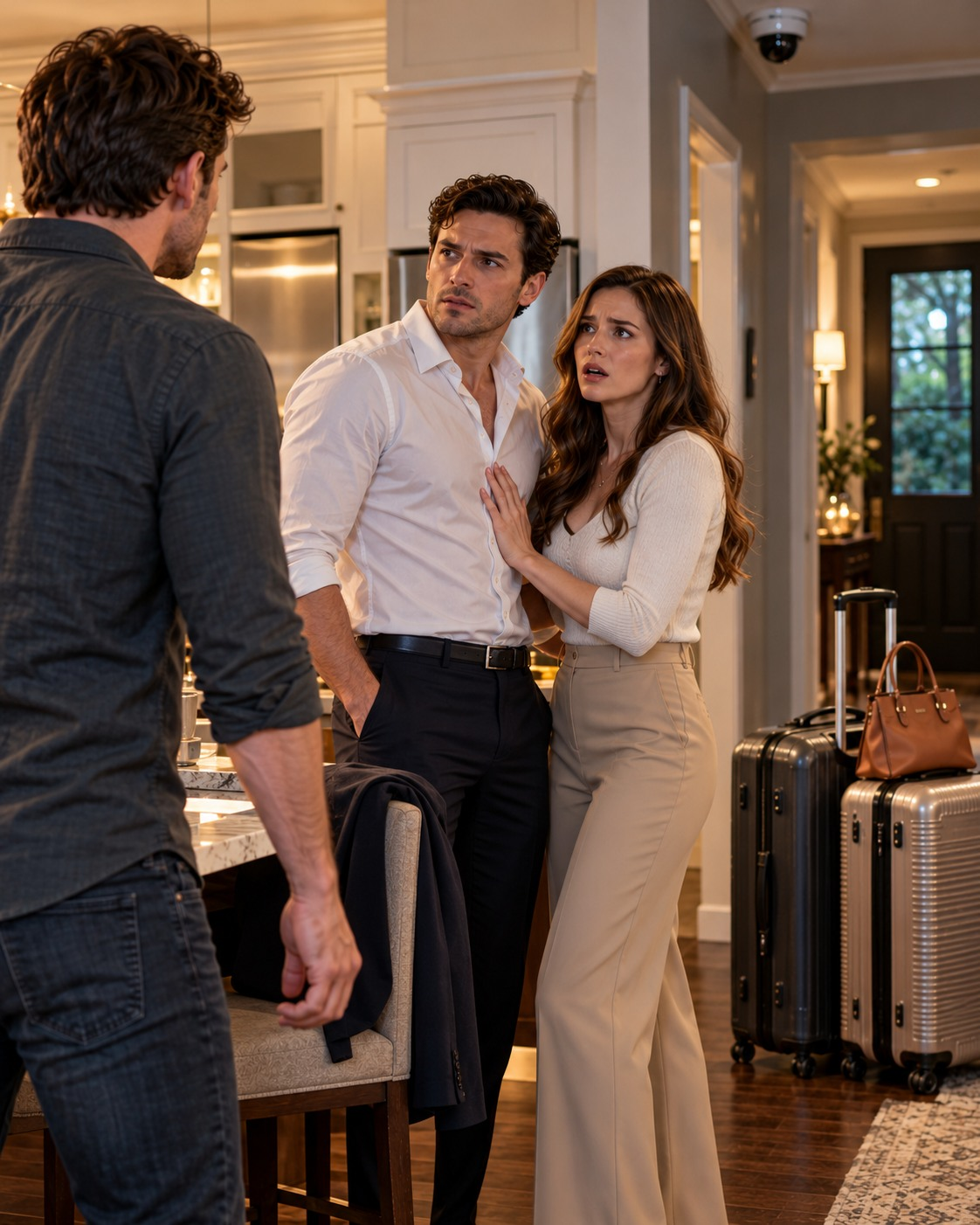
My mother reached into her coat.
Three police officers raised their weapons.
"Hands where we can see them!"
She froze.
For one terrible second, I thought the woman who had raised me was about to die in front of me.
Then she slowly withdrew her hand.
Between her fingers was a folded photograph.
Nothing more.
She held it out.
"Please," she whispered. "Before you decide who I am, look at this."
Detective Reeves approached carefully.
He took the photograph and unfolded it.
I watched his expression change.
Then he handed it to me.
The picture showed two women standing beside a hospital bed.
Both were young.
Both had dark hair.
Both looked almost identical.
One held a newborn baby wrapped in a blue blanket.
The other stood beside her, smiling.
On the back, someone had written:
Eleanor and Evelyn — October 1980.
My hands began trembling.
I looked up.
"Who is Evelyn?"
The woman standing before me closed her eyes.
"My sister."
I stared at her.
"Your twin sister?"
She nodded.
The room seemed to shift.
I looked at the photograph again.
Two women.
The same face.
The same smile.
The same dark eyes.
I thought about Richard's words.
The real Eleanor Mercer died four years ago.
I looked at the woman who had raised me.
"Which one are you?"
Her lips trembled.
"I'm Eleanor."
I wanted to believe her.
God, I wanted to.
But I'd spent the entire evening learning how easily faces could be copied, signatures forged, recordings altered, and identities stolen.
I couldn't accept another answer simply because I needed it to be true.
"Then why did Richard say you were dead?"
She wiped her cheeks.
"Because he wants you to believe the woman who raised you was an impostor."
I looked at Reeves.
He studied the photograph.
Then asked, "Where is Evelyn now?"
My mother swallowed.
"She died four years ago."
I felt cold.
"The same year Dad died?"
She nodded.
I stared at her.
"How?"
My mother looked toward Aaron.
"That's what I've been trying to tell you."
Aaron stepped closer.
His face was pale.
"Mom?"
She looked at him.
For a moment, neither spoke.
Then she said, "Evelyn was the woman who helped raise you after you were taken."
Aaron went completely still.
I looked between them.
"What?"
My mother nodded.
"Arthur Dawson arranged your disappearance. But he needed someone who could care for you without attracting attention. Evelyn had been estranged from our family for years. She needed money. Arthur found her."
Aaron's jaw tightened.
"She told me my parents abandoned me."
My mother began crying.
"I know."
"She called herself my aunt."
"She was your aunt."
Aaron looked away.
My mother continued.
"When Evelyn learned what Arthur had done, she tried to return you. But Arthur threatened to have her arrested for kidnapping. He had documents showing she'd accepted money."
I felt sick.
"Why didn't she tell you?"
"She did. Years later. By then, Richard had inherited Arthur's secrets and was using Aaron in his schemes."
Aaron stared at the floor.
My mother looked at me.
"Four years ago, Evelyn came to Thomas with evidence. She wanted to help us bring Aaron home."
I swallowed.
"And she died?"
My mother nodded.
"Two days before your father."
I stared at her.
"Richard killed her?"
"We believe his people did. Her death was reported as an accidental overdose. Samuel Voss signed the medical paperwork."
The same doctor.
The same carefully constructed explanations.
I looked at Reeves.
"Can we prove any of this?"
He nodded slowly.
"We can investigate the records, the deaths, and the people involved. But first, we need to establish everyone's identity independently."
My mother stepped forward.
"I'll give you whatever you need."
Reeves nodded.
"Fingerprints. DNA. Medical records. Historical documents."
"Anything."
I looked at her.
"Why didn't you tell me about Evelyn?"
She lowered her eyes.
"Because I was ashamed."
"Of what?"
"Of letting her disappear from our lives. Of believing Aaron was dead. Of allowing Richard to convince me that telling you the truth would put you in danger."
Her voice broke.
"And because every year I waited made it harder to explain why I'd waited."
I looked at the photograph.
Two sisters.
One holding a baby.
One smiling beside her.
A family secret that had become a weapon.
Then I looked at my mother.
"There's still the recording."
She nodded.
"I know."
"You told Richard not to call anyone until Dad was gone."
Tears filled her eyes.
"That's what the edited recording makes it sound like."
I felt my stomach tighten.
"Are you saying those words weren't yours?"
"They were mine."
I stared at her.
She took a shaky breath.
"But they weren't spoken in that order."
I looked toward Reeves.
He was already reaching for his phone.
My mother continued.
"Richard recorded everything. He used cameras in our house because he wanted proof he could use against Thomas. Later, Michael cut the recordings into pieces."
I remembered Claire's warning.
Don't trust your own evidence.
My mother looked at me.
"The original conversation was about Evelyn. Richard had just told me she'd died. I said not to call anyone until Thomas was gone because Richard had threatened to kill you if your father contacted the authorities."
I stared at her.
"That doesn't make sense."
"I know. Not without the rest."
She looked toward Reeves.
"Play the complete audio. Not the clips Richard sent."
Reeves nodded.
"We have the original files from the archive. The forensic team is examining them."
My mother swallowed.
"Then you'll hear what happened."
I looked at her.
"And the part where you said we had to finish what we started?"
She closed her eyes.
"That was about the evidence."
I felt cold.
"What evidence?"
"The documents Thomas had copied. He wanted me to make sure they reached the authorities if anything happened to him."
She looked at me.
"Daniel, I did something terrible that night."
I held my breath.
"I believed Richard when he said your father was having a medical emergency. I brought Samuel Voss into our home. When I realized they had drugged Thomas, I was afraid. I waited too long to call for help."
Her voice broke.
"I didn't kill your father. But I failed him."
I looked at her.
For the first time, she wasn't asking me to believe a perfect story.
She was admitting something ugly.
Something painful.
Something that might carry consequences.
And somehow, that made her more believable than anything else she'd said.
I stepped toward her.
She began crying.
"I'm sorry, Daniel."
I took her hands.
They were cold.
Familiar.
The same hands that had packed my school lunches.
Bandaged my scraped knees.
Held mine at my father's funeral.
"I need the truth," I whispered.
She nodded.
"You'll have it."
I looked toward Reeves.
"Then let's finish this."
Richard Dawson was in a guarded hospital room when we arrived.
A bullet had passed through his shoulder without causing a life-threatening injury.
He sat propped against pillows, his right arm secured in a sling.
Two officers stood outside.
Reeves entered first.
Lieutenant Collins followed.
My mother and I waited in an adjoining observation room, where we could watch through a secure video feed.
Aaron remained at the police facility giving a detailed statement.
I had wanted to confront Richard face-to-face.
Reeves had convinced me otherwise.
"Let him speak without you in the room," he'd said. "If he wants to confess, we need to hear what he actually knows."
I understood.
But understanding didn't make it easier.
On the screen, Richard looked smaller than I remembered.
Without his expensive suit, polished shoes, and carefully controlled smile, he seemed like an ordinary frightened man.
Reeves sat beside the bed.
"Mr. Dawson, you requested an opportunity to provide information about Thomas Mercer's death."
Richard nodded.
"I did."
"Before we proceed, you need to understand your rights."
Reeves explained them.
Richard listened.
Then said he wanted an attorney.
Reeves stopped questioning him.
For a moment, I thought Richard had planned another performance.
Then Richard looked toward the observation camera.
"Daniel's watching, isn't he?"
Reeves didn't answer.
Richard smiled faintly.
"Tell him his father wasn't innocent."
I felt my hands tighten.
My mother looked away.
Richard continued speaking, apparently unable to stop himself.
"Thomas knew about the money. He helped create the original structure."
Reeves remained silent.
Richard looked frustrated.
"He wasn't some saint."
I stared at the screen.
My father.
The man who'd taught me to tell the truth.
Had he helped Richard before trying to stop him?
I looked at my mother.
She nodded sadly.
"Your father helped create the first holding companies. He believed they were legitimate. When he discovered Arthur and Richard were using them to conceal theft, he tried to dismantle them."
I swallowed.
"Why didn't he report them immediately?"
"Because Richard showed him evidence that Aaron was alive."
I closed my eyes.
There it was.
The weakness Richard had exploited in everyone.
A missing child.
A threatened mother.
A frightened wife.
A son desperate to believe the people he loved.
Richard had learned exactly where to press.
The next morning, investigators finished a preliminary reconstruction of the recordings.
I watched the results with Reeves, Collins, and an independent forensic examiner.
This time, nobody asked me to accept a video at face value.
The examiner showed us the original file structure, the continuous timestamps, and the places where the earlier clips had been cut.
Then she played the recording.
My father was on the floor.
Dr. Voss knelt beside him.
Richard stood near the doorway.
My mother entered carrying a folder.
"Call an ambulance!" she shouted.
Richard grabbed her arm.
"Not until we know where Thomas put the records."
She pulled away.
"He's dying!"
Voss looked up.
"His pulse is weak."
My mother reached for the telephone.
Richard seized it.
"If you call anyone before Thomas tells me where the files are, Daniel dies next."
My mother froze.
Then she whispered, "Don't call anyone until he's gone."
Richard stared at her.
"What?"
She looked toward the hallway.
"Your men. Don't call anyone to go after Daniel until Thomas is gone. I need to speak to my husband."
Richard released the telephone.
My mother knelt beside my father.
"Thomas."
His eyes opened briefly.
She leaned close.
He whispered something.
The examiner enhanced the audio.
Three words emerged.
"Finish the records."
My mother nodded.
"Now we finish what we started."
Then she turned toward the telephone.
Richard moved to stop her.
But Voss caught his arm.
"Enough," the doctor said. "He's going into cardiac arrest."
My mother dialed emergency services.
The recording continued.
There was no sudden cut.
No manufactured ending.
I watched my mother try to save my father.
I watched Richard refuse to help.
I watched Voss perform chest compressions only after the situation became impossible to conceal.
And I watched my father die.
I cried quietly.
Not because the recording surprised me.
Because it finally gave me something I'd been denied for four years.
The truth about his final minutes.
Reeves stopped the video.
The examiner explained that the footage alone could not establish the precise medical cause of death, but it documented the delay in seeking emergency care, the threats, and the circumstances surrounding Voss's treatment.
Further investigation would determine the charges.
I nodded.
For once, I didn't need an immediate answer.
I needed the right one.
By the end of the week, the investigation had changed completely.
The woman who had pretended to be Claire Whitmore was identified as Nora Bell, a former private investigator hired through one of Richard's shell companies.
She had used stolen credentials, a convincing disguise, and edited recordings to impersonate Claire.
The black device she'd carried was a remote controller connected to the compromised security system in my house.
The cameras hadn't magically turned toward me.
They'd been remotely directed through equipment installed without my knowledge.
The local recorder had also been altered.
The original footage my mother recovered proved that several clips had been replaced or retimed.
The woman at my house at 2:17 really had been Claire Whitmore.
But the recording I'd watched later had been modified to conceal when Aaron and Michael returned to search for the flash drive.
The real Claire had been abducted after leaving my house and held at a separate property connected to Richard.
She was rescued after investigators traced a payment from the fraudulent account.
Rebecca Shaw had been helping her.
Rebecca was a former medical records administrator who had worked with Dr. Voss years earlier.
She'd discovered irregularities in Evelyn's death certificate and later helped my mother collect documents.
The anonymous messages had come from Rebecca and, at times, from Aaron after he began secretly working against Richard.
Their warnings had been incomplete because both were being watched.
Rebecca admitted she'd used frightening language to force me to act quickly.
I told her I understood why she'd done it.
I also told her that nearly every warning had made me doubt the wrong person.
She accepted that.
And apologized.
I learned that the recording of my father's voice beneath my hallway had been assembled from an authentic message he'd left for my mother.
The sentence about his killer standing beside me had been spliced together from separate statements.
Michael had installed the speaker and the floor mechanism while I was unconscious three nights earlier.
The red ribbon on the suitcase marked the location of the trigger.
Richard wanted me frightened, suspicious, and increasingly erratic.
He wanted the police to see a man unraveling.
Instead, the original recordings showed exactly how that unraveling had been engineered.
Trevor Collins was charged in connection with the identity-fraud conspiracy and obstruction of the investigation.
He cooperated after learning how close he'd come to helping Richard kill me.
His cooperation didn't erase what he'd done.
He'd entered my house.
Helped steal information.
Participated in a staged confrontation.
And endangered Madison by telling Michael where she was being questioned.
When he asked to apologize, I agreed to meet him once, with my attorney present.
He looked older than he had a week earlier.
"I'm sorry," he said.
I studied him.
"Do you understand what you did?"
He nodded.
"I wanted to believe you were a bad husband. It made what I was doing feel less wrong."
I looked at him.
"That belief almost cost people their lives."
His eyes filled with tears.
"I know."
I stood.
"I hope you tell the truth from now on."
Then I left.
I didn't need his friendship.
I didn't need his approval.
And I didn't need to carry his guilt for him.
Madison's confession was longer.
She admitted the affair.
The stolen documents.
The security access.
The false assault allegation.
The medication.
And the fact that she'd allowed Michael into our bedroom.
She also admitted that, before Richard began threatening my mother, she'd willingly helped him gather information because she believed I was hiding money and preparing to leave her.
That truth hurt more than the affair.
She hadn't trusted me enough to ask a question.
Instead, she'd gone to the man who wanted to destroy me.
The investigation established that the forged will and guardianship petition were part of a plan to gain control of the fraudulent accounts and the trust.
The unlabeled bottle contained a sedating medication.
Medical testing and the recovered footage supported the conclusion that I'd been drugged.
Dr. Voss faced criminal charges arising from that incident and the investigation into my father's death.
Michael Bennett was arrested.
Investigators recovered his communications with Richard, the altered security files, and records showing payments to Victor Hale.
Hale was arrested as well.
The evidence showed he'd helped hold my mother captive and moved her between locations.
The officers who had assisted Richard were identified through financial records and communications. Detective Reeves had not been one of them.
He'd been telling the truth.
The badge number Richard had used was stolen from an old report.
Officer Grant, who'd disappeared during the chaos outside my house, was found injured but alive.
He recovered.
Lieutenant Collins made sure the investigation continued beyond the first arrests.
She told me something I never forgot.
"Evidence doesn't become trustworthy because it supports what we want to believe. It becomes trustworthy when it survives being questioned."
I thought about that often.
Especially when I remembered how easily Richard had made me doubt my own mother.
The Mercer Family Trust records were recovered from unit 317.
The silver key opened a locked cabinet containing original ownership agreements, accounting ledgers, correspondence, and backup storage devices.
Those records confirmed that my father had owned twenty percent of Dawson-Mercer Construction.
They also showed how Richard and Michael had diverted money through fraudulent vendors and accounts opened in my name.
Aaron's cooperation helped establish which transactions he'd performed while impersonating me.
Bank records, device logs, photographs, and witness statements supported his admissions.
The forged signatures were examined.
The false account history was reconstructed.
And the money that had been routed through my identity was traced.
The process took months.
But eventually, the authorities formally cleared me of involvement in the fraud.
My legitimate ownership interest was recognized through the trust.
The stolen funds were subject to recovery proceedings.
And the fraudulent accounts were frozen and separated from my personal finances.
For the first time in years, I could look at a bank statement without wondering whether someone had secretly opened another account in my name.
I resigned from Dawson-Mercer Construction.
Not because I was ashamed.
Because I was finished letting Richard Dawson define my life.
Aaron's story was harder.
He had committed crimes.
Real ones.
He'd forged signatures.
Impersonated me.
Opened accounts.
Helped Richard conceal money.
But he'd also been a child stolen from his parents and raised inside a network of lies.
When he learned the truth, he had secretly copied records, warned Rebecca, and helped locate our mother.
His cooperation mattered.
So did his crimes.
He accepted both.
One afternoon, before his court hearing, we sat together in a small visitation room.
He looked at my watch.
"Dad gave you that?"
I nodded.
"On my thirtieth birthday."
Aaron smiled sadly.
"I used to wonder what he was like."
I swallowed.
"He was stubborn."
Aaron laughed softly.
"So are you."
I smiled.
"He was kind. But he made mistakes."
Aaron looked down.
"I wish I'd met him."
I thought about my father sitting in his garage.
The smell of sawdust.
The old radio playing quietly.
The way he always kept a second chair beside his workbench.
"I wish you had too."
Aaron looked at me.
"Do you think we'll ever be brothers?"
I considered the question.
I couldn't pretend the past hadn't happened.
I couldn't erase the years he'd spent wearing my identity.
But I also couldn't ignore the life that had been stolen from him.
"We already are," I said.
He looked up.
"That doesn't mean everything's forgiven."
He nodded.
"I know."
"It means we have a chance to decide what happens next."
His eyes filled with tears.
For the first time, I saw him smile without looking over his shoulder.
My mother moved into a small house near mine after she recovered.
She sold the old family home.
Too many memories lived inside those walls.
Some beautiful.
Some terrible.
She kept my father's photographs, his tools, and the old wooden box that had held the key.
She also kept Aaron's blue blanket.
One Sunday afternoon, I found her sitting on the porch with it folded across her lap.
"Are you okay?" I asked.
She nodded.
"I was thinking about how much time we lost."
I sat beside her.
She looked at me.
"I'm sorry I kept so much from you."
I took her hand.
"I know."
"I thought silence would protect you."
I looked toward the yard.
"Silence gave Richard room to keep hurting us."
She nodded.
"You're right."
We sat quietly for a while.
Then she said, "Your father loved you, Daniel."
My throat tightened.
"I know."
"He loved Aaron too. Even when he thought he was gone."
I looked at the blanket.
"I know that now."
She leaned her head against my shoulder.
For the first time since my father died, I felt that we were grieving him together.
Not through secrets.
Not through guilt.
But through the truth.
Madison and I divorced.
It wasn't a dramatic decision.
There was no shouting.
No final accusation.
No desperate attempt to turn the past into something it wasn't.
We met in a lawyer's office several months after the investigation began.
She looked thinner.
Tired.
She'd been cooperating with prosecutors and was facing the consequences of her actions.
When the paperwork was finished, she looked at me.
"Do you hate me?"
I thought about it.
I remembered our wedding.
Our first apartment.
The Christmas mornings.
The quiet dinners.
The ordinary years I'd believed were ours.
Then I remembered the lies.
The betrayal.
The bedroom recording.
And the way she'd told police I'd hurt her.
"No," I said.
She began crying.
"I don't hate you."
She wiped her eyes.
"Then maybe someday—"
I shook my head.
"Madison."
She stopped.
"I can forgive you for some things. I can hope you rebuild your life. But I can't be your husband again."
She lowered her eyes.
"I understand."
I stood.
She looked up one last time.
"Daniel, I really did love you."
I studied her.
"Maybe you did."
Then I left.
I didn't need to argue about what love meant.
I knew what I needed from it now.
Truth.
Respect.
Safety.
And the freedom to be myself.
One year after the night I came home at 4:17, I opened the doors of my own construction consulting business.
It was small.
Three employees.
A modest office.
A coffee machine that broke twice during the first month.
But it was mine.
We specialized in independent project oversight and construction safety reviews.
Every contract required clear records.
Every inspection had to be documented.
Every concern had to be addressed.
I hired people who weren't afraid to ask difficult questions.
And I made one promise to every client.
We would never sign off on work we hadn't verified.
On opening day, my mother arrived carrying flowers.
Aaron came with her.
His legal case had reached a resolution that included accountability for his offenses and an opportunity to rebuild his life under supervision.
He was working steadily.
Learning how to live without someone telling him who to pretend to be.
He brought me a small wrapped package.
I opened it.
Inside was a wooden sign.
MERCER INTEGRITY CONSULTING.
Below the name, he'd carved a sentence.
BUILT ON THE TRUTH.
I stared at it.
Then looked at him.
"You made this?"
He nodded.
"Mom said Dad taught you woodworking."
I smiled.
"He did."
Aaron shrugged.
"I thought maybe you could teach me."
I looked at my brother.
Then at my mother.
She was smiling through tears.
"Saturday morning," I said.
Aaron grinned.
"I'll bring coffee."
"Bring decent coffee."
He laughed.
And for the first time, the sound of his laughter didn't remind me of the man who'd stolen my face.
It reminded me of family.
That evening, after everyone had gone home, I drove to Oakwood Cemetery.
The sun was setting.
The maple tree above my father's grave moved gently in the breeze.
I stood beside the headstone.
For a long time, I said nothing.
Then I took the old leather watch from my wrist.
I turned it over.
The engraving was still there.
TO DANIEL — ALWAYS FIND YOUR WAY HOME.
I'd worn it through every terrible hour.
Through the accusations.
The threats.
The recordings.
The moment I believed my mother had betrayed us.
The moment I learned my brother was alive.
The moment the truth about my father's death finally emerged.
I fastened the watch again.
"Dad," I said quietly, "I found Aaron."
The breeze moved through the branches.
"Mom's okay."
I swallowed.
"And Richard can't hurt us anymore."
The criminal cases had resulted in convictions supported by the recovered records, testimony, and authenticated evidence. Richard and Michael were serving prison sentences. Dr. Voss and Victor Hale had also been held accountable for their roles.
The investigations into the older deaths had established the threats, medical misconduct, and deliberate delay in seeking help for my father. The official findings no longer described his death as an uncomplicated natural event.
His record had been corrected.
So had mine.
I looked at the headstone.
"I wish you'd told me everything."
My voice trembled.
"But I understand why you were afraid."
I stood there until the sun slipped behind the trees.
Then I drove home.
Not to the house where the cameras had watched me.
Not to the bedroom where someone had drugged me.
Not to the hallway where two suitcases had waited beside the door.
I'd sold that house.
I didn't want to spend the rest of my life trying to make it feel safe again.
My new home was smaller.
A brick house with a wide front porch and a workshop behind the garage.
There were no hidden speakers beneath the floor.
No mysterious suitcases.
No cameras controlled by someone else.
Just a place I'd chosen.
A place where I could sleep.
A place where I could wake up without wondering who had entered while I was unconscious.
I parked in the driveway.
For a moment, I remained behind the wheel.
I thought about the man I'd been a year earlier.
The man who believed his marriage was ordinary.
Who trusted Richard Dawson.
Who thought his father had died of a sudden heart attack.
Who didn't know he had a brother.
Who believed that if he worked hard and treated people fairly, his life would remain simple.
That man was gone.
But I wasn't sorry to have survived becoming someone else.
Someone who asked questions.
Someone who understood that trust had to be earned.
Someone who knew that love could exist alongside painful truths.
I stepped out of the car.
The porch light was on.
Inside, the kitchen smelled of fresh bread.
My mother had left a loaf on the counter earlier that afternoon.
Beside it was a note.
Don't forget dinner on Sunday. Aaron is bringing dessert. Love, Mom.
I smiled.
Then I noticed something on the kitchen table.
An old photograph.
My father and me.
I was twelve.
We were standing beside the wooden birdhouse we'd built together.
He had one arm around my shoulders.
I was grinning proudly at the camera.
I picked it up.
For years, I'd believed getting my life back meant returning to the way things had been.
Before Madison.
Before Trevor.
Before Richard's lies.
Before the recordings.
But I understood now that there was no going backward.
My marriage was over.
My father was gone.
My family had been changed by secrets that could never be undone.
And yet, I had more than I'd thought possible during those terrible hours.
My mother was alive.
My brother had come home.
My name had been cleared.
My father's work had been recognized.
And the future belonged to me again.
I placed the photograph on the mantel.
Then I walked onto the porch.
The evening was quiet.
A neighbor waved from across the street.
Somewhere nearby, children were laughing.
I sat in the wooden chair I'd built with Aaron the previous weekend.
It wasn't perfect.
One leg was slightly shorter than the others.
Aaron had offered to fix it.
I'd told him we'd do it together.
I looked at my father's watch.
4:17 p.m.
Exactly the time I'd returned home on the afternoon everything began.
I remembered standing outside my old front door.
The unfamiliar sedan.
The whispered words.
"He'll never know."
For a long time, those words had haunted me.
Now they meant something different.
Madison had believed I would never know about her affair.
Richard had believed I would never uncover the fraud.
Michael had believed I would never find the original recordings.
And the people who'd stolen my brother had believed our family would never discover what they'd done.
They'd all been wrong.
I took a slow breath.
The air smelled of cut grass and distant rain.
My phone vibrated.
A message from Aaron.
Mom says you're bringing the salad Sunday. Don't forget.
I laughed.
Then typed back.
Only if you promise not to burn dessert.
His reply came almost immediately.
No promises.
I set the phone down.
And smiled.
Not because everything had been repaired.
Some things never could be.
But because the people who mattered were still here.
Because the truth had finally been heard.
Because tomorrow belonged to me.
I leaned back in the chair and watched the last sunlight stretch across the yard.
For the first time in a very long time, I wasn't waiting for a threat.
I wasn't watching a recording.
I wasn't wondering what someone had hidden from me.
I was simply home.
And this time, I knew exactly who I was.






Comments 0