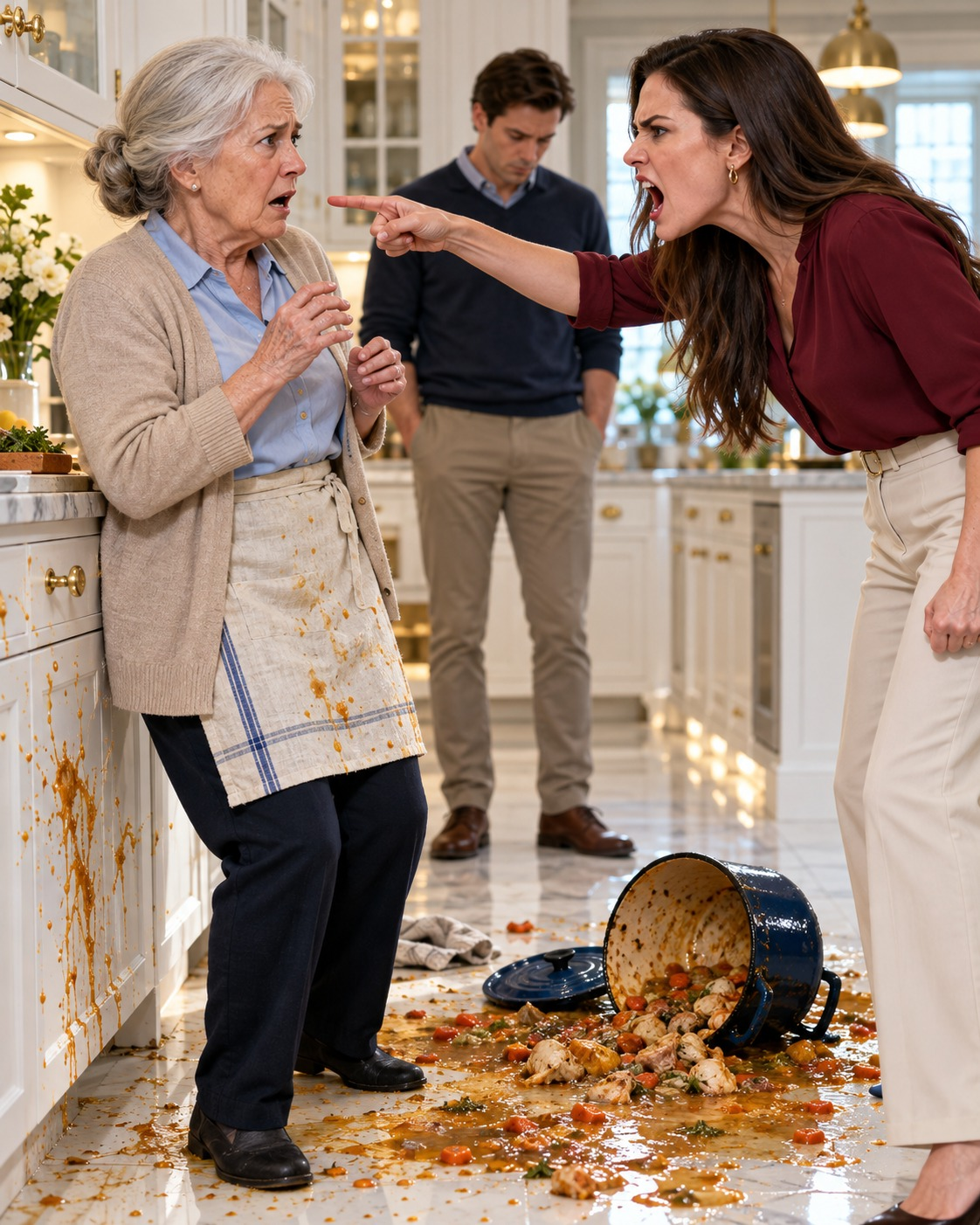
The heavy Dutch oven hit my kitchen floor with a crash.
"YOU ARE A GUEST IN MY HOUSE, MARGARET! START ACTING LIKE ONE!"
My daughter-in-law stood over the spilled chicken stew, pointing at my face.
Behind her, my son Daniel stared at a small envelope that had fallen from my apron pocket.
Five words were written across it.
For when peace costs too much.
My dead husband had known.
And I had been wrong about my son.
The kitchen went silent except for the thick broth dripping from the cabinet doors.
I stood against the counter, my hands raised slightly in front of my chest. At seventy-three, I had survived the death of my husband, two surgeries, and more lonely holidays than I cared to count. But I had never imagined I would stand in my own kitchen, frightened of the woman my son had married.
Lauren was forty-two, with straight copper-red hair that fell neatly over her emerald-green blouse. She looked as though she had stepped out of a magazine advertisement for expensive homes.
Except for the hatred in her eyes.
"Did you hear me?" she demanded.
I lowered my hands.
"Yes, Lauren. I heard you."
"Then maybe you'll finally understand that you can't keep interfering with how I run this household."
I glanced down at the overturned pot.
It was a navy-blue cast-iron Dutch oven Robert had given me for our thirty-fifth wedding anniversary.
He had saved for three months to buy it.
I remembered laughing when I opened the box.
"Robert, it's a cooking pot. You could have bought me flowers."
He had kissed my forehead.
"Flowers die, Maggie. This thing will outlive both of us."
He had been right about the flowers.
And almost right about the pot.
Now it lay on its side, surrounded by chicken, carrots, potatoes, and the remains of a dinner I had spent nearly four hours preparing.
The stew had splashed across the white cabinets and polished marble flooring.
The kitchen renovation had cost $86,400.
Robert and I had saved for years to afford it.
We had chosen every cabinet handle together.
Every tile.
Every light fixture.
And now Lauren stood in the middle of it, telling me I was a guest.
"Margaret!"
I looked up.
Lauren folded her arms.
"Are you going to apologize?"
I blinked.
"For what?"
She laughed sharply.
"Unbelievable."
Daniel shifted his weight behind her.
My son was forty-six now, with sandy-blond hair beginning to gray at the temples. He wore the dark olive sweater I had bought him for Christmas.
He looked exhausted.
But he did not look surprised.
That hurt more than I expected.
"Daniel," I said quietly.
He kept his eyes on the floor.
"Daniel, did you hear what your wife just said to me?"
He rubbed his forehead.
"Mom, please."
Two words.
That was all he had for me.
"Please what?"
"Don't make this worse."
I stared at him.
For a moment, I could almost see the little boy who used to run into my arms after school, his knees scraped and his backpack hanging from one shoulder.
The boy who cried when our family dog died.
The boy who once told me he would buy me a castle when he grew up.
Now he stood in the home I had given him shelter in, asking me not to make a scene.
Lauren had just thrown my dinner across the floor.
And somehow I was the problem.
"Your mother has been undermining me all afternoon," Lauren said.
Daniel sighed.
"Lauren—"
"No. She needs to hear this."
She turned back toward me.
"I told you we were having people over tomorrow. I told you I needed the kitchen cleared. And what did you do? You started cooking some enormous old-fashioned dinner nobody asked for."
I looked at the food on the floor.
"I was making supper for the children."
"The children already ate!"
"They asked for my chicken stew."
"Because you keep encouraging them to come running to you instead of listening to me!"
There it was.
The real reason.
Not the cooking.
Not the kitchen.
Not the dinner.
My grandchildren loved spending time with me, and Lauren had begun treating that love like a competition.
Nine-year-old Sophie had asked me that morning whether I could make Grandpa Robert's favorite stew.
She had never met him properly. She had been only three when he died.
But she loved hearing stories about him.
Her older brother, Ethan, had helped peel the carrots.
He was twelve now, tall for his age and quiet in the way children become when they learn that speaking can make adults angry.
Both children had been standing near the kitchen doorway when Lauren began shouting.
Sophie had screamed when the pot fell.
Ethan had immediately pulled her behind him.
I could still hear her crying from the family room.
"Lauren," I said, "the children were frightened."
Her expression hardened.
"Don't you dare use my children against me."
"I'm not."
"You always do this. You act like the sweet, helpless grandmother, and somehow I'm the villain."
I felt something tighten in my chest.
Not anger.
Grief.
Because I had heard versions of that accusation for years.
At first, the changes had been small.
Lauren rearranged my kitchen cabinets because she said the old organization was inefficient.
Then she moved my cookbooks into storage.
Then she replaced the curtains Robert had chosen.
I told myself she was trying to make the house feel like home.
After all, Daniel and Lauren had moved in during the worst period of our lives.
Robert had died six years earlier after a long illness.
Daniel had lost his job only months before the funeral.
Lauren was pregnant with Sophie, and their savings were almost gone.
They were terrified of losing their apartment.
I remembered Daniel sitting at this same kitchen island, his face buried in his hands.
"Mom, I don't know what we're going to do."
I had taken his hand.
"Come home."
He looked up.
"What?"
"Bring Lauren and Ethan. Stay here until you're back on your feet."
He had cried.
My grown son had cried in my arms.
I told him there would be no rent.
No pressure.
No deadline.
Robert would have wanted it that way.
At least, that was what I believed.
Six years later, my generosity had somehow become an obligation.
And my home had become theirs.
"Margaret, are you listening?"
Lauren's voice pulled me back.
"Yes."
"Then apologize."
I looked at Daniel.
He finally raised his eyes.
"Mom," he said, "maybe we should all calm down."
"Your wife threw a heavy pot across my kitchen."
"It was an accident," Lauren snapped.
I looked at her.
She had grabbed the pot's handle during our argument.
I had warned her it was hot.
She had jerked it away from me, and it had fallen.
Whether she meant to throw it or simply lost control, I couldn't say.
But I knew what I had seen.
And I knew she had not apologized.
"Daniel," I said, "this is my home."
His face changed.
It was only a flicker.
But I saw it.
Lauren gave a short, disbelieving laugh.
"Oh, here we go again."
I turned toward her.
"What does that mean?"
"It means every time someone disagrees with you, you remind us that your name is on the deed."
"Because it is."
"Legally, maybe."
I stared at her.
"Legally?"
She stepped closer.
"But Daniel and I have made this place a home. We raise our children here. We take care of everything. We manage the bills, the repairs, the yard, the insurance—"
"I pay the property taxes."
"That's not the point!"
"I paid for the kitchen."
"Stop bringing up money!"
"I paid for the roof last spring."
Her face reddened.
"You're impossible."
I glanced toward Daniel.
"Tell her."
He looked away.
"Mom, don't."
"Tell her whose house this is."
He said nothing.
Lauren smiled.
Not warmly.
It was the small, satisfied smile of someone who believed silence meant victory.
I had seen that smile before.
The afternoon my cookbooks disappeared.
The morning Robert's favorite recliner was moved into the garage.
The day I discovered our wedding photograph had been taken down from the hallway.
Every time I protested, Daniel had said the same thing.
"Mom, I just want peace."
Peace.
That word had become a weapon in my home.
Whenever Lauren wanted something, Daniel asked me to surrender it for peace.
Whenever I objected, I was accused of disturbing peace.
And whenever I swallowed my feelings, they called it compromise.
I looked around the ruined kitchen.
For the first time, I wondered how much more of myself I was expected to give away.
"I think," I said slowly, "I'd like to be alone."
Lauren rolled her eyes.
"Of course. Now you're the victim."
I turned toward the counter where I had left my purse.
I wanted to leave the room.
Maybe drive to the little coffee shop near the library.
Maybe sit in my car until my hands stopped shaking.
I reached for my purse.
Daniel moved.
"Mom."
His hand closed around my forearm.
Not painfully.
But firmly enough to stop me.
I looked down at his fingers.
He leaned closer.
"Don't walk out and embarrass Lauren."
I could hardly believe him.
"Embarrass her?"
"Please. She's had a stressful week."
I looked from his face to the stew on the floor.
"Daniel, she screamed at me."
"I know."
"She frightened your children."
"I know."
"She told me I was a guest in my own house."
His grip loosened.
"Mom, we can talk about this later."
I pulled my arm free.
"Then perhaps we should."
Lauren made an impatient sound.
"Wonderful. Another lecture."
I picked up my purse.
As I did, something slipped from the apron pocket beneath my cardigan.
A small cream-colored envelope fell onto the floor.
It landed just beyond the edge of the spilled stew.
Daniel looked down.
So did I.
My heart gave an unexpected jolt.
I recognized the envelope immediately.
It had been sitting in the back of my bedroom drawer for almost six years.
Thomas Bennett, Robert's attorney, had given it to me shortly after the funeral.
He had told me Robert wanted me to keep it somewhere safe.
I had carried it downstairs that morning because I intended to call Thomas after lunch.
Daniel had recently asked me about changing the deed.
Again.
He had described it as estate planning.
He said adding his name would make everything easier when I was gone.
Then he mentioned Lauren's name.
That was when I began to worry.
I had taken out the envelope, intending to read it again before calling Thomas.
But Sophie had come into my room asking about Grandpa Robert, and I had tucked it into my apron pocket without thinking.
Now it lay between my son and me.
Daniel bent down.
I moved quickly.
"Leave that."
He stopped.
His eyes remained on the envelope.
"What's that?"
"Something your father left me."
He stared.
I bent carefully and picked it up.
The paper had yellowed slightly.
Robert's handwriting was still clear.
Five words.
For when peace costs too much.
Daniel's expression changed.
The color seemed to drain from his face.
"Where did you get that?"
I looked at him.
"Your father gave it to Thomas before he died."
He swallowed.
"Have you opened it?"
I hesitated.
"Not recently."
Lauren stepped forward.
"What is everyone whispering about?"
Daniel ignored her.
"Mom, did Dad leave you other papers?"
The question surprised me.
"Why?"
He rubbed the back of his neck.
"No reason."
But there was a reason.
I could see it.
For the first time that afternoon, my son looked genuinely frightened.
Not of Lauren.
Not of an argument.
Of something else.
Something connected to the envelope in my hand.
I remembered Robert's final weeks.
He had been weaker than I had ever seen him.
Some days, he barely had the strength to speak.
But he had insisted on meeting privately with Thomas Bennett.
Twice.
I had assumed they were discussing the will.
Robert had always been careful about our finances.
He wanted me protected.
He wanted Daniel to have opportunities.
He wanted the grandchildren to grow up secure.
I never questioned those meetings.
Until now.
Lauren snapped her fingers.
"Daniel. What is going on?"
He turned toward her.
"Nothing."
"Then why do you look like that?"
"I said it's nothing."
His voice was sharper than I had heard in years.
Lauren blinked.
I looked at the envelope.
Then at my son.
And suddenly I remembered something Robert had said during his final month.
He had been lying in our bedroom, looking toward the window.
I was sitting beside him, holding his hand.
"Maggie," he whispered, "promise me something."
"Anything."
"Don't let our boy mistake your kindness for weakness."
I had laughed softly.
"Daniel would never do that."
Robert had not smiled.
"Promise me."
I promised.
Then I forgot.
Or perhaps I chose not to remember.
Because remembering would have meant admitting that my husband had seen something in our son that I refused to see.
I slipped the envelope into my purse.
"I need to make a phone call," I said.
Daniel stepped toward me.
"Mom, wait."
I looked at him.
"What?"
He opened his mouth.
Then closed it.
Lauren stared between us.
"Will somebody tell me what's happening?"
I walked toward the hallway.
Behind me, Daniel spoke again.
His voice was low.
Urgent.
"Mom, whatever you're thinking of doing, don't call Thomas."
I stopped.
Slowly, I turned around.
"Why not?"
Daniel looked at the envelope in my purse.
And for the first time in six years, my son said something that made me afraid of what I might discover.
"Because Dad told me what was in that letter."
I stared at him.
"What?"
His eyes filled with panic.
"He made me promise never to tell you."
Before I could ask another question, my phone began ringing inside my purse.
I pulled it out.
The name on the screen was Thomas Bennett.
And beneath his name was a message I had never expected to receive.
"Margaret, don't sign anything. I found the document Robert warned me about."






Comments 0