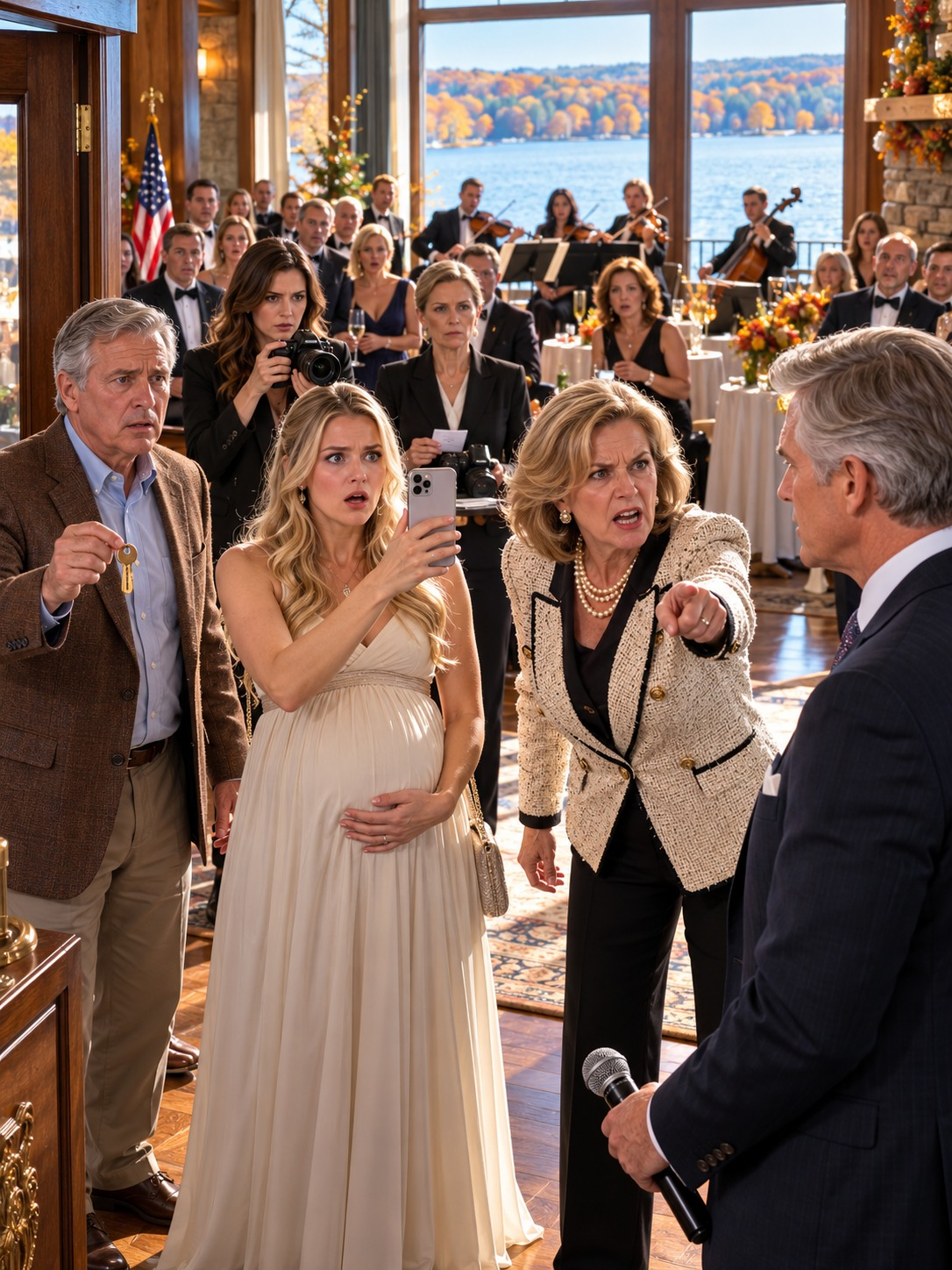
My mother thrust her finger toward the silver-haired man standing in the doorway.
"THIS HOUSE BELONGS TO MY DAUGHTER!"
Julian Ashworth calmly lowered his microphone and looked at the old brass key in my father's hand.
A tiny number was engraved along its metal handle: 1987.
My father had brought the wrong kind of proof.
And ninety people were about to find out why.
I stood near the back of the reception room, my Canon R5 pressed against my face.
Through the viewfinder, I could see my mother's expression clearly. Her mouth was open. Her eyebrows were raised. Her right hand remained pointed at Julian as though she expected the entire room to agree with her.
Nobody did.
The string quartet had stopped playing.
A waiter stood beside a champagne table with a silver tray balanced in one hand. A woman in a black blazer had just lowered her glass. Several guests had turned toward the entrance.
And my pregnant sister, Brianna, was still holding her phone.
She had been smiling only moments earlier.
Now she looked as though somebody had switched off the lights behind her eyes.
I pressed the shutter.
Click.
My father stood behind my mother, holding the brass key.
He looked from Julian to the guests, then back toward the entrance.
He had expected an empty house.
He had expected to walk inside, announce that the family had arrived, and let Brianna begin showing her followers the place where she planned to raise her twins.
Instead, he had walked into a room full of strangers.
And the man standing in front of him had just said the words none of them had prepared to hear.
"This is my property. Do you have legal permission to be here?"
Julian's voice had not risen above the ordinary volume of a conversation.
That made it worse.
My mother was accustomed to people responding when she raised her voice. She had spent decades using confidence as a substitute for permission.
But Julian didn't move.
He didn't apologize.
He didn't even look particularly surprised.
I lowered my camera for a moment.
Across the room, my sister's phone trembled.
She was livestreaming.
Her followers were watching everything.
I knew that because Brianna had told me about the livestream herself.
She had sent me a message two weeks earlier.
November 15. Big surprise. You're going to love what we're doing with the lake house.
I had read it three times.
Then I had put my phone down.
There was nothing to explain.
Not anymore.
Three months earlier, I had been sitting in an attorney's conference room when my entire life changed.
But the story really began eight years before that.
It began with a woman named Beatrice Marsh.
Aunt Beatrice was my father's older sister.
She was seventy-four when she died, a watercolor painter who had spent most of her adult life collecting brushes, old books, handmade pottery, and memories.
She owned a beautiful lake house in northern Wisconsin.
The property sat on a quiet stretch of water surrounded by tall trees. Its wooden deck faced the lake, and the windows were large enough to turn the autumn landscape into something resembling a painting.
She had purchased it in 1987 for approximately forty thousand dollars.
By the time she died, the property was worth around $1.2 million.
To most people, that number would have been the most important thing about the house.
To me, it wasn't.
I first visited when I was twenty-three.
At the time, I was living in Chicago and trying to establish myself as a professional photographer.
My business was barely surviving.
I owned an old secondhand camera, a laptop that overheated whenever I edited large photographs, and a car that made a strange clicking sound whenever I turned left.
I photographed weddings, family portraits, small business advertisements, and occasionally anything else someone was willing to pay me for.
Some months were good.
Others were terrible.
I remember one winter when I ate instant noodles for almost a week because two clients had delayed paying their invoices.
I didn't tell my parents.
They had never been particularly interested in my photography business.
My mother thought it was a hobby.
My father believed I would eventually find a proper career.
Brianna, meanwhile, had a talent for making every family gathering revolve around whatever was happening in her life.
She was prettier, louder, and far more comfortable asking people for things.
I wasn't jealous.
At least, I didn't think I was.
I simply learned to build a life that didn't require their approval.
That was when Aunt Beatrice became important to me.
The first time I arrived at her lake house, I had driven four hours through heavy traffic.
I was exhausted.
My hair was a mess, my camera bag was sitting on the passenger seat, and I had forgotten to eat lunch.
She opened the door wearing a faded blue sweater.
"Valerie Anne Marsh," she announced. "You look like you've been fighting the entire state of Illinois."
I laughed.
"Traffic."
"Traffic doesn't excuse that face. Come inside. There's soup."
That was Beatrice.
She never asked how much money I was making.
She never asked whether I had found a husband.
She never suggested I should be doing something more respectable.
She simply made room for me.
The house became my refuge.
On weekends when I wasn't working, I drove north.
Sometimes I brought my camera.
Sometimes I brought groceries.
Sometimes I arrived with nothing but a headache and a desire to sit quietly beside someone who didn't expect me to explain myself.
Beatrice loved painting the lake.
She worked mostly with watercolors, and her paintings were never perfectly realistic.
She liked the way colors blended when the paper was still wet.
She once told me that the best parts of a painting were sometimes the things you couldn't control.
I told her photography was different.
She disagreed.
"You're still waiting for the right light," she said. "You just pretend you can control it."
I remember laughing at that.
I remember almost everything about those visits.
The smell of coffee in the morning.
The old wooden stairs.
The little scratches on the kitchen table.
The way she kept a blanket folded over the back of her favorite chair.
I photographed mist rising from the lake.
I photographed the changing leaves.
I photographed her hands holding a paintbrush.
She never liked posing.
"Take pictures when I'm not looking," she told me.
So I did.
For eight years, I returned whenever I could.
I watched her become slower.
I noticed when she began needing help carrying groceries.
I helped arrange repairs around the property.
I drove her to appointments when she needed transportation.
I brought her food when she was sick.
And I listened.
Sometimes she talked about her childhood.
Sometimes she talked about my father.
Sometimes she simply sat beside me on the deck while the sun disappeared behind the trees.
Brianna visited once.
I remember that visit because she spent most of the afternoon taking photographs of herself near the dock.
She complained about the Wi-Fi.
She asked whether the house had a better television in another room.
Then she posted three photographs with the caption:
Summer magic.
She left before dinner.
Beatrice didn't criticize her.
She never did.
But after Brianna drove away, my aunt looked at the empty driveway.
"Your sister doesn't seem very interested in this place."
I shrugged.
"She's busy."
Beatrice looked at me.
"Being busy and showing up are two different things."
I didn't answer.
I didn't need to.
A week before she died, I visited her again.
The weather had turned cold.
She was sitting on the deck with a quilt around her shoulders, watching the water.
Her hands looked thinner than I remembered.
I brought her tea.
She held the cup with both hands.
"You know what I like about you, Val?"
I shook my head.
"You showed up. That's the whole thing."
I looked toward the lake.
I didn't know what to say.
She reached over and touched my wrist.
"Never let anybody convince you that your life matters less because it doesn't look like theirs."
I swallowed.
"Okay, Aunt Bea."
She smiled faintly.
"Promise me something."
"Anything."
"Don't spend your life trying to earn permission to be happy."
I nodded.
I thought she was simply offering another piece of advice.
I didn't realize how important those words would become.
Three weeks after her death, I attended the reading of her will.
My mother arrived wearing her best blazer.
My father carried a leather folder.
Brianna sat beside them, checking her phone beneath the conference table.
The attorney, Robert Fenn, arranged several documents in front of him.
He had represented Beatrice for years.
I had met him before, but never in circumstances like those.
He began with the usual formalities.
Then he reached the section concerning the property.
He adjusted his glasses.
"The lake house, including its contents and associated property rights, is to be transferred to Valerie Anne Marsh."
My mother stopped moving.
Brianna slowly lowered her phone.
My father looked at the attorney.
"Excuse me?"
Robert repeated the statement.
"The remaining investment accounts are also to be distributed to Valerie, according to the terms of the will."
Nobody spoke.
My mother turned toward me.
Her expression wasn't sadness.
It wasn't even confusion.
It was disbelief.
As though someone had just announced that I had won something I hadn't been allowed to enter.
Then Robert reached for a laptop.
"Miss Beatrice also left a recorded statement. She requested that it be played during the reading."
The screen lit up.
And there she was.
My aunt.
Sitting at her kitchen table.
Wearing the same faded blue sweater she had worn during my last visit.
Her hair was neatly combed.
Her expression was calm.
"If you're watching this," she began, "then I've probably made the decision everyone expected me to avoid."
My throat tightened.
She continued.
"I want to make one thing perfectly clear. Valerie showed up every week for eight years. She gave me her time when she had very little to spare. She never treated my house like an investment or a prize."
My mother's jaw tightened.
Beatrice looked directly into the camera.
"This house is hers. End of story."
The recording ended.
For several seconds, nobody moved.
Then my mother turned toward Robert.
"I don't understand how this happened."
Robert folded his hands.
"Your sister made her wishes very clear."
"But Brianna is having children."
"I understand."
"She needs stability."
Robert didn't respond immediately.
My father leaned forward.
"Surely there's room for discussion."
I looked at him.
He wasn't asking whether I was okay.
He wasn't asking what Beatrice had wanted.
He was asking whether the decision could be changed.
Robert closed the folder.
"The will is legally executed. Any questions about its administration should come through my office."
My mother stared at me.
And for the first time that afternoon, I understood something I hadn't wanted to believe.
My family wasn't going to celebrate the inheritance.
They were going to fight over it.
I left the conference room carrying a folder of documents and a photograph of Beatrice that I had brought with me.
Outside, my phone vibrated.
A message from my mother appeared.
We need to talk about what you're going to do with that house.
I read it.
Then another message arrived.
Brianna needs it more than you do.
I stopped walking.
Behind me, the conference room door opened.
I turned.
My father stepped into the hallway.
He looked at me with an expression I couldn't quite understand.
"Valerie," he said quietly. "Your mother wants to know when you're planning to sign the property over."
I stared at him.
He reached into his coat pocket.
And pulled out something I recognized immediately.
A copy of the old brass key.






Comments 0