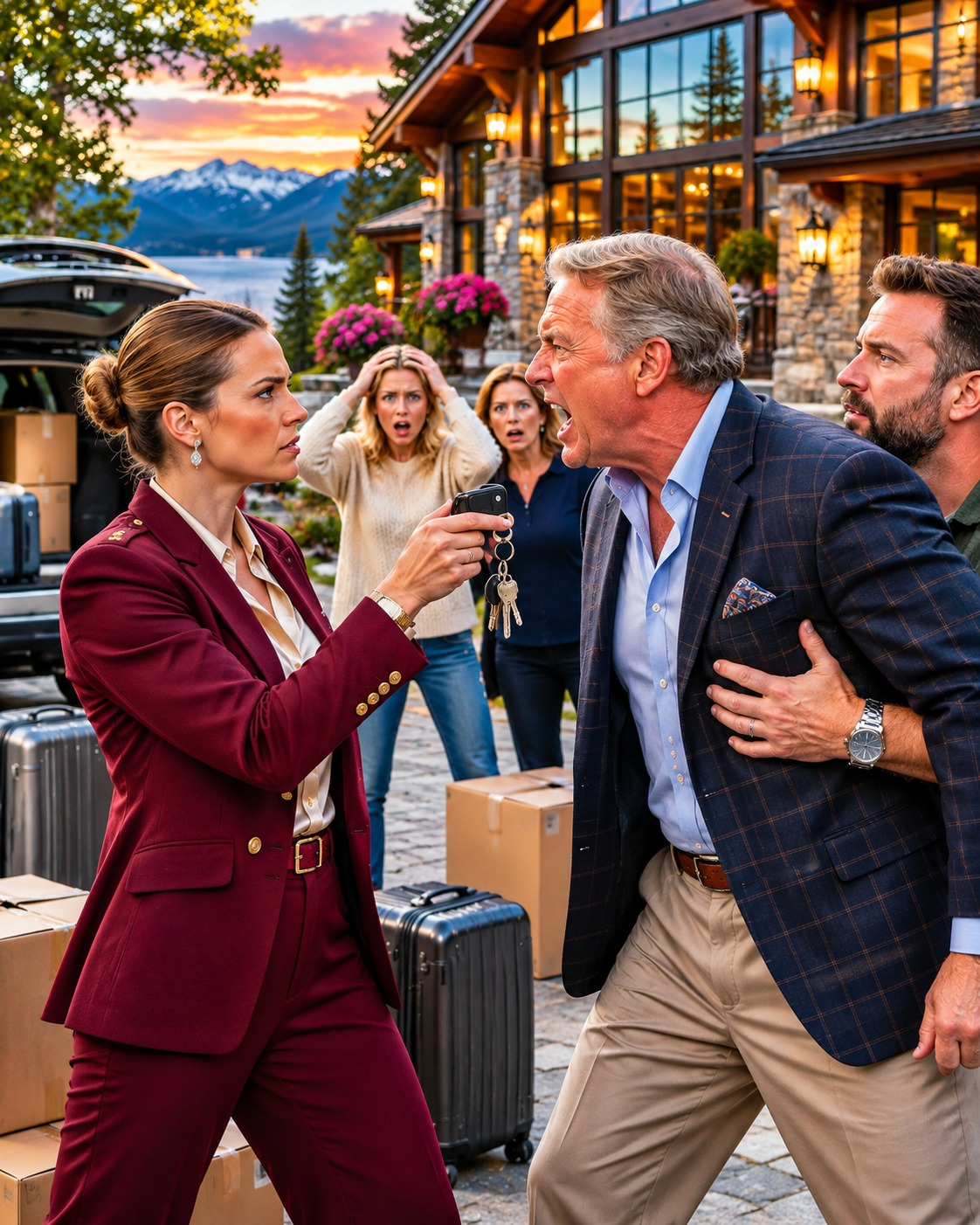
"GET OUT OF MY HOUSE, COMMANDER!"
My father slammed his champagne glass onto the kitchen counter as I stood in the doorway holding my military duffel bag.
Beside his glass lay a silver key ring.
One of the keys had a tiny brass tag engraved with two letters.
J.R.
James Reynolds.
My dead husband's initials.
That was when I realized this wasn't just about my house.
My father had taken something he was never supposed to touch.
Three hours earlier, I had been driving north with nothing on my mind except a hot shower, a quiet dinner, and the kind of sleep that only comes after three exhausting weeks at sea.
I had spent twenty years serving in the United States Navy.
Twenty years of deployments, emergency assignments, missed birthdays, sleepless nights, and responsibilities that never seemed to end.
I was Commander Rebecca Reynolds, forty-two years old, and I had learned to remain calm when everything around me was falling apart.
But nothing in my military training had prepared me for what I found when I opened the front door of my Lake Tahoe villa.
The first thing I heard was laughter.
Then came the sound of champagne glasses clinking.
Someone had turned on music in my living room.
And hanging above the fireplace, where my late husband's favorite photograph had always stood, was a large framed portrait of my younger sister Olivia, her husband David, and their two children.
I stopped walking.
For several seconds, I simply stared.
There were cardboard boxes stacked beside the staircase.
Children's toys covered the coffee table.
A pink balloon floated near the ceiling.
Someone had moved my husband's reading chair away from the fireplace.
And my father was standing in the center of the room, holding a champagne glass like a man celebrating the purchase of a new mansion.
Except he hadn't purchased anything.
I had.
Every square foot.
Every window.
Every piece of furniture.
I had paid for it with money James and I had saved throughout our marriage.
And now my family was throwing a party inside it.
"Rebecca!"
My father smiled when he noticed me.
It was the same smile he used whenever he was about to ask for something expensive.
"You're home early."
I looked at the balloons.
Then the boxes.
Then Olivia, who was sitting comfortably on my sofa with a champagne glass in her hand.
"What is going on?"
Nobody answered immediately.
Susan, my father's wife, exchanged a glance with Olivia.
David suddenly became fascinated with the television remote.
My father took another sip of champagne.
"Well," he said, "we were hoping to have everything settled before you arrived."
"Everything?"
He gestured around the room.
"Olivia and David are moving in."
I waited for him to finish.
He didn't.
"Moving in where?"
My father frowned.
"Here, Rebecca. Obviously."
For a moment, I thought I had misunderstood.
I had been awake for almost twenty hours.
Perhaps exhaustion was making ordinary words sound ridiculous.
"You're saying Olivia is staying here for a few days?"
Olivia laughed.
Not a nervous laugh.
A confident one.
"Oh, Rebecca. Don't be dramatic."
She lifted her champagne glass.
"We're moving here permanently."
I looked at her.
Then at my father.
Then back at her.
"Who gave you permission?"
My father set his glass down.
"I did."
Two words.
Spoken with absolute certainty.
I felt something tighten behind my ribs.
"Dad, you don't own this house."
His expression changed.
Not into embarrassment.
Into irritation.
As though I had interrupted a perfectly reasonable conversation.
"Rebecca, don't start."
"Don't start what?"
"An argument."
I stared at him.
"You invited people to move into my home without asking me, and you think I'm starting an argument?"
Susan sighed loudly.
"Must everything become a confrontation with you?"
I turned toward her.
"Did you know about this?"
She folded her arms.
"Your father was trying to do something good for his family."
"His family?"
Olivia stood up.
"Yes, Rebecca. Family. Remember that word?"
I looked at the portrait above the fireplace.
It showed Olivia and David smiling with their children in matching blue sweaters.
It was a beautiful photograph.
Under different circumstances, I might have complimented it.
But it was hanging where James's photograph belonged.
"Where is my husband's picture?"
Olivia glanced toward the fireplace.
"Oh. That old thing?"
My stomach dropped.
"What did you do with it?"
She shrugged.
"I put it somewhere safe."
"Where?"
"I don't remember. One of the boxes, probably."
I set my duffel bag on the floor.
Slowly.
Carefully.
Because if I moved too quickly, I was afraid I might do something I would regret.
"Take your portrait down."
Olivia blinked.
"Excuse me?"
"Take it down. Put James's photograph back. And then explain why your belongings are in my house."
My father stepped between us.
"Enough."
I looked at him.
He was sixty-five, broad-shouldered, silver-haired, and still convinced that raising his voice made him right.
For most of my childhood, it had worked.
When he shouted, I apologized.
When he criticized me, I tried harder.
When he demanded something, I gave it to him.
Even after I became a naval officer, some small part of me still wanted his approval.
But I was no longer the frightened girl standing in our childhood kitchen.
And this was no longer his house.
"Dad," I said quietly, "you need to tell me exactly what you've done."
He straightened his jacket.
"I've made a decision."
"About property you don't own?"
"About what's best for this family."
He pointed toward Olivia.
"Your sister has two children. They need space. They need stability. They need a proper home."
"Then she and David should buy one."
Olivia gasped.
"Are you serious?"
"Completely."
"You know how expensive houses are!"
"Yes," I said. "I bought one."
David looked down.
For the first time, I noticed that he hadn't said a single word.
That was unusual.
David normally had an opinion about everything.
Football.
Politics.
Interest rates.
The price of groceries.
But now, while his wife and father-in-law discussed taking possession of my property, he seemed determined to become invisible.
"David," I said, "did you agree to this?"
He cleared his throat.
"Rebecca, I think everybody's emotions are running high."
"That's not what I asked."
He looked toward Olivia.
She gave him a warning glance.
He fell silent again.
My father stepped closer.
"This villa is too big for one person."
I stared at him.
He continued.
"You spend most of your life on a military base or aboard a ship. Half the time, this place sits empty."
"That doesn't make it available."
"Olivia can actually use it."
"I use it."
"For what? Sitting around remembering James?"
The room went silent.
I felt as though someone had struck me.
My father noticed.
Of course he noticed.
He had always known where to aim.
James had been dead for three years.
Three years, four months, and eleven days.
I knew because there were mornings when I still reached across the bed expecting to find him there.
He had been my husband, my closest friend, and the one person who never made me feel that love was something I had to earn.
We had discovered the villa during an autumn trip to Lake Tahoe.
The mountains had been covered in golden trees.
James had stood on the terrace with a cup of coffee and said, "Becca, this is where we're going to grow old."
He had imagined a quiet retirement.
A dog.
A vegetable garden.
Long mornings watching the lake.
He never got any of those things.
After his death, I had completed the purchase using the savings we had protected together.
The villa was not a trophy.
It was the last dream we had shared.
And my father had just reduced it to an oversized building that someone else deserved more.
"Don't talk about James," I said.
My voice was barely above a whisper.
Dad rolled his eyes.
"Oh, for heaven's sake. Nobody is disrespecting James."
"You just did."
"You're being too sensitive."
Olivia stepped forward.
"Dad's right. You can't keep living in the past."
I turned toward her.
She was thirty-eight, blonde, attractive, and had spent most of her adult life expecting other people to solve her problems.
Five years earlier, I had bought her an SUV after she told me her family couldn't manage without a reliable vehicle.
I had paid for repairs to her house.
Covered emergency bills.
Helped with her children's expenses.
And now she was standing in my living room, explaining why I didn't deserve the home I owned.
"Olivia," I said, "how long have you been planning this?"
She hesitated.
My father answered for her.
"Long enough."
"How long?"
"Rebecca—"
"How. Long?"
Susan shifted uncomfortably.
Olivia stared at the floor.
And suddenly I understood.
This wasn't a spontaneous decision.
It wasn't a misunderstanding.
They had planned it.
They had waited until I was away on naval exercises.
They had brought boxes into my home.
Moved my belongings.
Replaced my husband's photograph.
And organized a celebration before I could object.
My father lifted his champagne glass again.
"Look, Rebecca. We're not asking you to like it. We're asking you to be reasonable."
I almost laughed.
Reasonable.
That word had followed me my entire life.
Be reasonable, Rebecca.
Your sister needs help.
Be reasonable, Rebecca.
Your father is under pressure.
Be reasonable, Rebecca.
You have a good career.
You can afford it.
I had been reasonable for so long that my family had forgotten I was allowed to say no.
"This is my house," I said.
My father lowered his glass.
"And I'm your father."
"Those are two different things."
His face darkened.
"Watch your tone."
I looked directly into his eyes.
"No."
The word seemed to surprise everyone.
Olivia's mouth opened slightly.
Susan unfolded her arms.
Even David looked up.
My father took a step toward me.
"Excuse me?"
"I said no. You don't get to decide who lives here. You don't get to move my belongings. And you certainly don't get to give away property that belongs to me."
He stared at me for several seconds.
Then he smiled.
It was not a pleasant smile.
"You're forgetting something, Commander."
I felt a chill.
"What?"
He walked toward the kitchen counter.
Beside his champagne glass sat a small silver key ring.
I recognized it immediately.
James had bought that key ring during our first vacation together.
He had engraved his initials on the brass tag because he was always losing his keys.
After he died, I kept it in a locked drawer in my bedroom.
Nobody else was supposed to have it.
My father picked it up.
The keys jingled softly.
"Your mother always said you were stubborn," he murmured.
I took a step forward.
"Where did you get that?"
He ignored the question.
"You think because you wear a uniform and have a fancy title, nobody can tell you what to do."
"Dad. Put those down."
He held the keys higher.
"You think you're better than your own family."
"Those belonged to James."
For the first time, his expression flickered.
Only briefly.
Then he recovered.
"Keys are keys, Rebecca."
I felt my hands go cold.
They had gone into my bedroom.
Opened my private drawer.
Taken something that had belonged to my dead husband.
And they were standing there acting as though I was unreasonable for objecting.
I looked around the room.
At Olivia's champagne.
At Susan's folded arms.
At David's silence.
At my father's satisfied expression.
Something inside me changed.
Not suddenly.
Not dramatically.
It was more like a door closing.
A door I had kept open for decades.
"All right," I said.
My father blinked.
"What?"
"All right."
I picked up my duffel bag.
Olivia frowned.
"Wait. That's it?"
I looked at her.
"What were you expecting?"
She didn't answer.
But I knew.
She had expected screaming.
Tears.
A dramatic confrontation that she could later describe to relatives as proof that I was unstable.
My father had expected me to beg.
Susan had expected me to apologize.
Instead, I walked toward the front door.
"Rebecca," Dad called.
I stopped.
"You're not going to make a scene?"
I looked back at him.
"No."
He seemed almost disappointed.
"Good. Maybe you're finally growing up."
I glanced at James's key ring in his hand.
Then at the family portrait above the fireplace.
Then at the house I had purchased with years of sacrifice.
"Enjoy your celebration," I said.
I walked outside.
The evening air felt cold against my face.
My truck was parked near the stone driveway.
Behind me, music started playing again.
Someone laughed.
A champagne cork popped.
I climbed into the driver's seat and closed the door.
For several minutes, I couldn't move.
I stared at the glowing windows of my villa.
At the mountains beyond the lake.
At the home James had dreamed of sharing with me.
And I cried.
Not loudly.
Not uncontrollably.
Just enough to let the pain escape before I had to become Commander Reynolds again.
Then I wiped my face.
Started the engine.
And drove away.
My father believed he had won.
Olivia believed she had inherited a mansion.
Susan believed the family had finally put me in my place.
And David probably believed staying quiet would protect him from whatever happened next.
None of them understood that I had spent twenty years learning how to handle situations where emotion could get people hurt.
I wasn't going to threaten them.
I wasn't going to destroy anything.
I wasn't going to risk my career or my freedom over their cruelty.
I was going to do something far more effective.
I was going to document everything.
By midnight, I had reached a hotel near Sacramento.
I opened my laptop.
Logged into my secure personal document archive.
And began reviewing the records connected to the villa.
Purchase agreement.
Deed.
Insurance policy.
Tax statements.
Renovation invoices.
Every major document carried my name.
Not my father's.
Not Olivia's.
Mine.
Then I opened the folder containing the estate paperwork James and I had prepared years earlier.
Most of it was exactly as I remembered.
But near the bottom was a scanned document I hadn't looked at since the year after his death.
It was a property-access authorization.
I opened it.
My signature appeared on the final page.
So did the date.
And beneath a paragraph I barely remembered reading was a sentence that made me sit perfectly still.
I enlarged the document.
Read the sentence again.
Then reached for my phone.
Because the authorization named one person who had once been allowed access to the villa.
And that person's name was...






Comments 0