"Your mother has been served."
Richard Ellis stood outside my front door, holding a sealed legal envelope.
Beside him was a younger man in a dark suit.
Behind them, a black sedan waited at the curb.
I looked at the envelope.
Then I looked at Richard.
For years, this man had manipulated my father's financial arrangements, frightened my mother, and used people I trusted to take money that never belonged to him.
Now he was standing on my porch, smiling as though he had already won.
"Served with what?" I asked.
Richard adjusted his jacket.
"A petition concerning your mother's financial capacity and the management of certain family assets."
I felt my jaw tighten.
"You filed a petition against a seventy-four-year-old woman?"
He shrugged.
"Age isn't the issue, Daniel. Competence is."
Behind me, I heard my mother gasp.
I turned.
Evelyn stood in the hallway.
Claire was beside her.
Vanessa remained near the staircase.
Richard looked past me.
"Good evening, Evelyn."
My mother immediately lowered her eyes.
And that small movement told me everything.
Even after everything we had discovered, she was still afraid of him.
I stepped between them.
"You're not coming inside."
Richard smiled.
"That's unfortunate. I hoped we could resolve this privately."
"Then you should have stopped stealing from my family."
His smile disappeared.
The younger man beside him cleared his throat.
"Mr. Carter, I'm here to deliver legal documents. I'm not involved in the underlying dispute."
I looked at him.
"Then you can leave them with me."
He explained that the papers were addressed to Evelyn and identified the required recipient.
I turned toward my mother.
"Mom, you don't have to speak to Richard."
She looked at the envelope.
Then she did something I hadn't expected.
She stepped forward.
Her hands were trembling.
But her voice was steady.
"Give me the papers."
Richard's expression changed.
"Evelyn, perhaps we should discuss—"
"No."
One word.
Quiet.
Firm.
My mother looked directly at him.
"I said give me the papers."
The younger man handed her the envelope.
She accepted it.
Then she looked at Richard.
"You don't get to tell me what to do anymore."
For the first time, Richard Ellis had nothing to say.
I closed the door.
My mother stood in the hallway holding the envelope.
She looked exhausted.
I reached toward her.
"Mom, let me take that."
She shook her head.
"No, sweetheart."
I stopped.
She looked at the documents.
"I want to read them."
Claire moved closer.
"We'll help you."
Mom nodded.
"But I want to understand what they're saying about me."
We went into the dining room.
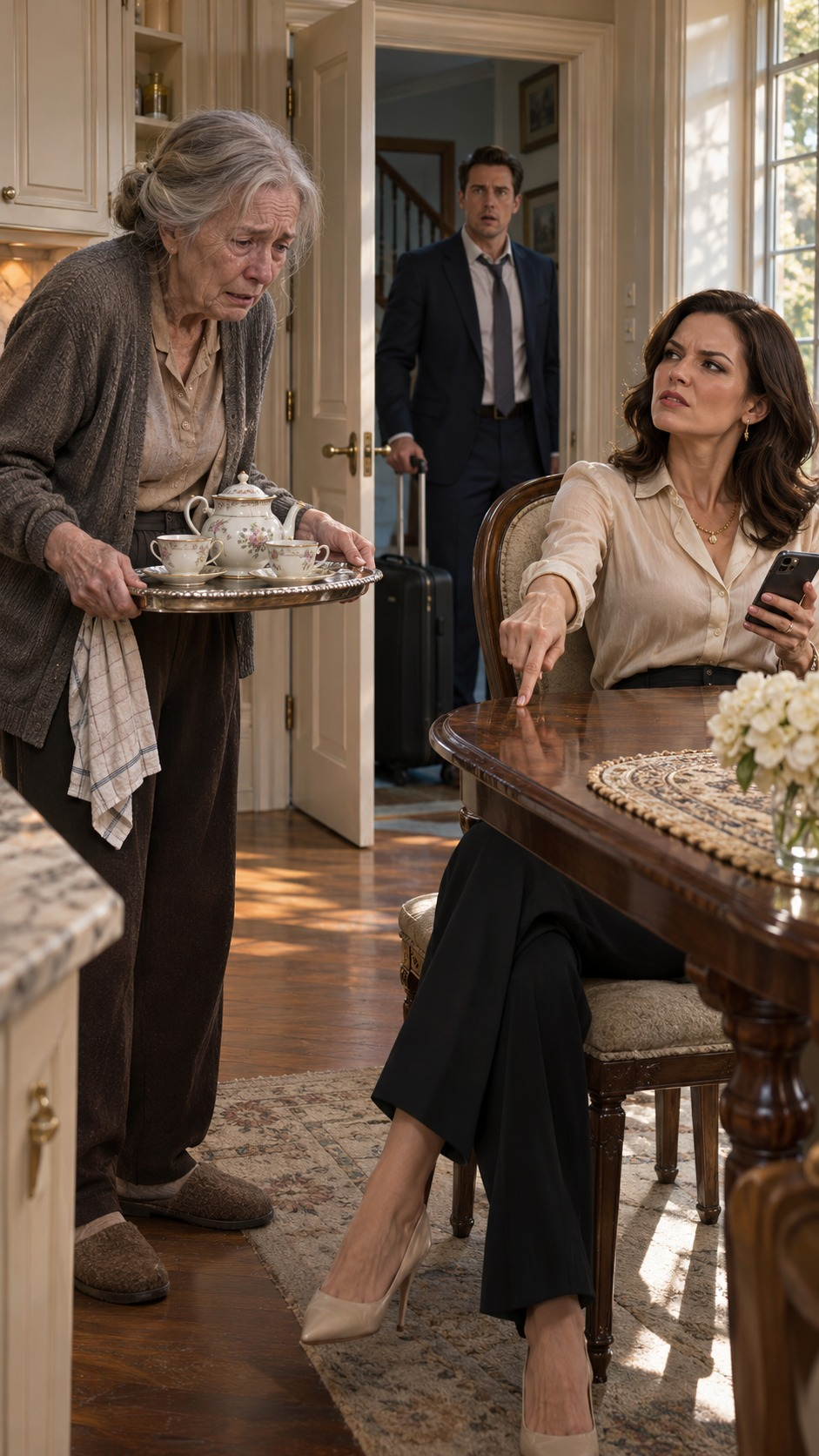
The same room where, only days earlier, I had discovered my mother carrying a silver tea tray with shaking hands.
The same room where Vanessa had ordered her to wipe the table again.
The same room where Evelyn had whispered two words that changed my life.
"Yes, Madam."
Now my mother sat at the head of the table.
I placed a glass of water beside her.
She opened the envelope.
The petition claimed that Evelyn had demonstrated financial confusion and might be vulnerable to exploitation.
It requested temporary oversight of certain assets while her capacity and the disputed financial arrangements were reviewed.
The supporting documents included statements from Richard's company.
And one statement from Vanessa.
I looked across the table.
My wife was staring at the floor.
"Vanessa."
She slowly raised her head.
"Did you sign this?"
She nodded.
"When?"
"Two weeks ago."
I felt my chest tighten.
"Before I came home early?"
She nodded again.
I looked at the statement.
It described my mother as forgetful, dependent, and unable to manage important decisions.
I remembered Evelyn organizing her own medications.
Remembered her reading the newspaper every morning.
Remembered her asking intelligent questions about her bank statements.
And I remembered the fear in her eyes when she thought she had displeased Vanessa.
"You wrote that she couldn't make decisions for herself."
Vanessa began crying.
"Richard told me it was necessary."
I shook my head.
"You knew it wasn't true."
She looked toward Evelyn.
"Yes."
My mother closed the document.
Then she looked at Vanessa.
"Why did you hate me so much?"
Vanessa covered her mouth.
"I didn't hate you."
Mom's voice remained calm.
"Then why did you treat me like I was nothing?"
Vanessa had no answer.
I watched my mother carefully.
She wasn't shouting.
She wasn't crying.
She was finally asking the question she had been too frightened to ask.
Vanessa whispered, "I thought if you agreed to the arrangement, Richard would leave us alone."
Mom shook her head.
"You could have told Daniel."
"I know."
"You could have told Claire."
"I know."
"You could have told me the truth."
Vanessa lowered her head.
My mother took a slow breath.
"Instead, you made me afraid inside my own home."
The room went silent.
Then Evelyn said something I would never forget.
"I was willing to forgive mistakes, Vanessa. But you kept making choices that hurt me."
Robert arrived that evening.
He examined the petition and the supporting statements.
Then he looked at Evelyn.
"Mrs. Carter, this filing does not mean anyone has taken control of your money or your home. It's a request to the court, and we can challenge it."
Mom nodded.
"Will I have to leave?"
"No. There is no order requiring that."
She exhaled.
Robert continued.
"We have your husband's original instructions, the account records, and evidence that some of the statements supporting this petition are unreliable. We'll respond through the proper legal process."
I looked at him.
"What about Richard?"
Robert placed his briefcase on the table.
"Investigators are reviewing the financial transfers. Mark has provided records, and Rebecca has given a statement."
"Is Richard going to be arrested?"
"I can't promise an outcome or a timeline. But the evidence is being taken seriously."
I nodded.
It wasn't the immediate justice I wanted.
But it was real.
And for the first time, we weren't relying on Richard's version of events.
Robert turned toward my mother.
"Evelyn, there's something important I want you to understand."
She looked up.
"Yes?"
"You're entitled to make your own decisions. If you want assistance, that assistance should come from people you choose."
Mom looked at Claire.
Then at me.
"I want my children to help me."
I reached for her hand.
"We will."
She shook her head gently.
"But I don't want either of you making every decision for me."
I smiled through tears.
"Then we won't."
She looked at Robert.
"I want to learn how to check my accounts myself."
Robert nodded.
"We can arrange that."
Then Mom sat a little straighter.
"And I want Richard Ellis to stay away from my house."
Robert made a note.
"We'll address that as well."
The following morning, I called Michael.
He answered almost immediately.
"Daniel?"
"Hey."
There was a pause.
"Is everything okay?"
I looked toward the kitchen.
Mom was sitting with Claire, drinking coffee.
For the first time in months, she wasn't waiting for someone to tell her what to do.
"Things are getting better," I said.
Michael exhaled.
"I'm glad."
I hesitated.
Then I asked the question I'd been thinking about all night.
"Would you like to meet us?"
He didn't answer immediately.
Finally, he whispered, "You mean you and Claire?"
"And Mom."
Another pause.
"Your mother knows about me?"
"Yes."
"Does she want to meet me?"
I looked toward Evelyn.
She had already told me she hoped to see him again.
"More than you know."
Michael's voice became unsteady.
"I don't want to cause problems."
I closed my eyes.
That sentence hurt.
A thirty-one-year-old man had spent his life believing his existence was something that needed to be hidden.
"Michael, you didn't cause any of this."
He took a shaky breath.
"I've always wondered what it would be like to have a brother."
I smiled.
"Me too."
We arranged for him to visit the following weekend.
Before ending the call, he asked one final question.
"Daniel?"
"Yeah?"
"Was our father a good man?"
I looked at the photograph on the mantel.
My father holding me as a child.
My father standing beside Claire at graduation.
My father smiling beside Evelyn.
Then I thought about Linda.
About Michael.
About the secrets.
About the mistakes.
And about the letters he'd left behind.
"He was a man who loved his family," I said carefully. "But he made some serious mistakes. I won't pretend otherwise."
Michael was quiet.
Then he whispered, "Thank you for telling me the truth."
The next several weeks were difficult.
There were meetings with attorneys.
Interviews.
Bank records to review.
Documents to sign.
And conversations I never imagined I would have.
Vanessa moved out of the house.
I didn't ask her to leave in anger.
I told her calmly that our marriage could not continue as though nothing had happened.
She had helped Richard obtain access to my mother's finances.
She had signed statements she knew were misleading.
And she had treated a vulnerable woman with deliberate cruelty.
Those weren't misunderstandings.
They were choices.
Vanessa cried.
She apologized.
She said she wanted to change.
I told her I hoped she would.
But I also told her that apologies could not erase what she'd done.
We separated, and I began divorce proceedings.
Vanessa obtained legal counsel and cooperated with investigators.
Her cooperation mattered.
But it didn't restore the trust she'd destroyed.
One evening, while she was collecting the last of her belongings, she stopped in the hallway.
"Daniel?"
I turned.
"Yes?"
She looked toward the kitchen.
"Do you think your mother will ever forgive me?"
I thought for a moment.
"That's her decision."
Vanessa nodded.
Then she whispered, "I really did love you."
I looked at her.
"Maybe you did."
She began crying.
"But love doesn't give someone permission to hurt the people who depend on them."
She lowered her head.
Then she picked up her suitcase and left.
I watched her car disappear down the street.
I felt sadness.
Not because I wanted her back.
But because I remembered the woman I thought I'd married.
The woman who smiled at family dinners.
The woman who told me she loved having Evelyn in our home.
The woman who kissed my cheek while my mother stood beside the table, terrified.
I had loved someone who wasn't honest with me.
And I had ignored signs because I wanted to believe our marriage was happy.
That was a painful truth.
But it was one I needed to accept.
Michael arrived on a Saturday afternoon.
I was standing on the porch when his rental car pulled into the driveway.
He stepped out slowly.
He was tall.
Dark-haired.
With my father's eyes.
For a moment, neither of us moved.
Then he smiled nervously.
"Daniel?"
I nodded.
"Michael."
He walked toward me.
We shook hands.
It felt strangely formal.
Then he laughed.
"This is weird."
I laughed too.
"Yeah. It is."
He looked at the house.
"So this is where Dad lived?"
"Yes."
He nodded slowly.
I could see the emotion building behind his eyes.
Then he asked:
"Can I come in?"
I stepped aside.
"Of course."
Claire was waiting in the living room.
She hugged him almost immediately.
Michael looked surprised.
Then he hugged her back.
I watched them.
For years, we'd been living separate lives without knowing we were connected.
And now we were standing in the same room.
But the most important moment was still ahead.
Mom appeared in the hallway.
She wore a soft blue sweater.
Her silver hair was neatly brushed.
She had insisted on preparing lunch herself, with Claire helping.
When Michael saw her, he stopped.
Evelyn stared at him.
Then her eyes filled.
"Michael?"
He nodded.
"Yes, ma'am."
She covered her mouth.
"Oh, sweetheart."
He looked uncertain.
"I don't know if you remember me."
Mom began crying.
"I do."
He stared at her.
She took a small step forward.
"You were twelve years old. You were playing basketball in the park."
Michael's eyes widened.
He looked at her.
Then he whispered:
"You're the lady who gave me my ball back."
Mom nodded.
Tears rolled down her cheeks.
"I told you that you had a beautiful smile."
Michael covered his mouth.
For several seconds, he couldn't speak.
Then he stepped forward.
"That was you?"
She nodded again.
He wrapped his arms around her.
And my mother held him as though she'd been waiting twenty years for that moment.
I turned away.
Claire was crying beside me.
Michael whispered something into Evelyn's shoulder.
I couldn't hear it.
Then Mom answered.
"You were never unwanted, sweetheart."
That was when I began crying too.
The financial investigation continued over the following months.
Mark Ellis provided transaction records showing that Richard had directed unauthorized transfers through several accounts connected to Northfield.
Rebecca's statement helped establish how the original hospital arrangements had been altered.
Linda supplied records confirming that funds intended for Michael had been redirected without her authorization.
And my father's documents from box 718 connected the earliest disputed transfers to the later withdrawals from Evelyn's account.
The evidence was complicated.
But it told a consistent story.
Richard had taken advantage of a family secret.
He had used fear to keep people silent.
He had relied on old documents to create the appearance of authority.
And when the original financial arrangements became difficult to conceal, he had drawn Mark and Vanessa into new transactions.
Eventually, criminal charges were filed against Richard in connection with the fraudulent transfers and falsified financial records.
He denied wrongdoing.
But the case proceeded.
Mark cooperated under the guidance of his attorney.
Vanessa also provided information about the documents she had signed and the instructions she'd received.
Their cooperation did not erase their responsibility, but it helped investigators establish what had happened.
The petition concerning my mother's financial capacity was withdrawn.
Her bank access was restored under arrangements she personally approved.
The disputed representative authorizations were canceled.
And the bank worked with her attorney to strengthen the protections on her accounts.
Several months later, Richard entered a guilty plea to financial fraud charges.
He was sentenced to prison and ordered to pay restitution.
The recovery process took longer.
Some funds had been moved repeatedly.
Some had been spent.
But investigators traced substantial amounts through the accounts Mark had identified.
Between recovered assets, restitution payments, and negotiated financial settlements, the disputed balances were eventually restored to Evelyn's account and Michael's trust.
It didn't happen overnight.
It took patience.
It took evidence.
And it took people finally telling the truth.
But the money returned to the people it belonged to.
When Robert called with the final confirmation, I was sitting beside Mom in the garden.
I listened carefully.
Then I ended the call.
Mom looked at me.
"Good news?"
I nodded.
"Very good news."
She smiled.
"Tell me."
"Your money is back, Mom. The final recovery has been completed."
She stared at me.
Then she whispered:
"All of it?"
"Everything covered by the settlement and restitution agreement. Robert confirmed the accounts."
She closed her eyes.
For a moment, I thought she might cry.
Instead, she took a long breath.
Then she said:
"Good."
I laughed softly.
"That's all?"
She opened her eyes.
"Daniel, I've spent enough time being afraid of money."
I smiled.
She looked toward the flowers.
"I just want to enjoy my life."
By the following spring, things had changed in ways I never expected.
Claire visited more often.
Michael came whenever he could.
Linda joined us for several family dinners.
And my mother began doing things she hadn't done in years.
She joined a book club.
She started taking short walks with a neighbor.
She signed up for a beginner's painting class.
She even bought herself a new dress.
A beautiful green one.
When I asked what the occasion was, she smiled.
"No occasion."
I laughed.
"Then why the dress?"
She looked at herself in the mirror.
"Because I liked it."
I stood in the doorway.
For a moment, I couldn't speak.
It was such a simple thing.
A seventy-four-year-old woman buying a dress because she liked it.
But after everything she'd endured, it felt enormous.
She turned toward me.
"Do you think it's too bright?"
I shook my head.
"No, Mom."
She smiled.
"I think I'll wear it to lunch with Claire."
"Good idea."
Then she walked past me.
And I realized something.
For the first time since her hip surgery, my mother was moving through the house without looking over her shoulder.
She wasn't waiting for instructions.
She wasn't apologizing for taking up space.
She wasn't trying to earn permission to exist.
She was simply living.
And that was worth more than any amount of money.
One Sunday afternoon, almost a year after the day I came home early, we gathered around the dining table.
Claire had brought dessert.
Michael had arrived from Colorado with Linda.
Mom had prepared her favorite roast chicken.
I had made mashed potatoes.
The kitchen was full of conversation.
Real conversation.
Laughter.
Stories.
Arguments about football.
Michael telling Claire about his job.
Linda asking Mom about her painting class.
At one point, Michael looked at me.
"Daniel, can I ask you something?"
"Sure."
He smiled.
"Do you ever think about how different everything would have been if you'd stayed in Cincinnati until Friday?"
I looked around the table.
At Claire.
At Linda.
At Michael.
At my mother.
Then I thought about that Wednesday afternoon.
Three thirty.
My suitcase still in my hand.
The sound of porcelain rattling.
Vanessa's cold voice.
And my mother's trembling reply.
"Yes, Madam."
I took a breath.
"Every day."
Michael nodded.
"That flight change really changed everything."
I looked at Mom.
She was smiling at something Claire had said.
"Yeah," I whispered. "It did."
After dinner, Mom stood to clear the plates.
I immediately reached for them.
"I've got it."
She laughed.
"Daniel, I can carry a plate."
I smiled.
"I know."
She looked at me.
"Then let me."
I stepped aside.
She picked up two plates and carried them toward the kitchen.
No trembling.
No fear.
No one ordering her to hurry.
No one demanding she call them Madam.
Just my mother.
In her own home.
Doing something because she wanted to.
I followed her into the kitchen.
She placed the plates beside the sink.
Then she turned toward me.
"Daniel?"
"Yeah, Mom?"
She reached for my hand.
"I never thanked you properly."
I frowned.
"For what?"
She smiled gently.
"For coming home."
I felt my throat tighten.
"Mom, you don't have to thank me."
She squeezed my hand.
"I know."
Then she looked toward the dining room, where the others were laughing.
"But I want to."
I put my arms around her.
She hugged me tightly.
For a long moment, neither of us spoke.
Then she whispered:
"I thought I was going to spend the rest of my life being afraid."
I closed my eyes.
"Not anymore."
She pulled back.
Her eyes were wet.
But she was smiling.
"Not anymore," she repeated.
Later that evening, after everyone had gone home, I sat alone at the dining table.
The house was quiet.
But it was a different kind of quiet.
Not the silence of fear.
Not the silence of people hiding secrets.
Not the silence of someone waiting for anger to erupt.
It was peaceful.
I looked at the framed photograph on the mantel.
My father.
My mother.
Claire.
Me.
And beside it was a newer photograph.
Taken only a few weeks earlier.
Mom standing between Claire and Michael.
Linda smiling beside them.
And me standing behind everyone, laughing because Michael had made a terrible joke just before the camera clicked.
It wasn't the family I thought I had.
But it was the family we had become.
My father had left us complicated truths.
His mistakes had caused pain.
His secrecy had allowed Richard to exploit people who trusted him.
But the truth had finally come out.
Michael knew where he came from.
Linda no longer had to hide.
Claire and I understood our mother's sacrifices.
And Evelyn had reclaimed the life that others tried to take from her.
I thought about Vanessa.
I didn't hate her.
But I no longer confused forgiveness with allowing someone back into my life.
Our divorce had been finalized.
We had gone our separate ways.
I hoped she would learn from what happened.
But my responsibility was no longer to protect her from the consequences of her choices.
My responsibility was to live honestly.
To protect the people I loved without controlling them.
And to make sure my mother never again felt that her place in our family depended on obedience.
I stood and turned off the dining room light.
As I walked toward the hallway, I heard Mom call from her bedroom.
"Daniel?"
I stopped.
"Yeah?"
"Don't forget your lunch tomorrow. I made you a sandwich."
I smiled.
"Thanks, Mom."
Then she added:
"And don't work too late."
I laughed.
"I'll try."
She appeared in the doorway wearing her favorite cardigan.
Not the old gray one she'd worn while serving Vanessa.
A new cream-colored cardigan she'd chosen herself.
She looked at me.
"Good night, sweetheart."
"Good night, Mom."
She smiled and closed her door.
I stood there for a moment.
Then I looked back toward the kitchen.
Almost a year earlier, I'd walked into that room and discovered that my mother was being treated like a servant.
I had thought the worst part was hearing her call my wife Madam.
But I eventually understood that the worst part was seeing how deeply she believed she had no right to say no.
That belief had been planted slowly.
Through threats.
Through guilt.
Through financial manipulation.
Through the repeated suggestion that she was old, helpless, and unwanted.
And it had taken time to undo.
Not one dramatic confrontation.
Not one recording.
Not one court decision.
Time.
Truth.
Patience.
And the freedom to make her own choices.
I reached for the kitchen light switch.
Then I noticed something on the counter.
A silver tea tray.
The same one my mother had been carrying that Wednesday afternoon.
She had polished it that morning.
And placed a small vase of fresh flowers on it.
I stared at it.
Then I smiled.
For months, that tray had represented humiliation.
Now it held flowers.
Nothing more.
Nothing less.
I switched off the light.
And as I walked upstairs, I realized that the most important thing I'd brought home from Cincinnati wasn't my suitcase.
It was the chance to see what had been happening in front of me.
To stop pretending everything was fine.
To listen when someone I loved was too frightened to speak.
And to understand that protecting family doesn't mean controlling them.
It means making sure they are free.
My mother was seventy-five now.
She had survived surgery.
Betrayal.
Financial exploitation.
And years of carrying secrets that were never hers to bear.
But she wasn't defined by any of those things.
She was Evelyn Carter.
A mother.
A grandmotherly presence to the younger people in our extended family.
A woman who loved painting, gardening, and old movies.
A woman who had once chosen kindness toward a child who wasn't hers.
A woman who deserved dignity long before anyone thought to fight for it.
And now, finally, she had it.
The next morning, I came downstairs to find her sitting at the kitchen table.
Sunlight streamed through the window.
She was reading the newspaper.
A cup of coffee sat beside her.
When she saw me, she smiled.
"Good morning, Daniel."
"Morning, Mom."
She folded the paper.
"Coffee?"
"Sure."
She reached for the pot.
I started to stand.
"I can get it."
She waved me back into my chair.
"Sit down. I'm already up."
I laughed.
"Okay."
She poured the coffee.
Then she sat across from me.
For a few minutes, we talked about ordinary things.
The weather.
Claire's plans.
Michael's next visit.
A painting she wanted to finish.
Nothing dramatic.
Nothing frightening.
Just life.
Then Mom looked at me and smiled.
"You know something, Daniel?"
"What?"
She took a sip of coffee.
"I think I'm going to have a very good year."
I looked at her.
And for the first time in a long time, I knew she was right.






Comments 0