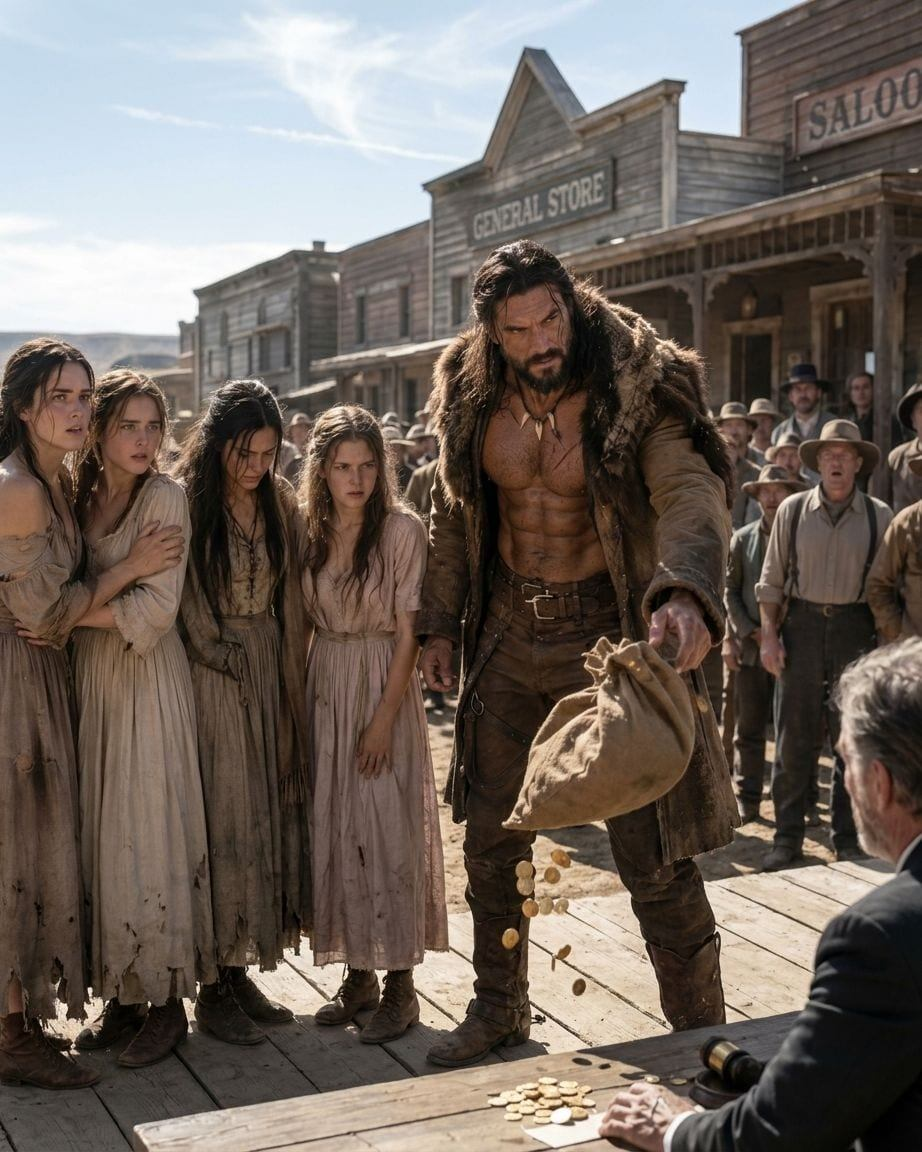
"Don't touch my sister!" Nora Hayes screamed, pulling eight-year-old Josie away from the man reaching toward the auction platform.
Bank manager Amos Farrow stepped forward with a leather-bound debt ledger.
A small red mark appeared beside the Hayes family name.
Beside it were four numbers.
Twenty. Seventeen. Fourteen. Eight.
Farrow wasn't recording what the sisters owed.
He was recording what each of them was worth.
And the man who had come to stop him knew exactly why.
Nora didn't know that yet.
All she knew was that her youngest sister was shaking so badly she could barely stand.
"Please," Josie whispered. "I want Mama."
Nora tightened her arms around the little girl.
"I know, sweetheart."
"Can we go home?"
The question hurt worse than anything the men in the square had said.
Home.
Two weeks earlier, home had meant a crooked little sod house three miles beyond the eastern ridge. It had meant a kitchen table with one broken leg, a roof that leaked during spring storms, and their mother's voice humming while she kneaded bread.
It had meant their father coming through the door after sunset, his boots covered in dirt, pretending he had found a silver dollar behind Josie's ear.
It had meant Clara complaining about the cold, Maeve stealing biscuits before supper, and Nora pretending she didn't notice.
They had been poor.
Terribly poor.
But they had belonged somewhere.
Then cholera came.
Their father died first.
William Hayes had been a stubborn man, the sort who believed a little fever could be cured by hard work and a strong cup of coffee.
By the second morning, he couldn't stand.
By the third, he was gone.
Their mother followed two days later.
Nora remembered every moment of that final night.
The way her mother's hand had felt against her cheek.
The way her lips had moved when speaking became difficult.
And the last thing she had managed to say.
"Keep them together."
Three words.
That was all.
Nora had promised.
Now she stood on a wooden platform in the center of Red Creek, watching strangers argue over how much her sisters were worth.
And she was beginning to understand that a promise could become a terrible burden when the whole world seemed determined to break it.
"Stand straight, girl."
Mayor Higgins tapped his wooden gavel against the auction table.
Nora looked at him.
He wore a black bowler hat and a dark suit that had once been expensive. Sweat ran down his temples, disappearing into the collar of his shirt.
He looked irritated.
Not ashamed.
Not troubled.
Irritated.
As though selling four orphaned girls were an unpleasant chore delaying his afternoon whiskey.
"I said stand straight."
Nora lifted her chin.
"I'm standing."
A few men laughed.
Higgins narrowed his eyes.
"You'd do well to remember your position."
"My position?"
"That's right."
Nora glanced at her sisters.
Clara stood beside her in a faded dress, her hands folded tightly at her waist. At seventeen, she had their mother's quiet eyes and their father's stubborn mouth.
Maeve, fourteen, looked ready to bite someone.
Josie simply clung to Nora's skirt.
Nora turned back to the mayor.
"My position is right here. With my family."
Higgins sighed.
"Nobody is disputing that you're sisters."
"Then don't separate us."
"The law is the law."
"Whose law?"
The laughter stopped.
Higgins stared at her.
Amos Farrow stepped forward before the mayor could answer.
"Territorial debt recovery statute," he said smoothly. "Your father signed an obligation. He failed to satisfy it. His estate must answer for the balance."
"Our father never borrowed five hundred dollars."
Farrow smiled.
It was a small smile.
The kind a man gave when he already knew the ending of a conversation.
"Your father signed the papers."
"Then show them to me."
"You're not entitled to examine bank documents."
"Why not?"
"Because you're twenty years old, Miss Hayes, and you have no legal standing to challenge a properly recorded debt."
Nora stared at him.
She knew very little about banking.
She knew even less about territorial law.
But she knew her father.
William Hayes had counted every penny before buying flour.
He had repaired his own boots rather than spend money on new ones.
He had once walked eleven miles to return a dollar a merchant had accidentally given him.
Five hundred dollars?
It might as well have been five thousand.
He would never have borrowed that kind of money without telling his family.
And yet Farrow had appeared beside the fresh graves carrying a ledger and demanding payment.
Nora could still see the scene.
The four sisters standing in black dresses their mother had sewn years earlier.
The wooden crosses behind them.
The bank manager removing his hat.
For one foolish moment, Nora had thought he had come to offer condolences.
Instead, he had opened the ledger.
"Your father's account is overdue."
She had stared at him.
"We just buried him."
"That doesn't erase a debt."
"We have no money."
"Then the estate must be liquidated."
"The farm is all we have."
"The farm is worthless."
And then he had looked at her sisters.
Not with sympathy.
With calculation.
That was when Nora had first felt something cold move through her stomach.
She felt it again now.
"Enough talking," Higgins announced.
He turned toward the crowd.
"Citizens of Red Creek, we are gathered to satisfy the outstanding obligations of the late William Hayes."
A man near the saloon spat into the dirt.
Another adjusted his hat.
Someone laughed.
Nora looked over the faces.
She recognized almost every one.
Mr. Miller, who had bought eggs from her mother.
Mrs. Pritchard, who had once borrowed their sewing machine.
The blacksmith who had repaired their father's wagon.
The shopkeeper who had given Josie a peppermint last Christmas.
They were all here.
Watching.
Nobody stepped forward to help.
"The eldest first," Higgins declared. "Nora Hayes. Twenty years old. Strong, healthy, accustomed to farm labor."
Nora felt Clara's fingers brush her arm.
"Don't," Clara whispered.
Nora didn't look at her.
"Ten dollars starts the bidding," Higgins said.
Silence.
Then a voice called from the crowd.
"Fifteen."
Nora recognized the speaker.
Ephraim Miller.
A thick-necked farmer with yellow teeth and hands like cracked leather.
His third wife had died the previous winter.
People said he worked women harder than his horses.
Miller scratched his chin.
"She looks sturdy enough."
Nora felt sick.
"Twenty," another man called.
"Twenty-five," Miller answered.
Higgins nodded approvingly.
"Twenty-five dollars. Do I hear thirty?"
Nora stepped forward.
"We stay together."
Higgins ignored her.
"Thirty?"
"I said we stay together!"
"Miss Hayes, you are interrupting a lawful proceeding."
"This isn't lawful!"
A murmur spread through the crowd.
Farrow moved closer to the platform.
"Careful, Nora."
She looked down at him.
"Don't call me that."
His smile faded.
"Your father made certain choices. You're paying for them."
"My father was a good man."
"Good men can make foolish decisions."
"Then show me the paper he signed."
Farrow's eyes hardened.
For one brief moment, something changed in his expression.
It was not anger.
It was alarm.
Then he closed the ledger.
"The auction will proceed."
Higgins cleared his throat.
"Twenty-five for the eldest. Now the second girl."
Clara went rigid.
Nora immediately moved in front of her.
"No."
Higgins slapped the gavel against the table.
"Stand aside!"
Clara gently touched Nora's shoulder.
"It's all right."
"No, it isn't."
Clara looked at her with a terrible calmness.
"If we fight, they'll make it worse."
Nora wanted to tell her that nothing could be worse.
But she knew that wasn't true.
The men in the crowd were proof enough.
"Clara Hayes," Higgins announced. "Seventeen. Good health. Quiet disposition. Suitable for domestic service."
"Thirty dollars," Farrow said.
The speed of his bid made Nora turn.
He hadn't even waited for the opening price.
Higgins blinked.
"Thirty?"
"Thirty."
Farrow looked directly at Clara.
"She'll be useful at the saloon."
Clara's face drained.
Maeve lunged forward.
"You stay away from her!"
Nora caught her arm.
"Maeve!"
"I'll kill him!"
The crowd laughed.
Farrow smiled again.
"Such spirit."
Maeve struggled against Nora's grip.
"I mean it!"
"Quiet," Nora whispered.
"He can't take her!"
"I know."
But Nora didn't know.
That was the terrible truth.
She didn't know how to stop any of it.
Her fingers moved instinctively toward her boot.
Inside the worn leather, hidden against her ankle, was a small paring knife.
Its blade was rusted.
Its wooden handle had belonged to their mother.
Nora had taken it from the kitchen on the morning the marshal came for them.
She had told herself it was for protection.
Now she wondered whether carrying it had only been another way of pretending she still had choices.
She looked at Farrow.
At Higgins.
At Miller.
At the armed marshal standing near the hitching post.
She could hurt one of them.
Maybe.
But then what?
The marshal would shoot her.
Clara would be taken to the saloon.
Maeve would be punished.
Josie would be left alone.
Nora slowly moved her hand away from her boot.
For the first time since their parents died, she felt completely powerless.
"Forty for the second," a man called.
Farrow's head snapped toward him.
"Fifty."
Nora looked at Clara.
Her sister's lips trembled.
But she didn't cry.
That made it worse.
Clara had always been the one who cried at sad stories, who rescued injured birds, who couldn't bear to watch their father slaughter chickens.
Now she stood perfectly still while strangers bid on her future.
"Fifty dollars," Higgins announced. "A fine offer."
A woman near the back raised her hand.
"I'll give five for the little one."
Josie lifted her head.
Nora felt her heart stop.
The woman wore a faded bonnet and held a basket against her hip.
She looked ordinary.
That was the most frightening part.
"She's small," the woman continued. "But she can scrub floors. I'll feed her."
Josie whispered, "Nora?"
Nora pulled her closer.
"No."
The woman frowned.
"Well, I ain't paying more than five."
"She's eight years old!"
Higgins struck the table.
"Miss Hayes!"
"She's a child!"
"The youngest will be placed in appropriate service."
"She's not going anywhere!"
The marshal shifted his weight.
Nora saw his hand move toward his holster.
She stopped shouting.
Not because she was finished.
Because Josie was watching her.
And the little girl's face had changed.
She wasn't simply frightened anymore.
She was beginning to understand.
These people meant to take her away.
Not tomorrow.
Not someday.
Today.
"Please," Josie whispered. "Don't let them."
Nora knelt on the wooden platform.
She took her sister's face between her hands.
"Look at me."
Josie's eyes were wet.
"Look at me, sweetheart."
The little girl obeyed.
"I'm right here."
"Promise?"
Nora swallowed.
She remembered her mother's final words.
Keep them together.
She had promised once.
She would promise again.
"Nobody is taking you away from me."
Behind her, Higgins called for another bid.
Nora ignored him.
She kissed Josie's forehead.
Then she stood.
And faced the crowd.
"Listen to me!"
Her voice cracked across the square.
A few men stopped talking.
"We buried our parents fourteen days ago."
Nobody answered.
"My little sister still wakes up calling for our mother."
The woman with the basket looked away.
"Our father worked this land for eleven years. He paid his taxes. He helped repair your fences. He brought water to your homes when the wells ran dry."
Nora looked directly at the blacksmith.
"You knew him."
The man lowered his eyes.
She turned toward Miller.
"You ate at our table."
Miller shrugged.
"Business is business."
Something inside Nora broke.
"Business?"
Her voice rose.
"You're buying human beings!"
Higgins slammed his gavel.
"Enough!"
Nora didn't stop.
"You all stood beside us at the funeral!"
The crowd shifted uneasily.
"You watched us bury our mother!"
Farrow stepped forward.
"Marshal."
The lawman straightened.
Nora saw him coming.
She backed toward her sisters.
"Please," she said.
The word came out smaller than she intended.
"Please don't do this."
Higgins raised his gavel.
"Going once on the eldest for twenty-five dollars."
Nora shook her head.
"Please."
"Going twice."
Maeve grabbed Clara's hand.
Josie began to cry.
Nora looked toward the street.
For one impossible second, she imagined her father coming around the corner.
She could almost see him.
His old brown hat.
His crooked smile.
The way he would lift Josie into his arms and tell the men to leave his girls alone.
But her father was dead.
And the gavel was falling.
Then—
THUD.
A heavy boot struck the first wooden step.
Higgins stopped.
The sound was ordinary enough.
A man climbing stairs.
Yet something about it silenced the nearest bidders.
THUD.
Another step.
The marshal turned.
The men near the general store moved aside.
Nora looked past the auctioneer.
A stranger was climbing toward them.
He was enormous.
Not merely tall.
Massive.
His shoulders seemed too broad for the narrow staircase.
He wore a weathered dark-green coat with a rough fur collar, heavy leather boots, and a hunting knife secured against his thigh.
His sandy-blond beard was streaked with gray.
A pale scar crossed his left cheekbone.
His eyes were the cold gray of winter stone.
He moved slowly.
Deliberately.
As though the entire town could wait until he was ready.
Someone whispered a name.
"Rust."
Another voice answered.
"Gideon Rust."
The crowd went still.
Nora had heard the name before.
Everyone in Red Creek had.
Gideon Rust lived beyond Black Pine Ridge, where the mountain roads disappeared into dense forest and winter storms could bury a cabin beneath ten feet of snow.
He came to town rarely.
He spoke even less.
Some said he had killed three men in a mining dispute.
Others claimed he had once dragged a wounded stranger through a blizzard for six miles.
Nora didn't know which stories were true.
She only knew that even the marshal had taken his hand away from his gun.
Mayor Higgins stared.
"Rust?"
The stranger climbed the final step.
Higgins took a small step backward.
"You're not due down from the mountain until next month."
Gideon said nothing.
His eyes moved across the platform.
First Clara.
Then Maeve.
Then Josie.
Finally Nora.
She straightened instinctively.
She would not let him see her fear.
But he saw it anyway.
His gaze dropped briefly to Josie's trembling hands.
Then to the tear tracks on Clara's cheeks.
Then to the wooden gavel.
Something tightened in his jaw.
"What is this?"
His voice was low.
Deep.
Almost quiet.
Higgins cleared his throat.
"A lawful debt auction."
Gideon looked at the four sisters again.
"Debt?"
"William Hayes died owing five hundred dollars," Farrow announced from below. "His estate is being liquidated."
Gideon turned toward him.
The bank manager's expression changed.
Only slightly.
But Nora noticed.
His smile disappeared.
Gideon studied him for a long moment.
"Farrow."
The bank manager nodded stiffly.
"Rust."
"You still running the bank?"
"Of course."
Gideon looked at the ledger under Farrow's arm.
Then back at the sisters.
"William Hayes had four daughters."
Farrow blinked.
"Yes."
"Four."
"That's correct."
Gideon stared at him.
"And you're selling them separately."
Higgins hurried to explain.
"The law provides for the recovery of outstanding obligations through indentured labor contracts—"
"I didn't ask about the law."
The mayor stopped.
Gideon looked at Nora.
"What's your name?"
She hesitated.
"Nora Hayes."
"How old?"
"Twenty."
He glanced at Clara.
"Seventeen," she whispered.
Maeve lifted her chin.
"Fourteen."
Josie hid behind Nora.
Gideon waited.
After a moment, the little girl whispered, "Eight."
He looked back toward Farrow.
For several seconds, nobody spoke.
Then Gideon asked, "How much?"
Higgins seemed relieved.
"Well, the bidding has begun. The eldest stands at twenty-five, the second at fifty, and—"
"All four."
The mayor blinked.
"Pardon?"
"How much for all four?"
Nora felt Clara's hand tighten around hers.
The crowd began murmuring.
Farrow stepped closer.
"That isn't how the auction works."
Gideon looked at him.
"Then change it."
Higgins gave a nervous laugh.
"Mr. Rust, we can't simply—"
"How much?"
The mayor swallowed.
"Five hundred dollars is the total debt."
Gideon reached inside his coat.
The marshal stiffened.
Several men stepped backward.
But Gideon didn't draw a weapon.
He withdrew a heavy leather pouch.
He placed it on the auction table.
THUMP.
The sound echoed across the wooden platform.
He loosened the cord.
Gold coins spilled across the boards.
Higgins stared.
Farrow's face went pale.
Gideon spoke quietly.
"Five hundred."
Nobody moved.
Nora looked at the coins.
She had never seen so much money in one place.
Her father had worked an entire lifetime and never possessed anything close to that amount.
Higgins opened his mouth.
Closed it.
Then looked toward Farrow.
The bank manager's fingers tightened around the ledger.
"This is highly irregular."
Gideon turned his head.
"Is it?"
"These are separate contracts."
"Then write one."
Farrow's eyes narrowed.
"You cannot simply walk into town and dictate the terms of a lawful sale."
Gideon stepped closer.
Not quickly.
Not threateningly.
He simply moved until Farrow had to tilt his head upward to meet his eyes.
"Five hundred dollars," Gideon repeated.
Then he pointed toward the sisters.
"All four. They stay together."
Nora could barely breathe.
She wanted to believe him.
But she had already learned what promises were worth in Red Creek.
She stepped forward.
"Sir?"
Gideon looked at her.
"If you buy us..."
Her throat tightened.
She forced herself to continue.
"Will you separate us later?"
He studied her face.
"No."
"Will you send Clara to the saloon?"
"No."
"Will you make Josie work?"
His eyes shifted toward the little girl.
"No."
Nora swallowed.
"Then why would you pay five hundred dollars for us?"
For the first time, Gideon's expression changed.
Not much.
Just a shadow passing behind his eyes.
"Because somebody should have stopped this before it started."
The words struck Nora harder than she expected.
She looked away.
She couldn't afford to cry.
Not yet.
Higgins reached toward the money.
Farrow caught his wrist.
"Wait."
The mayor froze.
The bank manager leaned close and whispered something.
Nora couldn't hear the words.
But she saw Gideon watching them.
And she saw the way Farrow's eyes kept returning to the mountain man's scar.
Something was wrong.
Something beyond the auction.
Farrow straightened.
"I'm afraid the bank cannot accept this arrangement."
Gideon's expression remained unchanged.
"Why?"
"Because the debt belongs to the Hayes estate, and there are certain conditions attached to its recovery."
"What conditions?"
"Confidential banking matters."
Gideon held out his hand.
"Show me the note."
Farrow went still.
"The what?"
"The paper William signed."
The bank manager didn't answer.
Gideon's voice lowered.
"Show me."
Higgins looked between them.
"Perhaps we should continue this discussion privately."
"No."
The word was quiet.
Final.
Gideon looked at Farrow.
"Right here."
Nora felt a strange sensation.
For the first time that afternoon, someone was asking the same question she had asked.
And Farrow still wasn't answering.
The bank manager forced a smile.
"The original note is secured at the bank."
"Then we'll go get it."
"That's unnecessary."
Gideon glanced toward the ledger.
"What's in there?"
"Accounts."
"Hayes accounts?"
"Among others."
Gideon extended his hand.
Farrow stepped backward.
The movement was small.
But everyone saw it.
The bank manager had been the most powerful man in Red Creek for as long as Nora could remember.
He controlled mortgages.
He controlled loans.
He decided who received credit at the general store and who lost their land.
People lowered their voices when he entered a room.
Now he was retreating from a man who hadn't raised his voice once.
Gideon looked toward the mayor.
"Take the money."
Higgins hesitated.
Then he reached for the pouch.
Farrow snapped, "Don't!"
The entire square went silent.
Gideon slowly turned back.
"Why not?"
Farrow's face had turned an ugly shade of red.
"Because there are things you don't understand."
Gideon stared at him.
Then he said something that made Nora's stomach tighten.
"I understand William Hayes."
Farrow stopped breathing for a moment.
Nora looked up.
"You knew my father?"
Gideon didn't answer immediately.
His gaze remained fixed on the bank manager.
"Long time ago."
Nora took another step.
"How?"
Before Gideon could speak, Farrow interrupted.
"This has gone far enough."
He turned toward the marshal.
"Remove this man from the platform."
The marshal didn't move.
Farrow's voice rose.
"That's an order!"
The lawman looked at Gideon.
Then at the hunting knife.
Then at the crowd.
"I'm not sure there's been any crime, Mr. Farrow."
"He's interfering with a legal auction!"
Gideon reached toward the money pouch.
He lifted one gold coin.
Turned it between his fingers.
Then placed it carefully on the table.
"I've offered the full debt."
Higgins nodded weakly.
"That is true."
"Then write the receipt."
Farrow's face twisted.
"You have no idea what you're doing."
Gideon leaned forward.
His voice was barely above a whisper.
"Yes, Amos."
He paused.
"I do."
For a moment, the two men stared at each other.
Nora sensed something passing between them.
Recognition.
History.
Fear.
Then Gideon turned toward the sisters.
"Stay close."
Nora nodded.
She didn't know why she trusted him.
Perhaps she didn't.
Perhaps she was simply too exhausted to keep fighting.
But when Josie reached for Gideon's coat, he didn't pull away.
The little girl touched the rough fabric with two fingers.
"Are we going home?"
Gideon looked down at her.
Something softened in his face.
"Not to that house, little one."
Josie's lip trembled.
"Where, then?"
He glanced toward the distant mountains.
"Somewhere safe."
Nora felt her throat close.
Safe.
She had almost forgotten what the word meant.
Higgins finally picked up his pen.
His hand shook as he opened the auction register.
"Very well," he murmured. "Five hundred dollars for the four Hayes sisters, to be held under one contract."
Gideon watched him write.
Nora watched the pen.
Each scratch across the paper seemed impossibly loud.
Higgins signed.
Then he pushed the register toward Farrow.
The bank manager didn't move.
"Amos," Higgins whispered.
Farrow stared at the page.
Then, slowly, he took the pen.
His hand hovered above the paper.
He looked at Gideon.
"You should have stayed on your mountain."
Gideon said nothing.
Farrow signed.
Higgins exhaled.
The mayor tore a receipt from the register and handed it to Gideon.
"Transaction complete."
Gideon examined the paper.
Then folded it and placed it inside his coat.
He looked at the sisters.
"Come."
Nora gathered Josie's hand.
Clara moved beside her.
Maeve followed.
For the first time all afternoon, nobody tried to stop them.
They descended the wooden steps together.
The crowd parted.
Nora felt eyes following them.
Some curious.
Some angry.
Some ashamed.
She didn't look back.
Not until she heard Farrow speak.
"Rust."
Gideon stopped.
The bank manager stood at the edge of the platform, clutching his ledger.
His expression was no longer merely angry.
It was frightened.
"You can't protect them from everything."
Gideon turned.
"No."
He paused.
"But I can protect them from you."
Farrow's face tightened.
Gideon continued toward the street.
Nora hurried to keep up.
They passed the general store.
The blacksmith's shop.
The hitching posts.
A wagon waited near the edge of town, its bed loaded with supplies beneath a canvas cover.
Two horses stood patiently in the traces.
Gideon lifted Josie into the wagon as easily as though she weighed nothing.
Then he helped Clara climb aboard.
Maeve refused his hand.
He didn't argue.
Nora remained beside the wheel.
She looked back toward the town square.
The auction platform was still visible.
So was Farrow.
He stood motionless beside the mayor.
Watching.
Nora turned toward Gideon.
"Mr. Rust?"
He looked at her.
"Why did you really come?"
His eyes narrowed slightly.
"What do you mean?"
"You knew my father."
"Yes."
"You knew about the debt?"
A pause.
"I knew there was trouble."
"What kind of trouble?"
Gideon glanced toward Farrow.
Then back at Nora.
"Your father wrote me a letter."
Nora felt her heart quicken.
"When?"
"Three weeks ago."
Before the cholera.
Before the funerals.
Before the auction.
"What did it say?"
Gideon hesitated.
For the first time since he had arrived, he seemed uncertain.
"That depends."
"On what?"
"Whether you want the truth."
Nora stared at him.
She thought of her father's grave.
Her mother's final words.
The ledger.
The numbers.
The five hundred dollars.
"I've had enough lies."
Gideon nodded slowly.
"Then you'll get the truth."
He reached into his coat.
Nora expected him to withdraw the letter.
Instead, he removed a small folded piece of paper.
Its edges were stained.
Its corners were worn.
He handed it to her.
Nora unfolded it carefully.
She recognized the handwriting immediately.
Her father's.
Three lines.
That was all.
Gideon, if anything happens to me, don't trust Farrow.
Keep my girls together.
And whatever you do, don't let them find what I buried beneath the—
The final word had been torn away.
Nora stared at the damaged paper.
Her hands began to shake.
She looked up.
"What did he bury?"
Gideon didn't answer.
Behind them, a horse whinnied.
Then a voice called from the street.
"Miss Hayes!"
Nora turned.
A young stable boy was running toward the wagon.
He looked terrified.
In his hand was a small wooden box.
"I was told to give you this."
"Who told you?"
The boy glanced over his shoulder.
"I don't know his name."
He pushed the box into her hands.
Then ran.
Nora stared at it.
The wood was dark.
The lid had been fastened with a small brass clasp.
She recognized the box.
Her father had kept it beneath his bed for as long as she could remember.
She had searched for it after his death.
It had disappeared.
Gideon saw the box.
His expression changed instantly.
"Where did you get that?"
Nora looked at him.
"It belonged to my father."
Gideon stepped closer.
"Don't open it here."
But Nora had already lifted the clasp.
Inside lay a silver pocket watch.
A folded bank receipt.
And a small photograph.
She picked up the photograph.
It showed her father standing beside a younger Gideon Rust.
Between them stood a third man.
Nora recognized him.
Amos Farrow.
But that wasn't what made her blood run cold.
On the back of the photograph, written in her father's unmistakable handwriting, were six words.
One of these men killed her.
Nora looked from the photograph to Gideon.
Then back toward the town square.
Farrow was gone.
And beneath the photograph, hidden inside the box, was another folded paper.
Gideon saw it.
His face went completely still.
"Nora," he said quietly. "Don't unfold that."
She looked at him.
"Why?"
He didn't answer.
Nora pulled the paper free.
It was a birth certificate.
Not hers.
Not Clara's.
Not Maeve's.
Not Josie's.
A fifth child.
A girl.
Born seventeen years earlier.
And when Nora saw the mother's name, she stopped breathing.
"She unfolded the final corner of the certificate. The mother's name was written in black ink. It belonged to a woman Nora had buried fourteen days ago."






Comments 0