"Easy, Molly! Don't you dare step back!"
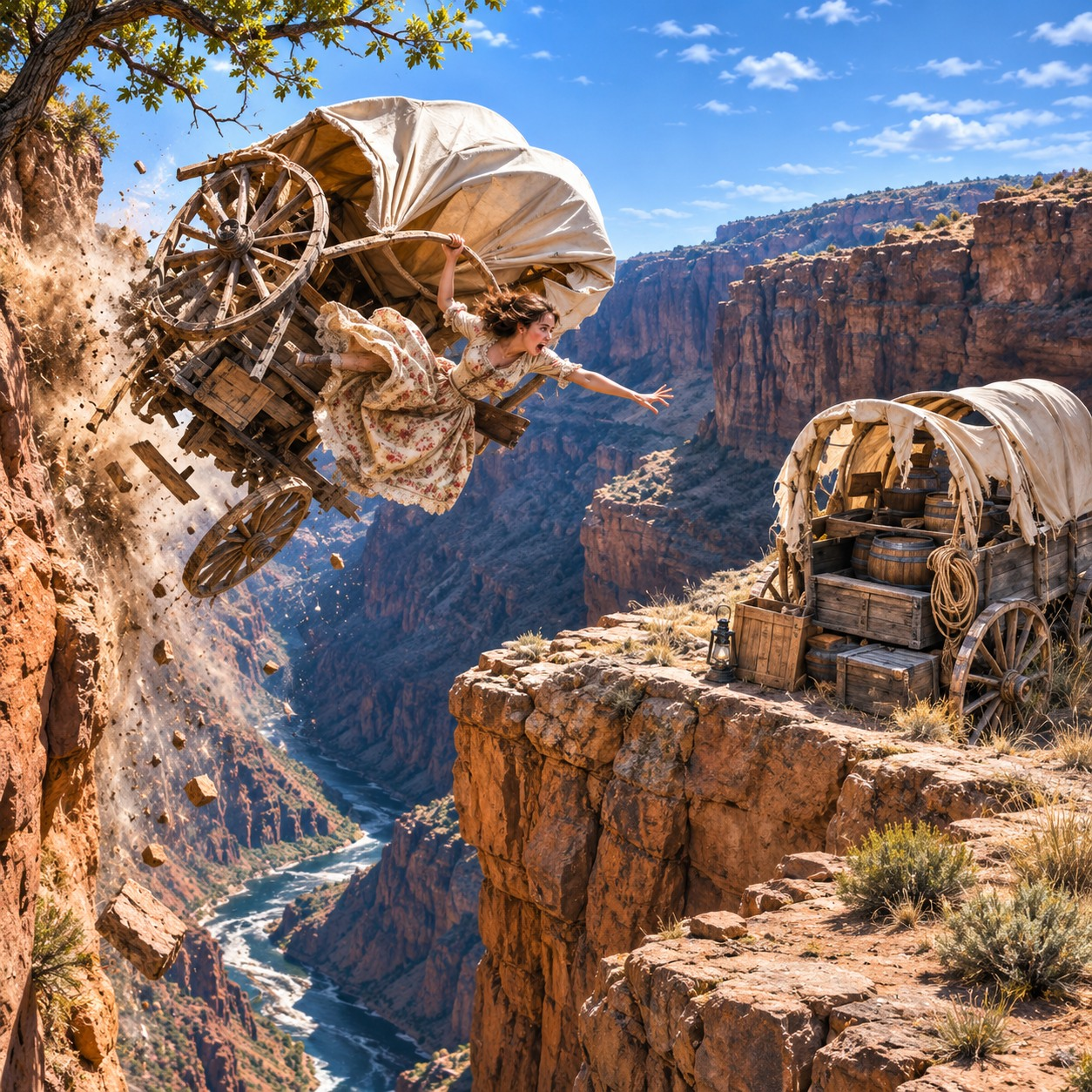
Emma Fletcher hauled on the leather reins as the ground cracked beneath the rear wheel of her freight wagon.
High above the road, Silas Harrow, the wealthiest landowner in Harrow County, stood beside his black horse, holding an old brass survey marker.
Three letters had been scratched into the metal.
E. F. F.
Silas looked down at Emma.
And for the first time in twenty years, he knew the Fletcher secret was no longer safely buried.
The first thing Emma heard was the sound of wood beginning to split.
Not breaking.
Not yet.
Just that terrible, drawn-out complaint of old timber carrying more weight than it ought to carry.
She knew the sound.
A woman who had spent five years hauling freight through the mountains learned to distinguish a harmless creak from a warning. The harmless kind came from wheels turning over stones, from loose boards rubbing against iron fittings, from a wagon settling beneath its load.
This sound came from underneath her.
From somewhere near the rear axle.
Emma tightened her fingers around the reins.
"Come on, girl," she whispered.
Molly flicked one ear backward.
The chestnut mare had been with Emma since the spring she turned sixteen. She was twelve now, broad through the chest and steady in the legs, with a dark mane that had never once been properly tamed.
Molly was not beautiful in the way wealthy ranchers liked their horses.
She had a white scar above her left knee, a crooked patch of hair along her shoulder, and the stubborn disposition of an animal that had learned to distrust foolish people.
But she knew the mountain.
And Emma trusted her more than she trusted most human beings.
The wagon creaked again.
Emma glanced over her shoulder.
Six fifty-pound sacks of flour rested beneath a canvas covering, along with crates of iron tools, coffee, nails, and supplies bound for the sawmill camp at Darnell's Crossing.
The freight would bring her eleven dollars and fifty cents.
After feed, repairs, and the debt she owed the Pine Hollow mercantile, she might keep six.
Six dollars.
That was what stood between Emma Fletcher and another week of hunger.
She had three paper dollars and six dimes in her apron pocket.
She had no husband.
No parents.
No brothers or sisters waiting at home.
And since her grandmother Hattie had died the previous winter, she had no one left who would notice if she failed to return.
That last thought came to her more often than she liked.
She pushed it away.
"Not today," she murmured.
The road ahead narrowed.
Wolf Ridge Road had been cut into the mountain in 1879, when men with picks and blasting powder had carved a passage through the red shale above Dryfork Canyon.
It was a dangerous piece of work.
In some places, the road measured twelve feet across.
In others, barely nine.
And along the upper shelf, there were two stretches where the outer shoulder had simply never existed.
A wagon could pass.
But there was no room for a mistake.
Four hundred feet below, the Dryfork River twisted between enormous red cliffs, its white water flashing in the morning sun.
Emma had driven the route eighty-seven times.
She remembered every journey.
The first had been with her grandmother sitting beside her, one hand on the wagon seat and the other wrapped around a small Bible.
Hattie had been sixty-eight then.
Her hands were swollen with arthritis, and her eyesight had begun to fail, but she could still judge the distance between a wheel and a cliff edge better than any freight driver in Pine Hollow.
"Keep your eyes on the road, Emma," she had said. "Fear makes a person look where they don't want to go."
Emma had been sixteen.
She had laughed nervously.
"What if I fall?"
Hattie had looked at her for a long moment.
"Then you find something to hold on to."
Emma remembered those words now.
She had no reason to know how important they would become.
At eight that morning, the October sun had finally reached the upper canyon.
The aspen trees along the lower ridge had turned the color of beaten brass. Their leaves drifted across the road, catching against rocks and collecting in shallow ruts.
Above them, dark pines held the last of the night's cold.
Emma wore a faded blue dress beneath a brown leather waistcoat. Her charcoal-gray apron had been patched three times, and the copper-red braid hanging over her shoulder had begun to unravel.
She was twenty-six years old.
People in Pine Hollow sometimes called her pretty.
Usually, they said it with the same pity they used when speaking of abandoned houses or horses that had outlived their usefulness.
Pretty Emma Fletcher.
Poor Emma Fletcher.
That unfortunate Fletcher girl.
She had learned to smile politely when they said it.
She had also learned that pity never paid a debt.
The freight company had belonged to her grandmother only in the loosest sense. Hattie had purchased the old wagon for twenty-two dollars after the Pine Hollow Freight Company retired it.
The wheels had been repaired twice.
The springs had been reset the previous spring.
The canvas had been stitched so often that the original seams were almost impossible to identify.
It was not much.
But it was hers.
And she intended to keep it.
A gust of wind moved through the canyon.
Molly lifted her head.
Emma felt the mare hesitate.
"What is it?"
Molly's ears pointed toward the bend ahead.
Emma followed her gaze.
A dark horse stood on a narrow trail above the main road.
Beside it was a man wearing a long black coat.
Even at that distance, Emma recognized him.
Silas Harrow.
She had seen him only a handful of times, usually riding through Pine Hollow with men who spoke softly around him and stepped aside before he reached them.
Silas owned cattle ranches, timber rights, and more land than most people could imagine.
His family had controlled the Harrow County Land Office for decades.
His father had been county commissioner.
His uncle had served as sheriff.
And his grandfather, according to local history, had helped establish the first permanent settlements along the Dryfork.
Silas was a man who expected doors to open before he touched them.
Emma had never understood why he seemed to dislike her.
The first time she met him, she had been seventeen, delivering flour to his ranch.
He had asked her name.
When she answered, his expression changed.
"Fletcher?" he had repeated.
"Yes, sir."
"Any relation to Hattie Fletcher?"
"My grandmother."
He had stared at her for several seconds.
Then he had turned to his foreman.
"Pay the girl and send her away."
She had not been invited back.
Now, nine years later, he was watching her from the ridge.
Emma lifted one hand in greeting.
Silas did not return it.
Instead, he looked toward the wagon.
Then toward the outer edge of the road.
A strange uneasiness moved through her.
Molly stopped.
"Come on, girl."
The mare refused.
Emma glanced upward again.
Silas was no longer looking at her.
He was studying something in his hand.
A small brass object.
He closed his fist around it.
Then he turned his horse away.
Emma frowned.
There was something wrong about seeing a wealthy landowner alone on a narrow mountain trail at that hour.
But Silas Harrow's business was none of hers.
And the sawmill camp expected its supplies.
She clicked her tongue.
Molly stepped forward.
The first stone fell when they reached the narrowest part of the shelf.
It was no larger than an apple.
Emma heard it strike the cliff below.
Then another followed.
She looked toward the outer wheel.
The road appeared solid.
But a thin crack ran through the shale.
She had never seen that crack before.
"Molly, stop."
The mare obeyed.
Emma leaned sideways, trying to judge the distance between the wheel and the edge.
Six inches.
Perhaps seven.
Enough, if the ground held.
Not enough, if it didn't.
She considered climbing down.
But there was no safe place to turn the wagon around.
The cliff wall rose almost vertically on her left.
On her right, the road simply ended.
She would have to move forward until she reached the wider section beyond the bend.
Emma took a slow breath.
"All right, sweetheart. Just a few more steps."
Molly moved.
The wagon followed.
One wheel passed over the crack.
Then the other.
For an instant, nothing happened.
Emma felt herself relax.
Then the mountain made a sound like a gunshot.
The road broke.
A slab of shale collapsed beneath the rear wheel.
The wagon dropped sharply to the right.
Emma was thrown against the wooden sideboard.
"Molly!"
The mare lunged forward.
The harness snapped tight.
A crate slammed into the flour sacks.
The rear axle twisted.
Emma grabbed the bench with one hand and pulled the reins with the other.
"Keep going!"
Molly strained against the weight.
Her hooves scraped the stone.
The wagon shifted another foot toward the edge.
Emma heard wood splinter.
The rear wheel hung over empty space.
Below it, hundreds of feet of canyon opened into the morning light.
She could see the river.
She could see individual rocks beside it.
And for one horrifying moment, she understood exactly how far she would fall.
"No!"
She threw her weight toward the cliff wall.
The wagon tilted farther.
A barrel broke loose and rolled against the sideboard.
The wood cracked.
The barrel disappeared over the edge.
Emma heard it strike the canyon wall below.
Then the rear axle broke.
The sound was enormous.
The wagon lurched sideways.
The wooden driver's bench tore away from its supports.
Emma lost her grip.
Her body lifted from the seat.
She reached for the reins.
Her fingers caught leather.
For half a second, she held on.
Molly screamed.
The horse's terrified cry echoed against the cliffs.
Emma saw the mare struggling to remain on the road, her front hooves planted against the stone.
Then the harness fitting broke.
The reins whipped through Emma's hands.
The wagon rolled outward.
And Emma Fletcher fell.
There are moments when the human mind refuses to understand what the body already knows.
Emma's first thought was absurd.
The flour.
She saw a white sack split open.
A cloud of flour burst into the air.
Then she saw the wagon wheel turning above her.
Then the blue sky.
Then the red cliff.
The world spun.
She tried to scream.
The wind stole the sound.
Her dress snapped violently around her legs.
Her apron whipped against her waist.
She reached for the cliff wall.
Her fingertips struck stone.
Pain shot through her hand.
She grabbed again.
Nothing.
The mountain rushed past.
A broken wooden beam tumbled beside her.
She twisted away from it.
A sharp rock tore the sleeve of her dress.
Her shoulder struck the cliff.
The impact knocked the breath from her lungs.
For one instant, she saw darkness.
Then she was falling again.
Find something to hold on to.
Her grandmother's voice.
Clear as if Hattie were sitting beside her.
Find something.
Emma threw both arms toward the cliff.
Her left hand struck a protruding root.
She grabbed it.
The force nearly tore her shoulder from its socket.
Her body swung violently.
Her apron caught against a second root.
Fabric ripped.
She slammed into a narrow shelf of sandstone.
Her boots scraped rock.
One foot found a ledge.
Then the other.
She collapsed forward, clawing at the stone with both hands.
The root above her groaned.
A shower of dust fell across her hair.
Emma pressed herself against the cliff.
She could not breathe.
Her chest refused to work.
She opened her mouth.
Nothing came.
Then air rushed into her lungs.
She gasped so violently that her entire body shook.
For several seconds, she could do nothing but cling to the rock.
Her left shoulder burned.
Blood ran from her right palm.
Her knees trembled.
She was alive.
Somehow.
Against every reasonable possibility, she was alive.
She began to laugh.
It came out as a broken, frightened sound.
Then she stopped.
Because the ledge beneath her shifted.
A small stone slipped away.
She watched it fall.
It vanished into the canyon.
Emma flattened herself against the rock.
"Don't move," she whispered.
Her voice sounded strange.
Small.
Almost childish.
She swallowed.
"Just don't move."
Above her, the remains of the wagon crashed against the cliff.
A wooden crate shattered somewhere out of sight.
Iron tools rang against stone.
Then came silence.
Emma closed her eyes.
"Molly."
She listened.
Nothing.
"Molly!"
Her voice echoed upward.
No answering whinny came.
She pictured the mare struggling on the narrow road.
The broken harness.
The frightened eyes.
The thought of losing her was almost more than Emma could bear.
But there was nothing she could do from where she lay.
She forced herself to look around.
The ledge was perhaps four feet wide.
It extended beneath a broad sandstone overhang, where centuries of wind had carved a shallow recess into the cliff.
A thick root grew from a crack above her.
It had caught her apron and slowed her fall.
Without it, she would already be dead.
Emma touched the torn fabric.
"Thank you, Grandma," she whispered.
She did not know whether she was thanking Hattie for teaching her to survive or for insisting that Emma wear a sturdy apron.
Perhaps both.
She carefully shifted her weight.
Her left shoulder protested.
Her right hand left a smear of blood on the stone.
She needed shelter from falling debris.
The overhang offered some protection.
Emma began crawling toward it.
Slowly.
One movement at a time.
She reached the shadow.
And stopped.
Something stood beneath the rock.
At first, she thought it was another formation of stone.
Then her eyes adjusted.
A wooden wheel.
An iron rim.
A curved canvas frame.
Emma stared.
"No."
She crawled closer.
The object emerged from the darkness.
It was a wagon.
An old covered freight wagon.
Its gray canvas had faded almost white.
Dust covered the wooden boards.
One wheel was buried halfway in fallen shale.
The other three remained attached.
The wagon stood beneath the sandstone overhang as though someone had parked it there yesterday and forgotten to return.
Emma stared at it.
There was no road leading to the ledge.
No visible trail.
No reasonable explanation for how a wagon could have reached such a place.
She looked upward.
The cliff rose hundreds of feet above her.
Then she looked toward the canyon.
The drop continued below.
The wagon could not have been driven there.
It must have fallen.
But how had it survived?
Emma moved closer.
A section of the canvas had torn away.
Inside were wooden crates, a collapsed blanket, and what appeared to be a small iron stove.
The wood was gray with age.
The iron fittings were heavily rusted.
A thick layer of dust covered everything.
This wagon had been here for decades.
Perhaps longer.
Emma reached toward the nearest wheel.
Her fingers brushed the hub.
Something had been carved into the wood.
She leaned closer.
The letters were faint.
But readable.
FLETCHER FREIGHT.
Emma stopped breathing.
Her grandfather's surname.
Her grandmother's surname.
Her own.
She stared at the carving.
Then she remembered something Hattie had once told her.
It had been a winter evening, three years before her grandmother died.
They were sitting beside a small stove, mending clothes.
Emma had asked about her grandfather.
Hattie had gone very still.
"Your grandfather was a good man," she had said.
"Then why does everyone say he stole land?"
Hattie's needle had stopped moving.
"Because people with money can afford to tell a story until everyone believes it."
Emma had waited.
But her grandmother had said nothing more.
Now, hundreds of feet beneath Wolf Ridge Road, Emma was staring at a wagon bearing her family's name.
She felt the first cold touch of something that had nothing to do with the October air.
She moved toward the rear opening.
A rusted iron latch held the canvas flap against the wooden frame.
Emma lifted it.
The metal broke in her hand.
She pulled the canvas aside.
Dust filled the air.
She coughed.
Inside, the wagon smelled of old leather, dry timber, and the stale mineral scent of stone that had not seen sunlight in years.
There were three wooden crates.
A broken lantern.
A coil of brittle rope.
And beneath a folded piece of canvas, an iron strongbox.
Emma stared at it.
The box was small enough for one person to carry.
Its corners were reinforced with black iron bands.
A heavy lock secured the lid.
Someone had taken considerable care to protect it.
Emma brushed away the dust.
Letters appeared beneath her fingertips.
E. F. F.
Her heart began to pound.
She knew those initials.
She had seen them once before.
On the inside cover of her grandmother's Bible.
Below them, Hattie had written a name.
Elias Franklin Fletcher.
Emma's grandfather.
She sat back on her heels.
The man everyone in Pine Hollow called a thief.
The man whose disgrace had followed her family for more than sixty years.
The man Hattie had loved until the day she died.
Emma touched the initials again.
"Grandpa Elias?"
The words sounded foolish in the empty wagon.
But she could not stop herself.
She examined the lock.
It was rusted, but intact.
She searched the nearby crates for something she could use to break it.
A narrow iron pry bar lay beneath a bundle of rotted canvas.
Emma picked it up.
Her injured shoulder throbbed.
She wedged the bar beneath the lock's mounting plate.
Then she pushed.
Nothing.
She tried again.
The metal shifted.
Pain flashed through her arm.
She gritted her teeth.
"Come on."
The mounting plate bent.
She pushed harder.
A screw tore free from the old wood.
The lock dropped onto the wagon floor.
Emma froze.
The sound echoed beneath the sandstone roof.
She listened.
Only wind.
She placed the pry bar aside.
Then she lifted the strongbox lid.
Inside lay a packet of letters tied with faded blue ribbon.
A leather-bound ledger.
A folded document sealed in wax.
And a small photograph.
Emma reached for the photograph first.
It showed a young man standing beside a covered wagon.
He wore a dark vest and held a hat against his chest.
Beside him stood a young woman with serious eyes.
Emma recognized the woman immediately.
Not because she had ever seen her at that age.
But because Hattie Fletcher's eyes had never changed.
Her grandmother.
Young.
Beautiful.
Smiling.
Emma felt tears gather.
She pressed her lips together.
"Hattie."
For a moment, she forgot the canyon.
Forgot the broken wagon.
Forgot the pain in her shoulder.
She was looking at the only person who had ever truly loved her.
And Hattie was standing beside the man whose name had ruined their family.
Emma turned the photograph over.
There was writing on the back.
Elias and Hattie.
October 27, 1827.
The day we promised to build a home.
Emma stared at the date.
October 27.
The same day as today.
Sixty years earlier.
A chill passed through her.
She placed the photograph carefully inside her apron.
Then she opened the leather ledger.
The first page contained a list of names.
The second contained measurements.
Land boundaries.
Survey numbers.
Water rights.
Timber rights.
Emma understood enough about freight and property to recognize that the entries described enormous stretches of land.
The Dryfork Valley.
The northern timberlands.
The river crossings.
The lower grazing country.
All of it.
She turned another page.
At the top, written in dark brown ink, were the words:
Original Harrow County Land Survey.
Below them appeared two signatures.
Elias Franklin Fletcher.
And Nathaniel Harrow.
Emma frowned.
Nathaniel Harrow.
Silas's grandfather.
She knew the name from the county courthouse.
A portrait of Nathaniel hung in the main hall, beneath a brass plaque honoring him as one of the founders of Harrow County.
Emma had passed that portrait dozens of times.
She turned another page.
Then another.
The entries grew more troubling.
Land originally assigned to Elias Fletcher had been transferred to Nathaniel Harrow.
The transfers were dated.
Witnessed.
Recorded.
But several signatures looked wrong.
Emma leaned closer.
Her grandfather's name appeared repeatedly.
Yet the handwriting changed.
On one page, the F in Fletcher curved sharply to the right.
On another, it leaned left.
On a third, the entire signature looked stiff and uncertain.
Emma remembered Hattie teaching her to recognize forged freight receipts.
"A liar can copy a name," her grandmother had said. "But he usually forgets how the hand moves."
Emma turned to the final entry.
A single sentence had been written across the bottom.
These transfers were made without my knowledge or consent.
Beneath it:
Elias F. Fletcher.
Emma's stomach tightened.
She reached for the sealed document.
The wax had hardened and cracked with age.
She carefully unfolded the paper.
It was a receipt.
Harrow County Land Office.
Dated November 3, 1827.
It acknowledged the filing of original land claims by Elias Franklin Fletcher.
The amount of land listed was staggering.
Thousands of acres.
Timber.
River access.
Mineral rights.
Property that would now be worth more money than Emma could imagine.
And beneath the official seal was another sentence.
All original claims remain vested in Elias Franklin Fletcher and his lawful heirs unless voluntarily transferred.
Emma read it twice.
Then a third time.
Her hands began to shake.
For years, she had believed her family lost everything because her grandfather stole land and disappeared.
But the papers suggested something entirely different.
Her grandfather had owned the land.
The Harrows had acquired it afterward.
And someone had falsified the records.
Emma looked toward the canyon.
Far above, she could see a narrow strip of blue sky.
Silas Harrow had been watching her that morning.
He had held something brass in his hand.
Something marked with the same initials she had found on the strongbox.
Her pulse quickened.
Was it possible he knew about this wagon?
Had his family known all along?
She turned back to the box.
Beneath the ledger lay the packet of letters.
The top envelope was addressed to Hattie.
Emma hesitated.
For sixty years, those letters had waited beneath the cliff.
Her grandmother had died believing her husband's name would never be cleared.
Perhaps the answers were here.
Perhaps the reason Hattie had refused to speak about Elias was hidden inside these pages.
Emma carefully untied the ribbon.
The first letter was dated October 28, 1827.
One day after the photograph.
She unfolded it.
The handwriting was neat but hurried.
My dearest Hattie,
If this letter reaches you, it means I have failed to return as promised.
Emma swallowed.
She read on.
I have discovered what Nathaniel intends to do with the land records. He believes the valley belongs to men powerful enough to take it. I have refused him.
He has threatened me.
I am taking the original ledger and the signed receipt to the territorial authorities.
If anything happens to me, you must never believe I abandoned you.
Emma pressed one hand over her mouth.
The letter continued.
There is one thing I have not told you.
Something Nathaniel learned about our family.
Something he intends to use against us.
The next line had been smeared.
Emma brought the paper closer to the light.
The ink was faint.
But she could make out several words.
The child...
Then a name.
A name she did not recognize.
She turned the page.
The remainder of the letter was missing.
Emma searched the envelope.
Nothing.
She checked beneath the ledger.
Nothing.
A strange sound came from outside.
She froze.
It was not the wind.
It was a stone striking another stone.
Then came the scrape of a boot against rock.
Emma slowly lowered the letter.
Someone was moving on the ledge.
She listened.
A man's voice broke the silence.
"Miss Fletcher?"
Emma's blood turned cold.
The voice was familiar.
Silas Harrow.
He was somewhere beyond the canvas opening.
She stared at the strongbox.
Then at the letters.
She had no weapon.
No way to run.
And only a few feet of rock separated her from a four-hundred-foot fall.
Silas spoke again.
"I know you're in there, Emma."
She did not answer.
His boots scraped against the stone.
Closer.
"You've found something that belongs to my family."
Emma quickly slipped the letter into her apron.
She closed the ledger.
Her injured hand left a small red mark on the leather cover.
Silas stopped outside.
For several seconds, neither spoke.
Then he said something that made Emma's heart hammer against her ribs.
"Your grandmother should have burned those papers when she had the chance."
Emma stared toward the opening.
He knew.
He had always known.
She backed away from the canvas flap.
Silas's shadow appeared against the wagon floor.
Then his hand reached through the opening.
He was holding a revolver.
"Now, Miss Fletcher," he said quietly, "let's talk about what really happened to your grandfather."
Emma looked down.
Beneath the ledger, half-hidden in the bottom of the strongbox, lay another envelope.
Unlike the others, this one had been sealed with black wax.
Written across its face were five words.
For Emma Fletcher. When Found.
Emma stopped breathing.
The envelope was sixty years old.
But it carried her name.
And outside the wagon, Silas Harrow pulled back the revolver's hammer.






Comments 0