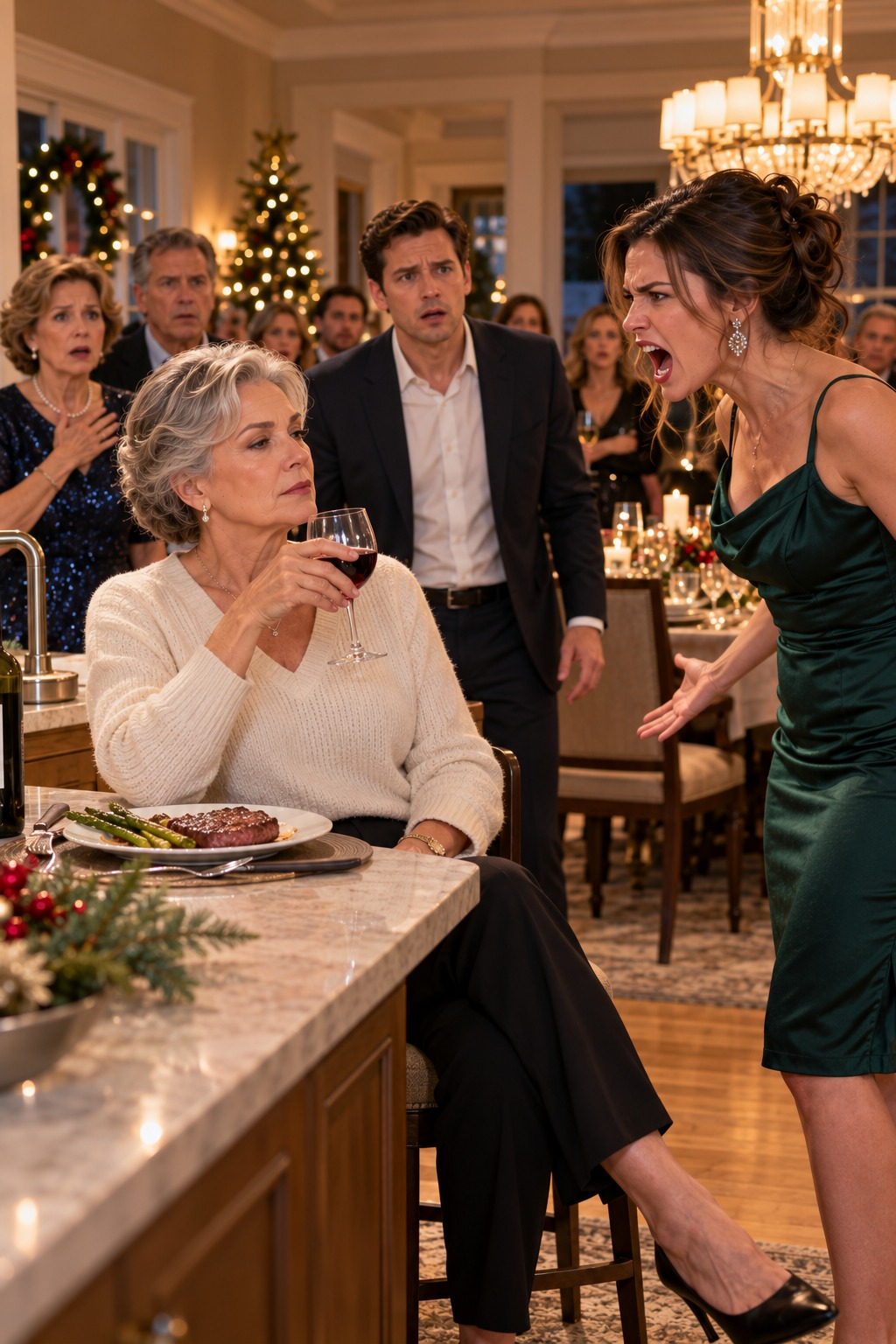
"WHERE THE HELL WERE YOU, YOU DAMN OLD WOMAN?"
Harper slammed her red fingernails against my marble kitchen island.
I set my wineglass beside a sealed envelope.
My name was printed on the front.
Harper hadn't noticed it yet.
But she was about to learn whose house she was standing in.
"MY FAMILY IS STARVING, AND THE TABLE STILL ISN'T SET!"
Her voice was so loud that the music stopped in the living room.
Fourteen people went silent.
Someone put down a champagne glass a little too hard. I heard the thin clink of crystal against my dining room table.
My son, Liam, appeared in the kitchen doorway, looking as though someone had just told him the house was on fire.
And there I sat.
Sixty-eight years old.
Wearing my favorite ivory sweater.
Enjoying a perfectly cooked ribeye steak with roasted asparagus and a glass of cabernet.
Not rushing.
Not apologizing.
Not lifting a finger to rescue anyone's evening.
Harper stood across from me in an expensive emerald-green cocktail dress. Her chestnut hair had been curled and pinned into an elaborate updo. Diamond-shaped earrings glittered beneath the chandelier.
She looked like a woman who had spent three hours preparing to be admired.
Unfortunately, she had also spent those three hours expecting someone else to do all the work.
"Did you hear me?" she demanded.
I finished chewing.
Swallowed.
Picked up my wineglass.
And took a small sip.
"Are you finished?" I asked.
Her mouth fell open.
For a moment, she looked genuinely confused.
I don't think anyone had ever responded to her anger with a question that simple.
"What did you just say?"
"I asked whether you were finished."
"Finished?"
"Yelling."
Behind her, Brenda, my daughter-in-law's mother, pressed one hand against her chest.
"Oh, my goodness," she whispered.
Liam shifted his weight from one foot to the other.
He wouldn't look at me.
That hurt more than Harper's shouting.
My son had always been gentle. Even as a little boy, he hated confrontation. If another child took his toy, Liam would usually find something else to play with.
When he was sixteen, a teacher accidentally gave him detention for something another student had done.
He served half of it before finally explaining what happened.
"Why didn't you say anything?" I'd asked.
He shrugged.
"I didn't want to make it a big deal."
That sentence had followed him into adulthood.
He didn't want arguments.
He didn't want anyone upset.
He didn't want to choose sides.
And somewhere along the way, my sweet, gentle boy had become a grown man who watched his wife humiliate his mother because defending me would have been uncomfortable.
"Liam!" Harper snapped. "Are you going to say something?"
My son opened his mouth.
Closed it.
Then glanced at the empty dining table.
"Mom," he began quietly, "maybe there's been some misunderstanding."
I looked at him.
"A misunderstanding?"
He rubbed the back of his neck.
"About dinner."
I almost laughed.
Not because anything was funny.
Because sometimes disappointment becomes so enormous that laughter is the only thing keeping it from crushing your chest.
"Tell me, Liam," I said. "What exactly did I misunderstand?"
He glanced at Harper.
There it was.
That tiny movement.
A grown man looking to his wife for permission to answer his own mother.
Harper folded her arms.
"We discussed this weeks ago."
"No," I replied. "You discussed it. There's a difference."
Brenda stepped forward.
"Chelsea, dear, surely we can settle this without making everyone uncomfortable."
I looked past her toward the dining room.
Fourteen people were watching.
Harper's father stood beside the Christmas tree, holding a drink.
Her younger sister sat frozen near the fireplace.
Two cousins whispered to each other.
Someone's husband pretended to examine the holiday decorations.
Every person in that room had arrived expecting a wonderful New Year's Eve dinner.
Roast beef.
Scalloped potatoes.
Green beans.
Fresh dinner rolls.
And the chocolate cake Harper loved from her favorite bakery.
They expected candles, music, champagne, and a beautiful table.
They expected me to provide all of it.
What none of them seemed to expect was that I might have plans of my own.
I looked at Brenda.
"I'm not uncomfortable."
Her expression changed.
"Well, perhaps you're not, but—"
"Your daughter is the one screaming."
Brenda blinked.
Harper gave a sharp, disbelieving laugh.
"Oh, so now I'm the problem?"
I put down my fork.
"You're certainly making a strong case for it."
Liam whispered, "Mom, please."
Two words.
Mom, please.
I'd heard them a thousand times.
When he wanted another cookie.
When he wanted to stay up late.
When he needed twenty dollars for a school trip.
When he was sixteen and wanted to borrow the car.
But that evening, those two words meant something different.
They meant: Please make yourself smaller so I don't have to stand up for you.
I looked at him for a long moment.
Then I turned back to my plate.
"There's plenty of room in the kitchen if anyone wants to make themselves a sandwich."
Harper stared at me.
"A sandwich?"
"There's bread in the pantry."
"You expect my family to eat sandwiches on New Year's Eve?"
"No," I said. "I expect adults to make their own arrangements when they haven't hired a caterer."
A man in the dining room coughed.
I suspected he was trying not to laugh.
Harper's cheeks turned red.
"You are being unbelievably selfish."
That word.
Selfish.
It had become her favorite description of me whenever I did something she didn't like.
When I declined to pay for the extra flowers at her wedding, I was selfish.
When I didn't offer to cover their honeymoon upgrade, I was selfish.
When I asked them to call before visiting, I was selfish.
And when I told her I wasn't interested in replacing the kitchen cabinets David and I had chosen together, I was apparently selfish beyond redemption.
I used to lie awake wondering what I could do to make her happy.
That was before I understood something.
Some people don't want you to make them happy.
They want you to make yourself useful.
And when you stop being useful, they call you difficult.
Four months earlier, I wouldn't have recognized the woman sitting at that kitchen island.
Four months earlier, I would have jumped off my stool.
I would have apologized.
I would have opened the refrigerator and started searching for ingredients.
I would have offered to order takeout.
I might even have driven to the grocery store myself, despite the holiday crowds, and spent the next three hours cooking while everyone else drank champagne.
I would have done all of it because I believed keeping the peace was the same as having peace.
It isn't.
Sometimes keeping the peace simply means one person swallows every insult so everyone else can remain comfortable.
For years, that person had been me.
But not anymore.
My name is Chelsea Powell.
I was sixty-eight years old that New Year's Eve.
And the house Harper was screaming inside belonged to me.
Not Liam.
Not Harper.
Me.
My husband, David, and I bought it thirty-one years earlier, when the neighborhood outside Columbus, Ohio, still had soybean fields at the end of our road.
We raised our son there.
We refinished the oak floors ourselves.
David built the bookshelves in the den.
I planted the maple tree beside the patio when Liam was eight.
Every room held a piece of our lives.
The little dent in the hallway wall came from Liam's first bicycle.
The scratch beneath the kitchen window came from our old golden retriever, Max.
The uneven shelf in the den was David's first attempt at woodworking.
He'd offered to replace it a dozen times.
I never let him.
After David died, I sometimes ran my fingers along that crooked shelf just to remember the sound of his laughter.
The mortgage had been paid off for years.
The deed was in my name.
Every tax bill, insurance payment, repair, and utility bill came to me.
I had never imagined that one day my daughter-in-law would walk through those rooms discussing which walls she wanted removed.
I certainly hadn't imagined my son would stand quietly beside her while she did it.
But to understand why I was eating steak alone while fourteen relatives waited for a dinner that didn't exist, you have to understand what happened after Liam got married.
The wedding was in late August.
A renovated barn venue about forty minutes outside Columbus.
White roses.
Gold chairs.
A four-tier cake.
Custom cocktails.
A photographer and a separate videographer.
And a neon sign displaying their last name behind the head table.
I remember thinking that last detail was funny.
Harper had told me three different times that she wasn't sure she wanted to take Liam's last name.
But the wedding was beautiful.
Liam looked happy.
And at the time, that was enough for me.
Harper came from a family that cared deeply about appearances.
Brenda always had perfect hair.
Her husband, Richard, wore expensive watches and liked to mention how much things cost.
Harper had inherited her mother's talent for making ordinary conversations feel like competitions.
At first, I mistook it for confidence.
When she corrected the way I arranged flowers, I thought she was particular.
When she complained about my cooking, I thought she had different tastes.
When she rearranged the furniture in my living room without asking, I told myself she was only trying to help.
David would have seen through it immediately.
He had a way of recognizing people who confused kindness with weakness.
"Chels," he used to tell me, "you can open your door to someone without handing them the keys."
I wish I'd remembered that sooner.
The first serious warning came six weeks after the wedding.
Liam and Harper stopped by on a Sunday afternoon.
I had made coffee.
Harper walked through the living room, looking at the walls.
Then she said, "You know, this place would feel so much bigger if we opened up the kitchen."
I smiled politely.
"David and I liked having separate rooms."
She tilted her head.
"Well, that was a different generation."
I remember the way she said it.
Not cruelly.
Almost casually.
As though my entire marriage, my taste, and the life David and I had built were outdated furniture waiting to be hauled away.
Liam said nothing.
Harper continued.
"We could take down that wall, put in a bigger island, maybe redo the flooring."
"We?" I asked.
She smiled.
"Oh, I'm just thinking out loud."
But she wasn't.
Over the following weeks, her suggestions became increasingly specific.
The guest bedroom should become a home office.
The den needed brighter paint.
The upstairs bathroom was embarrassing.
The backyard patio could be expanded.
And the kitchen cabinets, apparently, made the entire house look twenty years older.
Every time I reminded her that I was happy with my home, she acted as though I had personally insulted her.
Then came the conversations about money.
At first, they were small.
An expensive appliance they wanted.
A credit card balance that had grown after the wedding.
A honeymoon expense that hadn't been included in their budget.
Liam would call, sounding embarrassed.
"Mom, I hate to ask, but..."
I knew the rest before he said it.
Sometimes I helped.
Sometimes I said no.
And every time I said no, Harper became colder.
By Thanksgiving, she barely bothered to hide her irritation.
She arrived at my house carrying a bottle of wine and a list of complaints.
The turkey was too dry.
The potatoes needed more butter.
The dining room was too warm.
The music was too old-fashioned.
And when I sat down after spending six hours cooking, she asked whether I'd forgotten the cranberry sauce.
I hadn't forgotten it.
It was in the refrigerator.
She simply hadn't looked.
But the moment I stood to retrieve it, I caught a glimpse of Liam's face.
He looked relieved.
Not grateful.
Relieved.
Because once again, I'd prevented an argument.
That night, after everyone left, I stood alone in the kitchen washing dishes.
My back hurt.
My feet were swollen.
And I realized I had spent an entire holiday serving people who hadn't once asked whether I needed help.
That should have been the moment everything changed.
It wasn't.
I still needed one final lesson.
And Harper was about to give it to me.
Back at the kitchen island on New Year's Eve, she stared at my plate as though the sight of my dinner personally offended her.
"You cooked for yourself?" she demanded.
"Yes."
"And nothing for us?"
"That's correct."
She laughed again.
It was a sharp, ugly sound.
"Unbelievable."
I picked up my fork.
"Would you like some asparagus?"
Liam shut his eyes.
Brenda made a noise somewhere between a gasp and a sigh.
Harper stepped closer.
"You think this is funny?"
"No."
"Then why are you acting like this?"
I looked up at her.
"Because I'm hungry, Harper. And I'm eating my dinner."
Her hands curled into fists.
"You knew my family was coming."
"Yes."
"You knew we were expecting dinner."
"I knew you were expecting something."
"Then why didn't you prepare it?"
I placed my fork on the plate.
For the first time that evening, I gave her my full attention.
"Because I never agreed to."
The words hung between us.
Simple.
Undeniable.
Harper looked toward Liam.
"Liam, tell her."
He swallowed.
"Mom, Harper thought—"
"I know what Harper thought."
My voice remained quiet.
"What I'm asking is whether either of you remembers me agreeing to cook dinner for fourteen people."
Liam stared at the floor.
Harper opened her mouth.
Then closed it.
And there it was.
The silence I'd been waiting for.
Not the silence of people shocked by an elderly woman's refusal to obey.
The silence of people who knew perfectly well that no agreement had ever existed.
I took another sip of wine.
Harper's gaze moved across the island.
Past my plate.
Past the silverware.
Past the folded linen napkin.
Then it stopped.
On the envelope.
The one I'd placed beside my wineglass before the guests arrived.
Her eyes narrowed.
"What's that?"
I didn't answer immediately.
She leaned forward.
And for the first time that evening, I saw something other than anger cross her face.
Recognition.
She had noticed the name printed beneath mine.
A name she hadn't expected to see.
Her hand moved toward the envelope.
I placed two fingers gently over it.
"Not yet, Harper."
Behind her, Liam suddenly looked up.
He had seen the envelope too.
And when he recognized the handwriting in the corner, the color drained from his face.
"Mom," he whispered, "where did you get that?"
I looked at my son.
Then at his wife.
Neither of them seemed interested in dinner anymore.
Because someone had written three words across the back of that envelope.
Three words I hadn't been meant to read.
And just as Harper reached for it again, the doorbell rang.
Liam turned toward the front hallway.
Nobody moved.
Then a familiar man's voice called from the other side of the door.
"Chelsea? It's me. We need to talk before they see the papers."
Chapter 1 ends.






Comments 0