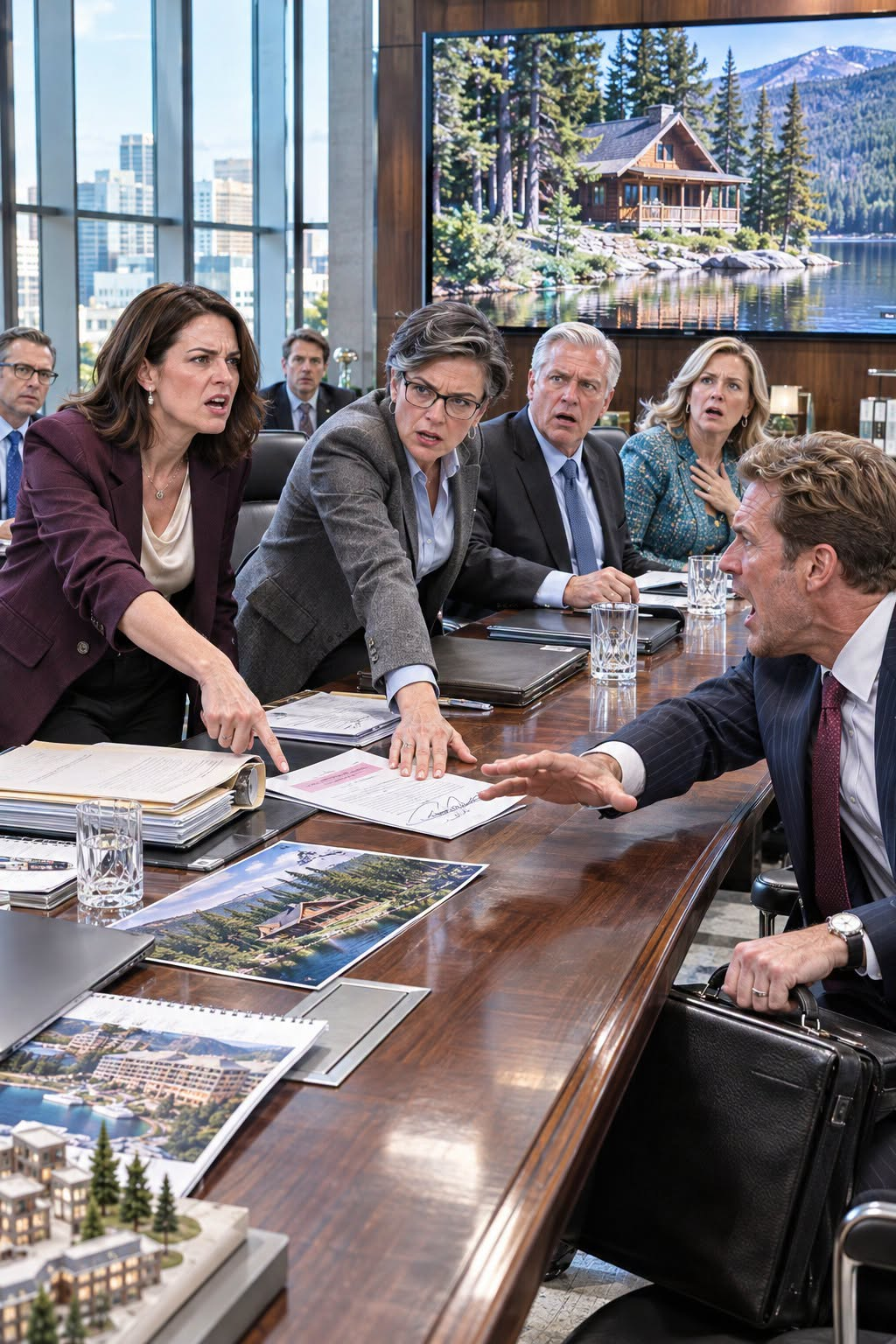
"Don't let her read the second page."
My uncle's voice came through my father's phone.
I looked down at the envelope on the desk.
Three pages.
Three signatures.
And a condition I had never seen before.
My father reached for the document again.
I pulled it toward me.
"Nobody is taking this away from me."
"Elise, you don't understand what you're looking at."
"Then explain it."
He looked toward the phone.
Richard was still on the line.
"Robert, tell her to put it down," my uncle said.
I slowly turned toward my father's desk phone.
"Richard, if you have something to say, say it to me."
Silence.
Then he answered.
"You were never supposed to see that agreement without someone explaining its purpose."
I stared at the first page.
"Whose purpose?"
"Your father's."
My father immediately interrupted.
"That's enough, Richard."
But I had already heard it.
For the first time, the two men sounded less like brothers and more like people trying to protect themselves from the same accusation.
I unfolded the second page.
The paper made a dry cracking sound.
At the top was a heading.
HARPER FAMILY PROPERTY PROTECTION AGREEMENT.
Beneath it were several paragraphs describing the intended treatment of certain properties acquired through family resources.
I read the first paragraph.
Then the second.
My confusion grew with every sentence.
The agreement referred to a family contribution made before the purchase of the cabin.
It also mentioned a financial arrangement involving three beneficiaries.
I looked at my father.
"What contribution?"
He rubbed his forehead.
"Your grandfather left some money."
I stopped reading.
"What money?"
"An inheritance."
"Whose inheritance?"
"Mine and Richard's."
I looked down again.
"Did you give me money to purchase the cabin?"
"No."
"Did Richard?"
"No."
"Then why are we discussing an inheritance?"
My father leaned against his desk.
"Because the money was supposed to be used for a family property investment."
I stared at him.
"What does that have to do with my cabin?"
He hesitated.
Then he said something I had never expected.
"Your grandfather wanted the family to own land near the lake."
I remembered my grandfather.
He had died when I was nineteen.
He had loved fishing, old wooden buildings, and the small communities surrounding the lake. He had never been wealthy by modern standards, but he owned several rental properties and had accumulated considerable savings over his lifetime.
He had also been the only person in the family who encouraged my interest in architecture.
When I was seventeen, he once told me that land was valuable because it gave people somewhere to begin again.
I had never known he wanted to buy property near the cabin.
"Why didn't you tell me?" I asked.
"Because the money wasn't available when you purchased it."
"Then how did it become connected to the agreement?"
My father looked toward the phone.
Richard finally spoke.
"Because the original plan was changed."
"Changed by whom?"
"Your father."
My father turned sharply.
"Don't put this all on me."
I looked between them.
"Enough. I want the truth."
Richard sighed.
"Your grandfather left a private investment fund. It was intended to support a future property purchase for the family. Your father and I were supposed to manage it."
"Was I supposed to be part of that?"
"Eventually."
I looked at the document.
"Then why does it say I was the original beneficiary?"
Neither man answered.
I turned to the final paragraph on the first page.
It described a property acquired by an individual family member, with the possibility of additional interests being recognized if certain conditions were satisfied.
I read the sentence again.
Then I looked at my father.
"Did you use my purchase to satisfy the conditions of this agreement?"
He said nothing.
That silence told me more than his previous explanations.
I took the envelope and sat in the chair opposite his desk.
The second page contained a table listing three financial contributions.
The first was an amount associated with my grandfather's estate.
The second was a smaller contribution described as administrative expenses.
The third was a figure attributed to the original purchaser.
My name appeared beside the third entry.
The amount matched the deposit I had paid from my personal savings.
I pointed toward it.
"This is my money."
My father nodded.
"Yes."
"And this is the money from Grandfather's estate?"
"Yes."
"Where did it go?"
He looked uncomfortable.
"Some of it was used for family expenses."
"Which expenses?"
"Property taxes. Legal costs. Maintenance on several properties."
I stared at him.
"Several properties?"
He didn't answer.
I turned toward Richard's voice on the phone.
"Where is the rest of the inheritance?"
My uncle responded carefully.
"That account was reorganized several years ago."
"Who controlled it?"
"Your father and I."
"And how much was left?"
Silence.
I looked at the document again.
The agreement had been drafted around the same time as my cabin purchase.
It appeared to connect my personal property to an inheritance fund that I had never known existed.
But there was another problem.
The cabin had been purchased with my own money.
The inheritance had not paid for the deposit, the mortgage, or the repairs.
If the family agreement was genuine, it still didn't explain how my father and uncle believed they had a right to sell my property.
"Naomi needs to examine this," I said.
My father immediately shook his head.
"No."
I looked up.
"What?"
"Don't bring lawyers into this."
I almost laughed.
"You're discussing a legal agreement that involves my property, and you're telling me not to involve lawyers?"
"This is a family matter."
"It stopped being a family matter when Darren tried to sell my cabin."
My father stood.
"Your brother made a mistake."
"Did you know he was going to do it?"
He didn't answer.
I placed the agreement on the desk.
"Did you?"
My father's expression hardened.
"I knew he was looking into a sale."
I felt my stomach tighten.
"How long?"
"A few weeks."
"And you didn't think to tell me?"
"We thought it would be better if the property was sold."
"Why?"
"Because things have changed."
"What things?"
He walked toward the window.
"Your uncle and I have obligations."
I stared at him.
"Financial obligations?"
He remained silent.
I suddenly understood that the cabin might not be the only thing at stake.
I photographed all three pages.
My father watched me without attempting to stop me again.
When I finished, I placed the original agreement back into the envelope.
"I'm taking a copy."
"Elise, this isn't going to help you."
"That's for me to decide."
I walked toward the door.
My father called after me.
"Your mother doesn't know everything."
I stopped.
"What does that mean?"
"She knows about the inheritance, but she doesn't know what happened afterward."
I turned around.
"Then perhaps you should tell her."
He shook his head.
"There's no point."
I studied his face.
For the first time, I noticed how tired he looked.
His usual confidence had disappeared.
His shoulders were lower, and his eyes avoided mine.
"Did you lose the inheritance?" I asked.
He didn't answer.
"Did Richard lose it?"
Still nothing.
I left the study.
My mother was waiting in the hallway.
She glanced at the envelope in my hand.
"Did your father give you the agreement?"
"Yes."
Her face changed.
"Then you know."
"Know what?"
She looked toward the study door.
"Elise, your grandfather wanted all of us to benefit from that land."
I stared at her.
"Then why did nobody tell me?"
"Because you were young."
"I was twenty-six when I bought the cabin."
"You were still young enough to make mistakes."
I almost smiled.
"I was old enough to sign a mortgage and pay it for fourteen years."
My mother looked away.
"Your father thought it was better to let you believe you had bought the property independently."
The hallway seemed to grow quieter.
I stepped closer.
"Let me believe?"
She nodded.
"Your grandfather's money was supposed to be part of the purchase eventually."
"But it wasn't."
"Not at the beginning."
"Did you know the agreement existed?"
"Yes."
I stared at her.
"Did you sign it?"
"No."
"Did you know Richard had removed it from the archive?"
Her expression changed.
"What?"
I watched her carefully.
"You didn't know?"
She shook her head.
For the first time that evening, my mother appeared genuinely surprised.
Then she looked toward the study.
"Robert?"
My father didn't come out.
My mother lowered her voice.
"Richard told us the agreement was being kept safely."
"Apparently, he took it out three years ago."
She looked confused.
"Why would he do that?"
I didn't answer.
Because I was beginning to suspect that the question had a very unpleasant answer.
I returned to Seabright just after seven.
Naomi was still in her office.
I placed the photographs of the agreement on her desk.
She examined each page carefully.
"Where did you get these?"
"My father."
Her expression tightened.
"Did he explain the financial contributions?"
"Partially."
I told her about my grandfather's inheritance, the family investment fund, and the reference to three beneficiaries.
Naomi listened without interrupting.
When I finished, she enlarged the second page.
"This is important."
"Why?"
"Because the language suggests that the agreement was intended to establish certain expectations regarding a family investment. But it doesn't automatically establish ownership of the cabin."
"Can they use it to challenge my deed?"
"They can attempt to. Whether they succeed is another question."
She turned toward me.
"Did your father admit that the inheritance was used to pay for the cabin?"
"No. He said it was intended to be used, but it wasn't available when I purchased the property."
"That's significant."
"How?"
"If your family never contributed money toward the purchase, their claim may be much weaker than they believe."
I leaned forward.
"What about the money they say was spent on family expenses?"
"We need the financial records."
"Can you get them?"
"I can request relevant documents through the appropriate channels. But first, we need to identify the actual legal status of the agreement."
Naomi opened another folder.
"There's something else you should know."
I waited.
"The altered authorization contains language taken almost directly from the family agreement."
I stared at her.
"What?"
She pointed toward a paragraph on the screen.
The wording was almost identical.
The same references to family interests.
The same description of administrative authority.
The same unusual phrase concerning the original beneficiary.
"Someone used the old agreement to prepare the new authorization," I said.
"That's my concern."
I looked down at the photographs.
"Could Darren have done that?"
"Possibly, but I doubt he drafted it."
"Richard?"
"More likely."
I remained silent.
Naomi continued.
"However, there's another possibility. The person who prepared the altered authorization may have had access to the original document before it was removed from the archive."
I looked at her.
"Meaning?"
"Someone may have been planning this for years."
The room became very still.
I thought about Darren's messages.
My mother's celebration.
My father's warnings.
Richard's signature.
The missing acknowledgment.
Everything pointed toward a family arrangement that had existed long before the auction.
"Naomi, I want the inheritance records."
"I'll pursue them."
"And I want the name of every company that has handled those funds."
She nodded.
"Understood."
My phone vibrated.
A message from Brooke appeared.
Elise, I need to tell you something about Darren. Please don't call Mom.
I opened it.
The next message arrived.
He came to the house tonight and asked Dad for the original cabin documents. Dad refused. They had a terrible argument.
I typed back.
What happened afterward?
The typing indicator appeared.
Then disappeared.
A minute passed.
Finally, Brooke sent another message.
Darren said if Dad didn't give him the documents, he would tell everyone what happened to Grandfather's inheritance.
I looked up at Naomi.
"What's wrong?" she asked.
I turned the phone toward her.
She read the message.
Then her expression changed.
"Elise, I think we need to find out what happened to that inheritance immediately."
Before I could respond, another message arrived.
This one included a photograph.
It showed Darren standing outside my parents' house.
He was holding a thick brown envelope.
And through the open doorway behind him, I could see my father sitting on the floor beside an overturned filing cabinet.
Brooke had written only six words beneath the photograph.
Dad says Richard took the original.
Then my phone began ringing.
The caller ID showed an unfamiliar number.
I answered.
A man's voice spoke quietly.
"Ms. Harper, my name is Peter Lawson. I represent Northstar Private Holdings."
I said nothing.
He continued.
"I understand you're planning to challenge the auction."
"That's correct."
A brief pause followed.
Then he said something that made Naomi immediately look up.
"Before you do that, I think you should know that your brother has already pledged the cabin as security for a debt of $650,000."
I gripped the phone.
"What debt?"
Peter lowered his voice.
"The debt isn't the most serious problem, Ms. Harper."
I stood.
"Then what is?"
He paused.
"Because according to the original family agreement, the cabin was only one of three properties Darren was authorized to transfer."
And before I could ask him to explain, he added:
"The other two properties are already under contract."






Comments 0