Emma opened her eyes fully on the sixth morning.
I was sitting beside her bed, reading a children's book.
She moved beneath the blanket.
"Mommy?"
I immediately looked up.
"Hi, baby."
She blinked slowly.
"Can I have some water?"
I pressed the call button for the nurse.
My heart was beating so quickly that I could barely speak.
The nurse arrived and helped assess Emma.
She explained that Emma was showing encouraging signs of recovery.
We were still following the medical team's instructions, but the immediate crisis had passed.
I held Emma's hand.
"How do you feel, sweetheart?"
She thought for a moment.
"Tired."
I smiled through my tears.
"That's okay."
Then she asked:
"Are we going home?"
I looked at David.
He had just entered the room carrying a small stuffed rabbit.
He approached the bed.
"Not quite yet, princess. The doctors want to make sure you're feeling better."
Emma looked at him.
"Can you stay?"
David kissed her forehead.
"Always."
I turned away briefly.
I didn't want Emma to see me crying again.
But she noticed.
"Mommy?"
I looked back.
"Yes?"
"Are you sad?"
I took her little hand.
"No, baby. I'm just happy you're awake."
She studied my face.
Then she whispered:
"Did I make everyone angry?"
My heart broke.
I leaned forward and gently brushed her curls away from her forehead.
"No."
"But Aunt Natalie said I was ruining the party."
I took a deep breath.
"Emma, listen to Mommy."
She looked at me.
"You did nothing wrong. You were tired. You wanted somewhere quiet to rest. That's completely okay."
She looked down at her blanket.
"Was I bad?"
I kissed her hand.
"Never."
David moved closer.
"Not even a little bit."
Emma looked at both of us.
Then she reached for her stuffed rabbit.
I sat beside her and held her hand until she fell asleep again.
This time, I watched her chest rise and fall.
I didn't look away.
Not once.
The investigation continued over the following weeks.
The medical findings helped establish the seriousness of Emma's condition and the need for immediate emergency treatment.
The exact circumstances surrounding the medication were reviewed carefully.
Natalie's changing statements created further problems for her.
She had admitted giving Emma the medication without my permission.
She had also admitted removing its packaging.
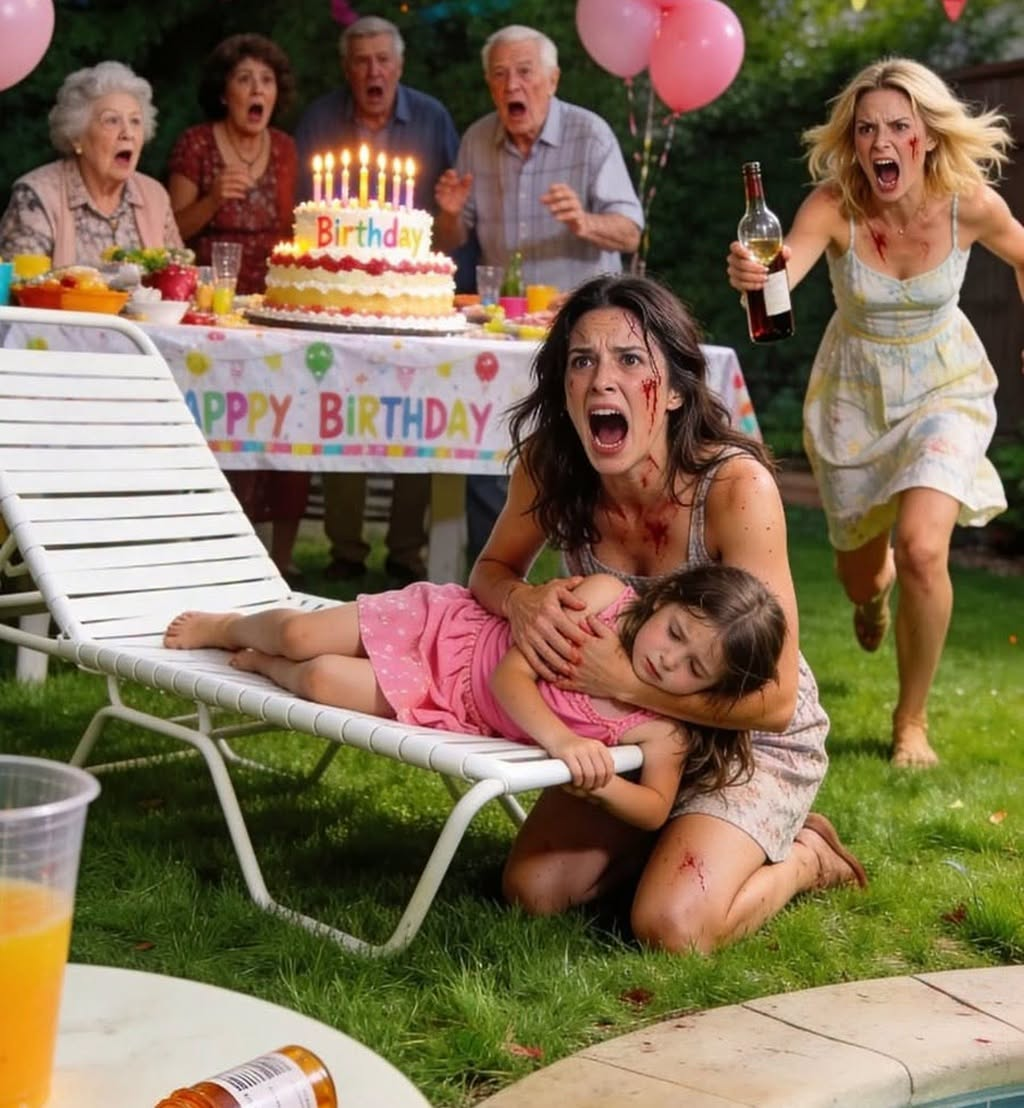
Witnesses confirmed that she had struck me with the wine bottle.
The physical evidence supported their accounts.
My mother was interviewed separately.
She eventually admitted that she had helped Natalie take Emma upstairs.
She also acknowledged that she had known Natalie intended to give Emma medication.
She claimed she believed it was harmless.
But she couldn't explain why she had tried to stop me from helping my daughter.
My father also gave a statement.
He admitted that he had initially dismissed the emergency and had failed to take immediate action.
Margaret and Linda provided their accounts.
The police reviewed the security recordings.
Nothing could undo what had happened.
But the truth was no longer something Natalie could control.
She was eventually charged in connection with the incident.
The legal process took time.
There were hearings, interviews, medical reports, and difficult conversations.
I learned that justice rarely arrived as dramatically as people imagined.
It came through paperwork.
Evidence.
Witness statements.
And the courage to keep telling the truth even when the people involved were related to you.
Natalie eventually entered a guilty plea to the charges arising from the incident.
The court considered the evidence, including the unauthorized administration of medication and the assault.
She was given a sentence and legal restrictions that prevented her from contacting Emma directly.
My mother and father also faced the consequences of their decisions.
They were not given the automatic forgiveness they expected.
I stopped attending family gatherings.
I stopped answering calls that began with excuses.
And I stopped allowing anyone to use the word family as a reason for me to ignore what had happened.
Emma was discharged from the hospital after the medical team determined she was well enough to continue recovering at home.
The first night back was difficult.
She wanted to sleep with the bedroom light on.
She asked me to leave the door open.
And several times, she called for me just to make sure I was nearby.
I never complained.
I moved a small bed beside ours for the first few nights.
David took turns sitting with her.
We read her favorite stories.
We let her choose her breakfast.
We didn't rush her.
Her recovery was not only physical.
She needed time to feel safe again.
I also needed time.
The injury to my head eventually healed, although I continued attending follow-up appointments.
But the emotional damage was harder to describe.
I sometimes woke in the middle of the night remembering the guest bedroom.
The blanket.
Emma's face.
The sound of the bottle breaking.
David noticed.
Whenever it happened, he reached for my hand.
"You don't have to carry this alone," he would whisper.
He was right.
We began speaking with a counselor who helped us process the trauma.
I learned that protecting my daughter didn't mean pretending I wasn't hurt.
It meant allowing myself to heal so I could continue being there for her.
Three months later, Emma returned to kindergarten.
On her first morning, she wore a lavender cardigan and carried her favorite notebook.
She stood beside me at the classroom entrance.
"Mommy?"
I knelt.
"Yes, sweetheart?"
"Will you be here when school finishes?"
I smiled.
"Every single day."
She hugged me.
Then she walked inside.
I watched her sit beside a little girl near the window.
They began drawing together.
For the first time in months, I saw her smile without hesitation.
That afternoon, David and I took her to a small park.
There were no loud birthday songs.
No crowded dining tables.
No relatives demanding attention.
Just the three of us.
Emma ran toward a patch of flowers.
"Look, Mommy!"
She pointed at a tiny yellow butterfly.
I smiled.
"It's beautiful."
She turned toward me.
"Can we draw it when we get home?"
"Of course."
David slipped his arm around my waist.
We watched her for a moment.
Then he kissed my forehead.
"She's going to be okay."
I leaned against him.
"I know."
A few weeks later, an envelope arrived.
It was from my mother.
I recognized her handwriting immediately.
I placed it on the kitchen table.
For several minutes, I couldn't bring myself to open it.
David stood beside me.
"You don't have to read it."
"I know."
But eventually, I unfolded the letter.
My mother wrote that she regretted what had happened.
She admitted that she had spent years making excuses for Natalie.
She had allowed her older daughter to dominate family gatherings because she believed avoiding conflict was the same as keeping peace.
She had also admitted that she had failed Emma.
The letter contained an apology.
A real one, perhaps.
But apologies didn't erase the image of my daughter lying motionless in that bedroom.
At the bottom, my mother had written:
I hope one day you will let me see Emma again.
I folded the letter.
David waited.
"What do you want to do?"
I looked toward the living room.
Emma was sitting on the rug, drawing a picture of our family.
She had drawn three people.
One tall.
One with long brown hair.
And one small girl wearing a purple dress.
I watched her for a moment.
Then I looked back at David.
"Not yet."
He nodded.
I placed the letter in a drawer.
I wasn't ready.
And I no longer felt obligated to make decisions according to someone else's timetable.
The following Saturday, Emma asked whether we could have a birthday celebration of our own.
Her birthday wasn't for several months.
But she wanted cake.
And balloons.
And a small party with just the people who made her feel happy.
David laughed.
"Absolutely."
We bought a small chocolate cake.
Emma chose yellow balloons instead of pink ones.
She invited two school friends.
We decorated the backyard with paper flowers and colorful ribbons.
There was no pressure.
No competition.
No one demanding that the day be perfect.
When the candles were lit, Emma looked at me.
"Can I make a wish?"
I smiled.
"Of course."
She closed her eyes.
For a few seconds, she was completely still.
Then she blew out the candles.
Everyone clapped.
David lifted her into his arms.
"What did you wish for?"
Emma giggled.
"I'm not telling."
I laughed.
For the first time in a long time, the sound came naturally.
Later that evening, after our guests had left, Emma climbed onto the couch beside me.
She rested her head against my shoulder.
"Mommy?"
"Yes, baby?"
"Can I tell you something?"
I brushed her hair away from her face.
"Anything."
She looked at her drawing.
"Sometimes I think I made Aunt Natalie angry because I didn't want to play."
I felt my throat tighten.
I turned toward her.
"Emma, sweetheart, grown-ups are responsible for their own choices."
She listened.
"You don't have to play when you're tired. You don't have to be loud when you want to be quiet. You don't have to make anyone happy by doing something that makes you uncomfortable."
She looked at me.
"Even family?"
I kissed her forehead.
"Especially when it comes to your safety."
She thought about that.
Then she wrapped her arms around my neck.
"I love you, Mommy."
I held her close.
"I love you more than anything."
David came into the room carrying three mugs of hot chocolate.
He placed them on the table.
Then he sat beside us.
Emma reached for his hand.
We stayed together on the couch, watching the evening light fade through the windows.
I thought about the years before Emma was born.
The appointments.
The treatments.
The disappointments.
The prayers.
I remembered how many times I had wondered whether I would ever hold my own child.
And now I understood something.
Being a mother wasn't about keeping every painful thing away from your child.
It was about standing beside her when the world became frightening.
It was about listening.
Believing her.
Protecting her.
And teaching her that love should never require fear.
My family had taught me a difficult lesson.
Being related to someone did not automatically make them safe.
Trust had to be earned.
And forgiveness could never be demanded.
I didn't know whether I would ever rebuild a relationship with my parents.
I didn't know what the future would bring for Natalie.
But I knew exactly what mattered now.
Emma was home.
She was drawing again.
She was laughing again.
And when she fell asleep that night, she did so in her own bed, surrounded by people who loved her without conditions.
I stood in her doorway for a moment.
Her little hand rested beside her favorite stuffed rabbit.
Her breathing was soft and steady.
David came up behind me and wrapped his arms around my shoulders.
"She's okay," he whispered.
I nodded.
"Yes."
He kissed my hair.
"Are you okay?"
I looked at my daughter.
Then I looked at the man who had stood beside me through the worst day of our lives.
For the first time, I could answer honestly.
"I'm getting there."
I turned off the hallway light, leaving her little night-light glowing beside the bed.
And as I walked away, I realized that the happiest ending wasn't having my old family back.
It was building a new kind of family.
One where nobody had to compete for love.
One where a child's tears were never dismissed.
One where protection was never confused with control.
And one where Emma would always know that she was wanted, cherished, and safe.






Comments 0