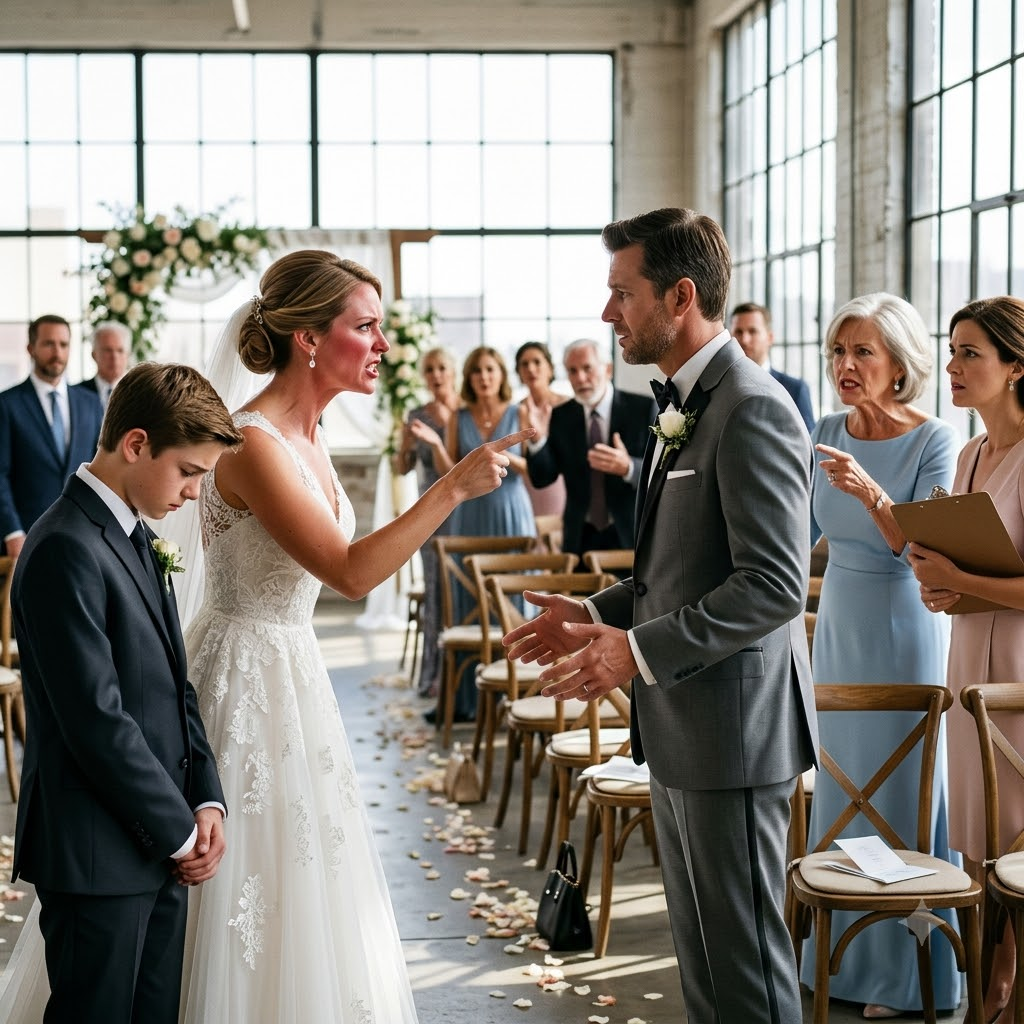
The document was dated three days before my wedding.
I read the heading again.
POST-MARRIAGE HOUSEHOLD TRANSITION PLAN.
Beneath it were two signatures.
Margaret Carter.
Greg Carter.
My hands began to tremble.
I looked at the first paragraph.
It stated that, following the marriage, the household would undergo a structured transition to establish clear boundaries between the existing children and the new family member.
The language was polished.
Professional.
Almost harmless.
But the second paragraph was different.
It proposed that Eli temporarily reside with his biological father while the newly married household adjusted to its new structure.
I read it twice.
Then I reached the final clause.
The arrangement was to be reviewed after six months, with the possibility of extending the separate residence if the household continued to experience difficulties.
Six months.
I looked at Greg.
"Did you sign this?"
He stared at the document.
"Joanna, I can explain."
"Did you sign it?"
He nodded.
I felt something inside me go quiet.
Not because I was surprised anymore.
Because I finally had the answer to the question I had been asking since the wedding.
Greg hadn't simply failed to defend my son.
He had already agreed to send him away.
I placed the document on the table.
"How long have you been planning this?"
Greg rubbed his forehead.
"It wasn't supposed to happen the way it did."
"How long?"
"About four months."
Lucas looked at his father.
"You told me it was just temporary."
Greg turned toward him.
"Lucas, please."
The boy lowered his eyes.
I looked back at Greg.
"You promised me Eli would always have a place in our home."
"He would have."
"Then why did you sign this?"
Greg pulled out a chair and sat down.
"Mom believed the children needed time to adjust."
"Six months?"
"Possibly."
"Without his mother?"
He shook his head.
"It wasn't meant to be permanent."
I stared at him.
"Did you ever ask me whether I wanted my son to live somewhere else?"
"No."
"Did you ask Eli?"
"No."
"Then you weren't planning a family transition. You were planning his removal."
Greg covered his face.
For several seconds, nobody spoke.
Then he said something that explained more than he probably intended.
"Mom told me it was the only way to keep the family together."
I looked at him.
"Which family?"
He didn't answer.
I stood.
"Lucas, thank you for showing me the messages. You did nothing wrong."
The boy looked up.
"Is Eli going to have to leave?"
I shook my head.
"No, sweetheart."
Lucas glanced toward the living room.
"Can I talk to him?"
I nodded.
He stood and walked out.
Greg remained seated.
I looked at him.
"You need to understand something. Eli is not a temporary inconvenience in my life. He is my child. He was my family before I met you, and he will remain my family long after this conversation."
Greg looked up.
"I know."
"No. You don't."
I picked up the document.
"You signed away the future of a child who trusted you."
He began to cry.
"I never wanted to hurt him."
I looked at him for a long moment.
"Then you should have protected him."
The following morning, I contacted Daniel Whitmore.
He arranged a meeting with an independent attorney who specialized in family and property matters.
I brought every document.
The household agreement.
The forged authorization.
The bank statements.
The assessment report.
The security footage.
The messages between Margaret and Lucas.
And finally, the signed transition plan.
For the first time, everything was in one place.
The attorney, Rachel Morgan, spent nearly three hours reviewing the records.
She didn't interrupt.
She didn't make assumptions.
She simply asked questions and took notes.
When she finished, she folded her hands.
"Joanna, there are several separate issues here."
I nodded.
"Please explain."
"First, the signature submitted under your name requires formal investigation. You have consistently denied authorizing it, and the records need to be preserved."
She turned to the next page.
"Second, the money transferred through Northbridge Family Holdings needs to be traced. We need to establish exactly where your contribution went and whether anyone had authority to move it."
"And the report about Eli?"
"That is another serious concern. It appears to contain allegations that were not independently verified. The consulting company has already acknowledged material omissions."
I nodded.
"What about the agreement Greg signed?"
Rachel examined it again.
"It does not, by itself, change your son's legal residence or parental rights. However, it is important evidence of what the adults were planning."
I felt a small measure of relief.
"So nobody can force Eli to move?"
"Not simply because of this document. Any legitimate change involving his residence would need to follow the applicable legal process and consider his welfare."
I exhaled.
For the first time in days, I felt I could breathe.
Rachel continued.
"There's something else. You should stop communicating directly with Margaret about these matters. Keep everything in writing, and let the appropriate professionals handle the financial and legal questions."
I nodded.
"That's what I want."
"Good. And Joanna?"
"Yes?"
"Do not let anyone convince you that protecting your child is an act of hostility."
I looked at her.
Then I smiled faintly.
Not because anything was funny.
Because someone had finally said what I needed to hear.
The investigation took several weeks.
The consulting company formally withdrew its preliminary assessment.
After reviewing the original footage, the messages, and Megan's statement, it acknowledged that the report had relied on incomplete information.
The allegation that Eli had threatened Lucas could not be substantiated.
The company also confirmed that neither Eli nor I had been interviewed before the preliminary findings were prepared.
The school provided written confirmation that it had never received a legitimate request from me to change Eli's educational arrangements.
The original report had been presented as a professional assessment.
But its foundation had been incomplete.
Megan provided a signed statement describing the events she witnessed.
Lucas's messages were preserved.
The hallway footage was secured.
Daniel supplied his original paperwork and confirmed that he had never agreed to any restriction on Eli's residence.
The evidence began to form a clear picture.
Margaret had wanted control over the new household.
She believed that Greg's children should retain their established position.
She viewed Eli as an obstacle to the arrangement she wanted.
Rather than discuss those concerns honestly, she had attempted to create a financial and legal structure that would make her preferred outcome easier to achieve.
Greg had signed the transition plan because he wanted to avoid confronting his mother.
He had convinced himself that temporary separation was a practical compromise.
But he had never considered what that compromise would mean to Eli.
The financial review revealed another important fact.
My eighteen thousand five hundred dollars had been transferred into the Northbridge-managed account without my authorization.
The funds had not been spent on the renovations Greg had originally described.
Instead, they had been combined with other household funds and used toward administrative costs associated with the proposed property structure.
Once the transactions were reviewed, the money was returned to me.
Margaret's forty-five-thousand-dollar transfer was also traced.
It had been intended to finance the restructuring of the Hawthorne Lane property and the associated household arrangements.
Richard Lawson cooperated with the review and supplied the company records.
Northbridge's proposed ownership interest was never finalized.
The company withdrew its pending claim.
The property remained outside the arrangement I had been asked to sign.
As for the unauthorized signature, the relevant records were referred for formal review.
I didn't need revenge.
I needed accountability.
And for the first time, I had enough evidence to insist on it.
Greg called me almost six weeks after the wedding.
I almost didn't answer.
But I wanted to hear what he had to say.
"Hello?"
"Joanna."
His voice sounded different.
Tired.
Quieter.
"How are you?"
"I'm fine."
There was a pause.
"I've been thinking about everything."
I said nothing.
"I know I hurt you."
"You hurt Eli."
"I know."
"Do you?"
He took a breath.
"I've spoken to a counselor."
I looked out the window.
"Why?"
"Because I need to understand why I let my mother make decisions for me."
I remained silent.
He continued.
"I always thought keeping the peace was the same as being a good son. If Mom was upset, I tried to fix things. If she disagreed with something, I changed the plan. I convinced myself that everyone would eventually adjust."
"And Eli?"
"I expected him to adjust too."
I closed my eyes.
"That's the problem, Greg."
"I know."
He paused.
"I want to apologize to him."
I considered that.
"Have you thought about what you would say?"
"Yes."
"An apology isn't a request for him to forgive you."
"I understand."
"And it isn't a way to get me back."
He was quiet.
"I understand that too."
I looked at the calendar.
Eli had a school event the following week.
"Then write him a letter. I'll let him decide whether he wants to read it."
"Thank you."
I was about to end the call when he spoke again.
"Joanna?"
"Yes?"
"I'm sorry I didn't choose you."
I stared at the window.
"You didn't have to choose between me and your mother."
"I know."
"You had to choose whether to stand up for a child who trusted you."
He began crying.
I didn't comfort him.
Some apologies deserved to be heard.
But not every apology deserved immediate forgiveness.
"Goodbye, Greg."
I ended the call.
And for the first time, I didn't feel the need to look at my phone again.
Margaret eventually sent me a letter.
It arrived in a plain white envelope.
There was no return address.
I recognized her handwriting.
I opened it at the kitchen table.
She wrote that she had been trying to protect her grandchildren.
She said she feared the household would become unstable.
She admitted that she had made decisions without properly consulting me.
But she also insisted that her intentions had been misunderstood.
She never directly apologized to Eli.
She never acknowledged that she had encouraged Lucas to provide misleading information.
And she never explained why she had allowed my signature to appear on an unauthorized document.
I folded the letter.
Then I placed it inside the file Rachel had prepared.
I didn't respond.
Some people spent their entire lives explaining why their actions were justified.
I no longer had to participate in those explanations.
Tasha also sent a message.
It was short.
I shouldn't have moved Eli's seat. I was wrong.
I read it once.
Then I put the phone down.
There was no need for a public argument.
The wedding was over.
The documents were being reviewed.
And my son no longer needed to stand in a corridor waiting for someone to decide whether he belonged.
The most important conversation happened on a Saturday afternoon.
Eli was sitting on the back porch with a glass of lemonade.
I joined him.
He looked up.
"Mom?"
"Yes?"
"Can I ask you something?"
"Anything."
"Are you sad about the wedding?"
I sat beside him.
I thought about the flowers.
The dress.
The guests.
The music.
The promises I had once believed Greg would keep.
"Sometimes," I answered honestly.
Eli looked down.
"I'm sorry."
I turned toward him.
"Why are you apologizing?"
"Because it ended."
I took his hand.
"Sweetheart, the wedding ending wasn't your fault."
"But you loved him."
"I did."
He looked at me.
"Would you still marry him if none of this happened?"
I considered the question.
Then I shook my head.
"Now that I know what I know, no."
He nodded.
"Because of me?"
"Because of the choices he made."
I touched his cheek.
"You didn't destroy anything. You showed me something I needed to see."
He was quiet.
Then he asked:
"Do you think Lucas hates me?"
I smiled gently.
"No. I think Lucas was caught in something that should never have involved him."
"Can I talk to him?"
"Of course."
Eli looked relieved.
"He's actually not that bad."
I laughed softly.
It was the first time I had heard him laugh about anything connected to Hawthorne Lane.
A few days later, Lucas sent Eli a message.
Sorry about everything. I should've told the truth sooner.
Eli replied:
It's okay. I know you didn't want to get involved.
Lucas wrote:
Want to play online sometime?
Eli smiled at his phone.
Sure.
It wasn't an instant friendship.
It wasn't a magical solution.
But it was a beginning.
And it belonged to the boys themselves.
Three months after the wedding, I received an unexpected package.
Inside was a small wooden box.
There was a note from Megan.
I found this while organizing the remaining files from Hawthorne Lane. I thought you might want it.
I opened the box.
Inside was Eli's original seating card.
The one that had been removed from the front row.
His name was written in my handwriting.
Eli Carter.
I ran my finger across the card.
I remembered writing it that morning.
I had imagined him walking beside me toward the altar.
I had imagined him sitting proudly in the front row.
I had imagined us beginning a new chapter together.
The card had been taken away.
But my son hadn't been.
I placed it inside a small frame and put it on the shelf in my office.
Not as a reminder of the wedding.
As a reminder of what mattered.
The following spring, I received a professional promotion.
After more than a decade working as an official court reporter, I was appointed to supervise a regional reporting team.
The position meant more responsibility.
Better hours.
And a little more financial stability.
Eli celebrated by asking whether we could finally take the vacation we had postponed during the wedding preparations.
I agreed.
We spent five days near Lake Michigan.
We walked along the shore.
We ate at small restaurants.
We took photographs.
And on the last evening, we watched the sun disappear behind the water.
Eli sat beside me on a wooden bench.
"Mom?"
"Yes?"
"Do you think we'll ever have another wedding?"
I looked at him.
"Maybe someday."
He smiled.
"But only if the person likes me."
I laughed.
"That's a pretty good requirement."
"And no one gets to move my chair."
I wrapped my arm around his shoulders.
"That one is nonnegotiable."
He leaned against me.
For a while, we watched the waves.
Then he said something that made me smile.
"You know what?"
"What?"
"I'm glad we left."
I kissed the top of his head.
"Me too."
A year after the wedding that never happened, I received a final update from Rachel.
The property review had been completed.
The unauthorized authorization had not been accepted.
The Northbridge arrangement had been withdrawn.
My financial contribution had been returned.
The consulting company had formally closed its assessment after acknowledging that its original report was unreliable.
The records involving the false statement were preserved for the appropriate review.
Daniel and I had also established a clearer financial arrangement for Eli's education.
Everything was documented.
Everything was transparent.
There would be no more secret meetings about his future.
No more decisions made without his parents.
And no more adults treating his place in a family as something that could be negotiated.
Greg eventually moved out of Hawthorne Lane.
He and his mother no longer managed the household together.
He continued counseling and gradually rebuilt his relationship with his children.
He sent Eli occasional birthday messages.
Eli responded when he wanted to.
There were no promises of reconciliation.
No pressure.
Just boundaries.
And that was enough.
As for Margaret, she never became part of our lives again.
I didn't need her approval.
I didn't need her apology.
I didn't need her to understand why she had been wrong.
I had finally learned that peace did not require convincing everyone to agree with me.
Sometimes peace simply meant refusing to let the same people hurt you twice.
On Eli's sixteenth birthday, I invited a few of his friends to dinner.
Claire came.
Daniel joined us.
Megan sent a gift and a handwritten card.
The kitchen was filled with laughter.
There were balloons attached to the chairs.
A chocolate cake sat in the middle of the table.
Eli blew out his candles.
Then he looked at me.
"Did you make a wish?"
I smiled.
"I wasn't the one blowing them out."
He laughed.
"Still. Did you?"
I looked around the table.
At my sister.
At my son.
At the people who had stood beside us when everything became difficult.
Then I looked at Eli.
"Yes."
"What was it?"
I leaned closer.
"That you always know you have a place where you're loved."
He smiled.
"That's not really a wish. That's already true."
My eyes filled.
He reached across the table and squeezed my hand.
And he was right.
It was already true.
I had once stood in a wedding venue holding a microphone, surrounded by people who believed they could decide the shape of my family.
They had taken away my son's chair.
They had tried to turn his feelings into evidence against him.
They had used money, paperwork, and carefully selected words to make exclusion look like responsibility.
But they had forgotten something.
I was his mother.
And my son's place in my life had never depended on a signature, a property agreement, or anyone else's permission.
That evening, after everyone had gone home, Eli helped me clear the table.
He picked up his birthday card from Claire and placed it beside the framed seating card in my office.
I looked at the two pieces of paper.
One carried his name from the wedding day.
The other carried his name from the day he turned sixteen.
Both belonged to the same boy.
Both reminded me that he had never been the problem.
I turned off the office light.
Then Eli called from the kitchen.
"Mom! There's still cake!"
I laughed and walked toward him.
"Save me a piece!"
He was waiting with two plates.
And this time, nobody was standing between us.
Nobody was deciding where he belonged.
Nobody was asking him to leave.
We sat together at the kitchen table, sharing the last piece of chocolate cake.
It wasn't the wedding I had imagined.
It was something better.
It was a home where my son never had to wonder whether he was wanted.
And that was the only happily-ever-after I had ever truly needed.






Comments 0