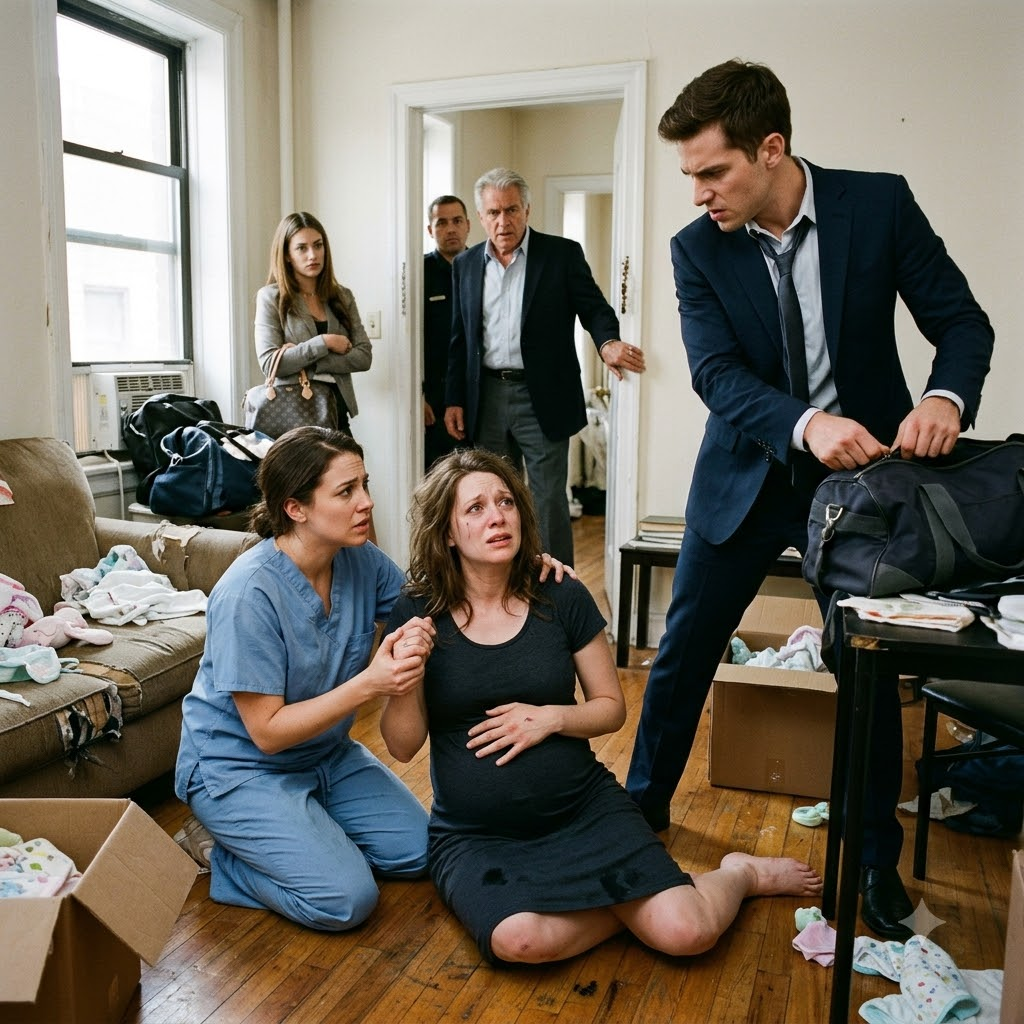
"And there's something you need to know about the baby before he's born..."
Margaret's voice trembled outside my hospital room.
I sat frozen, one hand resting over my stomach, the other holding my phone against my ear.
Rebecca Hale was still on the line.
"Lauren," she said firmly, "you do not have to open that door."
The handle turned again.
I looked toward it.
For eleven years, Margaret Ellis had been the woman I called whenever I was frightened.
When I failed an exam.
When I couldn't pay my rent.
When I cried because I believed my father didn't want me.
She had always answered.
And somehow, she had been involved in creating so much of the pain I needed comforting from.
"Aunt Margaret," I called, "stop trying the door."
The handle went still.
"Sweetheart, please."
"Don't call me that."
Silence.
I swallowed.
"What do you want?"
"I have the original document."
I looked at the phone.
Rebecca spoke quietly.
"Ask her to give it to hospital security. Don't accept anything directly."
I repeated the instruction.
Margaret began crying.
"Lauren, you don't understand. Charles is going to destroy me."
I closed my eyes.
"Then tell the truth."
"I tried."
"No."
My voice shook.
"You tried to protect yourself."
A long silence followed.
Then Margaret whispered, "I was afraid."
I looked down at my stomach.
"So was I."
The words surprised me.
But once they were spoken, I couldn't stop.
"I was afraid when Dad stopped calling. I was afraid when Thomas disappeared. I was afraid when Eric started getting angry about money."
My throat tightened.
"And I was terrified when I was bleeding on my apartment floor and my husband walked away."
Margaret made a small, broken sound.
I continued.
"You knew things about Eric. You knew he was lying to me. And you let me marry him."
"Lauren—"
"You watched me build a life with a man who was being paid to deceive me."
She began sobbing.
I wiped my eyes.
"Whatever you came here to say, you can say it to the investigators."
Then I pressed the nurse call button.
Within minutes, hospital security arrived.
Margaret handed over a sealed envelope.
She did not enter my room.
As the officers escorted her away, I heard her say something I would remember for the rest of my life.
"I thought if I lost Lauren, I'd have nobody."
I stared at the closed door.
For years, she had made sure I felt exactly the same way.
Rebecca arrived twenty minutes later.
My father came with her.
Daniel Brooks followed, carrying a folder of documents.
The sealed envelope Margaret had surrendered lay on the table.
I looked at it.
"Is that really the original?"
Rebecca sat beside me.
"We'll have to verify it. We won't rely on Margaret's description alone."
I nodded.
My father looked exhausted.
His silver hair seemed whiter than it had a week earlier.
But when he saw me, his expression softened.
"How are you feeling?"
I managed a small smile.
"Like everyone in Manhattan wants me to sign something."
He laughed despite himself.
Then his face became serious.
"Lauren, we can wait."
I shook my head.
"No."
I rested my hands over my stomach.
"I want to understand what my mother did for me."
Rebecca opened her folder.
"The authenticated trust records answer much of that question."
She placed a document in front of me.
At the top were the words:
ELEANOR WHITMORE PRIVATE PROTECTIVE TRUST
I recognized the name.
I recognized my mother's signature.
But this document carried something the others had lacked.
A complete certification history.
Independent trustee records.
And an attached schedule of amendments.
Rebecca pointed to the first page.
"Your mother established this trust for your benefit. The assets were placed under independent management, separate from Whitmore Capital's ordinary corporate accounts."
I nodded.
"Then why did Margaret's name appear as the sole beneficiary?"
"Because someone submitted a purported replacement designation naming her."
My father looked at the document.
"Charles."
Rebecca nodded.
"The evidence points toward Charles Vance and Margaret participating in that attempt. But the independent trustee's records show the replacement was never properly accepted."
I stared at her.
"Then Margaret never owned it?"
"Not through that document."
I exhaled.
For days, I had been afraid that my mother had left everything to the aunt who betrayed me.
Now I understood that the paper bearing Margaret's name had been part of the deception.
Rebecca turned another page.
"Your mother also anticipated that someone might attempt to gain influence through your future marriage."
My heart tightened.
"How?"
"She included provisions preventing a spouse from obtaining control merely through marriage or through an agreement you didn't knowingly authorize."
I looked down at my wedding ring, still resting in a small plastic bag with my personal belongings.
"And the baby?"
Rebecca's expression softened.
"That's the most important part."
She turned to the final amendment.
"Your mother provided that when you have your first child, a separate educational and welfare trust will be established for that child."
I stared.
"What?"
"Your son will have resources reserved for his education, health, and future needs."
Tears filled my eyes.
Rebecca continued.
"But those resources will be administered by an independent trustee. Neither Eric nor any other parent or relative can simply take control of them."
I looked at my father.
He was crying.
I turned back to Rebecca.
"Mom did that?"
She nodded.
"Yes."
I placed a hand over my stomach.
My mother had died before I graduated from high school.
Before I fell in love.
Before I married.
Before I knew I would have a son.
And somehow, she had found a way to protect him.
I began crying.
Rebecca waited.
Then she said, "The provision Charles was trying to exploit concerned representation of a future minor beneficiary. He apparently wanted documents he could use to claim that Eric had been authorized to act in connection with the trust."
I swallowed.
"Would it have worked?"
"The trust contains safeguards against that. But forged documents and false claims can still create expensive disputes and delays."
I looked at the envelope Margaret had brought.
"Then what was she trying to make me sign?"
Rebecca opened it carefully.
Inside was another purported consent form.
It claimed I had approved Eric as a representative in matters involving my future child.
At the bottom was a blank signature line.
Mine.
I stared at it.
For the first time, I didn't feel confused.
I felt angry.
Not the helpless anger that made me cry.
A clear, steady anger.
"They thought I would sign this because I was scared."
Rebecca nodded.
"That appears to have been the plan."
I pushed the paper away.
"Then they don't know me anymore."
The truth about my mother's final day came two days later.
Not through another anonymous message.
Not through a threatening phone call.
Through records.
Witnesses.
And the full recording Helen Mercer had preserved.
My father and I listened together, with Rebecca and Daniel present.
The recording began with my mother's voice.
I had heard fragments before.
But this time, there were no missing sections.
No sudden cuts.
No mysterious instructions arriving from unknown numbers.
Just Eleanor Whitmore.
Alive.
Angry.
And frightened.
"Charles, I know what you submitted."
His voice answered.
"Eleanor, you're misunderstanding the arrangement."
"No. I understand it perfectly."
There was a rustling sound.
Then my mother spoke again.
"You changed the beneficiary designation without my authorization."
Charles said something too quietly to understand.
My mother continued.
"And Margaret helped you."
A woman's voice answered.
Margaret.
"Eleanor, please. I only wanted what you promised me."
My father closed his eyes.
The recording continued.
"I promised to help you, Margaret. I never promised to give you Lauren's future."
Margaret began crying.
Charles interrupted.
"We can settle this privately."
My mother's voice hardened.
"No. I've already instructed the independent trustee to reject the changes. I've preserved the records, and I'm notifying Richard."
A chair scraped.
Then Margaret spoke.
"You'll ruin us."
My mother answered quietly.
"No. You did that yourselves."
The next sound was a sharp intake of breath.
Then my mother said, "I don't feel well."
My father's hand tightened around mine.
We listened as Helen asked whether she needed help.
My mother answered that she felt dizzy.
Charles said they should sit her down.
Then Helen called for medical assistance.
The recording ended several minutes later.
I stared at the table.
"That's it?"
Daniel nodded.
"That's the complete file Helen preserved."
I looked at him.
"Did they hurt her?"
He took a careful breath.
"The medical records and independent review do not establish that anyone physically harmed your mother or caused her medical emergency."
I swallowed.
"Then what happened?"
My father answered.
"She suffered a sudden medical crisis. The doctors tried to save her."
His voice broke.
Daniel continued.
"But Charles submitted a disputed authorization changing who the hospital could communicate with. That interfered with Richard's ability to receive information and reach Eleanor."
I stared at my father.
He looked down.
"Margaret knew I was outside."
My chest tightened.
"What?"
He nodded.
"She was told I'd arrived."
I covered my mouth.
Daniel spoke gently.
"According to her statement, Margaret didn't correct the false authorization. She allowed the hospital to believe Eleanor had revoked Richard's access."
My father closed his eyes.
"I was there, Lauren."
I reached for his hand.
He began crying.
"I was right outside her room."
I moved closer.
And held him.
For eleven years, he had carried the belief that he had abandoned my mother.
Now he knew something worse and something kinder at the same time.
He had arrived too late to save her.
But he had not chosen to stay away.
And the people who had told him he wasn't wanted had been lying.
The investigation took months.
There were no miraculous arrests in the middle of the night.
No dramatic confession that solved everything in five minutes.
There were interviews.
Subpoenas.
Forensic examinations.
Bank records.
And long days when Rebecca called to explain developments I barely understood.
But the evidence kept growing.
The forged signatures were traced through document versions and account records.
The consulting payments to Margaret were confirmed.
The marriage placement agreement was authenticated.
Eric's payments were matched to the dates of our relationship.
And the money he had transferred from our joint savings account was identified in his business records.
The supposed insurance papers I had signed three months before my hospitalization turned out to be part of an attempt to support unauthorized financial guarantees.
I had not understood what I was signing.
Eric eventually admitted that he had deliberately misrepresented them.
That admission mattered.
So did Sienna's recording.
So did the documents Helen had kept.
So did Thomas Reed's account of the threats that drove him away.
The anonymous messages were eventually traced to a former employee of Charles's consulting firm who had helped prepare false records. The employee had begun sending warnings after learning that the investigation was closing in.
Some of the messages contained genuine information.
Others were misleading.
The photographs supposedly showing my father and Charles together inside the bank vault had been altered from old security images and corporate photographs.
My father had never secretly opened my mother's deposit box with Charles.
The bank confirmed that the box had remained secured until its contents were reviewed under proper legal authority.
That discovery hurt almost as much as the original lie.
Someone had tried to turn me against my father again.
And for a moment, I had almost believed them.
When I apologized, Dad shook his head.
"Lauren, you were frightened."
I looked down.
"I should have trusted you."
He took my hand.
"Trust isn't something I get to demand. It's something I have to keep earning."
I began crying.
He smiled sadly.
"We have time now."
And for the first time, I believed him.
Charles Vance was eventually charged in connection with the fraudulent financial scheme.
Margaret also faced charges arising from her participation in the false documents and unauthorized transactions.
Their cases proceeded through the courts.
The evidence concerning my mother's hospital authorization became part of the investigation, although no one was charged with causing her death.
I was relieved by that distinction.
I wanted the truth.
Not a story made more dramatic than the evidence allowed.
Months later, Charles pleaded guilty to several financial offenses as part of a negotiated resolution.
Margaret also entered a guilty plea to offenses connected with the forged records and transfers.
The court imposed penalties, restitution obligations, and sentences reflecting their respective conduct.
The process did not return my childhood.
It did not give my mother another day.
It did not erase the years my father and I had lost.
But it established something important.
What happened to me had not been a misunderstanding.
It had been a deliberate scheme.
And the people responsible could no longer pretend otherwise.
I never visited Margaret in custody.
For a long time, I felt guilty about that.
Then Rebecca said something that stayed with me.
"You can hope someone changes without making yourself responsible for their rehabilitation."
I wrote Margaret one letter.
I told her I remembered the good things.
The birthday cakes.
The rides to school.
The nights she stayed beside me when I cried.
But I also told her that kindness did not cancel betrayal.
I wished her the courage to become honest with herself.
And I told her I would not be continuing our relationship.
I mailed the letter.
Then I went home.
Eric's consequences were different.
He cooperated with investigators after his attorney advised him to preserve and disclose the evidence.
He admitted receiving money to begin a relationship with me.
He admitted concealing the arrangement.
He admitted misleading me about the documents I signed.
He also acknowledged that he had left me during a medical emergency.
His cooperation did not erase those choices.
He faced financial claims, legal penalties, and the collapse of the business he had built on false representations.
The investors pursued recovery of their losses.
The corporate housing arrangement ended through the required process.
Eric moved out of the Midtown apartment.
His luxury car was returned.
The expensive furniture disappeared.
And the photographs he once used to advertise his success were removed from his social media accounts.
The man who had told me I was a burden had spent years chasing an image of wealth.
In the end, that image had cost him almost everything.
One afternoon, Rebecca called.
"Lauren, Eric has agreed to the financial terms we've been negotiating."
I sat at the kitchen table of my new apartment.
My heart began pounding.
"What terms?"
"He has agreed to a documented repayment arrangement concerning the marital funds he improperly used, subject to his actual financial capacity and the other legal proceedings."
I closed my eyes.
"My teaching savings?"
"Yes. The agreement addresses them."
I exhaled.
"And the divorce?"
"We're close to finalizing it."
I looked toward the window.
Outside, children were playing in a small courtyard.
For a moment, I couldn't speak.
Then I whispered, "Thank you."
Rebecca's voice softened.
"You're welcome."
I ended the call.
And cried.
Not because I missed Eric.
Not because I wanted him back.
But because I could finally imagine a life where his decisions no longer controlled mine.
Sienna sent me a letter.
It arrived several weeks after I left the hospital.
I recognized her name immediately.
For a long time, I let the envelope sit unopened.
Then one evening, I read it.
She didn't ask me to forgive her.
She didn't blame Eric for everything.
She admitted that she had known he was married.
She admitted that she had seen me in distress.
And she admitted that she had chosen to walk away.
She wrote that cooperating with investigators was the least she could do.
Then she apologized.
Without excuses.
Without conditions.
I read the letter twice.
Then placed it in a drawer.
I never wrote back.
But I stopped imagining conversations where I screamed at her.
I stopped wondering whether she was happier than I was.
I stopped measuring my worth against the woman Eric had chosen.
Sienna had her own life to repair.
And I had mine.
My new apartment was in a quiet neighborhood in Queens.
It had two bedrooms.
A small kitchen.
A living room with sunlight in the afternoon.
And a nursery with yellow walls.
Not pale yellow.
Not cream.
Sunshine yellow.
My father stood in the doorway the day the painters finished.
He stared at the room.
"Well."
I laughed.
"What?"
He smiled.
"It's definitely yellow."
I crossed my arms.
"Too much?"
He shook his head.
"No."
He stepped inside.
"It's perfect."
The crib stood beneath the window.
A soft white rug covered the floor.
There were shelves for books.
A rocking chair.
And a framed photograph of my mother.
I had placed it beside the crib.
My father looked at the photograph.
His expression softened.
"She would have loved this."
I smiled.
"I know."
He stood beside me.
For a moment, we watched the sunlight move across the yellow walls.
Then he said, "You know, there's a much larger house available if you ever change your mind."
I laughed.
"Dad."
"What?"
"I like my apartment."
He raised both hands.
"Just making sure."
I smiled.
"And I like paying my own bills."
He nodded.
"I know."
I looked at him.
"But thank you for helping me get here."
His eyes filled.
"Always."
I had accepted a temporary loan from him to cover the move and my immediate expenses.
We had written down the terms because I wanted to.
Not because he demanded it.
I also began working with a financial adviser who had no connection to Whitmore Capital.
For the first time, I was learning how to manage money without fear.
The trust my mother established gave me security.
But it didn't decide what kind of woman I would become.
I still wanted to teach.
I still wanted to stand in front of a classroom.
I still wanted to help children discover that they were capable of more than they believed.
And I was finally making that dream real.
Thomas Reed visited one Saturday afternoon.
He brought a small box.
Inside was a collection of children's books.
I laughed.
"Thomas, he's not even born yet."
He smiled.
"Never too early."
I picked up a picture book.
On the inside cover, he had written:
For Lauren's little boy. May every story remind you that the world is bigger than fear.
My throat tightened.
"Thank you."
Thomas nodded.
"You're welcome."
We sat in the living room drinking tea.
For a while, we talked about college.
About our old friends.
About the terrible coffee in the campus library.
Then the conversation became quiet.
Thomas looked at me.
"Lauren, can I ask you something?"
I nodded.
"Do you ever wonder what would have happened if Margaret hadn't separated us?"
I looked down at my cup.
"Sometimes."
He smiled sadly.
"Me too."
I took a breath.
"But I don't think we can live inside that question."
He nodded slowly.
"No."
I looked at him.
"You were important to me, Thomas."
His eyes softened.
"You were important to me too."
I smiled.
"And I'm glad you're back in my life."
He nodded.
"Me too."
We didn't kiss.
We didn't make promises.
We didn't pretend that six years could disappear because the truth had finally come out.
But when he left, he hugged me gently.
And I felt something peaceful.
Not the desperate need to be chosen.
Not the fear of being abandoned.
Just gratitude.
Some people return to our lives to become our future.
Others return to help us understand our past.
Thomas had given me something I hadn't known I needed.
The knowledge that I had been loved honestly once.
And that Eric's betrayal had not made me unlovable.
Three months later, my divorce was finalized.
I sat beside Rebecca in a quiet office when she handed me the confirmation.
"Lauren," she said, smiling, "it's done."
I stared at the paper.
For three years, I had been Lauren Dawson.
A wife.
A woman who apologized for buying groceries.
A woman who hid unpaid bills.
A woman who had stopped talking about teaching because her husband said it was pointless.
Now I was legally free of that marriage.
I looked at Rebecca.
"Can I use Whitmore again?"
She smiled.
"We've addressed the name change in the paperwork."
I laughed through tears.
"Good."
I looked down at the document.
Lauren Whitmore.
My name.
My mother's name.
My father's name.
And most importantly, a name I was choosing for myself.
I folded the paper carefully.
Then I called Dad.
He answered immediately.
"Sweetheart?"
"It's done."
He was quiet for a moment.
Then he asked, "How do you feel?"
I looked out the window.
I expected to feel triumphant.
I expected fireworks.
I expected some enormous rush of happiness.
Instead, I felt calm.
"Free," I whispered.
My father exhaled.
"Then let's celebrate."
I laughed.
"How?"
"Blueberry muffins?"
I burst out laughing.
"Dad, please. Anything but blueberry muffins."
My son was born on a rainy Thursday morning.
Two weeks before my due date, I woke with contractions.
At first, I thought they were the usual discomforts of late pregnancy.
Then another came.
Stronger.
I looked at the clock.
And reached for my phone.
"Dad?"
He answered on the second ring.
"Lauren?"
"I think it's time."
There was silence.
Then a crash.
"Dad?"
"I'm fine."
I heard him moving.
"Where are my keys?"
I started laughing.
"Dad, calm down."
"I'm calm."
Another crash.
I laughed harder.
"You don't sound calm."
"I am extremely calm."
Twenty minutes later, he arrived at my apartment carrying a hospital bag.
My hospital bag.
The one I had already packed.
He had somehow picked up the spare one from his house.
I stared at him.
"Dad."
He looked down.
Then back at me.
"Oh."
I began laughing so hard that another contraction caught me by surprise.
He immediately became serious.
"Okay. Hospital. Now."
Dr. Grant and the maternity team were ready when we arrived.
The labor was long.
There were moments when I was frightened.
Moments when I cried.
Moments when I told my father I couldn't do it.
He stood beside me.
Held my hand.
And reminded me to breathe.
At one point, I looked at him through tears.
"Dad?"
"Yes, sweetheart?"
"I'm scared."
His eyes filled.
"I know."
I gripped his hand.
"What if something goes wrong?"
He leaned closer.
"You're surrounded by people who know how to help you. And I'm right here."
I closed my eyes.
Another contraction came.
I cried out.
He stayed.
He didn't look away.
He didn't complain.
He didn't tell me I was being dramatic.
He stayed.
And when my son finally entered the world, his first cry filled the room.
I stopped breathing.
Then I began sobbing.
The nurse placed him against my chest.
He was warm.
Tiny.
Perfect.
His little face was red.
His fists were clenched.
And his cry was the most beautiful sound I had ever heard.
"Hi," I whispered.
He moved against me.
I laughed through tears.
"Hi, sweetheart."
My father stood beside the bed.
His face was wet.
He looked at the baby.
Then at me.
"Oh, Lauren."
I smiled.
"Dad, meet your grandson."
He covered his mouth.
The nurse asked, "Does he have a name?"
I looked down at my son.
For months, I had kept the name to myself.
I wanted to say it when I could finally see his face.
When I could hold him.
When I could promise him that he belonged to no one but himself.
I kissed his forehead.
"His name is Noah."
My father smiled through tears.
"Noah."
I nodded.
"Noah James Whitmore."
Dad looked at me.
"James?"
I smiled.
"Mom's father's name."
His expression changed.
Then he began crying again.
I laughed softly.
"Dad, you're going to make me cry."
He leaned down and kissed my forehead.
"Too late."
I looked at my son.
Noah opened his eyes for a brief moment.
And I felt something inside me settle.
Not because everything in my life had become perfect.
But because the little boy I had fought so hard to protect was finally here.
Alive.
Safe.
Loved.
Eric learned about Noah's birth through his attorney.
I had asked Rebecca to handle the communication.
I wasn't ready to speak with him directly.
And I didn't owe him that conversation simply because he wanted one.
Several days later, Rebecca told me Eric had sent a letter.
She asked whether I wanted to read it.
I thought for a moment.
Then nodded.
The letter was short.
He congratulated me on Noah's birth.
He acknowledged that he had failed me as a husband.
He wrote that he would comply with the legal arrangements concerning support and any future parenting matters.
He did not ask me to take him back.
He did not ask for forgiveness.
He did not tell me he deserved another chance.
At the bottom, he had written:
I hope Noah grows up knowing that none of what happened was his fault.
I read the sentence twice.
Then folded the letter.
I didn't cry.
I didn't feel angry.
I simply placed it in the file Rebecca had helped me organize.
Any future relationship between Eric and Noah would be addressed carefully, with appropriate legal guidance and Noah's well-being first.
Eric would have to demonstrate responsibility through actions.
Not promises.
Not money.
Not apologies.
And I would never again confuse someone's regret with my obligation to return.
Six months after Noah's birth, I completed the final requirements for my teaching certification.
I stood in front of my bathroom mirror that morning, holding the confirmation email on my phone.
I read it three times.
Then I began laughing.
"Noah!"
He sat in his little activity seat beside the doorway, waving a plastic giraffe.
I crouched beside him.
"Guess what?"
He smiled.
I kissed his cheek.
"Mommy did it."
He squealed.
I laughed.
"Yes, she did."
I called my father.
He answered immediately.
"Lauren?"
"Dad, I passed."
There was silence.
Then he shouted, "You did?"
I laughed.
"Yes!"
"Oh, sweetheart!"
I heard him laughing.
Then crying.
Then laughing again.
I shook my head.
"Dad, you're impossible."
He sniffed.
"I'm proud of you."
My throat tightened.
"Thank you."
"No, Lauren. Listen to me."
I smiled.
"I'm listening."
"You built this life. You made these choices. You kept going when it would have been easier to give up."
Tears filled my eyes.
"And I am so proud to be your father."
I closed my eyes.
For years, I had believed that teaching disappointed him.
Now he was celebrating the dream I had refused to surrender.
I looked at Noah.
He was chewing on the giraffe's ear.
I laughed through tears.
"Dad?"
"Yes?"
"Can you babysit Saturday?"
He answered immediately.
"Absolutely."
I smiled.
"Because I have an interview at an elementary school."
I got the job.
A third-grade teaching position at a public school in Queens.
The classroom had tall windows.
A reading corner.
A battered bookshelf.
And twenty-four desks.
On my first day, I stood at the door greeting students.
Some were excited.
Some were shy.
One little boy clutched his backpack straps and stared at the floor.
I crouched beside him.
"Hi. I'm Ms. Whitmore."
He looked up.
"I'm nervous."
I smiled.
"Me too."
His eyes widened.
"Really?"
"Really."
He thought about that.
Then asked, "What if I make a mistake?"
I smiled gently.
"Then we'll learn from it."
He looked at me.
"You're not going to get mad?"
I shook my head.
"Not for trying."
He smiled.
And walked into the classroom.
I watched him go.
Then I looked around.
At the desks.
The books.
The colorful drawings on the walls.
The place I had dreamed of for so long.
And I realized something.
I hadn't just survived.
I had come back to myself.
One year after Noah was born, my father hosted a small birthday party in the garden of his home.
Not a lavish event.
No reporters.
No business associates.
No expensive decorations.
Just family.
A few friends.
Rebecca stopped by with a gift.
Daniel arrived carrying a toy train.
Thomas brought a collection of picture books.
And Dr. Grant sent a card with a handwritten message.
My father had insisted on baking the cake himself.
It leaned slightly to one side.
The frosting was uneven.
And the yellow icing looked suspiciously like mustard.
I stared at it.
"Dad."
He looked proud.
"What?"
I pointed.
"Did you make that?"
"Yes."
I tried not to laugh.
"It's beautiful."
He narrowed his eyes.
"You're lying."
I burst out laughing.
He laughed too.
Noah sat in his high chair, wearing a little blue shirt.
He clapped whenever someone looked at him.
My father leaned toward him.
"Happy birthday, little man."
Noah reached for his grandfather's glasses.
Dad laughed.
"Careful. Those are expensive."
I smiled.
"He's a Whitmore. He has expensive taste."
Dad laughed so hard he nearly dropped the cake.
We sang.
Noah stared at the candle.
Then tried to grab it.
I gently moved his hand.
"Not yet, sweetheart."
My father blew it out for him.
Everyone cheered.
Noah squealed.
And I laughed until my cheeks hurt.
Later, after the guests had gone, I carried Noah into the garden.
The evening air was warm.
The roses were blooming.
My father stood beside the old stone bench where my mother used to sit.
I joined him.
Noah rested his head against my shoulder.
For a while, we watched the sunset.
Then Dad spoke.
"Your mother loved this garden."
I smiled.
"I remember."
He looked at the roses.
"She used to say the best things in life needed patience."
I laughed softly.
"She also said gardens were supposed to be messy."
He smiled.
"That sounds like her."
I looked down at Noah.
He was almost asleep.
His little fingers curled around my necklace.
I thought about the woman I had been the night Eric left me.
Twenty-six years old.
Six months pregnant.
Bleeding on the floor of a shabby apartment.
Begging a man who didn't love me to stay.
I remembered the terror.
The loneliness.
The terrible certainty that nobody was coming.
Then I looked at my father.
At the man who had arrived at my door with silver hair and tears in his eyes.
At the man who had stayed.
Who had listened.
Who had learned that loving me meant respecting the life I wanted.
"Dad?"
He turned.
"Yes, sweetheart?"
"Thank you for finding me."
His eyes filled.
He shook his head.
"Lauren, I should have found you years ago."
I smiled sadly.
"Maybe."
I looked at Noah.
"But you came when I needed you."
My father stepped closer.
"And I'll keep coming."
I leaned against him.
He wrapped one arm around my shoulders.
For a moment, we stood together beneath the roses.
Three generations.
One family.
Not the family I had imagined when I was a little girl.
Not the family I had tried to build with Eric.
But a family made of people who chose honesty over appearances.
Respect over control.
And love without conditions.
That night, I carried Noah into his yellow nursery.
He was sleepy from the party.
His cheeks were warm.
His little hands rested against my shoulder.
I lowered him into his crib.
He opened his eyes.
"Hi, baby," I whispered.
He smiled.
I brushed a strand of soft hair from his forehead.
"Did you have a good birthday?"
He made a happy little sound.
I laughed softly.
"I think you did."
I sat in the rocking chair beside his crib.
On the wall above the bookshelf hung two photographs.
One of my mother.
One of my father holding Noah on the day he was born.
Between them was a small framed sentence from my mother's letter.
You owe no one your future.
I looked at the words.
Then at my son.
For so long, I had believed happiness meant being chosen by someone else.
Being loved by a husband.
Being accepted by a family.
Being worthy of staying for.
But happiness had turned out to be something quieter.
A safe home.
A classroom full of children.
A father who called every evening.
A son who reached for me when he was frightened.
A life where I could make decisions without asking permission.
Noah yawned.
I leaned closer.
"Do you remember what I promised you?"
He blinked sleepily.
I smiled.
"I promised you would never have to earn my love."
I touched his tiny hand.
"And I meant it."
His fingers curled around mine.
I felt tears rise.
Not sad tears.
Not frightened tears.
Just the kind that come when your heart is too full to hold everything.
"I don't know what you'll become," I whispered.
"Maybe a teacher. Maybe a doctor. Maybe an artist. Maybe something I can't even imagine yet."
He smiled in his sleep.
I laughed softly.
"Whatever it is, I'll be proud of you."
I kissed his forehead.
"And if you ever make a mistake, you can come home."
I brushed my thumb across his little fingers.
"If you're scared, you can come home."
My voice trembled.
"If the world makes you feel small, you can come home."
I looked around the yellow room.
At the books.
The toys.
The soft blanket folded over the chair.
The sunlight-colored walls.
And I smiled.
"Because this is your home, Noah."
I leaned down and kissed him one last time.
"And you will always be loved here."
He closed his eyes.
His breathing became slow and peaceful.
I stood beside the crib for another moment.
Then I switched off the lamp.
A soft night-light glowed beside the bookshelf.
I walked toward the door.
Before leaving, I looked back.
My son was sleeping.
Safe.
Warm.
Loved.
Downstairs, my father was waiting with two cups of tea.
Tomorrow, I would teach.
Tomorrow, Noah would laugh.
Tomorrow, there would be laundry, grocery lists, lesson plans, and all the ordinary little problems of an ordinary life.
And I couldn't wait.
I stepped into the hallway and closed the nursery door gently behind me.
For the first time in my life, I wasn't afraid of what came next.
I was home.






Comments 0