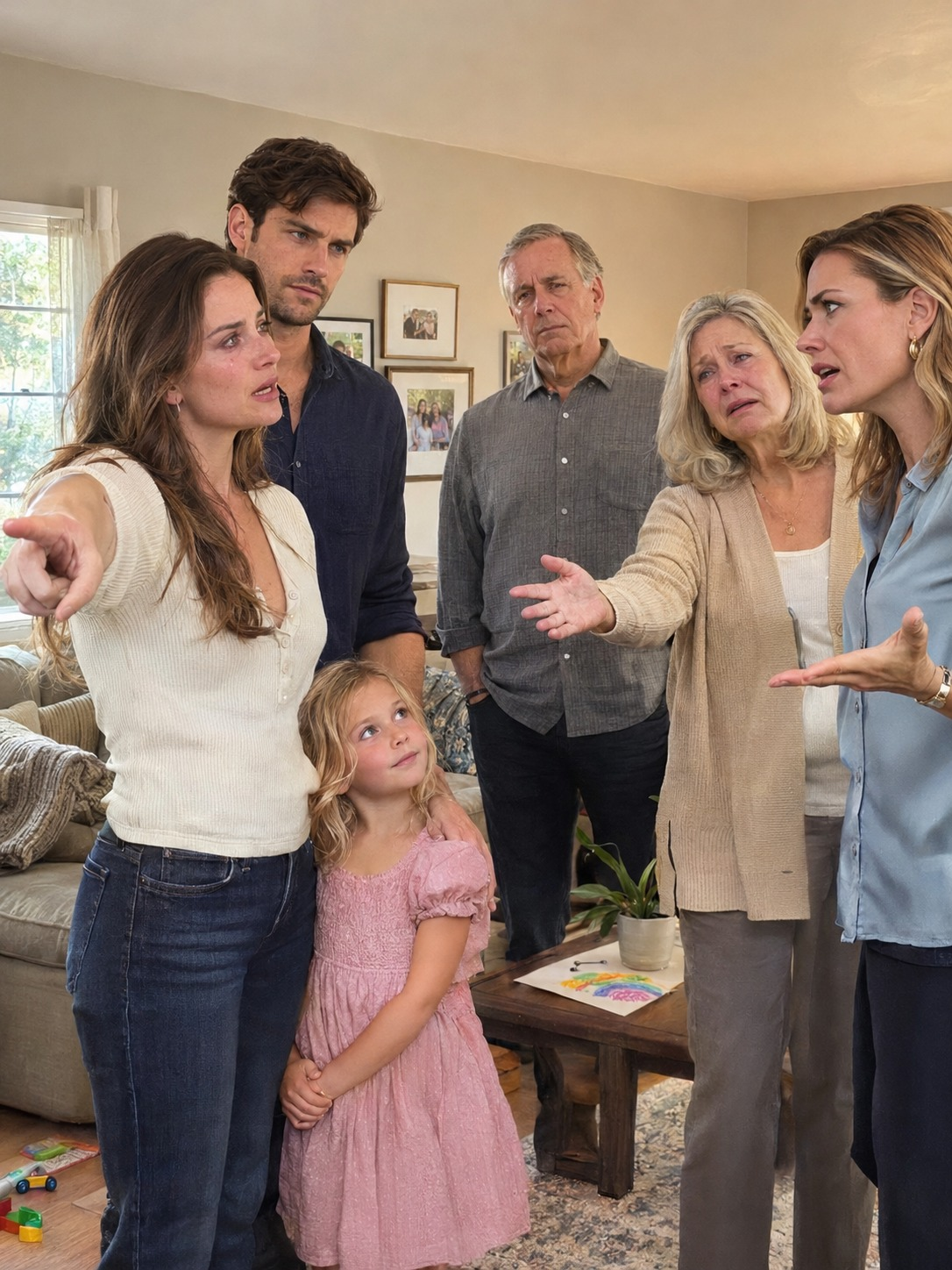
The hand reaching for the lock belonged to my mother.
I knew it before the photograph finished loading.
Her gold wedding band was visible. So was the thin silver bracelet she had worn almost every day when I was a child.
In the picture, seven-year-old me stood outside the storage room behind our old house, wearing a yellow birthday dress that had once belonged to Amanda.
My hair was tied into two crooked ponytails.
My face was turned toward the camera.
And behind me, my mother was reaching toward the brass padlock hanging from the storage room door.
I stared at the photograph until the screen dimmed.
"Anna?"
Chris stood beside me.
I hadn't realized I was holding my breath.
"That's my mother," I whispered.
He leaned closer.
"Are you sure?"
"Look at her bracelet."
He studied the image.
"What's happening here?"
I swallowed.
"That's the door Amanda locked me behind when I was seven."
Chris looked at me.
"You told me about that."
"Not everything."
His expression changed.
"What do you mean?"
I sat down at the kitchen table.
My legs suddenly felt unreliable.
For nearly thirty years, I had carried a particular memory of that afternoon.
Amanda tricking me into the storage room.
The door slamming.
The lock clicking.
The music from her birthday party.
My fists pounding against the wood until my knuckles hurt.
And my mother telling me afterward that I had invented the entire thing.
But the photograph suggested something I had never considered.
My mother had been there.
Not afterward.
Not when Amanda finally opened the door.
Before.
Or perhaps during.
I enlarged the picture.
The old wooden door filled most of the frame. A narrow strip of afternoon sunlight fell across the concrete walkway. My mother's hand hovered near the lock.
The photograph didn't show what she did next.
It didn't prove she locked me inside.
It didn't even prove she knew what Amanda planned.
But it proved she had been close enough to that door to remember more than she'd ever admitted.
"Why would Dad send this?" Chris asked.
I shook my head.
"I don't know."
Another message appeared.
Dad: You should come over before you make accusations you can't take back.
I stared at the words.
There it was.
The same warning I'd heard throughout my childhood.
Be careful what you say.
Think about the consequences.
Don't embarrass the family.
Only this time, there was a police investigation involving my daughter.
And my father was sending photographs from a birthday party almost three decades earlier.
Chris pulled out the chair beside me.
"You're not going there alone."
"Mom said I should."
"That doesn't mean you have to."
I looked at him.
He wasn't angry with me.
He wasn't impatient.
He was simply waiting for me to understand that my mother's instructions were not laws.
"I know," I said.
But the truth was, I was still learning.
The storage room had smelled like dust, cardboard, and old Christmas decorations.
I remembered that more clearly than anything else.
I remembered the rough concrete floor beneath my knees.
The cardboard box full of winter coats.
The narrow window too high for me to reach.
And the terrible moment when I realized nobody was coming.
Amanda's tenth birthday party had been a major event.
My mother had spent weeks planning it.
There were pink balloons, a three-layer cake, matching paper plates, and a rented entertainer who made animals out of balloons.
Amanda wore a new blue dress.
I wore her old yellow one.
Mom had told me I should feel lucky because it was still perfectly good.
I hadn't complained.
Complaining was dangerous in our house.
Not because anyone would necessarily shout.
Sometimes they did.
But the worst punishment was disappointment.
Mom could make me feel ashamed with a single look.
That afternoon, Amanda had been surrounded by friends.
I wanted to play with them.
She didn't want me there.
"You're too little," she said.
"I'm only three years younger."
"Exactly."
Her friends laughed.
I remember feeling embarrassed.
Then Amanda smiled.
"I have a surprise for you."
I followed her around the side of the house.
She told me there was a present hidden in the storage room.
Something just for me.
I believed her.
That was the saddest part.
Even then, after years of being treated like an inconvenience, I still believed my sister might have done something kind.
She opened the storage room door.
"Look on the top shelf."
I stepped inside.
There were boxes everywhere.
I stood on my toes.
"I can't see anything."
"Try harder."
I moved farther inside.
Then the door slammed.
I turned.
"Amanda?"
The lock clicked.
At first, I thought she was joking.
"Amanda, open it!"
She laughed.
"Maybe later."
I pushed against the door.
It didn't move.
"Amanda!"
Her footsteps disappeared.
I remember standing there, waiting for her to return.
I was certain she would.
Surely she couldn't leave me there.
Surely someone would notice.
But the minutes passed.
The music continued.
Children shouted in the backyard.
I banged on the door.
I called for Mom.
I called for Dad.
Eventually, my throat hurt too much to keep shouting.
I sat on the floor.
And I waited.
When Amanda finally opened the door, the sunlight hurt my eyes.
She looked bored.
"Why are you crying?"
I ran past her.
I found Mom near the birthday cake.
I grabbed her skirt.
"Amanda locked me in the storage room!"
My mother looked down.
"What?"
"She locked the door!"
Amanda appeared behind me.
"No, I didn't."
I turned.
"Yes, you did!"
Mom frowned.
"Anna, lower your voice."
"But she—"
"Today is Amanda's birthday."
I started crying harder.
Dad came over.
He listened to Amanda explain that I'd hidden in the storage room because I was jealous of the party.
Then he looked at me.
"Why would you do something like that?"
I couldn't understand the question.
"I didn't!"
"Anna."
His voice became stern.
"Enough."
I was sent to my room.
No cake.
No party games.
No birthday dinner.
And when I tried to explain again that evening, Mom told me that lying was a serious character flaw.
For years, I remembered that day as the moment I learned my family wouldn't believe me.
Now I wondered whether believing me had ever been the problem.
"Anna."
Chris's voice brought me back.
I realized I was crying.
I wiped my face.
"Sorry."
"Don't apologize."
I looked at the photograph again.
"She knew."
Chris was quiet.
"We don't know exactly what she knew," he said gently.
I nodded.
He was right.
I wanted to be careful.
I didn't want to become like my family, twisting facts until they supported whatever conclusion felt most convenient.
But I couldn't ignore the photograph.
And I couldn't ignore the timing.
My parents were using something from my childhood to pressure me while police investigated what had happened to Lucy.
"Why would Dad keep this?" I asked.
Chris studied the screen.
"Maybe he thinks it proves something."
"Like what?"
"I don't know."
I looked at the message again.
I kept what was inside.
What did that mean?
Something inside the storage room?
Something connected to the photograph?
Or was Dad simply trying to frighten me with an old memory?
My phone buzzed.
Another message from Mom.
Mom: Your father is trying to help you understand. Don't make this harder than it needs to be.
I stared at it.
Then I typed:
Me: I will not discuss Lucy's case in exchange for anything. I am telling the police the truth.
I read the message twice.
My thumb hovered over Send.
Chris watched me.
"You don't have to explain yourself."
"I know."
I deleted the message.
Not because I was afraid.
Because I suddenly understood that every explanation gave my parents another opportunity to argue.
They already knew what had happened.
They simply didn't like my response.
I placed the phone facedown.
Then I went to check on Lucy.
She was sitting on the living room rug, drawing a picture.
Chris had put on one of her favorite movies, but she'd lost interest halfway through.
A purple crayon rested beside her knee.
"Hi, Mommy."
"Hi, sweetheart."
I sat beside her.
"What are you drawing?"
"Our house."
I looked at the page.
There were three stick figures standing beneath a yellow sun.
One had long dark hair.
One was taller.
The smallest held both their hands.
"That's beautiful."
Lucy smiled faintly.
Then she pointed toward the edge of the paper.
"That's our car."
I followed her finger.
She had drawn a small blue rectangle with black wheels.
There was a tiny person inside.
My stomach tightened.
"Who's that?"
"Me."
I kept my voice steady.
"Do you want to tell me about it?"
She shrugged.
"It's when I was waiting."
I looked at her carefully.
"Does drawing help you feel better?"
"A little."
I nodded.
"Then you can draw whatever you want."
She picked up the purple crayon again.
After a moment, she asked, "Are we going to Grandma's?"
I froze.
"Why do you ask?"
"Because she said we might have to talk about what happened."
My heart began pounding.
"When did she say that?"
"Yesterday."
"At the outing?"
Lucy nodded.
"After she came back to the car."
I swallowed.
I didn't want to question her repeatedly.
The doctor had advised us to avoid making her relive the experience unnecessarily, and Officer Miller had explained that trained professionals might need to speak with her.
But I needed to understand whether someone had already pressured my daughter.
"Did Grandma tell you what to say?"
Lucy looked uncertain.
"She said good girls don't get people in trouble."
I felt cold.
"What did you think she meant?"
Lucy looked down at her drawing.
"That I shouldn't tell."
I gently touched her shoulder.
"Sweetheart, telling someone when you're scared or hurt is never wrong."
She nodded.
"Even if they get mad?"
"Even then."
She considered that.
Then she whispered, "Grandma gets really mad."
I remembered my own childhood.
The silent dinners.
The disappointed looks.
The way Mom could make a room feel unsafe without raising her voice.
"I know," I said.
Lucy looked up.
"Did Grandma get mad at you when you were little?"
I hesitated.
"Sometimes."
"Did you cry?"
"Yes."
She seemed surprised.
"You did?"
I smiled sadly.
"Lots of times."
Lucy moved closer.
"Did Daddy help you?"
I brushed a curl away from her forehead.
"I didn't know Daddy yet."
She thought about that.
Then she slipped her small hand into mine.
"I can help you now."
I nearly broke.
Instead, I kissed her forehead.
"You already do, sweetheart."
Around noon, Chris suggested we call Lucy's pediatrician.
We arranged a follow-up appointment and asked about supporting her after a frightening experience.
The nurse advised us to keep routines predictable, reassure her that she was safe, and watch for changes in sleep, behavior, or anxiety.
She also recommended speaking with a child mental health professional if Lucy continued showing signs of distress.
I wrote everything down.
Then I called my supervisor.
I explained that I needed several days away from work.
She didn't hesitate.
"Take whatever time you need, Anna."
I thanked her.
After we ended the call, I stared at my laptop.
My family had spent years telling me that I was difficult whenever I needed something.
Yet my employer had shown more understanding in a five-minute conversation than my parents had shown since Lucy was hospitalized.
The realization hurt more than I expected.
At 12:37 p.m., my father called.
I let it ring.
He called again.
Then a third time.
Finally, I answered.
"Hello, Dad."
"Anna."
His voice was flat.
"Your mother says you're refusing to come over."
"I'm staying with Lucy."
"Your husband can watch her."
"That's not the point."
He sighed.
"You've always been stubborn."
I closed my eyes.
"What do you want, Dad?"
"I want you to stop tearing this family apart."
I looked toward the living room.
Lucy was building a tower out of wooden blocks.
"Lucy was left alone in a hot car."
"We know."
"Then why are you blaming me?"
"Because you're turning a mistake into a public spectacle."
I stared at the phone.
"A mistake?"
"Nobody intended for anyone to get hurt."
"That doesn't change what happened."
Dad exhaled.
"Your sister made a poor decision."
"And Mom?"
Silence.
"Mom saw Lucy crying and walked away."
"Your mother was trying to support Amanda."
I felt something inside me harden.
"By leaving my daughter in danger?"
"Anna, watch your tone."
There it was.
The old command.
I had obeyed it for thirty-six years.
This time, I didn't.
"No."
He paused.
"What?"
"I'm not going to watch my tone while you excuse what happened to Lucy."
His voice sharpened.
"You're speaking to your father."
"And I'm speaking about my daughter."
Silence.
Then he said, "You need to remember who raised you."
I looked down at my hands.
For years, that sentence had worked.
It reminded me of every sacrifice my parents claimed to have made.
Every meal.
Every school uniform.
Every birthday present.
Every ordinary responsibility of raising a child, presented as a debt I could never repay.
But now I heard it differently.
"You raised me to believe Amanda mattered more," I said.
Dad scoffed.
"That's ridiculous."
"Is it?"
"Your mother and I treated you equally."
I thought of the birthday party.
The locked storage room.
The photograph.
"Then why did you punish me when Amanda locked me inside that shed?"
He went silent.
I waited.
Finally, he said, "You're still holding on to that?"
I felt my throat tighten.
"You sent me a photograph."
"Because you need to understand the truth."
"What truth?"
Dad hesitated.
"Your mother was there because she heard you making a scene."
I stared at the wall.
"She heard me?"
"Yes."
"Then she knew I was inside?"
He didn't answer.
"Dad."
"Anna, that was nearly thirty years ago."
"Did she know?"
His voice became impatient.
"You were always a sensitive child."
I closed my eyes.
He wasn't going to answer.
Not directly.
Instead, he would question my memory.
My emotions.
My character.
Anything except the facts.
"What did you mean when you said you kept what was inside?" I asked.
There was a long pause.
Then he said, "You should come see it."
"What is it?"
"Something that might change how you remember that day."
I felt a chill.
"Then send me a picture."
"No."
"Why not?"
"Because some things should be discussed face-to-face."
I looked toward Chris.
He was standing in the doorway, listening.
"Anything you want to tell me, you can tell me now."
Dad's voice hardened.
"Your mother is right. You've changed."
I took a breath.
"Maybe."
"Not for the better."
I looked at Lucy.
She had finished her tower.
Now she was carefully placing a little wooden bird on top.
"I disagree."
Dad was quiet.
Then he said something that made my stomach twist.
"You've always had a habit of making yourself the victim, Anna."
I closed my eyes.
"And now you're teaching Lucy to do the same."
For a moment, I couldn't breathe.
Then I said, very quietly, "Don't ever say that about my daughter again."
He scoffed.
"See? This is exactly what I mean."
I ended the call.
My hands were shaking.
But I didn't call back.
That afternoon, I opened a folder on my computer containing old family photographs.
I had scanned most of them years earlier, when Mom complained that nobody ever helped preserve family memories.
Of course, I had volunteered.
I searched for Amanda's tenth birthday.
There were dozens of pictures.
Amanda smiling beside her cake.
Amanda opening presents.
Amanda surrounded by friends.
Mom laughing with neighbors.
Dad standing beside the grill.
I clicked through them slowly.
Then I noticed something.
In nearly every photograph, Amanda was the center of attention.
That wasn't unusual.
It was her birthday.
But I began looking for myself.
There I was in one picture, standing near the edge of the patio.
In another, I was carrying paper cups.
Then I disappeared.
For almost two hours of photographs, there was no sign of me.
I checked the timestamps on the scanned images, but they were unreliable because the originals had been developed from film.
Still, the sequence told a story.
Amanda's party continued.
People laughed.
Cake was served.
Presents were opened.
And somewhere nearby, I had been locked inside a storage room.
I stared at the screen.
Then I found a photograph that made me sit straighter.
It showed Mom standing near the side of the house.
She was talking to a woman I recognized.
Aunt Linda.
My mother's younger sister.
Linda had always been kinder to me than the rest of the family.
She lived several hours away now, and we rarely spoke.
But I remembered her visiting that birthday party.
I enlarged the photograph.
Linda's face was turned toward the storage room.
Her expression was serious.
Mom appeared to be speaking urgently.
I stared at the picture.
Then I reached for my phone.
Aunt Linda answered on the third ring.
"Anna?"
"Hi, Aunt Linda."
"Well, this is a surprise."
Her voice was warm.
"How are you, sweetheart?"
I swallowed.
"Not great."
Her tone changed immediately.
"What's wrong?"
I told her about Lucy.
Not every detail.
Just enough.
By the time I finished, Linda was silent.
Then she whispered, "Oh, Anna."
I closed my eyes.
"She's home now."
"Thank God."
"She's still frightened."
"Of course she is."
I heard Linda take a breath.
"Have you spoken to your mother?"
"Yes."
"And?"
I hesitated.
"She thinks I'm overreacting."
Linda was quiet.
Then she said, "That sounds familiar."
I stared at the phone.
"What do you mean?"
She sighed.
"Your mother has always had a difficult time admitting Amanda does anything wrong."
I felt my chest tighten.
"You noticed?"
"Anna, everybody noticed."
I sat down.
For years, I had believed the problem existed only in my imagination.
"Then why didn't anybody say anything?"
Linda was silent.
When she finally spoke, her voice sounded older.
"Some of us tried."
I stared at the wall.
"Who?"
"I did. More than once."
"What happened?"
"Your mother told me to mind my own business."
I swallowed.
"Do you remember Amanda's tenth birthday?"
The silence changed.
I could hear Linda breathing.
"Yes."
"Do you remember the storage room?"
Another pause.
"Anna."
Her voice had become very quiet.
"What do you remember about that day?"
I looked at the photograph on my computer.
"I remember being locked inside."
Linda said nothing.
"I remember Amanda laughing."
Still nothing.
"And I remember Mom and Dad telling me I lied."
Linda exhaled shakily.
"Oh, sweetheart."
My heart began pounding.
"What?"
"I wondered if you'd ever ask me about that."
I sat completely still.
"Why?"
"Because I never believed the story your mother told."
I gripped the phone.
"What story?"
Linda hesitated.
"That you locked yourself inside because you were jealous."
My eyes filled.
"You didn't believe her?"
"No."
"Why not?"
Linda's voice trembled slightly.
"Because I heard you screaming."
The room seemed to tilt.
"You heard me?"
"Yes."
I pressed my hand against my mouth.
"Why didn't you open the door?"
There was a long silence.
Then Linda said, "Because by the time I got there, your mother was already standing outside it."
I couldn't move.
"What was she doing?"
Linda took a breath.
"She had the key."
My heart pounded.
"Did she unlock it?"
"No."
I stared at the photograph on my computer.
"Why?"
Linda's voice broke.
"Because Amanda was standing beside her, crying. Your mother was trying to calm her down."
I closed my eyes.
"What was Amanda crying about?"
"She was afraid she'd get in trouble."
I felt sick.
"So Mom knew?"
Linda didn't answer immediately.
Then she said, "Anna, your mother knew you were inside."
I stared at the wall.
The words settled over me slowly.
For thirty years, I had believed my parents simply hadn't believed me.
Now I understood that at least one of them had known the truth.
And had punished me anyway.
I wiped my face.
"Did you say anything?"
"Yes."
"What happened?"
"Your mother told me not to interfere."
I swallowed.
"And you listened?"
Linda's voice became thick with regret.
"I shouldn't have."
I looked down.
"I was seven."
"I know."
"I was scared."
"I know, sweetheart."
I could hear her crying.
"I'm sorry."
For a long moment, neither of us spoke.
Then Linda said, "Anna, there's something else."
I closed my eyes.
"What?"
"Your mother wasn't the only one who knew."
I felt my pulse quicken.
"Who else?"
Linda hesitated.
"Your father."
I stared at the phone.
"He knew?"
"Yes."
"How?"
"Because I told him."
My stomach dropped.
"When?"
"While you were still locked inside."
I couldn't breathe.
"What did he say?"
Linda was silent for several seconds.
Then she whispered, "He told me to leave it alone."
I stared at the photograph of my younger self.
Seven years old.
Standing beside a locked door.
Waiting for someone to believe me.
And now I knew.
They had believed me.
They simply hadn't cared enough to help.
When Chris came into the room, I was still holding the phone.
Linda had promised to write down everything she remembered.
I thanked her.
Then I ended the call.
Chris sat beside me.
"What happened?"
I told him.
Everything.
He listened without interrupting.
When I finished, he stared at the computer screen.
"Your parents knew?"
I nodded.
"And they punished you?"
"Yes."
He looked toward the family photographs.
Then back at me.
"Anna, that's not a misunderstanding."
I swallowed.
"I know."
"It's not a childhood disagreement."
"I know."
He took my hand.
"That's cruelty."
I looked down.
For years, I had avoided using words like that.
Cruelty.
Neglect.
Manipulation.
I preferred softer language.
Complicated.
Difficult.
Unfair.
But those words had protected my family more than they had protected me.
I looked at the photograph Dad had sent.
The padlock.
My mother's hand.
My younger self.
Then I thought of Lucy.
Her small hands knocking against the car window.
Her voice calling for Grandma.
Her belief that someone would come back if she behaved.
I felt something change inside me.
Not suddenly.
Not dramatically.
More like a door opening in a room I'd spent my whole life pretending didn't exist.
"I need to stop this," I whispered.
Chris nodded.
"Then we will."
I looked at him.
"Not just for Lucy."
He waited.
"For me too."
He squeezed my hand.
"Especially for you."
At 4:18 p.m., my mother sent another message.
Mom: Your father says you still haven't answered him. We expect you here by six.
I stared at the screen.
Then another message appeared.
Mom: Amanda is coming too. We need to settle this as a family.
I felt my stomach tighten.
I knew what that meant.
A family meeting.
The kind where everyone sat around the dining table and explained why I was wrong.
The kind where Mom cried.
Dad lectured.
Amanda acted wounded.
And I apologized just to make it stop.
I had attended dozens of those meetings.
I had never won one.
Because the outcome was always decided before I arrived.
Chris read the messages.
"You're not going."
I shook my head.
"No."
He looked relieved.
Then I opened my banking app.
The scheduled monthly transfer to my parents was still active.
Two thousand dollars.
Every month.
For nearly five years.
I stared at the number.
I thought about the birthday gifts I'd bought for Amanda's children.
The tuition money I'd lent her.
The emergency expenses I'd covered.
The vacations I'd postponed.
The savings I'd sacrificed.
All while my parents told me I should be grateful to have such a close family.
I opened the scheduled payments.
My finger hovered over the cancellation button.
For a moment, I felt seven years old again.
Afraid of being punished.
Afraid of disappointing Mom.
Afraid of losing the family I had spent my entire life trying to deserve.
Then I heard Lucy laughing in the living room.
Chris was helping her build another tower.
I pressed Cancel.
A confirmation appeared.
I pressed it again.
The payment disappeared from the schedule.
My hands shook.
But I didn't regret it.
I canceled the next scheduled transfer.
Then the next.
When I finished, I placed the phone on the table.
Chris watched me.
"What did you do?"
I looked at him.
"I stopped paying their mortgage."
He was quiet.
Then he nodded.
"Good."
I let out a breath I felt I'd been holding for years.
At 5:42 p.m., Dad called.
I didn't answer.
At 5:46, Mom called.
I didn't answer.
At 5:51, Amanda sent a message.
Amanda: Mom says you're refusing to come because you know you're wrong.
I ignored it.
At 5:57, another message appeared.
Amanda: You always have to make everything about yourself.
I took a screenshot.
At 6:03, Dad sent one final message.
Dad: If you don't come tonight, don't expect us to help you when this gets worse.
I stared at it.
Then I typed a reply.
Me: I will be giving the police an accurate statement. Please do not contact Lucy directly.
I pressed Send.
A moment later, Mom replied.
Mom: You have no right to keep our granddaughter from us.
I looked toward the living room.
Lucy was asleep on the sofa, her head resting against Chris's arm.
I typed:
Me: Lucy's safety comes first.
Then I put the phone away.
For the first time in my life, I didn't wait for permission to end a conversation.
At 7:26 p.m., the doorbell rang.
Chris looked toward the front door.
I froze.
We weren't expecting anyone.
Lucy stirred on the sofa.
"Who is it?"
Chris gently brushed her hair back.
"Stay here, peanut."
He stood.
I followed him into the hallway.
Through the narrow glass panel beside the front door, I could see a figure standing on the porch.
My mother.
She was holding a large brown envelope.
My father stood behind her.
And Amanda was beside him, her arms folded tightly across her chest.
Chris looked at me.
"You don't have to open it."
I stared at the three people outside.
My mother raised her hand and knocked.
Hard.
"Anna!"
Her voice carried through the door.
"We know you're home."
Lucy called from the living room.
"Mommy?"
I turned toward her voice.
Chris touched my shoulder.
"I'll handle this."
But before he could move, my phone vibrated.
A message from Aunt Linda.
I opened it.
Linda: Anna, I just remembered something important about the storage room. Your father didn't keep the padlock because he felt guilty.
My heart began pounding.
A second message appeared.
Linda: He kept it because there was something hidden inside the room that day.
I stared at the screen.
Then a third message arrived.
Linda: I found an old letter your mother sent me afterward. Anna, there's something about Amanda that you need to know before you open that door.
Outside, my mother knocked again.
"Anna! Open up!"
I looked through the glass.
Mom was holding the brown envelope against her chest.
Dad leaned toward her and whispered something.
Amanda suddenly looked toward the street.
And then I noticed the small white label attached to the envelope.
It had my name written across it.
In my mother's handwriting.
Beneath my name were three words.
FOR ANNA ONLY.
My phone vibrated one last time.
A photograph from Aunt Linda began loading.
It showed the first page of the letter.
At the top was a date from twenty-nine years earlier.
And directly beneath it, in my mother's handwriting, was a sentence that made my blood run cold.
"If Anna ever finds out what Amanda really did that day, she'll..."






Comments 0