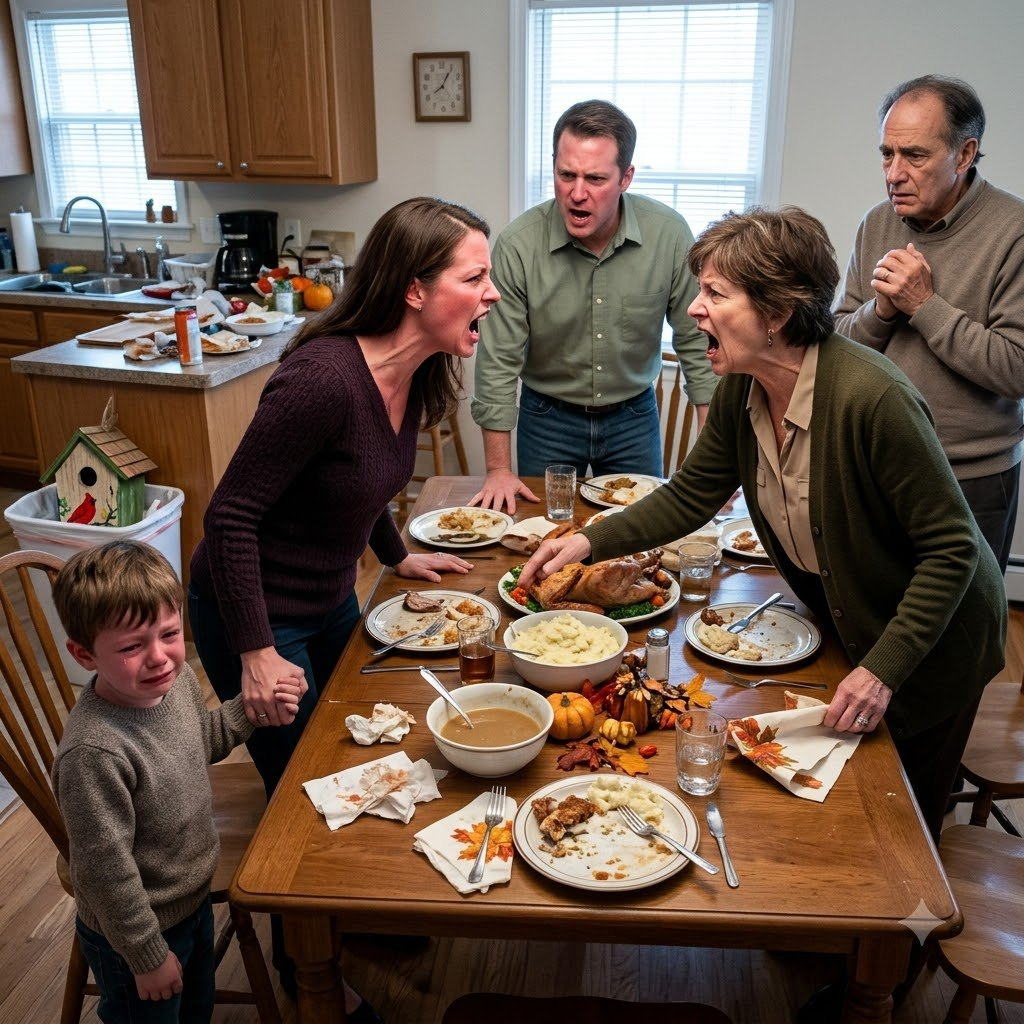
"Evan, wait!"
He was already halfway to the front door.
I followed him, still holding the photograph that had fallen from the envelope.
"Where are you going?"
"To my mother's house."
"What did the letter say?"
He stopped.
For a moment, I thought he might refuse to answer.
Then he handed me the paper.
The first sentence made my stomach tighten.
Dear Evan, your mother has refused to allow me to give you the opportunity your grandfather wanted you to have.
I continued reading.
You are twelve years old now, and I believe you deserve to know that your future belongs to you. Nobody has the right to decide that your dreams are less important than your sister's.
The letter was signed by Margaret.
There was no explanation of what opportunity she meant.
No mention of money.
No specific accusation.
But the anger in her handwriting was unmistakable.
"Evan, what is she talking about?"
"I don't know."
He opened the front door.
"But I'm going to find out."
I caught his arm.
"Theo's in the garage. He doesn't need to watch another family argument."
Evan looked toward the workshop.
The anger in his expression softened.
He closed the door.
"You're right."
He returned to the kitchen and sat down.
For several minutes, he stared at Margaret's letter.
Then he told me something I had never heard before.
When Evan was twelve, he had entered a woodworking competition sponsored by a local community center.
His project was a miniature wooden suspension bridge.
He had spent months designing it.
His grandfather, Walter's father, had taught him how to measure angles and distribute weight.
The bridge had won first place.
"I remember bringing home the certificate," Evan said. "Grandpa was so proud."
"What did Judith say?"
"She asked whether there was a cash prize."
There hadn't been.
Instead, the winner received an invitation to attend a summer engineering program for gifted students.
Evan had been thrilled.
But Judith refused to let him attend.
"She said it was too expensive."
"Was it?"
"I thought so. I never saw the paperwork."
He rubbed his forehead.
"Denise went to an expensive dance camp that same summer."
I looked down at Margaret's letter.
Suddenly, its meaning seemed much clearer.
"Did your grandfather offer to pay for the program?"
Evan stared at me.
"I don't know."
His voice cracked.
"He died the following spring."
I reached across the table and took his hand.
There were moments in our marriage when I had wondered why Evan hesitated before spending money on himself.
Why he apologized whenever he purchased new tools.
Why he insisted that Theo's birthday celebrations were more important than his own.
Now those little pieces of his personality were beginning to fit together.
He had been raised to believe that wanting something for himself was selfish.
And someone had benefited from that belief.
The following morning, Denise called.
She didn't ask how Theo was doing.
She didn't ask whether Evan had spoken to Walter.
Instead, she wanted to discuss Christmas presents.
"Mom already ordered gifts for the girls," she explained. "We need to know what Theo wants."
I looked toward the backyard.
Theo was standing beside his birdhouse, scattering birdseed beneath the wooden post.
"He wants his grandmother to apologize."
Denise groaned.
"You're seriously still doing this?"
"Yes."
"He's nine. He'll get over it."
"Would you say that if it happened to Chloe?"
"That's different."
I waited.
"How?"
Denise became quiet.
Then she said, "The girls are very sensitive."
I almost laughed.
Apparently, sensitivity was a personality trait when it belonged to her children.
When it belonged to mine, it was a character defect.
"Denise, do you remember Evan's woodworking competition when he was twelve?"
The question caught her off guard.
"What competition?"
"The one he won before you went to dance camp."
"Oh. That thing."
"Do you know why he couldn't attend the summer program?"
She sighed.
"Why are we talking about something that happened decades ago?"
"Because I'm curious."
"Mom said we couldn't afford both."
My heart sank.
"So there was a choice?"
"I guess."
"And your parents chose your dance camp?"
"Well, I was serious about dancing."
"Evan was serious about engineering."
"That's not the same."
I couldn't believe what I was hearing.
"Why isn't it?"
Denise hesitated.
"Because Evan was always good at school. He didn't need extra opportunities."
I looked toward the garage, where my husband was helping Theo organize his tools.
"Everyone needs opportunities, Denise."
She disconnected shortly afterward.
That conversation stayed with me throughout the day.
Not because Denise had sounded particularly cruel.
Because she hadn't sounded cruel at all.
She had sounded perfectly reasonable to herself.
She genuinely believed that her brother's sacrifices were normal.
That was how thoroughly Judith had trained the entire family to accept the imbalance.
By Monday morning, Thanksgiving had become the subject of several uncomfortable conversations.
Judith had apparently contacted relatives we hadn't spoken to in months.
According to her version of events, Theo had thrown a tantrum because she didn't display his gift immediately.
Evan had shouted at her.
I had stormed out.
The birdhouse being thrown into the garbage was conveniently absent from the story.
My husband's cousin, Rebecca, called during lunch.
"I heard there was some trouble Thursday."
"That's one way to describe it."
"Judith said Theo was disrespectful."
I felt my jaw tighten.
"He was trying to retrieve his handmade gift from the trash."
Rebecca became silent.
"She threw it away?"
"In front of him."
"Oh, my goodness."
I explained what had happened.
When I finished, Rebecca released a long breath.
"That sounds familiar."
"What do you mean?"
"She did something similar to Evan when we were kids."
I sat straighter.
"The sailboat?"
"No. His science fair project."
Another incident.
Another memory Evan had never shared.
Rebecca explained that Evan had built a working model of a water filtration system when he was fourteen.
Judith had removed it from the dining room before relatives arrived because she considered it unattractive.
When Evan complained, she threatened to throw it away.
"He carried it upstairs and didn't come down for dinner," Rebecca recalled.
"Nobody said anything?"
"We were kids."
She paused.
"But Margaret did."
I gripped the phone.
"What happened?"
"She told Judith that treating one child like an inconvenience and the other like a princess was going to destroy the family."
"What did Judith say?"
"She told Margaret to leave."
Rebecca lowered her voice.
"I don't think Margaret ever came back after that."
I asked whether she knew how to contact her.
Rebecca promised to look through some old address books.
After we hung up, I sat alone at the kitchen table.
The more people talked, the more Judith's carefully maintained image began to crack.
But the most disturbing part was that none of these stories seemed surprising to the people telling them.
They had watched Evan suffer.
Then they had continued attending holiday dinners.
That afternoon, Theo came home from school carrying a folded sheet of paper.
"Mom, we made Christmas wish lists."
He handed it to me.
Most children would have asked for toys, video games, or bicycles.
Theo had written three things.
A new paintbrush.
Wood for another birdhouse.
Grandma to like me.
I stared at the last line.
"Sweetheart."
He looked up.
"Do you think Santa can help with that one?"
I pulled him into my arms.
I wanted to tell him that Judith loved him.
I wanted to offer the comforting answer that parents instinctively reach for when their children are hurting.
But I couldn't promise something I wasn't certain was true.
"You don't need to change anything about yourself to deserve Grandma's love."
He rested his chin against my shoulder.
"Even if my birdhouse was ugly?"
"Especially then."
He smiled a little.
That evening, I showed Evan the wish list.
He read it silently.
Then he went upstairs and closed our bedroom door.
When he returned, his eyes were red.
"I'm not letting her do this to him," he said.
There was no hesitation in his voice.
The next day, Judith arrived unannounced.
Her silver SUV pulled into our driveway shortly after dinner.
She stepped onto the porch carrying two expensive shopping bags.
Evan answered the door.
"What are you doing here?"
"I came to see my grandson."
"Did you come to apologize?"
Judith's smile disappeared.
"I brought him presents."
"That's not what I asked."
She attempted to step past him.
Evan remained in the doorway.
"You're not coming inside until we talk."
Judith looked genuinely offended.
"I'm your mother."
"And I'm Theo's father."
I stood behind him.
For the first time, Judith seemed uncertain about how to proceed.
She placed the shopping bags on the porch.
"You're being manipulated."
Evan shook his head.
"No, Mom. I'm finally paying attention."
Her eyes moved toward me.
"This is your doing."
I didn't respond.
Evan continued.
"Tell me about my engineering program."
Judith froze.
"What?"
"The summer program I was supposed to attend when I was twelve."
"That was years ago."
"Did Grandpa offer to pay for it?"
She glanced toward her car.
"I don't remember."
"Did Aunt Margaret write to me about it?"
Her face changed.
It was subtle.
But unmistakable.
"Who have you been speaking to?"
"Answer the question."
Judith picked up her shopping bags.
"I'm not standing here being interrogated."
"Then tell me why Margaret stopped visiting."
"She was jealous."
"Of what?"
"Of our family."
Evan laughed bitterly.
"That's not what everyone else remembers."
Judith stepped closer.
"You need to be very careful about digging up things you don't understand."
"Is that a threat?"
"It's advice."
She turned and walked toward her SUV.
Before getting inside, she looked back.
"Your father is getting older, Evan. His memory isn't what it used to be. Don't encourage him to embarrass himself."
Then she drove away.
Evan stood on the porch long after her taillights disappeared.
"She knows," he said.
"About the letters?"
"About something."
That night, Rebecca sent me a message.
She had found an old telephone number for Margaret.
I showed Evan.
He dialed it immediately.
The number had been disconnected.
Rebecca promised to keep looking.
Meanwhile, Evan searched online for Margaret's name.
There were several possible matches, but nothing he could confidently identify as his aunt.
We were about to give up for the evening when his phone vibrated.
The unknown number again.
This time, the message contained no photographs.
Your mother came to see you tonight, didn't she?
Evan sat upright.
Who are you?
The response arrived almost immediately.
Someone who remembers what happened.
He typed another message.
Are you Margaret?
Three dots appeared.
Then disappeared.
Several seconds later, another message arrived.
Ask Denise what she received on her eighteenth birthday.
Evan frowned.
He called his sister.
She answered on the fourth ring.
"What now?"
"Do you remember what Mom and Dad gave you when you turned eighteen?"
Denise laughed.
"Of course. My car."
"What else?"
Her laughter stopped.
"Evan, why?"
"Just tell me."
There was a long silence.
Then Denise spoke so quietly that I had to lean closer to hear her.
"Who told you about the account?"
Evan looked at me.
"What account?"
Denise hung up.
He immediately tried calling her again.
She declined the call.
Then his phone vibrated once more.
The unknown sender had attached a photograph of an old bank document.
Two names appeared at the top.
Evan's.
And Denise's.
Beneath them was a handwritten authorization bearing Judith's signature.
Evan enlarged the document.
Before he could read the amount, someone began pounding on our front door.
Three hard knocks.
Then Denise's frightened voice came from the porch.
"Evan, open up. Mom doesn't know I'm here."






Comments 0