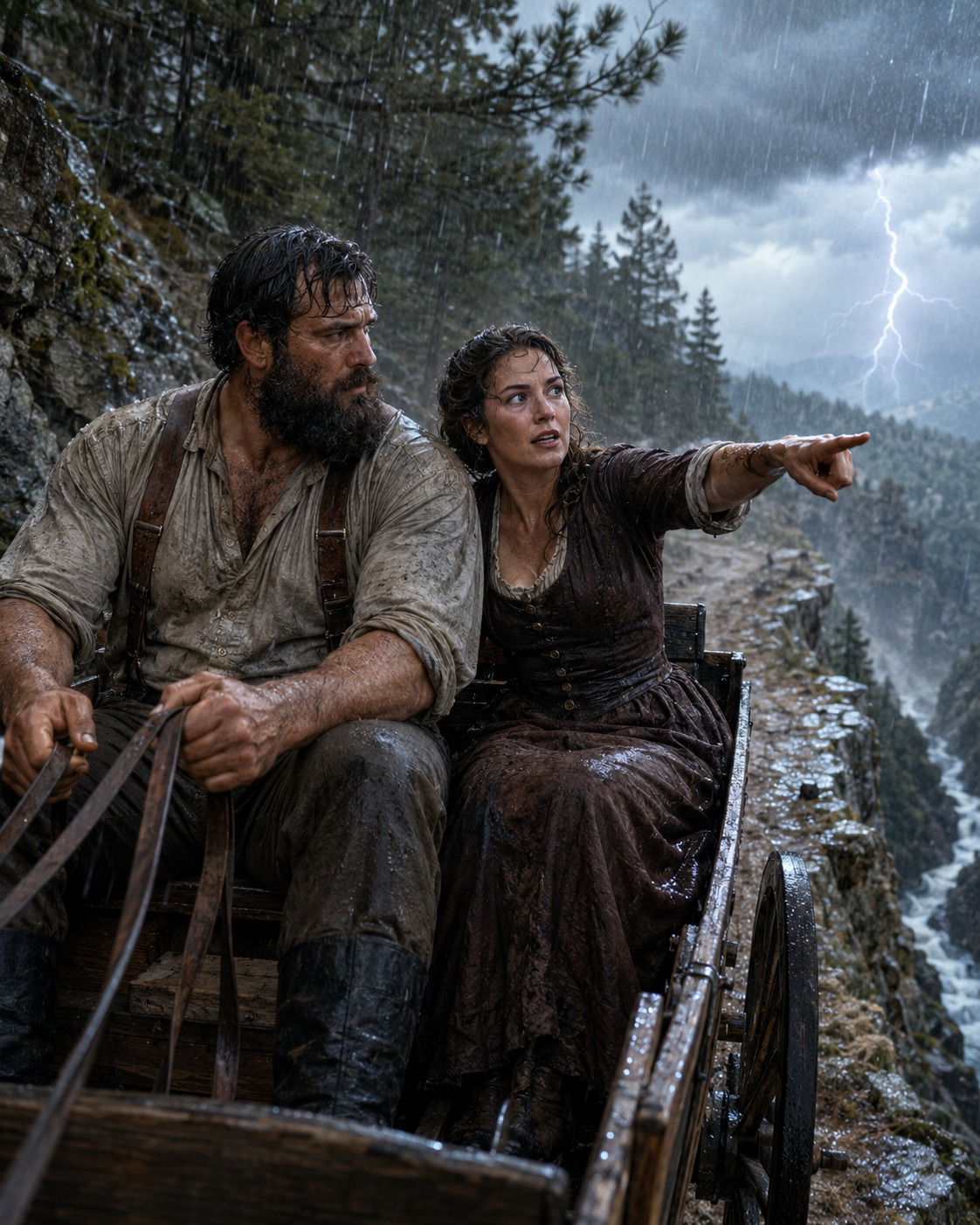
Mara stared at the four words written across the folded paper.
YOUR FATHER IS ALIVE.
For several seconds, she forgot about the footsteps in the corridor.
She forgot about Whitmore.
She even forgot that Abel was standing between her and a man who had already threatened their lives.
Her father was alive.
The man she had buried in her memories when she was a little girl.
The man her mother had told her was gone forever.
The man whose name had disappeared from every family conversation after his supposed death.
Mara slowly unfolded the paper.
Her fingers trembled.
"Mara," Abel whispered.
She looked at him.
"That's my father's handwriting."
The voice from the corridor interrupted them.
"Put the letter down."
Whitmore stepped into the lantern light.
His expensive coat was wet, and his white bandage had begun slipping from his nose. Behind him stood the older man who had accompanied him to the house.
The rifle was now in his hands.
Abel moved forward.
"You're not coming any closer."
Whitmore smiled.
"Still playing the protector, Stone?"
"Leave."
"I don't think you understand what's happening."
Abel's voice remained low.
"I understand that you're standing in my cellar without permission."
Whitmore glanced toward Mara.
"She has something that belongs to me."
Mara tightened her grip on the letter.
"My mother's letter?"
"That document contains information you have no right to possess."
"It was addressed to me."
"Your mother had no authority to make promises concerning that property."
Mara looked at him.
"Then why are you so frightened of a letter?"
Whitmore's expression hardened.
The older man raised his rifle slightly.
Abel immediately shifted his weight.
"Lower it."
"Nobody needs to get hurt," Whitmore said.
Mara almost laughed.
He had brought armed men into their home, forged a debt in her name, and followed her across the mountains.
Now he wanted to discuss preventing violence.
"You're very concerned about people getting hurt for someone who keeps bringing weapons to other people's homes."
Whitmore ignored her.
He extended his hand.
"Give me the letter."
Mara stepped backward.
"No."
His eyes narrowed.
"Don't make this difficult."
"I haven't made anything difficult. You did that yourself."
Abel glanced toward the narrow staircase.
He was calculating the distance.
Mara recognized the expression.
He was looking for a way to get her and Clara out of the cellar without allowing the rifleman a clear shot.
Clara stood behind the desk.
Her face had gone pale.
She was trembling so badly that the folded papers in her hand rustled.
Mara looked at her.
"Clara, stay behind the shelves."
The young woman obeyed.
Whitmore noticed the movement.
"She's already caused enough trouble."
Abel's eyes hardened.
"Don't speak about her."
Whitmore laughed.
"You really have no idea what your father left behind, do you?"
Abel became still.
"What does my father have to do with this?"
"Everything."
"Explain."
Whitmore looked toward the ledger.
"Your father made a foolish decision twenty years ago. He believed he could protect people who had no business owning valuable land."
Mara felt her stomach tighten.
"My mother?"
Whitmore looked at her.
"Your mother was only the beginning."
"What does that mean?"
"It means Elizabeth Bell was not the only person who benefited from the Stone family's generosity."
Abel stepped closer.
"My father didn't give away land."
Whitmore's smile widened.
"Then perhaps you should ask why he disappeared."
The words struck Abel visibly.
Mara turned toward him.
She had not known that Abel's father had disappeared.
He had spoken about their difficult relationship, but never about what happened afterward.
Abel's voice became colder.
"My father died eleven years ago."
"Did he?"
"His grave is on the property."
"An empty grave can be very convincing."
The cellar fell silent.
Abel stared at Whitmore.
For the first time since Mara had met him, the giant looked genuinely shaken.
"You're lying."
Whitmore shrugged.
"Perhaps. Perhaps not."
Mara looked down at the letter.
The words were becoming harder to read.
She forced herself to concentrate.
Her mother's handwriting continued beneath the message.
My darling Mara,
If this letter has reached you, then the people who tried to bury our family's history have failed.
I never wanted you to grow up believing your father abandoned you.
Mara stopped.
Her throat tightened.
She read the next lines.
He did not leave because he stopped loving us. He left because he discovered what certain men were doing with the land entrusted to the Stone family.
Her eyes moved across the page.
He promised he would return when it was safe.
I waited.
I waited longer than I should have.
And when the letters stopped, I made the only decision I believed could protect you.
Mara lowered the paper.
"She knew."
Abel turned toward her.
"What?"
"My mother knew my father was alive."
Whitmore took another step.
"Enough."
Mara continued reading.
Your father left something beneath the mountain. Something that belongs to you.
Do not let anyone convince you that you have no claim to it.
And whatever happens, remember that the truth is not always buried with the dead.
Mara's eyes filled.
She blinked quickly.
She would not cry in front of Whitmore.
Not while he stood there believing he could take whatever he wanted.
Abel watched her.
He did not ask what the letter said.
He simply stood beside her.
Then Clara spoke.
"There's something else you should know."
Whitmore turned sharply.
"Be quiet."
Clara flinched.
Mara looked at her.
"Tell us."
The young woman swallowed.
"My grandmother worked for the Stone family. She knew Elizabeth Bell."
Abel looked toward her.
"How?"
"She was the housekeeper."
"At this property?"
Clara nodded.
"Before your father disappeared, she helped him hide the original land records."
Whitmore's face changed.
Mara noticed.
He was no longer merely irritated.
He was afraid.
"That's enough," he said.
Clara continued.
"My grandmother told me that Mr. Stone discovered a scheme involving forged deeds and fraudulent loans. Several families were being forced off their land."
Abel looked at the ledger.
"Whitmore."
Clara nodded.
"His father began it. He continued it."
Whitmore's voice rose.
"That is a lie."
Clara stepped farther behind the desk.
"My grandmother kept copies."
Whitmore looked toward the rifleman.
"Get her."
Abel moved instantly.
He knocked the rifle barrel upward before the man could aim.
The weapon discharged.
The shot exploded against the stone ceiling.
Dust and fragments of mortar fell across the chamber.
Mara dropped to the floor.
Clara screamed.
Abel grabbed the rifleman's wrist and twisted the weapon away.
The older man stumbled against the shelves.
Several jars shattered.
Whitmore rushed toward the desk.
Mara reacted before she could think.
She grabbed the heavy iron lantern and swung it against his forearm.
He shouted.
The folded papers flew from his hand.
Abel pushed the rifleman against the stone wall.
The man struggled briefly, then collapsed against the shelves.
Whitmore stumbled backward.
He looked at Mara with disbelief.
"You little—"
"Finish that sentence," she said, breathing hard, "and I may discover how much worse your nose can become."
Abel turned.
"Are you hurt?"
"No."
He looked at her arm.
A small cut marked her wrist.
"Mara."
"It's nothing."
He glanced toward Whitmore.
The man was backing toward the corridor.
Abel took one step forward.
"Stay where you are."
Whitmore looked at the rifleman.
Then at the staircase.
He made his decision.
He ran.
His boots struck the stone steps.
Abel started after him.
Mara caught his sleeve.
"Abel!"
He stopped.
"Clara!"
The young woman was crouched beside the desk.
She was holding a small wooden box.
"There's something in here!"
Abel looked toward the staircase.
Then toward Clara.
He chose to stay.
The footsteps above them grew fainter.
A moment later, the front door slammed.
Whitmore was gone.
The older rifleman remained against the shelves, groaning.
Abel took the weapon and placed it out of reach.
Then he approached Clara.
"Are you hurt?"
She shook her head.
Mara knelt beside her.
"Let me see."
Clara's hands were shaking.
The wooden box was small enough to fit inside a coat pocket.
Its surface was scratched, and a brass number seventeen had been engraved on the lid.
Mara looked at the key.
Then at the box.
"The key."
Abel handed it to her.
She inserted it.
The lock opened.
Inside lay three things.
A silver pocket watch.
A folded photograph.
And a small envelope addressed to Mara.
She stared at the handwriting.
It was the same as the letter.
Her mother's.
Mara lifted the envelope carefully.
Her name was written across the front.
Not Mara Bell.
Mara Elizabeth Bell.
She opened it.
A small photograph slipped into her lap.
It showed a younger woman standing beside a tall man.
The woman was unmistakably her mother.
The man had dark hair, a narrow face, and a warm expression.
Mara picked up the photograph.
Her breath caught.
She knew that face.
Not from childhood.
Not from a family portrait.
From the few photographs her mother had kept in a small wooden drawer.
Her father.
The man in the photograph was her father.
And he was standing beside a much younger Abel Stone.
Mara turned the photograph over.
Three names were written on the back.
Elizabeth Bell.
Thomas Bell.
And Abel Stone.
The date was twenty years earlier.
Abel looked over her shoulder.
He stared at the photograph.
"That's my father."
Mara looked at him.
"You knew him?"
He shook his head slowly.
"I was seventeen when he disappeared. I remember the face."
He took the photograph.
His thumb moved over the image of the older man.
"He looks exactly the same."
Mara felt a strange mixture of grief and relief.
Her father had existed.
He had loved her mother.
He had stood beside the man who had become her husband.
And someone had spent years making sure she never discovered the connection.
She opened the envelope.
Inside was another letter.
My dearest Mara,
If you have found this, then I have failed to return home as promised.
I don't know how old you will be when you read these words.
I don't know whether you will remember my voice.
But I want you to know that I never abandoned you.
Mara pressed the letter against her chest.
A tear escaped despite her determination.
Abel crouched beside her.
He did not touch her immediately.
He waited.
When she reached for his hand, he took hers gently.
She continued reading.
There are people who believe money gives them ownership over everything. They believe a signature can erase a family, and a forged document can turn a lie into law.
I discovered that Whitmore's family had been using the old Stone property records to steal land from families who could not afford to defend themselves.
Your mother refused to sign away her inheritance.
I supported her.
And for that, we became their enemies.
Mara looked up.
"Her inheritance."
Abel nodded.
She continued.
The property was left to your mother by her grandfather. It includes the eastern valley, the river crossing, and the old timber road.
The original deed is hidden somewhere beneath Wolfjaw Mountain.
Your mother knows where the first clue is.
Mara stopped reading.
Her mother had never told her.
Not once.
The letter continued.
If Elizabeth is no longer with you, look for the silver watch.
The hands were stopped deliberately.
The time they show will tell you where to begin.
Mara lifted the pocket watch.
It was old and beautifully made.
The silver casing was engraved with tiny pine branches.
She opened it.
The hands pointed to 4:17.
She looked at Abel.
"Seventeen again."
He nodded.
Clara stepped closer.
"My grandmother said the same thing."
Mara looked at her.
"What?"
"She said the number seventeen was important."
Abel examined the watch.
"Does it work?"
"No."
He tried turning the small crown.
Nothing happened.
Mara studied the face.
Then she noticed something.
A tiny line had been scratched beneath the number four.
It was almost invisible.
She turned the watch sideways.
There was a small latch.
She pressed it.
The back casing opened.
Inside was a narrow compartment.
A folded strip of paper rested inside.
Mara carefully removed it.
There was a hand-drawn map.
It showed the property surrounding Wolfjaw Mountain.
A line began at the house.
It continued toward the eastern ridge.
Then it ended at a small symbol.
A circle.
With seventeen written inside.
Abel examined it.
"I know this place."
Mara looked at him.
"Where?"
"The old watermill."
Clara shook her head.
"That's impossible."
Abel turned.
"Why?"
"Because the watermill burned down years ago."
"I know."
"Then how can anything be hidden there?"
Abel looked at the map.
"Because the cellar beneath it never burned."
Mara studied the drawing.
The old watermill stood on the eastern side of the property, close to the river.
It was the same area marked on the ledger.
She looked at the letter again.
Her father had left a trail.
A trail that began in their home.
A trail that led toward the burned watermill.
And somewhere along it was the original deed.
The document that could destroy Whitmore's entire operation.
But there was another question.
Why had Whitmore allowed them to discover so much?
Why had he brought them the forged debt?
Why had he risked revealing the ledger?
Abel seemed to be thinking the same thing.
"He wanted the letter," he said.
Mara nodded.
"Because he knows what it contains."
"And because he knows where the deed is."
Clara looked frightened.
"My grandmother said he would come back."
Mara turned toward her.
"When?"
Clara shook her head.
"I don't know."
Abel stood.
"We can't stay here."
Mara looked at the injured rifleman.
"What about him?"
"He'll be tied up until the sheriff arrives."
Abel secured the man with a length of rope.
Then he helped Clara stand.
The young woman nearly collapsed.
Mara caught her.
"You need food and rest."
Clara shook her head.
"We have to leave."
"Why?"
"Because Whitmore won't come alone next time."
Abel looked toward the staircase.
"She's right."
Mara folded the letters and placed them inside her satchel.
She kept the photograph in her hand.
For a moment, she looked at her father's face again.
Then she slipped it into the envelope.
They climbed the cellar stairs.
Abel closed the trapdoor and secured the lock.
Mara looked toward the kitchen.
The coffee cups were still on the table.
The chairs remained where they had left them.
But the house no longer felt like the place she had entered that afternoon.
It felt like the center of something much larger.
Something that had begun long before her arrival.
Abel walked toward the window.
He pulled the curtain aside.
His expression changed.
"What is it?" Mara asked.
He did not answer.
She approached.
Outside, the rain had stopped.
The pasture was empty.
But the gate stood open.
Beyond it, near the pine trees, stood a dark horse.
A man sat in the saddle.
He was not Whitmore.
He was older.
His coat was faded.
His shoulders were slightly bent.
He wore a wide-brimmed hat pulled low over his face.
Mara stepped closer to the glass.
The rider slowly raised his head.
Even from a distance, she recognized something familiar.
The shape of his jaw.
The way he held his shoulders.
The same dark eyes she had seen in the photograph.
Her fingers went cold.
Abel turned toward her.
"Mara?"
She could barely speak.
The man outside lifted one hand.
Then he dismounted.
He began walking toward the house.
Mara took one step backward.
The letter slipped from her fingers.
Because the man approaching their front porch looked exactly like the father she had spent twenty years believing was dead.






Comments 0