"Lance, if you are reading this, your mother has already told you that I am dead."
I read the sentence again.
Then I read it a third time.
My father had written those words nearly four years earlier.
But my father was alive.
I had spoken to him several times over the past few days. I had heard his voice. I had listened to him admit that my mother had signed financial documents without my permission.
So why would he write something like this?
Kendra stood beside me, staring at the paper.
"Read the rest," she whispered.
I carefully unfolded the remaining pages.
Melissa moved closer.
The first paragraph was written in my father's familiar handwriting.
Lance, I don't know when you will receive this letter. I only know that if Yolanda discovers what I've done, she will make sure you never see the truth.
I swallowed.
The next paragraph was even more disturbing.
I discovered that your mother had used your financial information to secure a loan connected to Brian's business. At first, she told me you had agreed. I believed her because I wanted to believe that my family was still honest with one another.
I stopped reading.
Kendra covered her mouth.
Melissa looked at me.
"Your father knew."
I nodded.
I continued.
But when I asked to see the original authorization, I discovered that your name had been copied onto a document you had never signed.
My fingers tightened around the paper.
I confronted Yolanda. She told me the arrangement was temporary. She said Brian needed help and that everything would be repaid before anyone noticed.
I looked at Kendra.
The letter continued.
I asked her why she had used Kendra's information. She told me that Kendra had agreed to help. I knew that wasn't true.
Kendra began crying.
"How did he know?"
I shook my head.
I didn't know.
I continued reading.
Your mother became angry when I questioned her. She told me I was too old to understand how modern financial arrangements worked. She said I should leave everything to her.
The handwriting became less controlled.
That was when I realized the house was no longer safe.
I paused.
Melissa leaned forward.
"What does that mean?"
I turned the page.
There was another paragraph.
I discovered that Yolanda had arranged for the property to secure a separate financial obligation. The agreement included a transfer provision that could remove the house from our control if certain payments were missed.
My stomach tightened.
The mortgage payments.
The financial agreements.
The second beneficiary.
Everything was connected.
I read the next lines.
I refused to sign the transfer. I told her the property belonged to the family, and I wanted it protected for Lance and his children.
Kendra looked at me.
"Your father wanted the house to go to you?"
I nodded slowly.
The next sentence confirmed it.
You have sacrificed enough for us. I will not allow your children to lose the security you worked so hard to provide.
For the first time in several days, I felt something other than anger.
My father had known what I was doing.
He had understood the sacrifices.
And apparently, he had tried to protect us.
But the letter wasn't finished.
I turned another page.
At the top, my father had written:
THE DAY I DISAPPEARED.
I stared at those words.
"What?" Kendra whispered.
I began reading.
On October 14, I made a decision that I believed would protect my family.
I looked at Melissa.
"October 14?"
She nodded.
"That's when he gave me the envelope."
I continued.
I told Yolanda that I was going to speak with an attorney. I intended to revoke the financial authorization and have the property agreement reviewed.
The next lines were difficult to read.
She told me that if I did that, Brian would lose everything.
I felt my jaw tighten.
She also told me that Lance would be blamed for the financial arrangements because his name appeared on the documents.
Kendra whispered:
"She was going to blame you."
I kept reading.
I realized that my wife was no longer trying to solve a family problem. She was trying to protect a financial arrangement that could destroy our son.
I turned the page.
And then I saw the sentence that made my hands go cold.
The following morning, I left the house without telling Yolanda where I was going.
I stopped.
Melissa stared at me.
"Your father disappeared?"
I nodded.
The letter continued.
I arranged to stay with someone I trusted while I sought legal advice. I wanted to make sure the original documents were preserved before confronting anyone.
I looked at the date.
Four years earlier.
That was the period when my mother had told relatives that Dad was too sick to receive visitors.
She had said he was spending time recovering.
She had told me he needed peace and quiet.
And I had believed her.
I remembered calling him several times.
Sometimes she answered.
Sometimes she said he was asleep.
Sometimes she said he didn't feel like talking.
I had never questioned it.
My father had apparently been somewhere else.
And my mother had allowed me to believe he was incapable of speaking to me.
I continued.
Yolanda eventually told the family that I had died.
My heart stopped.
Kendra grabbed my arm.
"What?"
I stared at the letter.
She said I had passed away after a medical emergency. She told people that the funeral arrangements had been handled privately because I had requested no service.
Melissa covered her mouth.
I couldn't speak.
My mother had told people my father was dead.
But I had spoken to him.
I had seen him.
I had heard him.
Something about the timeline didn't make sense.
Then I reached the next paragraph.
If you have seen me recently, understand that I did not return because everything was resolved. I returned because I learned that Yolanda was preparing to transfer the property again.
I looked at Kendra.
The letter was dated several years earlier.
But it seemed to describe exactly what was happening now.
I read the final paragraph.
Lance, if you are reading this, do not assume that everyone who appears to be helping your mother is acting against you. Some people have been kept in the dark. Others have been promised things that were never theirs to receive.
Then, beneath it:
Find the original property deed. It will tell you who truly owns the house.
I lowered the letter.
Melissa was staring at me.
"Did he say where the deed was?"
I shook my head.
"No."
Kendra pointed toward the envelope.
"Is there anything else?"
I examined the remaining pages.
There was one final sheet.
It contained a handwritten address.
And beneath it, my father's signature.
I recognized the street.
It was a small residential neighborhood about forty minutes from my parents' house.
I had never been there.
But the address was familiar for another reason.
My mother had once told me that an old family friend lived there.
A man named Harold Bennett.
I looked at Kendra.
"Do you know him?"
She shook her head.
Melissa suddenly spoke.
"I do."
I turned.
"How?"
She looked frightened.
"Your father introduced me to him six years ago."
I felt my stomach tighten.
"What did he say?"
Melissa swallowed.
"He told me that Harold was the person who would keep the original documents safe."
I looked down at the address.
Then I read the final handwritten sentence.
If anything happens to me, Harold knows where the original deed is hidden.
At 7:30 p.m., I called Officer Doyle.
I explained what we'd found.
I told her that Melissa had received a letter from my father, apparently written several years earlier.
I described the contents and provided photographs.
She listened carefully.
"Mr. Wallace, do you have the original document?"
"Yes."
"Please preserve it."
"I will."
"Don't travel to the address in that letter without discussing it with us first."
I looked at Kendra.
"Understood."
Officer Doyle continued.
"Has your father confirmed that he wrote this?"
"Not yet."
"Then we need to verify the document and speak with him directly."
I agreed.
Before ending the call, I asked:
"Officer Doyle, is it possible that someone could have falsely reported my father as deceased?"
She paused.
"That's a serious allegation. We would need to establish what was reported and whether any official records were affected."
I understood.
I didn't want to jump to conclusions.
But the letter had raised questions that couldn't be ignored.
My mother had apparently told people my father was dead.
Yet he was alive.
And she had continued managing financial arrangements in his name.
Officer Doyle asked me to send her the letter's photographs.
I did.
Then I called Rebecca at the bank.
She agreed to add the information to the existing investigation.
I asked whether a property deed could establish who legally owned the house.
"Absolutely," she said. "But we need to distinguish between the title records, the mortgage documents, and any contractual beneficiary arrangements. They're not necessarily the same thing."
I thanked her.
That distinction mattered.
My mother could promise the house to Melissa.
She could list Brian as a beneficiary.
She could even sign an agreement claiming I had accepted responsibility.
But none of those things automatically established legal ownership.
We needed the original deed.
And apparently, Harold Bennett knew where it was.
At 8:15 p.m., my phone rang.
Dad.
I answered immediately.
"Hello?"
"Lance."
His voice was quiet.
"Dad, where are you?"
"At home."
"Are you alone?"
He hesitated.
"Yes."
I looked at Kendra.
"Are you sure?"
"Your mother went to Brian's."
I took a breath.
"Dad, we found your letter."
Silence.
Then he asked:
"Which letter?"
"The one you left with Melissa."
I heard him exhale.
"She still has it?"
"Yes."
"Good."
I sat down.
"Dad, why did you write that Mom had told everyone you were dead?"
He didn't answer.
I continued.
"Why did she tell people that?"
He sighed.
"Because she wanted control of the property."
"How would telling people you were dead help her?"
"She thought she could manage everything without me interfering."
"Did she file anything official?"
"I don't know."
I closed my eyes.
"Where have you been all these years?"
"Staying with someone who helped me."
"Harold Bennett?"
He became silent.
That was enough.
"Dad, is Harold holding the original deed?"
"Yes."
I looked at Kendra.
She nodded.
I continued.
"Why didn't you tell me?"
"Because I was afraid."
"Of Mom?"
"Of what she would do if she knew you were involved."
I rubbed my forehead.
"Dad, I've been involved for six years. I've been paying your mortgage."
"I know."
"One hundred fifty-one thousand dollars."
"I know, son."
"Then why didn't you tell me the truth?"
His voice broke.
"Because I thought I could fix everything before it reached you."
I stared at the floor.
"You let me believe you were helpless."
"I was ashamed."
"Of what?"
"Of letting your mother get this far."
I closed my eyes.
For years, I had believed my father was simply a man who had lost control of his finances after a heart attack.
Now I was learning that he had watched my mother make decisions that affected his children and grandchildren.
And he had remained silent.
I asked:
"Dad, did you know Mom had listed Kendra as the primary applicant?"
"No."
"Did you know Brian received the money?"
"Yes."
"Did you know Melissa was supposed to receive the house?"
He sighed.
"Your mother told me that was temporary."
I gripped the phone.
"Why does everyone keep saying temporary?"
"Because that's what she called it."
"Was it temporary?"
"No."
His answer came immediately.
I looked at Kendra.
Dad continued.
"She had already made arrangements to transfer the property. I found out after the bank sent a notice."
I felt my stomach tighten.
"What notice?"
"A notice concerning the loan."
"Was the house at risk?"
"Yes."
I closed my eyes.
"How close?"
He didn't answer.
Then he said:
"Very close."
I looked at the letter.
"Where is the original deed?"
"With Harold."
"Can we get it?"
"Yes."
"Then I want to see it."
Dad became nervous.
"Not yet."
"Why?"
"Because Harold has something else."
"What?"
"The original document showing who paid the deposit when we bought the house."
I frowned.
"What does that have to do with anything?"
Dad took a breath.
"Everything."
I sat upright.
"Explain."
He lowered his voice.
"Lance, your mother has been telling everyone that she and I bought the house with our savings."
I stared at the wall.
"Didn't you?"
"No."
"Then who did?"
He paused.
Then he said:
"Your grandfather."
I felt my chest tighten.
"My grandfather?"
"Yes."
"How?"
"Before he died, he gave us money to purchase the property. But he placed a condition on the gift."
"What condition?"
Dad was silent.
I asked again.
Finally, he said:
"The house was supposed to remain in trust for the grandchildren."
I looked at Kendra.
She covered her mouth.
"What?"
Dad continued.
"Your grandfather wanted the property protected for the next generation. He specifically said it should never be used to secure a business loan."
I stared at the letter.
The financial arrangement.
The property transfer.
The second beneficiary.
The missing deed.
Suddenly, I understood why my father had been so determined to preserve the original documents.
My mother might not have had the authority to transfer the house at all.
But there was another problem.
"Did your mother know about the trust?" I asked.
Dad sighed.
"Yes."
"Then why did she keep making agreements?"
"She believed she could change the arrangement."
"Could she?"
"No."
I closed my eyes.
"Did Brian know?"
"Not at first."
"And Melissa?"
"She knew nothing about it."
I looked at Kendra.
Then I asked the question that had been bothering me.
"Dad, why did Mom tell everyone you were dead?"
His answer was quiet.
"Because she needed people to believe she had the right to act without me."
I swallowed.
"Did you ever confront her?"
"Yes."
"What happened?"
He didn't answer.
Then he said:
"She told me that if I came back, she would make sure you were blamed for everything."
I felt my blood turn cold.
"How?"
"She had copies of the documents with your name and Kendra's name on them."
I stared at the phone.
"She threatened to accuse us?"
"Yes."
I looked at Kendra.
She was crying silently.
I asked:
"Did you believe her?"
"No. But I knew she could cause trouble before the truth came out."
I rubbed my forehead.
"Dad, we need to stop this."
"I know."
"Then help us."
He was quiet.
Finally, he said:
"I will."
I took a breath.
"Can you come to the police station tomorrow?"
"Yes."
"Can you bring Harold?"
"I'll ask him."
I thanked him.
Before ending the call, my father said something unexpected.
"Lance?"
"Yes?"
"There's something about your grandfather's trust that I haven't told you."
I waited.
He continued:
"Your mother wasn't the only person who tried to change it."
I felt my stomach tighten.
"Who else?"
Dad whispered:
"Brian."
At 9:40 p.m., Kendra and I sat at the kitchen table.
The children were asleep.
The house was quiet.
The letter lay between us.
I had read it so many times that I could almost remember every sentence.
Kendra looked at me.
"Do you think Brian knew about the trust?"
"I don't know."
"Your father said he tried to change it."
"Yes."
"Why would he do that?"
I stared at the page.
"Because he thought he was entitled to the house."
Kendra shook her head.
"But your grandfather wanted it protected for the grandchildren."
"Exactly."
She looked toward the living room.
"Kayla and Simon."
I nodded.
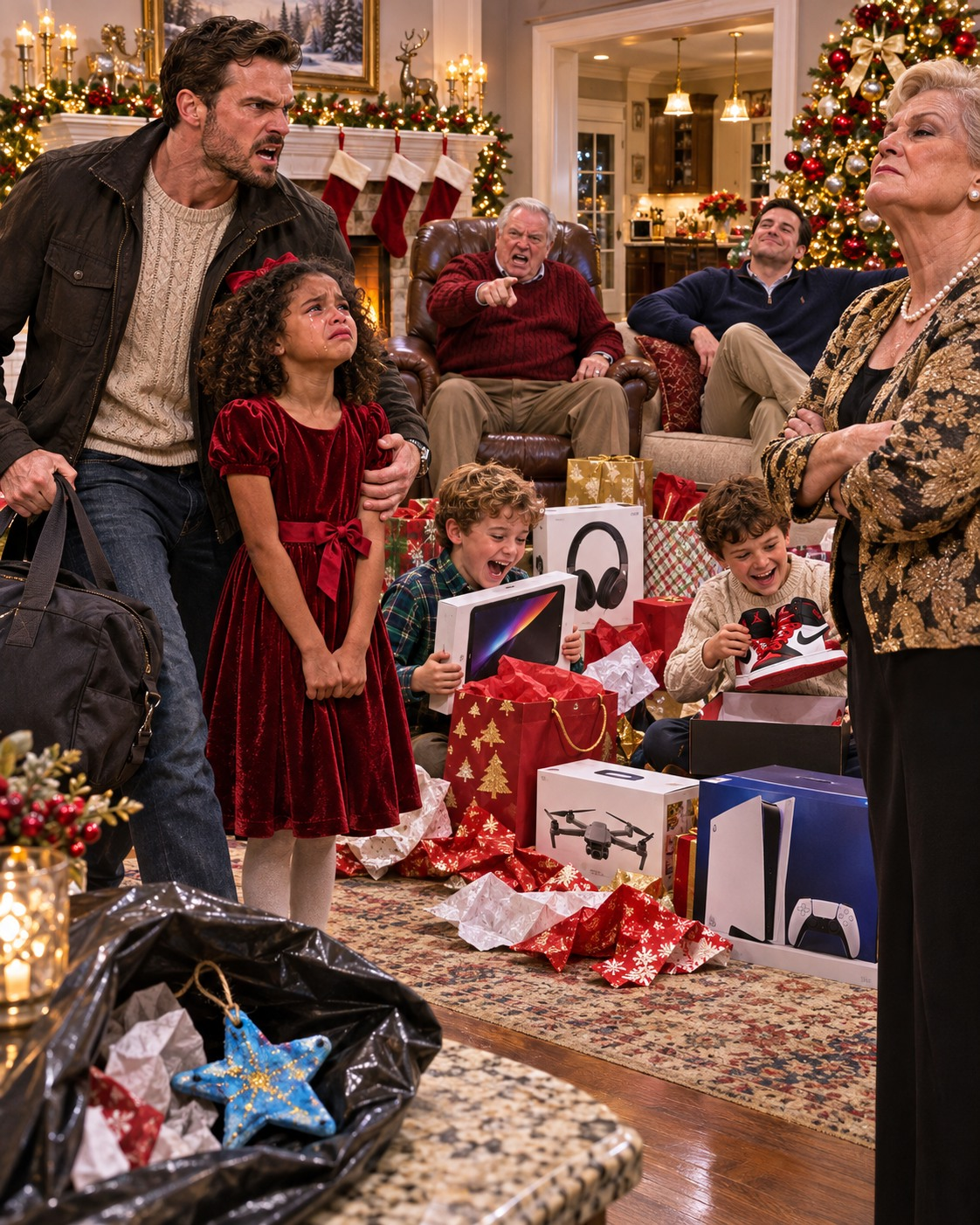
I remembered Christmas morning.
Kayla standing beside the tree.
Her cousins opening expensive presents.
Her grandmother giving her nothing.
And my father shouting that I was teaching her jealousy.
The irony was painful.
My parents had apparently been making financial decisions involving property that was meant to benefit the grandchildren.
Yet they had treated my daughter as though she didn't deserve even a small present.
I looked at Kendra.
"Whatever happens, I'm not letting them drag the children into this."
She reached across the table.
"Neither am I."
My phone vibrated.
A message from Melissa.
I found another paper inside the envelope.
I opened it.
It was a small handwritten note.
The message was short.
Harold must not give Lance the deed until he has seen the trust amendment.
I frowned.
There was no explanation.
Kendra leaned closer.
"What's a trust amendment?"
I shook my head.
"I don't know."
Another message arrived.
This time, Melissa had attached a photograph.
It showed the bottom of the note.
There was another sentence.
The amendment was signed after Robert disappeared.
I felt my chest tighten.
If my father had disappeared four years earlier, someone had apparently signed a change to the family trust during that period.
I immediately called Dad.
He answered after the first ring.
"Dad, did you sign a trust amendment after you disappeared?"
Silence.
Then:
"No."
"Did Mom?"
"I don't know."
"Who signed it?"
He took a breath.
Then he said:
"Lance, that's the reason I need you to speak with Harold before anyone else."
"Why?"
"Because the amendment was never supposed to exist."
I stared at Kendra.
"What does it say?"
My father lowered his voice.
"It removes the grandchildren from the trust."
I felt my entire body go cold.
"Who replaces them?"
He hesitated.
Then he whispered:
"Brian."
I looked at Kendra.
She covered her mouth.
But Dad wasn't finished.
He said:
"There's one more thing."
"What?"
"The amendment carries my signature."
I closed my eyes.
"You said you never signed it."
"I didn't."
"Then who did?"
My father took a shaky breath.
And finally answered:
"Someone signed it using a power of attorney that was supposed to have been revoked years earlier."
I stared at the letter.
Then at the photograph.
Then at the handwritten note.
Everything had been leading to the same question.
Who had been controlling my father's financial identity while everyone believed he was dead?
Before I could ask another question, my phone received an incoming photograph from an unknown number.
It showed a legal document.
A trust amendment.
Dated four years earlier.
My father's name appeared at the bottom.
And beneath his signature was the name of the witness.
Yolanda Wallace.
But the second witness was someone whose involvement none of us had ever suspected.
Kendra leaned closer.
Her eyes widened.
Then she whispered:
"Lance... that's the name of the attorney who handled our children's savings accounts."
I looked at the document again.
And before I could call Officer Doyle, the unknown number sent one final message:
ASK YOUR FATHER WHO REALLY SIGNED THE AMENDMENT.






Comments 0