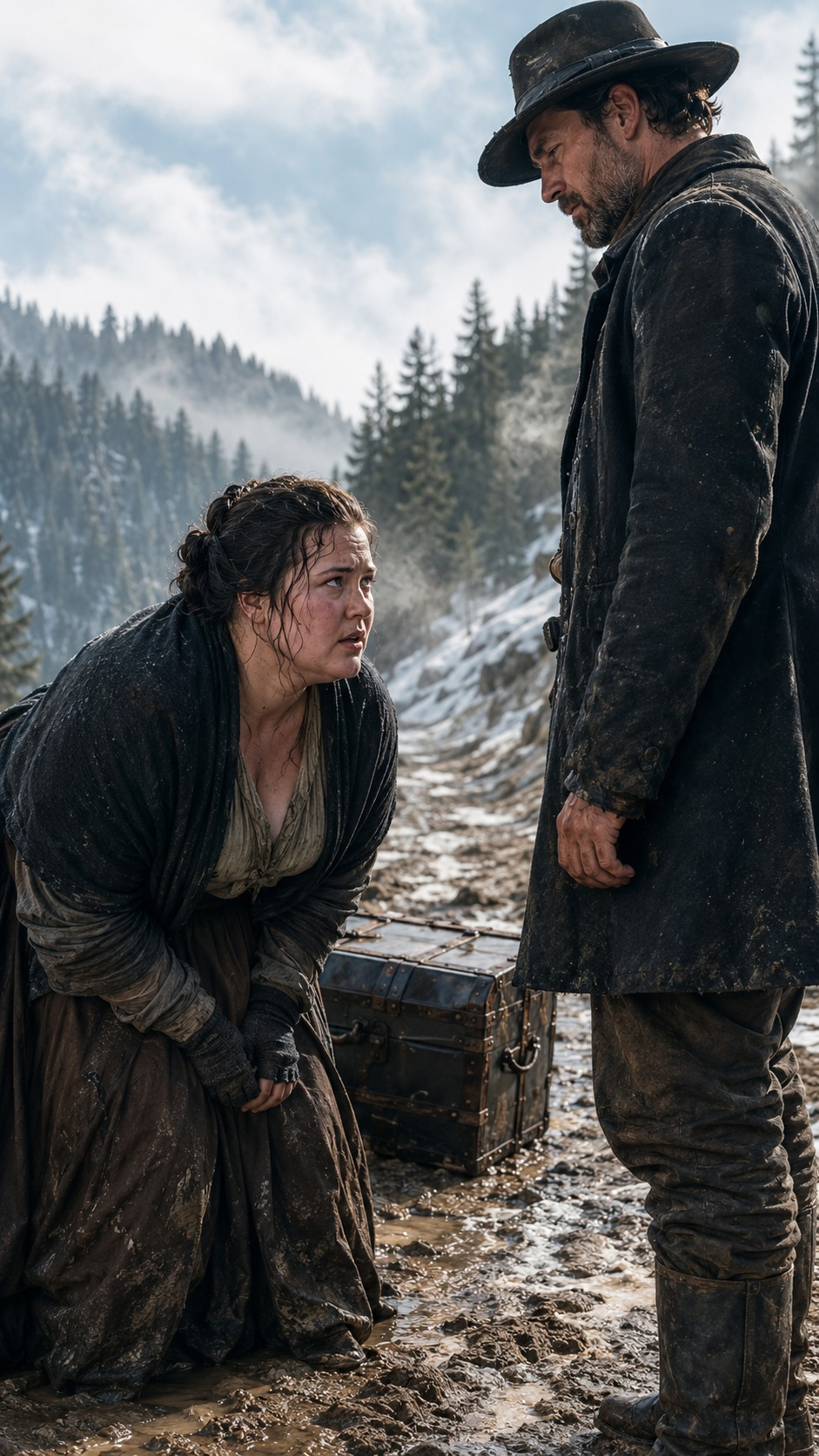
Harriet dragged her wooden trunk through the mud and shouted:
"I'm not getting back on that train!"
Gideon Black, the mountain trapper who had sent four brides running, stared at the battered trunk beside his boot.
There was something carved into its wooden handle.
The initials H.M.
He had expected another frightened woman.
He had found a stubborn one.
For several seconds, neither spoke.
Harriet's chest rose and fell with painful effort. Her legs trembled beneath her heavy brown skirt, and her fingers were stiff from gripping the trunk handle. She had walked farther than her body wanted to carry her, and every step had seemed to make the mountain steeper.
But she refused to sit down again.
Not in front of him.
Not after everything that had happened in Chicago.
Gideon looked at her as though she were an unexpected problem left in the middle of his trail.
He was a tall man, broad across the shoulders, with a thick beard and a weather-beaten face. His faded hunting coat was stained from years of work in the wilderness. A dark hat shadowed his eyes, making it difficult to read what he was thinking.
He had not offered to carry her trunk.
He had not offered her a hand.
And he had not once asked whether she was hurt.
"You're making this harder than it needs to be," he finally said.
Harriet swallowed.
"I didn't make the mountain."
"No. But you chose to come up it."
"I did."
"Then you ought to understand what you're getting yourself into."
She glanced toward the narrow trail disappearing between the pine trees.
The wagon was supposedly waiting another mile ahead. The conductor had mentioned that the road was damaged, and Gideon had confirmed it with the same expression he might have used to announce that the sky was gray.
Twenty minutes earlier, Harriet had believed she could manage the walk.
Now she was not so sure.
Her lungs burned. Her boots were soaked. The thin mountain air seemed to offer less oxygen with every breath.
But she had not traveled all the way from Chicago to turn around because a stranger wanted to test her endurance.
Gideon adjusted his gloves.
"Four women came before you."
Harriet looked at him.
"I heard."
"Then you heard what happened."
"Some of it."
"They didn't like the work. They didn't like the cabin. They didn't like the winters. One of them started crying before we even reached the timberline."
His voice held no embarrassment.
If anything, he seemed to be describing something that proved his judgment had always been correct.
Harriet studied his face.
"And what did you do?"
"I took them back."
"All four?"
"Every one."
He paused.
"You're welcome to make yourself the fifth."
There it was.
The invitation to fail.
Harriet had encountered that expression before. She had seen it on the faces of men who believed that a woman's worth could be measured by the space she occupied, the food she consumed, and the trouble she supposedly caused.
Her brothers had worn that expression for years.
She knew it well.
"How far is the wagon?" she asked.
Gideon frowned.
"A mile."
"Then we'd better keep walking."
She bent down, caught the trunk handle again, and pulled.
The heavy trunk moved several inches before one corner caught against a rock.
Gideon watched.
He did not help.
Harriet tried again.
This time the trunk slid forward, scraping against the wet ground.
A small sound escaped her throat. She could feel her back protesting, and her knees threatened to fold beneath her.
She kept moving.
Gideon finally turned and continued along the trail.
Harriet followed.
Neither spoke for the next several minutes.
The forest grew denser as they climbed. Tall pines stood on both sides of the narrow path, their branches carrying patches of snow. Mist drifted between the distant trees. The muddy ground was broken by exposed stones and shallow pools of icy water.
Harriet could hear Gideon's boots ahead of her.
He walked as though the mountain belonged to him.
Perhaps, in a way, it did.
He knew every turn, every dangerous slope, every place where the ground became unstable after rain or melting snow.
Harriet knew none of it.
She knew only that her trunk was heavy and her body was tired.
And that she had no intention of returning to Chicago.
After another stretch of climbing, she stopped.
Her hands fell away from the handle.
For a moment, she could not draw a full breath.
She bent forward, placing both hands on her knees.
The world seemed to tilt.
The mountain air entered her lungs in short, painful pulls.
Gideon stopped several feet above her.
He turned.
"That's enough."
Harriet did not answer.
"You heard me."
She nodded slightly, still trying to breathe.
"Train leaves at three," he said. "I can pay your fare back to Chicago."
His words were so ordinary that they almost sounded kind.
But his eyes told a different story.
He was waiting.
Waiting for her to admit defeat.
Waiting for the tears.
Waiting for the familiar moment when another woman realized that marrying Gideon Black had been a terrible mistake.
Harriet slowly raised her head.
"I have nothing in Chicago," she said.
Her voice was rough.
Gideon shifted his weight.
"Everybody has something."
"Not everybody."
"Family?"
She looked away for a moment.
"No."
"Money?"
"No."
"Friends?"
Harriet shook her head.
The questions seemed to strip away the last few pieces of dignity she had managed to protect.
She hated that he could ask them so casually.
She hated that he could stand there, comfortable in his warm coat, while she struggled to remain upright.
But she hated the thought of returning to her brothers even more.
"I have nowhere to go," she continued. "And I'm not getting back on that train."
Gideon stared at her.
For a moment, something moved behind his eyes.
It was not sympathy.
It was closer to irritation.
He looked toward the trail and then back at the woman struggling beneath the weight of her trunk.
"You're going to regret this."
"Maybe."
"You don't know what life is like up here."
"Then I'll learn."
"You won't find anyone to help you."
"I didn't come here expecting a crowd."
His jaw tightened.
He seemed to be searching for an answer that would put her back in her place.
Harriet did not give him one.
Instead, she reached for the trunk again.
The handle slipped against her damp fingers.
She pulled harder.
The trunk lurched forward and struck Gideon's boot.
He looked down.
Harriet looked at him.
"Excuse me," she said flatly.
It was the first time he had heard her speak to him without sounding apologetic.
He stepped aside.
"Come on, then."
She straightened as much as her exhausted body allowed.
Gideon turned and resumed walking.
This time, he did not mention the train.
By the time they reached the wagon, the light had begun to fade.
The driver was an older man who looked at Harriet's exhausted face and then at Gideon.
"Another one?"
Gideon gave him a warning look.
The driver immediately turned away.
Harriet heard the question.
She also heard the silence that followed.
Another one.
Not a bride.
Not a wife.
Another one.
She climbed into the wagon with difficulty and placed her trunk beside her.
Gideon took the seat opposite her.
The driver clicked his tongue, and the horses began moving.
For the first time since leaving the station, Harriet had a few minutes without having to drag anything.
She leaned against the wooden side of the wagon and closed her eyes.
Her body ached.
Her feet throbbed.
Her stomach had been empty since the train station.
But she was still there.
She had not gone back.
Gideon watched her from across the wagon.
"You'll need to understand something," he said.
Harriet opened her eyes.
"My cabin isn't a boardinghouse."
"I didn't think it was."
"I work outside most days. I trap, hunt, cut wood, and maintain the property. I don't have time to entertain anyone."
"I didn't come to be entertained."
"You'll cook."
"All right."
"Clean."
"All right."
"Wash your own clothes."
Harriet looked down at her muddy skirt.
"I imagine that's already necessary."
He ignored the remark.
"You don't touch my rifles."
"Understood."
"You don't go beyond the tree line without telling me."
"Why?"
"Because bears are waking up hungry."
For the first time, Harriet looked genuinely concerned.
Gideon noticed.
"Now you're listening."
She turned toward the forest.
"I was listening before. I just didn't have anything to say."
He studied her for another moment.
Then he looked away.
The rest of the journey passed in silence.
When the cabin finally appeared, Harriet understood why the previous women had left.
It stood against a rocky mountainside, built from dark logs that seemed to absorb the last of the evening light.
There were no flowers.
No welcoming lanterns.
No smoke rising in a comforting column from the chimney.
The building looked less like a home than a place where someone had decided to survive without ever needing to be happy.
Gideon climbed down first.
He opened the cabin door and stepped inside.
Harriet followed, struggling to pull her trunk over the uneven threshold.
The smell struck her immediately.
Old smoke.
Rancid animal fat.
Dried blood.
Damp leather.
Something else she could not identify.
She stopped.
Gideon placed his hat on a wooden peg.
"That's your room."
He pointed toward the narrow sleeping area beside the hearth.
Harriet looked at the blankets.
Then at the floor.
Then at a metal bucket near the fireplace.
Something dark and thick clung to its inside.
Blood.
A pile of animal hides lay in one corner. Some were folded. Others had been left in a heap. The air was heavy with the smell of things that had not been properly cleaned.
Harriet swallowed.
Gideon watched her carefully.
"Problem?"
She did not answer immediately.
He seemed to recognize the hesitation.
"One of the others vomited right there."
He pointed to a section of the floor.
"Didn't even make it to the door."
Harriet looked at the spot.
Then at him.
"How long ago?"
"Which one?"
"Does it matter?"
For a moment, Gideon almost smiled.
Almost.
"Three years."
Harriet slowly looked around again.
Three years.
He had been living like this for three years.
She could not imagine how anyone could tolerate it.
But she also knew that complaining would give him exactly what he wanted.
So she placed her hands on the trunk.
"Where should I put this?"
Gideon pointed toward the wall.
She dragged it across the floor.
The wooden legs scraped against the boards.
He moved toward the stove.
"Don't touch my rifles. Don't go beyond the tree line. The creek is down the slope."
"All right."
"I'll be back later."
"Where are you going?"
"Hunting."
He opened the door.
Cold air entered the cabin.
Harriet watched him step outside.
Then the door closed.
She was alone.
For several minutes, she did not move.
The cabin seemed to become even quieter after Gideon left.
A log shifted in the fireplace.
The wind pressed against the walls.
Somewhere outside, a branch cracked.
Harriet sat on the edge of the narrow bed.
Her hands rested in her lap.
She looked at the bucket.
At the hides.
At the blackened stove.
Then she lowered her head.
For the first time since leaving Chicago, she allowed herself to remember.
Her brothers standing in the kitchen.
Their voices.
The way they had looked at her.
The way they had laughed when she asked whether she could stay another month.
She remembered the words.
Cow.
Burden.
Mistake.
She remembered being told that no respectable man would ever want her.
And she remembered the advertisement.
A mountain man seeking a wife.
A man who lived alone.
A man who needed someone to share his household.
Her brothers had called it her only chance.
Perhaps they had been right about one thing.
It was her only chance to leave.
But they had been wrong about something else.
She was not going to spend the rest of her life apologizing for existing.
Harriet slowly stood.
She walked toward the metal bucket.
The smell made her stomach tighten.
She found a lid nearby and covered it.
Then she searched for water.
There was a basin beneath the table and a stack of old cloths beside the hearth.
She filled the basin from a container near the door.
Her first attempt to lift it almost made her drop it.
She stopped.
Breathed.
Tried again.
Then she began cleaning.
She wiped the table.
Swept the ashes.
Moved the hides away from the sleeping area.
She opened the door to let the stale air escape.
The work was difficult.
Her back hurt from the journey, and her hands were sore from dragging the trunk.
But every small improvement made the cabin feel slightly less hostile.
She found a broom behind the stove.
She discovered a clean corner of the table beneath the grime.
She located a stack of firewood and carried several pieces inside.
When she finally returned to the stove, she noticed that the ashes were almost completely cold.
She cleaned them out and arranged the wood.
It took several attempts to get the fire burning properly.
The first flame died.
The second barely caught.
The third finally took hold.
Warmth began spreading through the room.
Harriet sat back on her heels.
Her hands were black with soot.
Her dress was still muddy.
Her hair had come almost entirely loose.
But the floor was clean.
The bucket was gone.
The stove was burning.
She looked around.
It was not a home yet.
But it was no longer the place she had walked into.
Three hours passed before the door opened.
Gideon stepped inside carrying several dead rabbits.
He stopped.
His eyes moved across the room.
The clean floor.
The burning stove.
The cleared table.
The absence of the blood bucket.
Then he looked at Harriet.
She was standing beside the stove, scrubbing his blackened skillet with a piece of rough cloth.
Her sleeves were rolled up.
Her hands were red from the work.
She did not look up immediately.
Gideon lowered the rabbits onto the table.
Fresh blood smeared across the clean wood.
Harriet finally turned.
She looked at the rabbits.
Then at the stain.
Then at him.
"Skin them outside," she said flatly. "I just swept the floor."
Gideon stood perfectly still.
He had come home expecting another frightened bride.
He had expected complaints, tears, or perhaps an argument.
He had not expected an instruction.
For the first time since the train station, he had absolutely nothing to say.
And Harriet returned to scrubbing the skillet.
But Gideon had not noticed one thing.
While he was gone, she had discovered something beneath the loose floorboard beside the fireplace.
Something that did not belong in an ordinary hunting cabin.
And when he finally saw where she was looking, his expression changed.






Comments 0