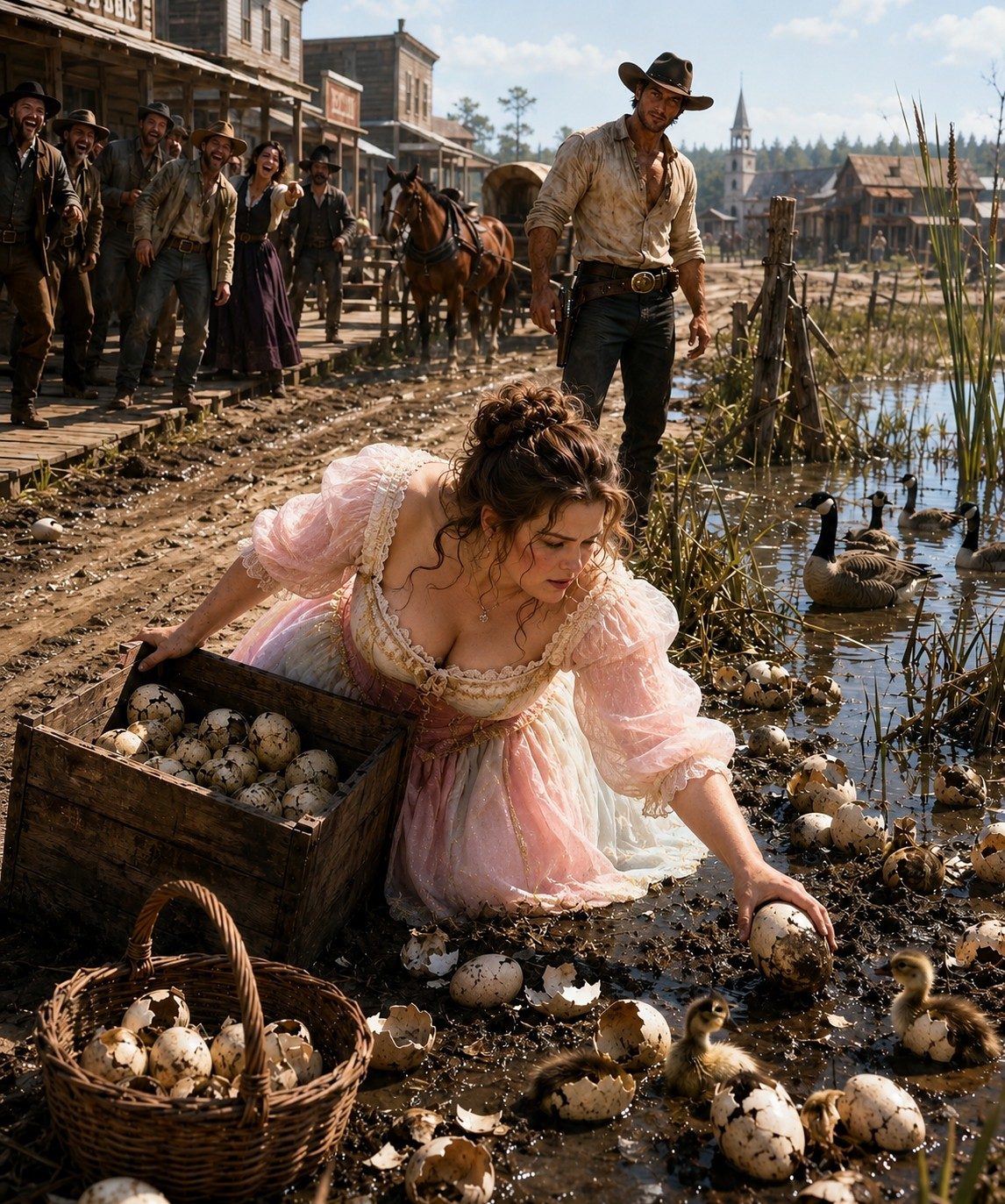
The next morning, Rowan discovered that one of the incubator trays had been disturbed.
Several eggs had shifted.
One had rolled against the wooden edge.
A small amount of moisture had collected beneath it.
Rowan immediately called Matthias.
He arrived within twenty minutes.
Together, they examined every egg.
Most remained stable.
But one had developed a new fracture.
Matthias lifted it carefully.
"Someone has been inside."
Rowan looked toward the door.
There was no broken lock.
The window had been secured from the inside.
Whoever had entered knew the property.
Matthias examined the floor.
Near the rear wall lay a small piece of dark leather.
He picked it up.
"Boot strap," he said.
Rowan looked at him.
"Rusk?"
"I cannot say."
They decided to move the eggs temporarily to Matthias's better-protected incubator room.
Rowan did not like leaving her property.
But the eggs mattered more than her pride.
Over the next several days, the work became increasingly demanding.
The incubation process required careful monitoring.
Matthias taught Rowan how to check development without exposing the eggs to unnecessary temperature changes.
He explained that the remaining incubation period would be crucial.
They also discussed the marsh.
He showed her how the sedge could provide grazing for geese.
The cattails offered shelter.
The shallow water supported natural feeding.
The land that ranchers considered useless might support a productive waterfowl operation.
Rowan began keeping detailed notes.
She calculated possible feed expenses.
She estimated the number of goslings that might survive.
She considered selling eggs, breeding birds, and eventually supplying feathers and down.
But the numbers remained uncertain.
There were too many damaged eggs.
Too many expenses.
Too many things she could not afford to get wrong.
One evening, Matthias brought her a small notebook.
It contained twenty years of observations about his own flock.
Feeding schedules.
Seasonal breeding records.
Hatching rates.
Weather patterns.
Rowan looked through the pages.
"You've been keeping all this?"
"Of course."
"Why?"
"Because memory becomes unreliable. Ink is patient."
She smiled faintly.
It was the first time she had smiled in days.
Then Matthias grew serious.
"Your uncle understood something about this marsh."
"What?"
"He once asked me whether the land could support a large breeding flock without being drained."
Rowan looked up.
"When?"
"About twelve years ago."
"Why didn't he tell me?"
"Perhaps he wanted you to discover it yourself."
Matthias hesitated.
"Your uncle also refused to sell the northern water passage to Rusk."
Rowan remembered the letter.
Do not let anyone convince you that the water is your enemy.
She suddenly wanted to know everything her uncle had done before his death.
The next day, she searched the cabin.
Inside a loose floorboard beneath the bed, she found a small tin box.
It contained old receipts, handwritten maps, and several letters.
One letter was addressed to Matthias.
Another carried the name of the county surveyor.
The final envelope was sealed.
On its front, her uncle had written:
For Rowan. Only if they come for the water.
Her hands trembled.
She broke the seal.
Inside was a single folded map.
And beneath it was a letter describing a hidden legal document that could protect the Sink from anyone attempting to claim its natural water rights.
But the letter ended before revealing where the document had been placed.
Rowan turned the page.
The last sentence read:
If Rusk has already marked the northern boundary, then he knows about the spring.






Comments 0