The name on the deed was Owen Bennett.
For several seconds, I couldn't speak.
I stared at the photograph Claire had placed on my desk, reading the same line over and over.
GRANTEE: OWEN BENNETT.
My younger brother.
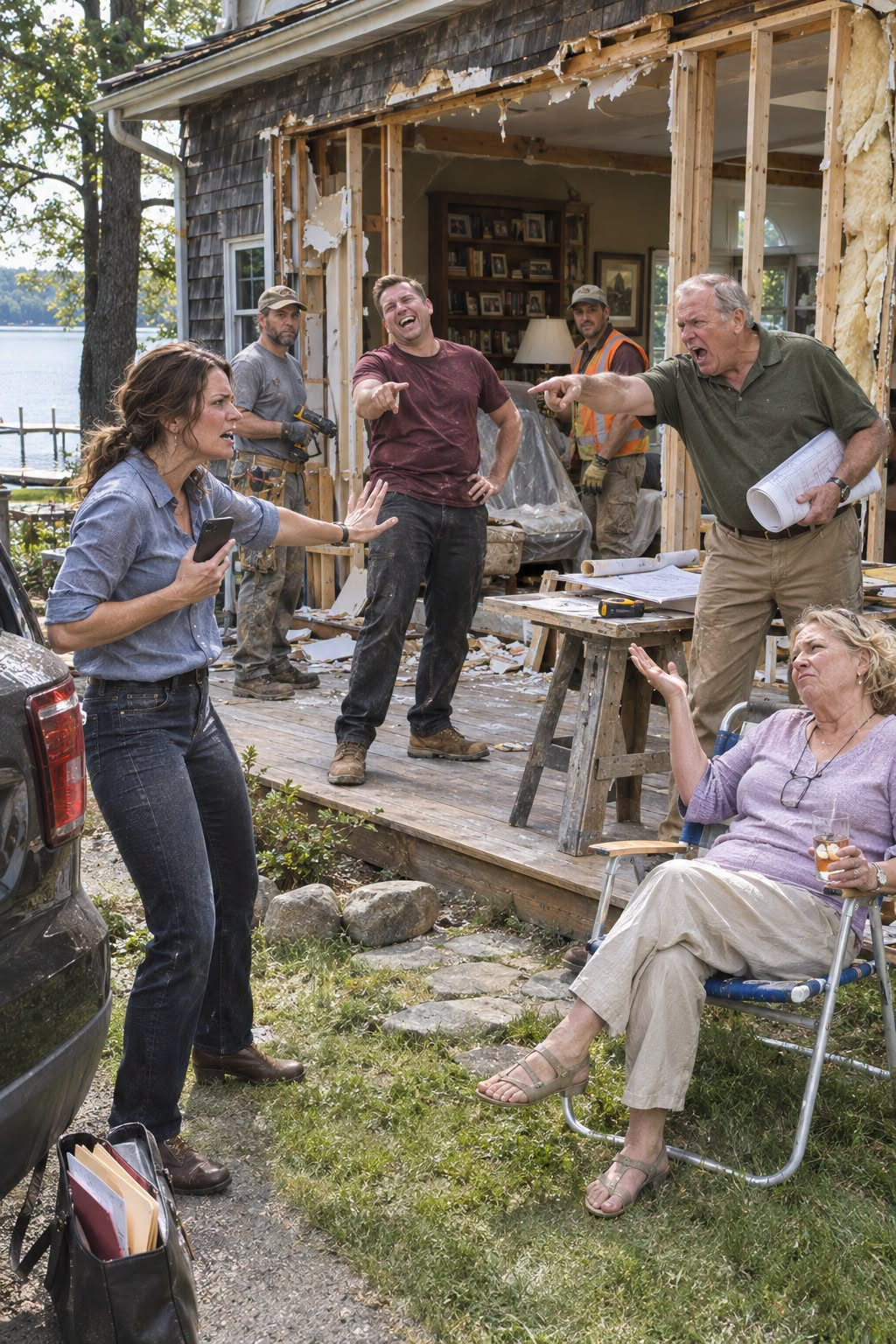
The man who had spent the afternoon laughing while contractors destroyed my sunroom.
The man who had told me the renovation was a wonderful surprise.
The man who apparently believed that anything I owned could eventually become his if he waited long enough.
I looked up at Claire.
"Where did you get this?"
She sat across from me, her hands clasped so tightly that her knuckles had turned white.
"Your mother showed it to me."
"When?"
"Yesterday morning."
"And you didn't think to call me?"
Her eyes filled with tears.
"Nora, I didn't understand what was happening."
I looked back at the photograph.
The document appeared to be a deed transferring ownership of the narrow lakeside parcel beside my cottage. My grandmother had left that land to me when she died. It was less than an acre, mostly wooded, with a rocky shoreline and no road access except through my cottage property.
For years, everyone in my family had dismissed it as useless.
My father once suggested selling it to a neighboring property owner for a few thousand dollars.
Owen called it a mosquito sanctuary.
My mother said I should be grateful that Grandma had left me anything at all.
But I loved that land.
My grandmother and I had walked there every summer when I was little. She showed me where wild blueberries grew and taught me how to recognize the different birds nesting near the water.
When she died, the parcel was the only piece of property she left directly to me.
I had never considered selling it.
And now my brother's name appeared on a document claiming ownership.
"Claire," I said quietly, "I need you to tell me everything."
She wiped her eyes.
"Your mother came into the office around nine yesterday morning. She said she needed copies of some property records."
"Which records?"
"The lake house purchase documents. Your identification information. And the deed for the land beside it."
I stared at her.
"Why would you give her those?"
"She said you had asked her to collect them."
I leaned back.
"Did she show you an email from me?"
"No."
"A text?"
"No."
"Did you call me?"
Claire looked down.
"No."
The silence between us felt enormous.
I had built my agency from almost nothing. I had worked nights, weekends, and holidays to keep it alive. When I hired Claire, I trusted her with the parts of the business I couldn't manage alone.
And now that trust had been used against me.
"She told me it was related to family estate planning," Claire continued. "She said your father had hired someone to help organize the properties."
"What someone?"
"I don't know his full name."
"Did she mention a lawyer?"
"She said he handled real estate transactions."
I remembered June's description of the man with the black leather briefcase.
"Did you meet him?"
Claire hesitated.
"Yes."
My stomach tightened.
"When?"
"Yesterday afternoon."
"Where?"
"Here."
I stared at her.
"He came to my office?"
She nodded.
"He arrived after your mother left. He said he was collecting the documents for your family."
"Did he identify himself?"
"He gave me a business card."
"Do you still have it?"
Claire reached into her handbag and pulled out a small white card.
She placed it on my desk.
The name printed across the front was:
GRAHAM VOSS
Property Consultant
Briar Residential Holdings
There was a telephone number and an office address in Grand Rapids.
No law firm.
No attorney registration information.
Just a title that sounded official enough to impress someone who didn't know better.
I photographed the card.
"Did he ask you to sign anything?"
Claire nodded slowly.
My chest tightened.
"What?"
"A statement confirming that I recognized your signature."
I stared at her.
"You signed it?"
She began crying.
"He told me it was just an administrative verification."
"Claire."
"I know."
"Did you actually witness me signing anything?"
"No."
"Then why would you sign a statement saying you did?"
She covered her face.
"Because your mother said you had already approved everything."
I looked toward the window.
Outside, cars moved along the street. People walked past coffee shops and office buildings. The ordinary rhythm of downtown Grand Rapids continued as though my entire life hadn't begun unraveling.
I turned back.
"Did you receive any money?"
Claire looked horrified.
"No."
"Any promise of money?"
"No."
"Did Graham Voss offer you anything?"
She shook her head.
"I swear, Nora. I thought I was helping you."
I believed she hadn't intended to steal from me.
But I also understood that good intentions didn't erase the consequences of signing a false statement.
"You're going to need to speak with my attorney," I said.
She nodded.
"I will."
"And until this is resolved, I need to restrict your access to personal records and certain administrative systems."
Her face crumpled.
"Are you firing me?"
"Not tonight."
She looked relieved.
"But Claire, I need you to understand something. You helped someone create documents that may have been used to take my property."
She lowered her eyes.
"I understand."
I wasn't sure she did.
Not yet.
I asked her to write down everything she remembered about my mother's visit and Graham Voss's appearance. I told her to preserve emails, messages, visitor records, and any documents she had handled.
Then I called Daniel.
He answered immediately.
"Nora?"
"I found out who the mysterious man was."
I gave him the name.
There was a pause.
"Graham Voss?"
"Yes."
"Where did you hear that name?"
"My operations director met him yesterday."
Daniel was silent for several seconds.
Then he said, "Don't contact him."
I sat straighter.
"Why?"
"Because I want to verify his role before he knows we're investigating."
I looked at the business card.
"He's calling himself a property consultant."
"That doesn't give him authority to transfer your land."
"I know."
"Send me the card and the deed photograph."
I forwarded both.
Daniel examined them while I waited.
Finally, he spoke.
"Nora, this deed photograph raises serious concerns, but we need to distinguish between a document someone prepared and a deed that was actually recorded."
"What does that mean?"
"It means Owen's name appearing on a paper doesn't automatically make him the legal owner. We need the official recording information and the underlying instrument."
I exhaled.
"So the land might still be mine."
"Yes. And if someone recorded a fraudulent deed, we'll take the appropriate steps to challenge it."
I stared at my grandmother's name in the property's history.
"What about the signature?"
"We'll obtain the original or certified copy and examine it. We may also need a handwriting expert."
I rubbed my forehead.
"Daniel, my parents have lost their minds."
His voice softened.
"Maybe. But right now, I need you to focus on documents, not motives."
I looked at the photograph again.
"There's something else."
"What?"
"My mother apparently came to my office yesterday and obtained copies of my personal property records."
"How?"
"Claire gave them to her."
Daniel sighed.
"Preserve every record of that visit. Don't let anyone delete anything."
"I won't."
"And Nora?"
"Yes?"
"Your family may be relying on your reluctance to take action against them."
I stared at the wall.
He was right.
My parents knew me.
They knew I hated confrontation.
They knew I had spent years quietly solving their financial problems.
They knew I would rather work an extra weekend than argue over money.
And they had apparently mistaken that willingness to help for an inability to say no.
"I'm not going to ignore this," I said.
"Good. I'll have formal notices prepared first thing tomorrow."
After we ended the call, I sat alone in my office.
Claire had gone home.
The building was quiet.
My computer screen still displayed the unfinished hospital proposal I had abandoned that afternoon.
I stared at it.
Twelve hours earlier, my biggest concern had been whether the client would approve our branding strategy.
Now I was wondering whether my parents had helped forge legal documents to transfer property to my brother.
I opened a folder containing photographs of my lake house.
There was the sunroom before the demolition.
Morning light pouring through the tall windows.
My wicker chair beside the small table.
My grandmother's blue ceramic mug.
A stack of notebooks.
I remembered the first weekend I spent there alone.
I had arrived with two grocery bags, a sleeping bag, and a cheap coffee maker. The plumbing barely worked, and the roof leaked above the kitchen.
But I had sat on the porch that evening and watched the lake turn gold.
For the first time in years, I had felt as though I owned something that belonged entirely to me.
Not my business.
Not my parents' needs.
Not my brother's emergencies.
Just a quiet place where nobody expected anything.
I closed the photograph.
Then my phone rang.
It was Owen.
I let it ring twice before answering.
"What?"
"Nice attitude," he said.
I didn't respond.
He continued.
"Mom's been crying all evening."
"That's unfortunate."
"Seriously, Nora?"
"What do you want?"
He sighed dramatically.
"Can we just talk like adults?"
I almost laughed.
"You mean without bulldozers?"
"Don't exaggerate. Nobody brought a bulldozer."
"You're right. They only demolished my sunroom."
He made an irritated sound.
"Look, Dad says you're threatening legal action."
"I'm protecting my property."
"Against your own family."
"Against anyone who damages it without permission."
He was quiet for a moment.
Then his tone changed.
"You're going to regret this."
I sat straighter.
"Is that a threat?"
"No. It's a fact."
"What exactly am I going to regret?"
He hesitated.
"You're going to lose people who care about you."
I looked at the photographs on my desk.
"People who care about me don't forge my signature."
The line went silent.
Then Owen said, very carefully, "What signature?"
I waited.
He didn't repeat the question.
"Goodnight, Owen."
I ended the call.
Thirty seconds later, he called again.
I ignored it.
Then came a text.
You have no idea what Dad has already done for you.
I read it twice.
Then another message appeared.
If you keep pushing, you're going to make everything worse.
I forwarded both to Daniel.
He replied almost immediately.
Preserve these. Do not respond.
I turned off my office lights and drove home.
My condominium was on the fourth floor of a brick building overlooking a quiet residential street. I had lived there for six years, long enough to know which floorboard creaked near the kitchen and which window caught the best afternoon light.
I locked the door behind me.
Then I checked it again.
I wasn't frightened of my family physically.
But I was beginning to understand how little I knew about what they were capable of doing.
I made tea, sat at my kitchen table, and opened my laptop.
I searched for Graham Voss.
The first results were ordinary business listings.
A consulting company.
A professional profile.
An old advertisement for property investment services.
Then I found something that made me pause.
A court record from several years earlier mentioned a business associated with his name in a civil dispute involving a failed property transaction.
I couldn't tell from the public summary whether he had personally done anything improper.
But the case was enough to make me uneasy.
I saved the link for Daniel.
Then I searched Briar Residential Holdings.
The company appeared to have been formed recently.
Its public listing showed a registered office in Grand Rapids.
I clicked through the available information.
The registered agent was Graham Voss.
There was no obvious connection to Owen.
At least, not one I could see.
I closed the browser.
My phone rang again.
This time, it was Paige.
"Hi," I answered.
"Nora, I'm sorry to call so late."
"It's okay."
Her voice sounded strained.
"I talked to Owen."
My stomach tightened.
"About what?"
"The house."
I waited.
"He said your father had already arranged everything. He said you were only upset because you didn't like being surprised."
I closed my eyes.
"Paige, that's not true."
"I know."
She took a shaky breath.
"That's why I'm calling."
I sat upright.
"What happened?"
"I asked him to show me the documents."
"And?"
"He got angry."
I said nothing.
"He told me I was being disloyal. He said I needed to trust him."
I heard her sniffle.
"Then he said something that scared me."
"What?"
"He said if the property arrangement fell apart, we'd lose everything."
I stared at the kitchen wall.
"What does everything mean?"
"I asked him."
"And?"
"He wouldn't tell me."
I thought about the financial obligations mentioned in the agreement.
The twelve-thousand-dollar construction deposit.
The mysterious property consultant.
The attempted transfer of my grandmother's land.
"Paige, has Owen borrowed money recently?"
She hesitated.
"I found a letter in our apartment."
My pulse quickened.
"What kind of letter?"
"From a lender."
"How much?"
She was silent.
"Paige?"
"Forty-eight thousand dollars."
I closed my eyes.
Forty-eight thousand.
My brother had somehow accumulated another enormous debt.
"What was the loan for?"
"I don't know. The letter said the account was overdue."
"Did you ask him?"
"Yes."
"What did he say?"
"That Dad was handling it."
I felt a familiar coldness settle beneath my ribs.
Of course.
Dad was handling it.
That phrase had apparently become the explanation for everything.
"Paige, please don't sign anything."
"I won't."
"And keep copies of whatever you find."
She agreed.
Before hanging up, she whispered, "Nora, I really thought we were going to be a family living by the lake."
I looked at the photograph of my sunroom on the laptop.
"I know."
After the call, I sat in silence for a long time.
I didn't hate Paige.
If anything, I felt sorry for her.
She was pregnant, frightened, and discovering that her husband had been making financial decisions without telling her.
But sympathy didn't change ownership.
And it didn't make what my family had done acceptable.
The next morning, I arrived at my office before seven.
I had barely finished making coffee when Daniel called.
"The letters are ready," he said.
"What letters?"
"Formal notices to your father, brother, and the contractor. They demand that unauthorized work stop, that relevant documents and communications be preserved, and that nobody attempt to transfer or encumber your property."
I exhaled.
"Good."
"We're also preparing the necessary steps to challenge any fraudulent filing."
"How quickly?"
"As quickly as the records and procedures allow."
I looked toward the empty reception area.
"Daniel, I want them to understand that I'm serious."
"They will."
He paused.
"There's something else. I received confirmation that the document involving your grandmother's parcel was submitted for recording."
My stomach dropped.
"So Owen owns it?"
"No. Submission doesn't establish that a fraudulent transfer is valid. We're obtaining the official record and preparing to contest it."
I gripped the phone.
"Who submitted it?"
"We're tracing that now."
I stared at my desk.
"Daniel, how far does this go?"
"I don't know yet."
Then he added, "But I want you to review your other properties carefully."
I thought about my condominium.
My parents' bungalow.
The lake house.
The inherited parcel.
"Why?"
"Because whoever prepared these documents may have had access to more than one deed."
I felt a chill.
"Are you saying they could have tried this with another property?"
"I'm saying we need to verify that they haven't."
After we hung up, I opened my property records.
I started with the condominium.
Everything appeared normal.
Then the lake house.
The title information still showed my name.
Then my grandmother's parcel.
I stared at the pending transaction information.
Finally, I opened the records for my parents' bungalow.
The house I had purchased eight years earlier.
The house where they lived rent-free.
The house whose mortgage I still paid every month.
The public ownership information showed my name.
But beneath it was a recent inquiry associated with the property.
I clicked.
A new page opened.
There was a reference to a preliminary title search.
Requested by a real estate brokerage.
I frowned.
Why would a brokerage be researching my parents' house?
I copied the information and sent it to Daniel.
Then I called my mother.
She answered on the third ring.
"Nora?"
"Mom, I need to ask you something."
She sighed.
"Can this wait? I'm making breakfast."
"No."
Silence.
"What is it?"
"Has anyone contacted you about selling the bungalow?"
She didn't answer.
I waited.
"Mom?"
"Why would you ask that?"
"Because there's a title inquiry on the property."
Another silence.
Then she said, "Your father handles those things."
I closed my eyes.
"Mom, the house belongs to me."
"We know."
"Then why would anyone be discussing a sale?"
She sounded irritated.
"Nora, not everything is about money."
I stared at the phone.
"Actually, this seems to be entirely about money."
Her voice hardened.
"You've become very cold."
I took a breath.
"Has Dad spoken to a real estate agent?"
She hesitated.
Then said, "You'll have to ask him."
Before I could respond, she hung up.
I sat motionless.
My parents had never hung up on me before.
Not even during arguments.
Something was happening.
And they were becoming desperate.
At nine thirty, Daniel emailed me copies of the formal notices.
I read every word.
The letters were firm, professional, and precise.
They identified me as the legal owner of the lake house.
They demanded preservation of documents and communications.
They prohibited further unauthorized construction.
They instructed the recipients to communicate through counsel regarding the disputed property transactions.
I approved them.
Daniel arranged for delivery.
At eleven fifteen, my father called.
I answered.
"What have you done?" he shouted.
I moved the phone away from my ear.
"Good morning, Dad."
"Don't play games with me!"
I looked at the letter on my screen.
"Did you receive the notice?"
"You sent a lawyer after your own father!"
"I sent a lawyer because you demolished my house without permission."
He breathed heavily.
"Do you have any idea what this is going to cost?"
"Yes. I'm beginning to."
"You're going to ruin your brother!"
I stared at the wall.
"No, Dad. Owen made his own decisions."
"You don't understand what's at stake."
"Then explain it."
He went silent.
I waited.
Finally, he said, "Come to the bungalow tonight."
"Why?"
"We need to talk."
"About what?"
"Everything."
I looked at my calendar.
"I'll come with Daniel."
"No lawyers."
"Then we can speak by phone."
He cursed under his breath.
"Nora, I'm trying to protect this family."
I took a slow breath.
"From what?"
He didn't answer.
Instead, he said something that made my blood run cold.
"Your grandmother should never have left you that land."
I sat completely still.
"What?"
He exhaled sharply.
"Forget I said that."
"No. Explain what you mean."
But he had already ended the call.
I stared at the phone.
My grandmother had been dead for almost twelve years.
She had left me the parcel because we spent summers together there.
My father had never liked that decision.
But I had always assumed it was ordinary resentment.
Now I wasn't so sure.
I opened the folder containing my grandmother's estate documents.
There was her will.
The probate paperwork.
The deed transferring the parcel into my name.
And a handwritten letter she had left me.
I hadn't read it in years.
I unfolded the scanned copy.
Her handwriting was small and careful.
She wrote about the summers we spent together, the birds near the shoreline, and the importance of having a place where I could think clearly.
Near the bottom, she had written a sentence I barely remembered.
"Keep this land in your own name, sweetheart. There are reasons I chose you."
I stared at those words.
Reasons.
What reasons?
I had always thought she meant that I loved the property more than anyone else.
But my father's strange comment made me wonder whether there was something I didn't know.
I called Daniel.
He answered immediately.
"Nora?"
"I need you to look into my grandmother's estate."
"Why?"
"Because my father just told me she should never have left me the land."
There was a pause.
Then Daniel said, "That's interesting."
"Why?"
"Because I just received another document from the county records office."
My heart began pounding.
"What document?"
"It's connected to the attempted transfer of your grandmother's parcel."
I sat upright.
"Who filed it?"
"I want you to see the document yourself."
An email notification appeared.
I opened it.
There was a scanned affidavit.
A statement claiming that the original transfer from my grandmother's estate had been improperly executed.
I read the first paragraph.
Then the second.
My eyes moved toward the bottom.
There was a signature.
Not Owen's.
Not my father's.
Not Graham Voss's.
The signature belonged to my mother.
Elaine Bennett.
I stared at it.
Then I noticed something beneath her name.
A handwritten note identifying another person who had supposedly provided supporting testimony.
I leaned closer.
The name was partially obscured by the county recording stamp.
I enlarged the image.
The letters slowly became clearer.
And just as I recognized the first name, Daniel said:
"Nora, there's someone from your grandmother's past you need to meet."
I looked at the document.
"Who?"
He hesitated.
Then he said, "She's been trying to contact you for years."
Before I could ask another question, my office receptionist knocked on the door.
"Nora?"
I looked up.
She was holding a small envelope.
"Someone just delivered this by hand."
I frowned.
"Who?"
"An older woman. She said you would know what it meant."
My receptionist placed the envelope on my desk.
There was no return address.
Only my name.
And beneath it, written in faded blue ink, were five words:
YOUR GRANDMOTHER DIDN'T DIE BELIEVING THEM.
I reached for the envelope.
It was already open.
Inside was a photograph.
And the woman standing beside my grandmother was...






Comments 0